






With the American Revolution on the Horizon, Benjamin Franklin Announces That He is Leaving England and “Purposing to embark for America in a few Days …”


A momentous announcement that brought Franklin from Europe to America - the scene of what would be his greatest triumphs and the signing of the Declaration of Independence
“I cannot depart without taking Leave of my dear Lord Kaims, to whose Civilities and Friendship I have been so much oblig’d…”
One of the last letters of Franklin from Europe before the Revolution having reached the market
Benjamin Franklin first went to London in 1757 as an agent for...


“I cannot depart without taking Leave of my dear Lord Kaims, to whose Civilities and Friendship I have been so much oblig’d…”
One of the last letters of Franklin from Europe before the Revolution having reached the market
Benjamin Franklin first went to London in 1757 as an agent for the Pennsylvania Assembly, primarily to lobby against the political power of the Penn family (the colony’s proprietors) and to argue that their vast landholdings should be taxed like everyone else’s. He returned home briefly in 1762, but went back to London in 1764 and remained there continuously until March 1775.
Over this second long stay, Franklin’s portfolio expanded. He became the agent not just for Pennsylvania but also for Georgia, New Jersey, and Massachusetts, representing their colonial assemblies in dealings with Parliament and the Crown. Thus, he spent a decade in London essentially as an unofficial ambassador for American interests.
As an agent, Franklin had important responsibilities. He opposed British taxation measures, lobbying against the Stamp Act in 1765 and later working against other revenue measures like the Townshend Acts of 1767, trying to persuade British officials that taxing the colonies without their consent was both unjust and impractical. He famously testified before the House of Commons in 1766 regarding the Stamp Act, helping build the case for its repeal. He also served as an intermediary, trying to explain colonial grievances to British ministers while also explaining British policy to colonial leaders back home, positioning himself as moderating voice.
Then, in 1774, the Hutchinson Letters Affair broke, and it would soon render Franklin’s tenure in England untenable. Acting as Massachusetts’s agent, in 1772-1773 Franklin had obtained and sent to Massachusetts a set of private letters written by Governor Thomas Hutchinson that seemed to encourage harsher British measures against the colonies. Franklin believed that releasing them would ease tensions by showing colonists that a specific corrupt official—not the King or Parliament generally—was to blame for oppressive policies. However, when these letters became public, his plan backfired badly and caused a scandal. In January 1774, Franklin was summoned before the Privy Council to a session known as “the Cockpit,” where for over an hour he was subjected by solicitor General Alexander Wedderburn to a scathing public tirade, calling him a thief and worse, accusing him of stealing and leaking the Hutchinson letters to incite rebellion. Franklin stood motionless throughout, wearing an old-fashioned wig and a suit of figured Manchester velvet, and one observer described him as receiving Wedderburn’s rhetorical onslaught with philosophic calm and apparent contempt. He offered no rebuttal at the time. Buts he was humiliated in front of a large audience, stripped of his position as deputy postmaster general for the colonies, and effectively became persona non grata in British government circles. He’d entered the room still hoping for reconciliation between Britain and the colonies; he left it transformed from a loyal servant of the Crown into a man firmly on the path toward American independence.
After the Cockpit affair, Franklin remained in London for another year, still hoping to find some path to reconcile Britain and the colonies. He engaged in secret, informal negotiations with British ministers and intermediaries. But by early 1775, especially after Parliament rejected Lord Chatham’s conciliatory plan (which Franklin had helped shape) and tensions escalated. It became clear that reconciliation efforts had collapsed and further efforts were futile. Moreover, Franklin sensed that war was becoming inevitable and that his usefulness—and perhaps even his safety—in London was diminishing. So Franklin had tried to prevent the very breakdown between Britain and the colonies that would soon occur. But now his position was untenable and he determined to return home to America.
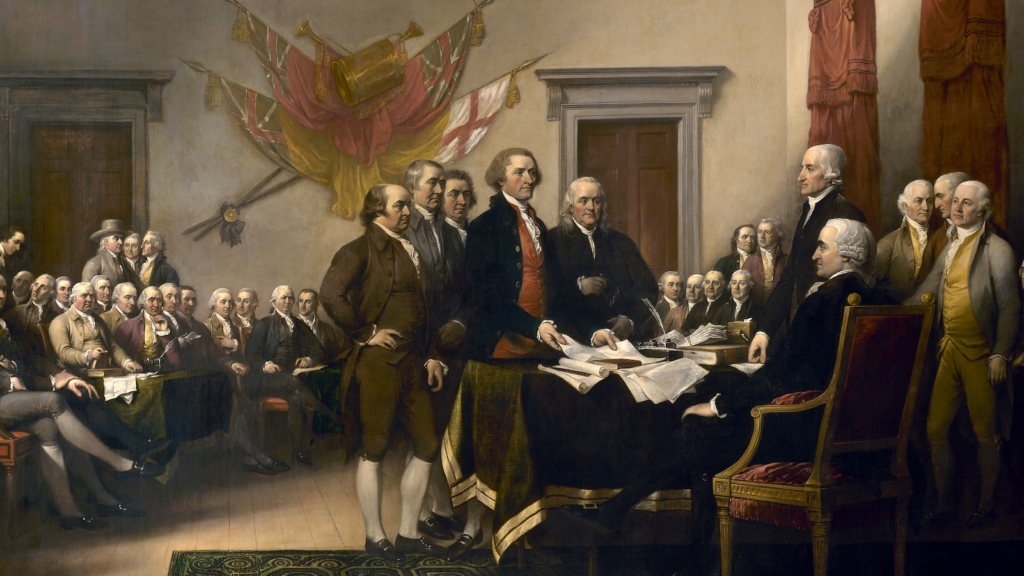
He sailed from England in March 1775 and arrived back in Philadelphia in early May 1775, just after the battles of Lexington and Concord (which occurred April 19, 1775). The very next day after his arrival, the Pennsylvania Assembly elected him as a delegate to the Second Continental Congress, which was about to convene. He served in this body throughout the early years of the Revolution. Thus Franklin moved quickly from colonial agent to revolutionary leader. In July 1775, Congress appointed Franklin as the first Postmaster General of the United Colonies, and he also took on a role helping organize Pennsylvania’s defenses, including work related to militia and military preparedness. In June 1776, he was named one of the five members of the committee tasked with drafting the Declaration of Independence, alongside Jefferson, Adams, Sherman, and Livingston. Though Jefferson did the primary drafting, Franklin reviewed and edited the document.
Benjamin Franklin and Lord Kames (Henry Home, a Scottish judge and major figure of the Scottish Enlightenment) had a warm, long-running friendship built on intellectual respect and correspondence over roughly two decades. Franklin first encountered Kames during his visits to Scotland, notably in 1759. The two hit it off immediately, bonding over shared intellectual interests—Kames was a prolific writer on law, philosophy, aesthetics, and moral theory, while Franklin was already established as a scientist and thinker. After that visit, they maintained a steady correspondence from the early 1760s through the eve of the Revolution. Their letters are full of genuine affection. They discussed Franklin’s publications, including his famous Pennsylvania fireplace design and his essays on population. As tensions between Britain and the colonies escalated through the 1760s, their letters increasingly turned to “the Disputes with America.” Franklin once sent Kames a paper meant to smooth over the Boston non-importation controversy, and Franklin expressed pleasure that Kames was turning his attention to political subjects like money, taxes, and commerce. Perhaps the most historically significant part of their relationship was during a visit with Kames in Scotland that the idea of Franklin writing his memoirs first took root. Franklin later opened his famous Autobiography by recalling this encouragement—Kames is one of the figures credited with prompting Franklin to set his life story down in writing. Fittingly, as Franklin prepared to leave London for what would be the last time before the Revolution, he wrote Kames a warm goodbye letter dated March 14, 1775—just days before departing for America. In it, Franklin expressed that he could not depart without taking leave of his dear Lord Kames, to whom he felt deeply obliged for years of friendship and kindness, and offered warm wishes for Kames and his wife’s happiness. It’s a touching bookend to a friendship that had spanned the most consequential years of Franklin’s life in Britain.
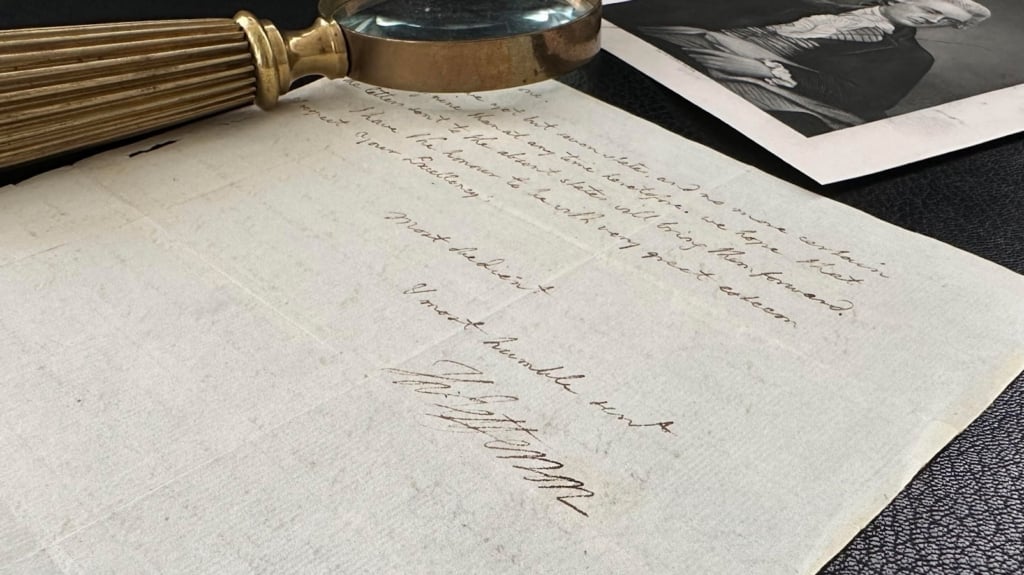
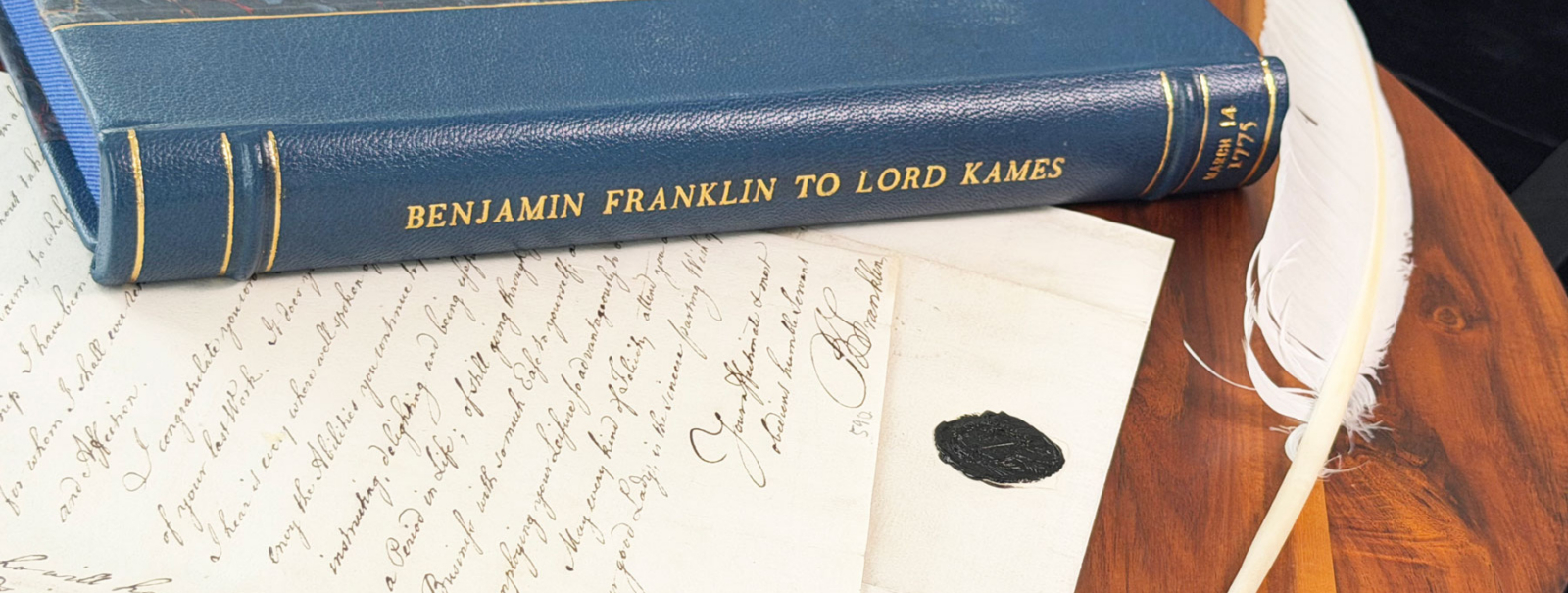
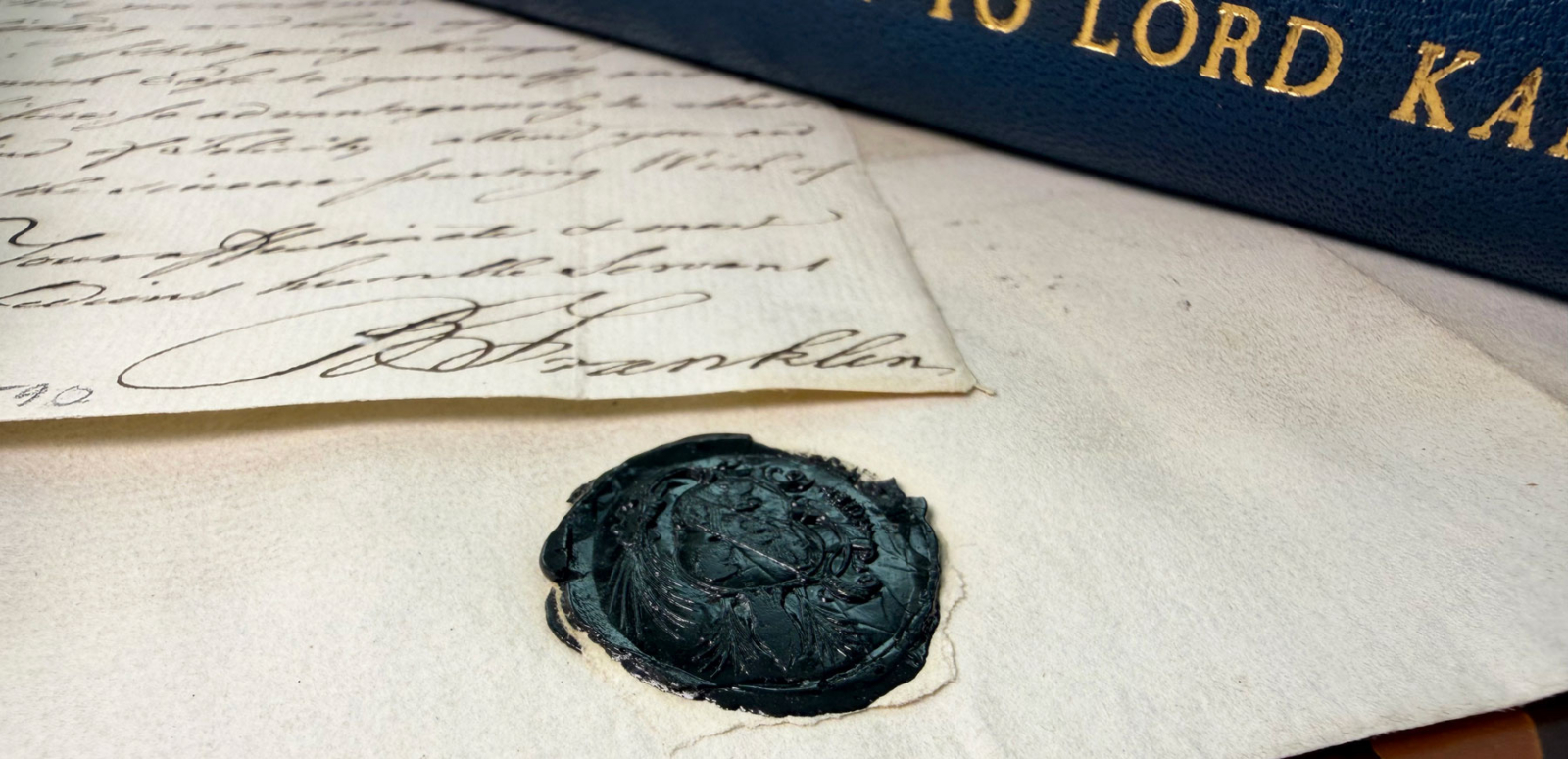
This is that very letter. Autograph letter signed, London, March 14, 1775, to Lord Kames (“Lord Kaims,”), announcing that he is leaving for America and bidding him a fond farewell. He also acknowledges the recent publication of Kames’s influential monograph, Sketches of the History of Man, and states with approval that Kames’ work was being used to the benefit of others. The letter is sealed with a black-wax impression of Franklin’s heraldic seal, a rare addition.
“Purposing to embark for America in a few Days, I cannot depart without taking Leave of my dear Lord Kaims, to whose Civilities and Friendship I have been so much oblig’d, and for whom I shall ever retain the sincerest Esteem and Affection.
“I congratulate you cordially on the Success of your last Work. It does you great Honour. I hear it every where well spoken of. I almost envy the Abilities you continue to possess of instructing, delighting and being useful at so late a Period in Life; of still going through so much Business with so much Ease to yourself; and of employing your Leisure so advantageously to others.
“May every kind of Felicity attend you and your good Lady, is the sincere parting Wish of Your affectionate and most obedient humble Servant, B Franklin.”
Franklin added an extensive postscript in the left margin regarding the bearer of the letter, Benjamin Duffield, a young American who sought to attend Edinburgh’s prestigious medical school: “Mr. Duffield, who will have the Honour of presenting this to your Hands is a young Gentleman for whom I have a great Regard. He at present studies Physic in your University. I beg leave to recommend him to your Protection.” This shows how Franklin used his Scottish connections to help Americans studying in Edinburgh.
Franklin’s announcement that he was returning to America was a momentous one, and less than a week after writing this letter, he was sailing homeward to Pennsylvania, which would be the scene of his greatest triumphs.

Frame, Display, Preserve
Each frame is custom constructed, using only proper museum archival materials. This includes:The finest frames, tailored to match the document you have chosen. These can period style, antiqued, gilded, wood, etc. Fabric mats, including silk and satin, as well as museum mat board with hand painted bevels. Attachment of the document to the matting to ensure its protection. This "hinging" is done according to archival standards. Protective "glass," or Tru Vue Optium Acrylic glazing, which is shatter resistant, 99% UV protective, and anti-reflective. You benefit from our decades of experience in designing and creating beautiful, compelling, and protective framed historical documents.
Learn more about our Framing Services


