






Florence Nightingale Encourages Her Protege: “if there is patience, you may augur good things.”


Nightingale, at age 74 and in poor health, continues to work, writing, “There is so much pressing work”
The letter is to Amelia de Laney, who had attended the Nightingale Training School in the 1880s
Being religious, she tells de Laney “God bless you & prosper your work”
In the Crimean War, Florence Nightingale led a team of nurses to the military hospitals where British soldiers were dying in...


The letter is to Amelia de Laney, who had attended the Nightingale Training School in the 1880s
Being religious, she tells de Laney “God bless you & prosper your work”
In the Crimean War, Florence Nightingale led a team of nurses to the military hospitals where British soldiers were dying in horrifying conditions – far more from disease and poor sanitation than from battle wounds. She transformed the hospitals, dramatically cutting the death rate from around 43% down to just 2%. She became known as “The Lady with the Lamp” for walking the wards at night checking on patients. After the war she returned home a national hero but threw herself straight back into work rather than enjoying her fame. She spent the rest of her life campaigning for better sanitation in military and civilian hospitals, public health reform, and the professionalization of nursing. In 1860 she founded the first professional nursing school at St. Thomas’ Hospital in London, using money donated by a grateful public. Nurses trained there went on to reform healthcare across the world. Nightingale wrote over 200 works including Notes on Nursing, which became a worldwide bestseller, and extensive writings on theology, public health and hospital reform.
By 1894, Florence Nightingale was 74 years old and had been a invalid for decades, suffering from what is now believed was chronic brucellosis (or “Crimean fever”) contracted during the Crimean War. This severe bacterial illness caused her debilitating fatigue, chronic pain, and intermittent fevers, severely restricting her mobility. But despite being often confined to her room in South Street, London, she had by 1894 reached a period where her depression lifted, allowing her to occasionally receive visitors. Invitations to visit her at home were, however, hard to obtain.
Even under these trying circumstances, she remained an active healthcare pioneer. In 1894, she prepared and submitted a seminal paper titled “Sick-Nursing and Health-Nursing” for the International Congress of Charities, Correction and Philanthropy in Chicago.
Amelia de Laney attended the Nightingale Training School at St. Thomas’s Hospital between 1883 and 1886. In 1894, Florence Nightingale gifted a heavily annotated copy of Gray’s Anatomy to de Laney, who she regarded highly. The inscription, dated Easter 1894, contained her “love & prayers for her highest success.” Though when de Laney moved in 1894 to a position as matron at the newly founded Epileptic Colony in Chalfont St Peter, Nightingale privately expressed her concerns to her friend Henry Bonham Carter, commenting that the work was “entirely new. It is not hospital work at all… It seems to me an immense responsibility.”
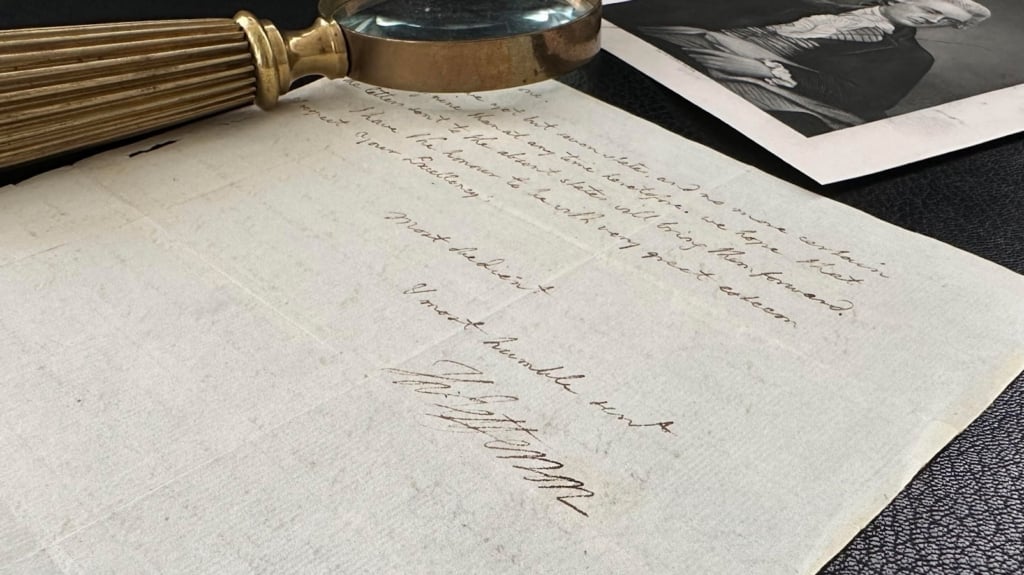
Autograph letter signed, 10 South St., Mayfair, London, October 18, 1894, to de Laney, whom she addresses as “Dear Miss de Laney,” wishing that her work will proper but declining to see her because of her pressing workload. “I was so glad to hear from you, tho’ as you say there is not much settled yet. But if there is patience, you may augur good things. I wish I could see you now, as you kindly offer. But doctor has strictly forbidden my seeing anyone. And tho’ i cannot adhere to this, because there is so much pressing work, I dare not, however unwillingly, stay to add another just now. I am sure you would not wish it. I have not left my room for above a twelvemonth. And my kind doctor comes now every day. I very much hope to see you later on. God bless you & prosper your work. Yours sincerely, F. Nightingale.”
It is interesting to note that Nightingale, who was religious, ends the letter to her old student de Laney, “God bless you & prosper your work.” It is also fascinating that Nightingale, in her 70s, continued to have “much pressing work.”
An uncommon letter of Nightingale touching on her encouragement to her protege, and on her faith and health.

Frame, Display, Preserve
Each frame is custom constructed, using only proper museum archival materials. This includes:The finest frames, tailored to match the document you have chosen. These can period style, antiqued, gilded, wood, etc. Fabric mats, including silk and satin, as well as museum mat board with hand painted bevels. Attachment of the document to the matting to ensure its protection. This "hinging" is done according to archival standards. Protective "glass," or Tru Vue Optium Acrylic glazing, which is shatter resistant, 99% UV protective, and anti-reflective. You benefit from our decades of experience in designing and creating beautiful, compelling, and protective framed historical documents.
Learn more about our Framing Services

