




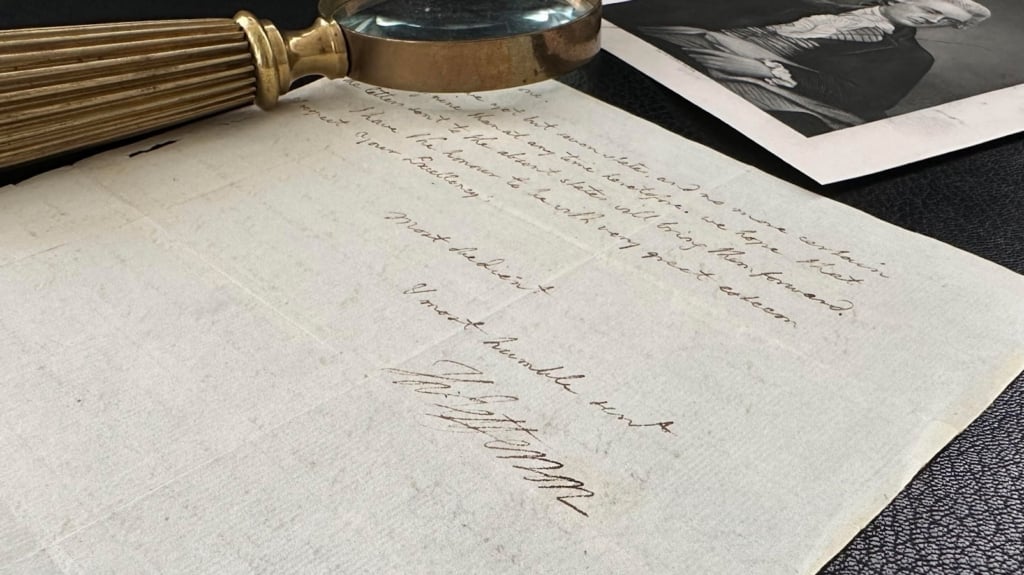


The Raab Collection has acquired a remarkable letter of Winston Churchill, written mere weeks before the start of World War II, showing his leadership, prescience, and foresight as a lone voice during the wilderness years.
Nathan Raab was interviewed on the Inspired by History podcast about this letter in which Churchill reveals that he is traveling to France to inspect the Maginot Line. Churchill believed war was imminent and that his colleagues in Parliament were ignoring the signs – and he was right. Listen to the interview below or via your podcast player of choice. Or, if you prefer, read this lightly edited transcript of the conversation with photos and embedded links to more resources.
Today we’re talking about a letter of Winston Churchill from a truly critical point in time. Just weeks before Germany invaded Poland in 1939, thus starting World War II. It finds Churchill visiting France to assess the Maginot Line and French defenses because he felt a crisis was coming. Nate, tell us more about Churchill at this moment. He’s not PM yet, but he’s sounding the alarm and taking the lead.
Nathan: This is the great calm before the storm. Churchill is a back bench member of Parliament. He is one of the lone voices who sees what’s coming. He sees the armament for the Germans. He sees the lack of preparation for the Allies, and he is alone in the wilderness trying to get the government of Neville Chamberlain and the other Allies to see this grave threat. And you really kind of capture this great moment right on the precipice of what would become this massive global conflict that would draw in not only the Germans and the other Western Europeans, but would reach into the Pacific and of course draw in the United States a few years later.
He didn’t have any official role at this point, is that right?
Nathan: He wasn’t in Chamberlain’s cabinet. He held no formal government role in that sense. He was a member of Parliament. He had very little clout, very little responsibility beyond those duties. Within two weeks of writing this letter, however, he would be asked to be First Lord of the Admiralty. As the truth of what Churchill’s been preaching begins to sink in, and they see the events around the world transpiring much as he had predicted, I think they realized that, hey, this, this guy’s onto something. He sees something that maybe the rest of us ought to, and his voice is an important one. But this moment, this really is kind of, you’re right on the precipice. He’s not First Lord of the Admiralty. He’s eight, nine months away from being Prime Minister. The events of the war are beginning to unfold. It’s not yet clear that there will be this global conflagration, although Churchill knows that there will be, and he’s off to France to inspect the proverbial troops.
He couldn’t have been alone in his feelings about appeasement and war. And I think he wrote some articles at the time and he kept trying to warn the British government that this was going to happen.
Nathan: Well, I’m sure he wasn’t alone. I think he was that the loudest voice and because he went on to become a Cabinet member and then a Prime Minister, the most prominent, he was a minority opinion certainly for a long period of time until it became clear that the Germans had broader ambitions that appeasement was a doomed strategy. But no, I’m sure there were people in his immediate orbit and other ideological constituents of his.
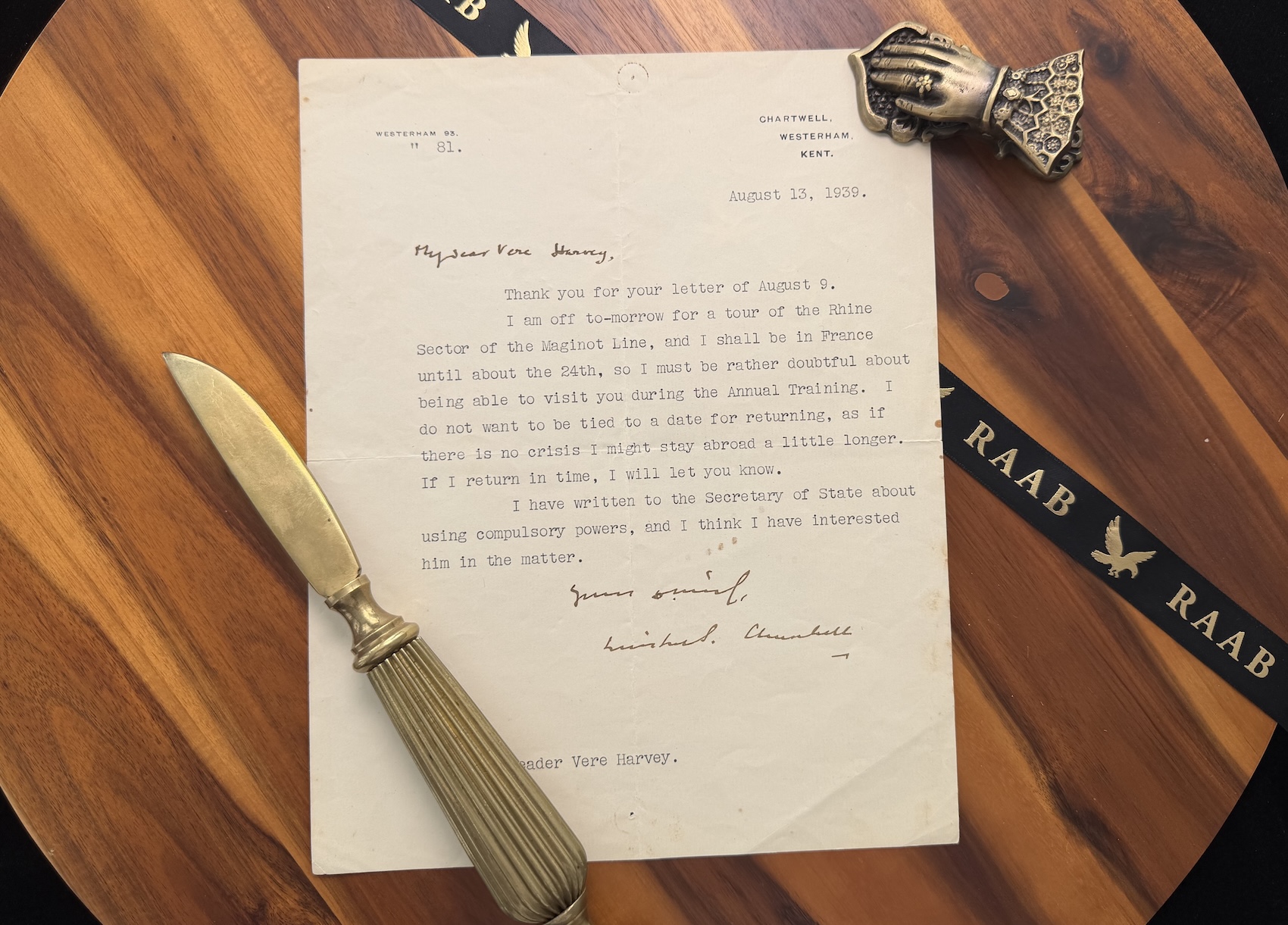
So here he is in mid August 1939. He’s about to embark on this trip to France and he writes this letter. What does he say exactly? What’s his goal for the trip?
Nathan: Well, the goal for the trip, he wants to go inspect what will become the front line. The Maginot line was created in the twenties and thirties as kind of a defense, a shield against an invasion of France by the Germans. He wants to see how it is, what it looks like. He’s aware that there’s armament happening in Germany, and I guess, the premise of the trip is that he wants to see if we’re really prepared. I’ve never seen a letter of Churchill mentioning the Maginot Line, which is one of the great military geographical spots in history. And it would become even more so, you know, the Germans crossing the Maginot Line. Churchill correctly noted in his visit that the Germans seemed like they’re ramping things up, but also the Maginot Line is, you can’t move it. So, forces move around and go north and south and find better places and worse places to infiltrate. But the Maginot Line was not as useful as I think that people thought it would be.
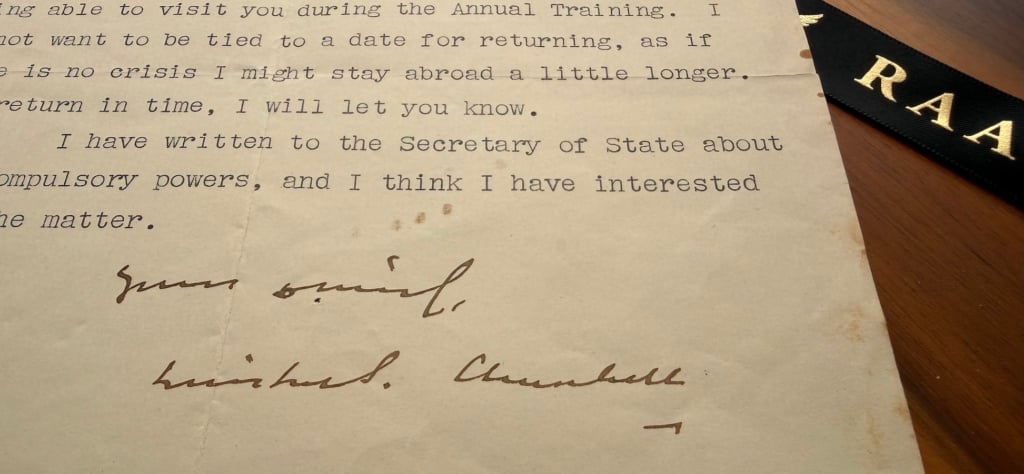
Here you have him in August of 1939 saying, in a trip that would subsequently become famous because this is the moment when Churchill realized there’s no going back, he writes: “I am off tomorrow for a tour of the Rhine sector of the Maginot Line, and I shall be in France until about the 24th.” And he continues, he doesn’t want to be tied to a date for returning because if there’s no crisis, he might stay abroad a little longer. Of course there was a crisis.
I thought it was really interesting, he’s got a journalist with him and that journalist writes: “The trip tore to shreds any illusion that it was not Germany’s intention to wage war and to wage it soon.” It’s just really poignant. Was Britain at all prepared for that?
Nathan: Well, he didn’t think so. At the end of this letter he, in another prescient comment, says that he’s written to the Secretary of State about using compulsory powers, and I think I’ve interested him in the matter. Compulsory powers, of course, are industrial mobilization, human resource mobilization, as in troops, mobilization of the powers of executive authority to put the country on wartime footing. I mean, here he is saying, the implication is that the Chamberlain government is not really that focused on compulsory power, something that they would be. So the Compulsory Powers Act would pass the following month, so it would become an issue. But a lot of this was spurred on by something that Churchill no doubt saw in August that the rest of the world saw in September. Two weeks after this letter, Hitler invades Poland, and at that point, I think people saw that the writing was on the wall. This was not gonna get better on its own.
It’s pretty incredible the foresight that he’s showing in this letter. I mean, before this letter too, but this letter really is evidence of it.
Nathan: Churchill’s foresight ahead of World War II is what makes him such a revered figure. He saw, I mean, we still talk of the words appeasement. If you were to ask anybody who would know anything about history and just mention the word appeasement, everybody would know that it related to the government of Neville Chamberlain, and that the person who refused, that talked against appeasement, that knew foresaw the strategy was shortsighted and ultimately doomed, was Winston Churchill. It is one of the factors that makes him the heroic figure, crying out for action in the darkness, in the wilderness, when no one was paying attention.
It’s difficult to know what would’ve happened if really much earlier on, the world had listened to him. But this image of Churchill fighting uphill to warn the world of what was coming, to warn England and through them the world, what was coming, is etched in history. It’s what makes Churchill Churchill.

There is certainly an active market for Churchill letters, autographs, signed books. Where does this letter fall on that rarity scale? What determines its value?
Nathan: People collect Churchill throughout his life. He had an active youth. He was in the Boer War as a non-combatant, but was of course captured. He was actively involved at a governmental level during World War I. He was a writer, author, a member of Parliament and then Prime Minister, and then there’s a post Prime Ministerial period, and people care about what he said at all those times. What makes this valuable is you see the world on the edge of what would become the largest military conflict in world history to date and hopefully ever, but to certainly to date, and you see the foresight and the wisdom that he’s showing in the presence of disinterest, let’s charitably put it.
You see the factors that made him a great Prime Minister. You see his ability to see what was happening, his desire to visit the Maginot Line, his hinting that a crisis may be yet to come, his pressure on the administration, on the government of Neville Chamberlain to enact compulsory powers. All the elements of Churchill’s greatness are planted here, and the value of this, it’s of course an incredibly valuable and rare letter. Winston Churchill was Prime Minister for several years, he was, however, only in the wilderness for just a few months.
To learn more about collecting Winston Churchill signed documents, visit our dedicated Churchill page and read our illustrated guide, “7 Churchill Documents to Add to Your Collection.”
