





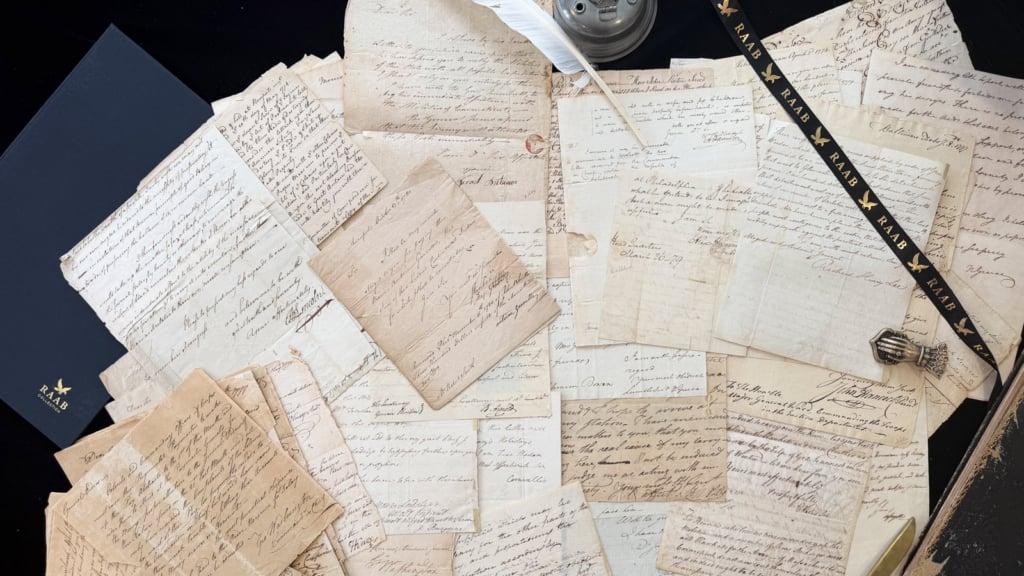
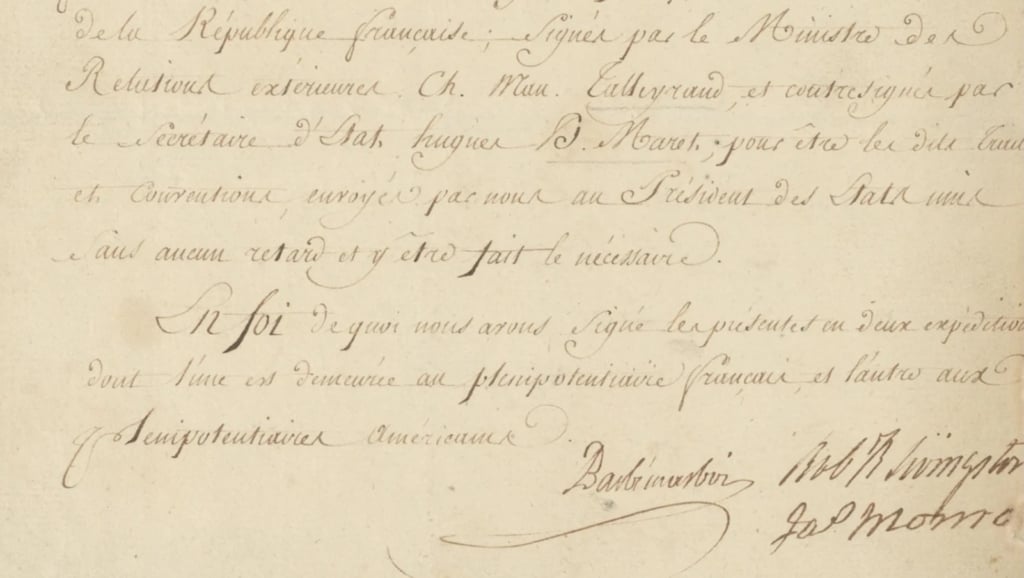


The Raab Collection has acquired a great treasure: a manuscript that sheds light on the Louisiana Purchase, signed by the men who negotiated its terms.
Nathan Raab was interviewed on the Inspired by History podcast about this very important piece of American history: the constitutional questions it raised, its significance in enabling westward expansion, and its noteworthy provenance. Listen to the interview below or via your podcast player of choice. Or, if you prefer, read this lightly edited transcript of the conversation with photos and embedded links to more resources.
Everyone has heard of the Louisiana Purchase, the landmark deal wherein the U.S. under President Thomas Jefferson acquired more than 800,000 square miles of territory from France, thus doubling the nation’s size. Well, today we’re discussing an important document from that very important event, a manuscript sent by the French that acknowledges the treaty and instructs the U.S. to complete the deal, so to speak. Am I getting that right?
Nathan: Yeah, this is the original document wherein the country of France led by Napoleon, gave to the US representatives – Minister to France Robert Livingston and former Minister to France James Monroe – gave the treaty itself.
This document represents the very moment when France gave the Louisiana Purchase Treaty to the United States and said, ‘put it on the desk of President Thomas Jefferson.’ This is the very moment in time where they met in this public facility in France, in what today we would think of as a small meeting room, and handed the treaty to James Monroe and Robert Livingston as agents to Thomas Jefferson of the United States. They gave the treaty signed by Napoleon to America. It was the moment of transfer. Just a remarkable moment.
Who are the players? Who’s in the room?
Nathan: So you have James Monroe. He’s the former Minister to France. You have Robert Livingston, who’s the current Minister to France. You have the Minister of the Treasury and negotiator Barbé de Marbois from France, on France’s side, and as far as I know, those are the players who signed this document. Those are the men who sat in this room and transferred this momentous, history-changing treaty.
Interesting. Think of them leaving there, getting on a boat, bringing it back to Jefferson.
Nathan: Well, actually they didn’t do that. The treaty itself was given to Peter Augustus Jay, who was John Jay’s son. And one of the issues is that after they’ve given this treaty to the United States, there’s some thought that maybe Napoleon has this change of heart, or that he’s been duped somehow and they should be paying more, or the terms should be more stringent. So there’s a lot of shenanigans and delay going on that keeps Jay’s son, Peter Augustus, from getting on that boat. Eventually he gets his credentials and leaves and finds a vessel and arrives in the United States, gives it to Jefferson. It is a very short timetable in which to introduce it to Congress for its ratification. And he does so.
It’s really an interesting moment in the growth of the United States because Jefferson did not expect this. He was looking for a much smaller treaty, and France’s desire to sell the entire territory came as something of a surprise and represented some constitutional issues about what authority does the executive have in expanding the physical territory of the United States. Just an incredible moment. The United States, in many ways, exists in the form that it does because of this document.
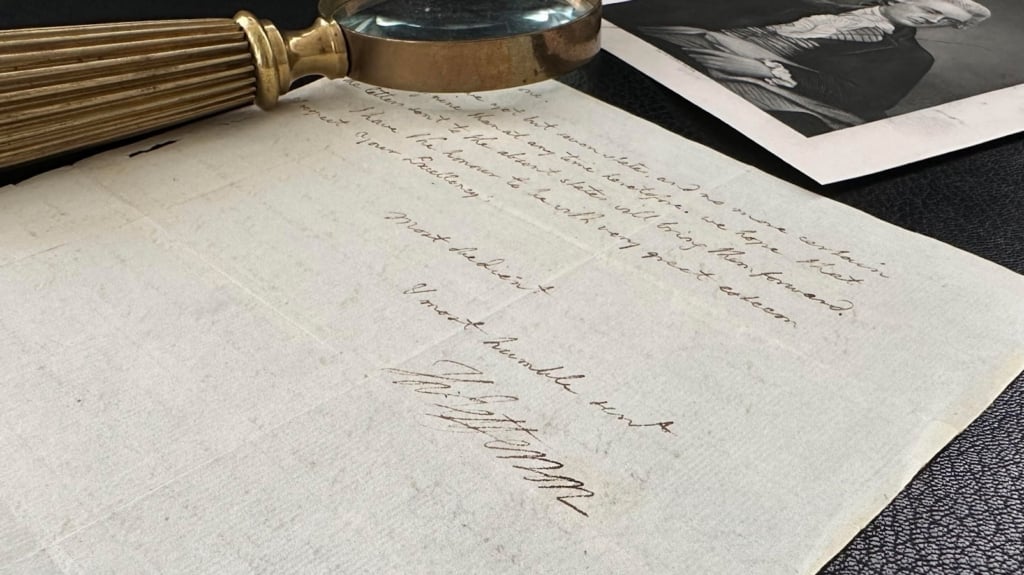
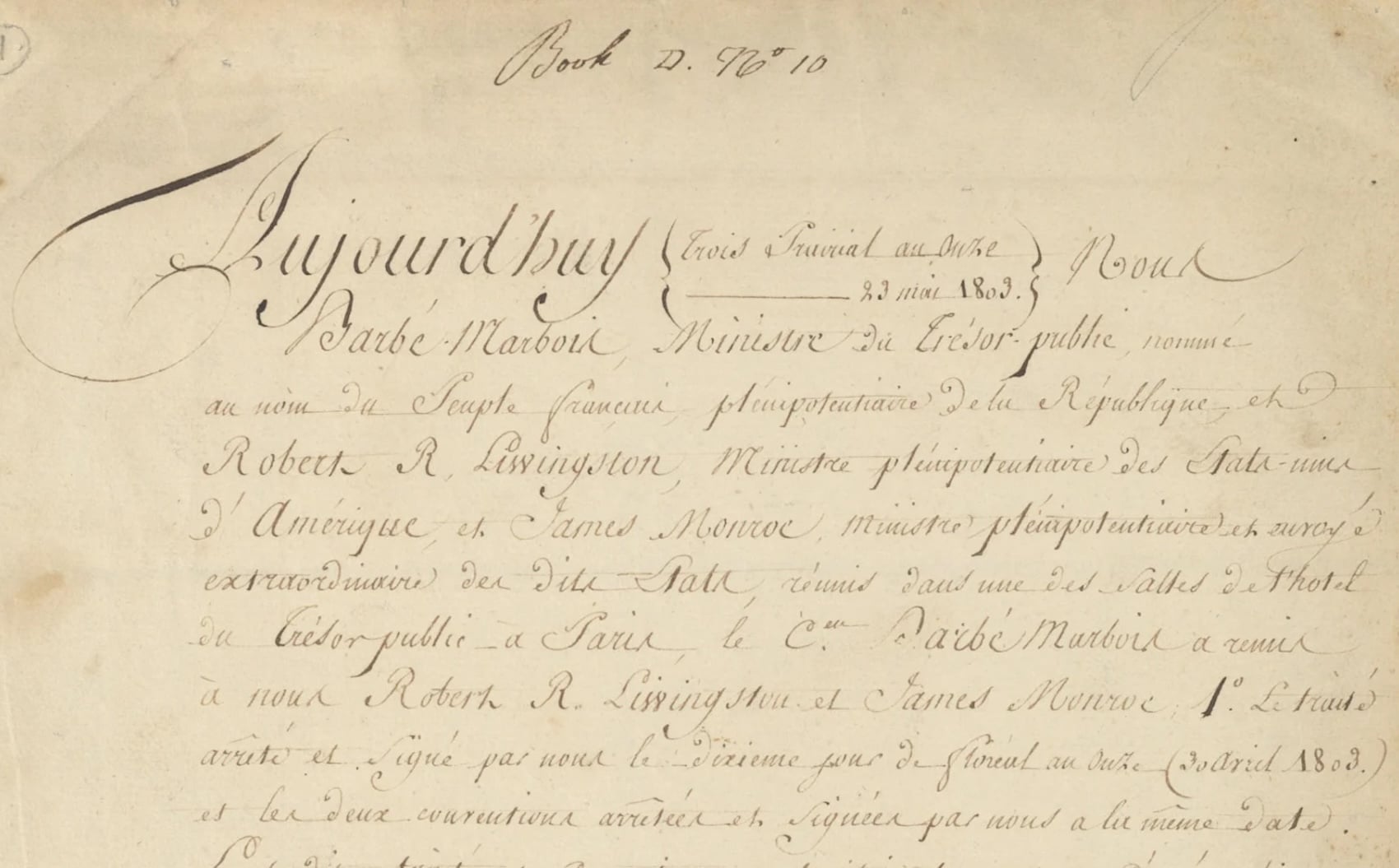
It has a very formal look to it. It has that copperplate script handwriting, but it’s not like a declaration and it’s not also a letter. It’s kind of a weird combination of the two.
Nathan: So, first of all, the script is interesting from an American perspective because, when you think of the paleography, meaning the type of script, this is very French. I mean, this is very early 19th-century French script. The scribe trained to be able to write like this, would’ve filled this out. It acknowledges the dual national aspect of it. It’s both the French Republican calendar, which doesn’t exist today, and the American calendar, so the 23rd of May and also, the French month, which is a completely different date, which requires translation, but in this case they’ve written both.
The script is very early 19th-century French formal script. You see it all the time. It’s what we would call a manuscript document signed. It’s not in the hand of Marbois or Monroe or Livingston. It’s fascinating, it’s beautiful, but the script is to be expected.
What about it caught your historian’s eye?
Nathan: Well, there are very few moments that you can pinpoint where the history of an entire continent really, certainly country, is affected, changes in such a dramatic fashion. And you know, I can only imagine, put yourself in that room with Livingston and Monroe to be receiving this document signed by Napoleon, which cedes half of the United States as we know it today to the United States, it’s just a remarkable moment. They must have been, I mean, their excitement, their shock at the turn of events, because again, this wasn’t what they expected, and it’s all encapsulated in this document. This document says it, it names the players, says what’s being exchanged. The date is a remarkable date. I mean, this document set off a whole generation of westward exploration and some of the major events that were part of it. The Lewis and Clark expedition was made possible because of it. It’s safe to say that the history of the United States would be dramatically different had these events not taken place.
So, you know, in a world where we are looking for documents because of their historical importance, and the historical importance is what dictates the value and the market interest, this is at the very top. It’s hard to imagine a more historically significant document than this.
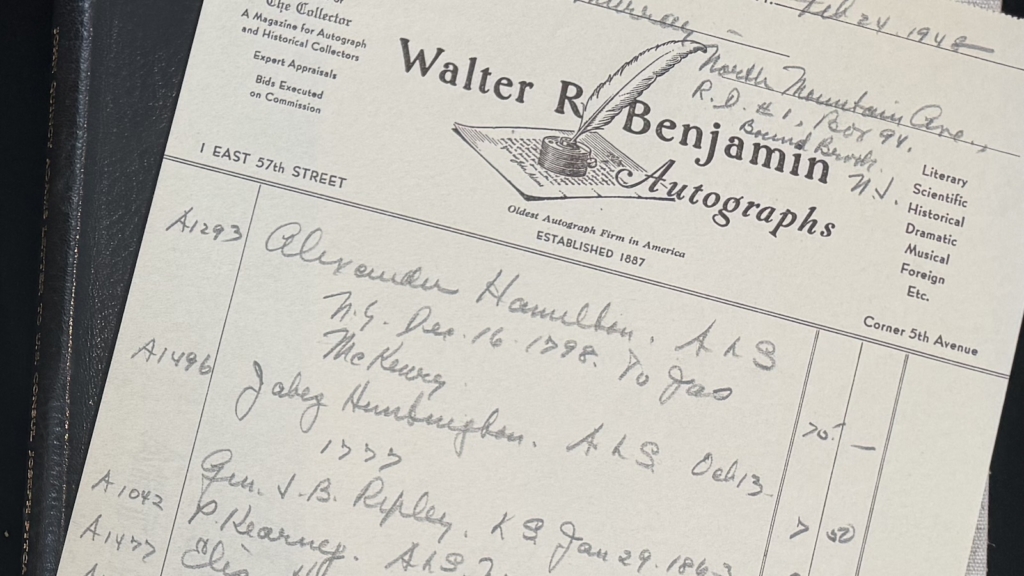
In terms of provenance, I understand this document was part of a rather famous and longstanding private collection.
Nathan: This document was formerly in the Karpeles Manuscript Library. David Karpeles was a very longtime collector who did the public a great service by acquiring important pieces of history over a very long period of time. He had a great eye and great attention to historical importance. He was knowledgeable about the history and had the funds to support it. He set up museums all around the country that brought history to communities that might not otherwise have major history museums. So, he didn’t put one in New York City to my knowledge, but he’d have them in smaller places like Duluth.
This was formerly in one of his libraries. The fascinating story about this, and we can say this because it made news at the time, is that it was saved during a four-alarm fire. It was saved from destruction by firefighters. Years ago. You know, you think of the remarkable path that some of these documents take. They have their own provenance that attest to their continued survival. This one survived not only just the general course of history, stayed out of the waste paper basket, but it literally survived a fire. The story itself is fascinating.
What else would you like to say about this document?
Nathan: There are very few documents that when you look at them, you kind of put yourself in the room with the people that have signed it. And I find it is inescapable the feeling of awe, just the overwhelming feeling of awe, to imagine what it would’ve been like to be in this room and receive this document at that crucial moment in history, so far from home, realizing from Monroe and Livingston’s perspective what this portended for this new country, which remember it wasn’t that old. This is 1803. The Constitution was ratified in 1787 for the most part and went into effect in 1789. So you’re dealing with a country still figuring itself out, and here they are 14 years later, sitting on a document which hugely expanded the territory of this new country.
It’s hard to imagine what it would’ve been like to be in that room, but one does feel the weight of history with this piece.
