



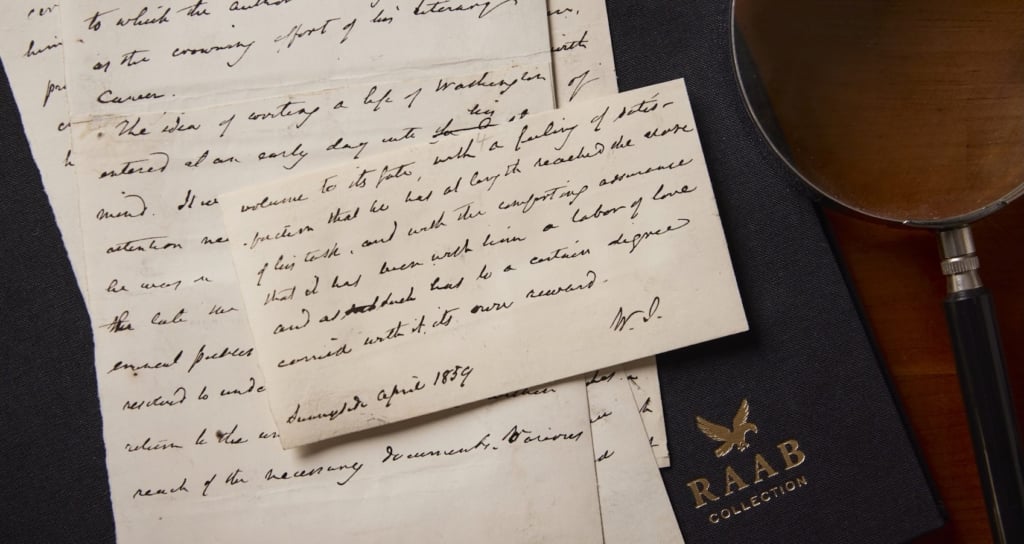


A Great Treasure: The United States Receives French Cession of the Louisiana Purchase and Instructions from Napoleon to Deliver to President Jefferson
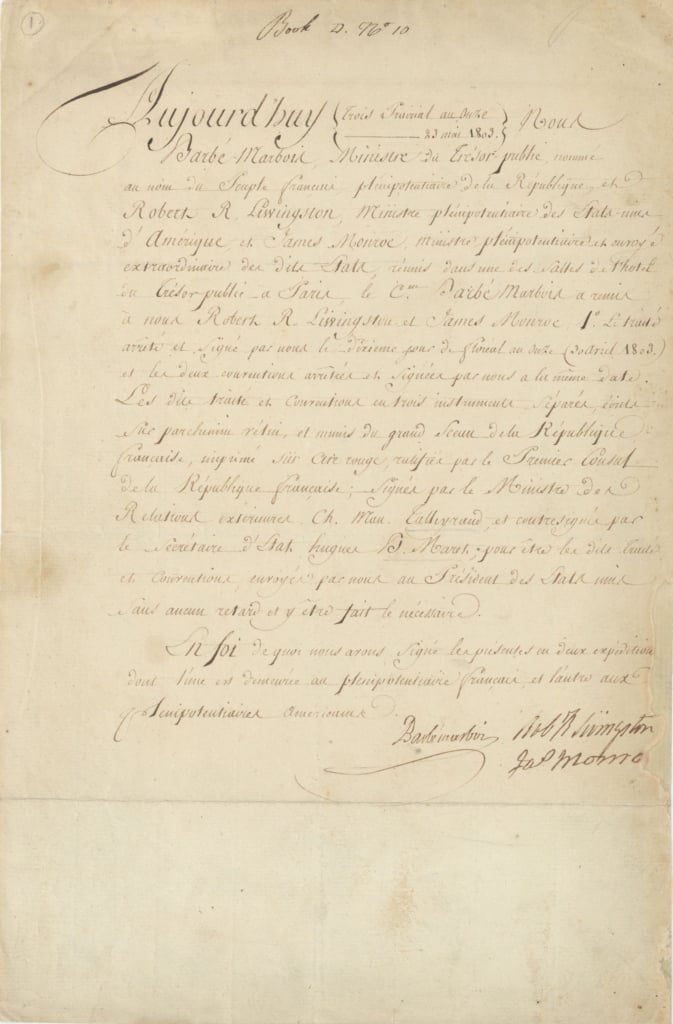

A Foundational Document in American and World History: The Treaty Formally Passes from the Desk of Napoleon to that of Thomas Jefferson
- Currency:
- USD
- GBP
- JPY
- EUR
- CNY
 This currency selector is for viewing only.
The Raab Collection only accepts USD payments at checkout.
Exchange rates are updated hourly. Rates may be inaccurate.
James Monroe and Robert Livingston receive the Treaty signed by Napoleon, notification of French ratification, and instructions from the French: Deliver this “to the President of the United States without delay to do what must be done” and secure American ratification
This doubled the size of the United States and is...


James Monroe and Robert Livingston receive the Treaty signed by Napoleon, notification of French ratification, and instructions from the French: Deliver this “to the President of the United States without delay to do what must be done” and secure American ratification
This doubled the size of the United States and is one of the most significant moments in American history; In 2019, this document was saved from a fire at the Karpeles Manuscript Library and survived
This document, central to the Louisiana Purchase, is among the most important we have ever carried
Hear more on Inspired by History:
The Louisiana Purchase stands as one of the most transformative acts in American history, instantly doubling the size of the young republic and securing U.S. control of the Mississippi River and the vital port of New Orleans. Negotiated at a moment of shifting global power—amid Napoleon’s imperial ambitions, the threat of imminent renewed war with Great Britain, and the collapse of French plans in the Caribbean—the agreement reshaped the geopolitical balance of North America and set the United States on a path toward continental expansion and emergence as a major world power.
As the United States had spread across the Appalachians, the Mississippi River became an increasingly important conduit for the produce of America’s West (which at that time referred to the land between the Appalachians and the Mississippi). Since 1762, Spain had owned the territory of Louisiana, which included 828,000 square miles. The territory made up all or part of fifteen modern U.S. states between the Mississippi River and the Rocky Mountains. The Pinckney Treaty of 1795 had resolved friction between Spain and the United States over the right to navigate the Mississippi and the right for Americans to transfer their goods to ocean-going vessels at New Orleans. With the Pinckney treaty in place and the weak Spanish empire in control of Louisiana, American statesmen felt comfortable that the United States’ westward expansion would not be restricted in the future.
This situation was threatened by Napoleon Bonaparte’s plans to revive the French empire in the New World. He planned to recapture the valuable sugar colony of Haiti from a slave rebellion, and then use Louisiana as the granary for his empire. France acquired Louisiana from Spain in 1800 and took possession in 1802, sending a large French army to St. Domingue and preparing to send another to New Orleans. Americans became very apprehensive about having the more-powerful French in control of the Mississippi and New Orleans. President Thomas Jefferson noted, “There is on the globe one single spot, the possessor of which is our natural and habitual enemy. It is New Orleans.” He determined to do something to change this situation.
In addition to making military preparations for a conflict in the Mississippi Valley, in April 1803 Jefferson sent former Minister to France James Monroe to join present Minister to France, Robert Livingston, to try to purchase New Orleans and West Florida for as much as $10 million. Failing that, they were to attempt to create a military alliance with England. Meanwhile, the French Army in St. Domingue was being decimated by yellow fever, and war between France and England was on the horizon. Napoleon decided to give up his plans for Louisiana, and offered a surprised Monroe and Livingston the entire territory of Louisiana – all 828,000 square miles of it – for $15 million. That was three cents per acre. Although buying all of Louisiana far exceeded their instructions from President Jefferson, Monroe and Livingston saw the golden opportunity and agreed. The treaty was signed on April 30, 1803.
The treaty itself actually consisted of three linked agreements: the Treaty of Cession, by which France transferred the Louisiana territory to the United States and guaranteed rights of property, religion, and eventual citizenship to its inhabitants; a first convention establishing that the United States would pay 60 million francs (about $11.25 million) to France through government bonds as the purchase price; and a second convention by which the United States assumed 20 million francs (about $3.75 million) in claims owed to American citizens for prior French seizures and commercial losses. Together, these three instruments formed the full legal structure of the purchase, bringing the total cost to 80 million francs, or roughly $15 million.
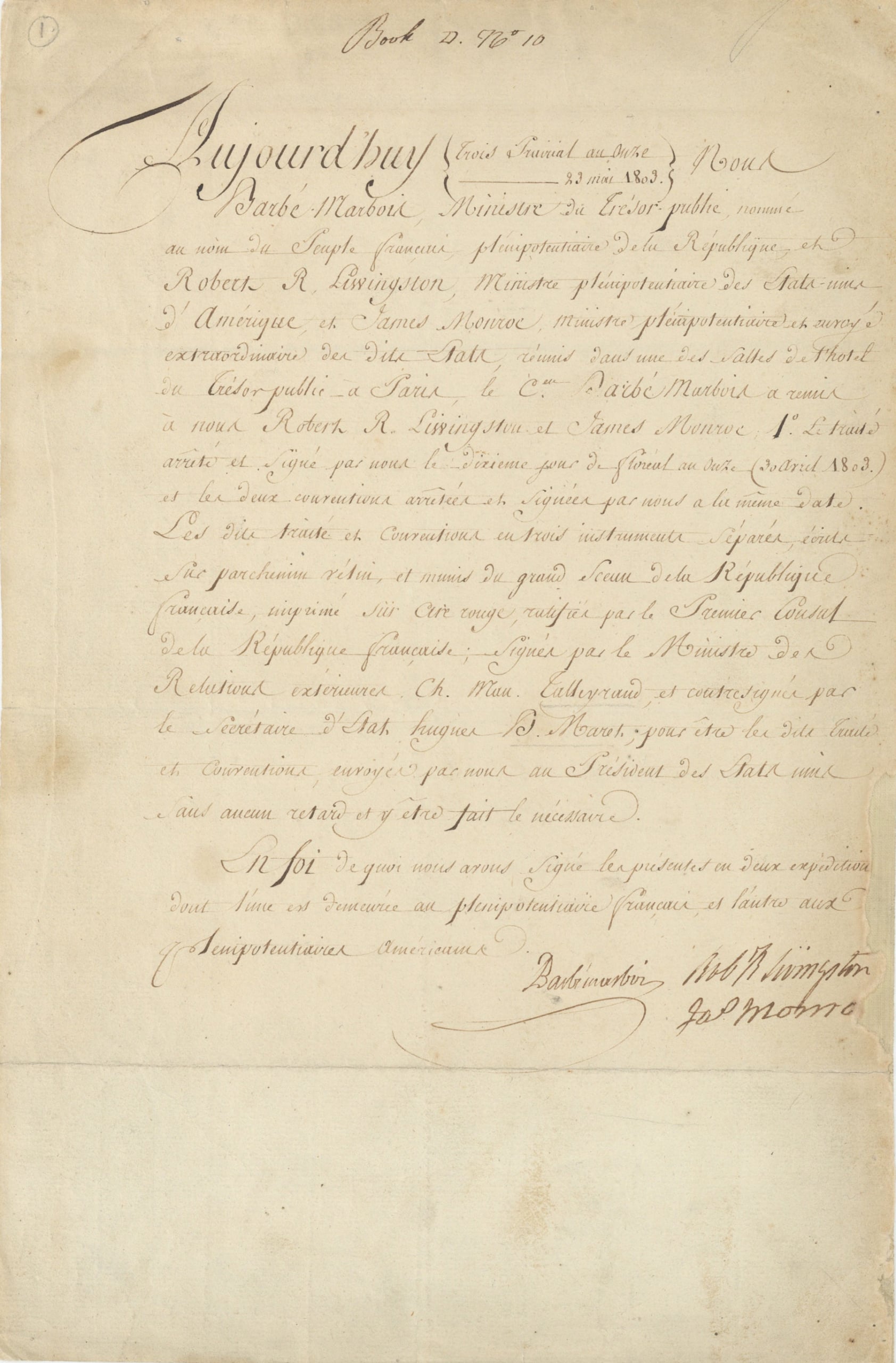
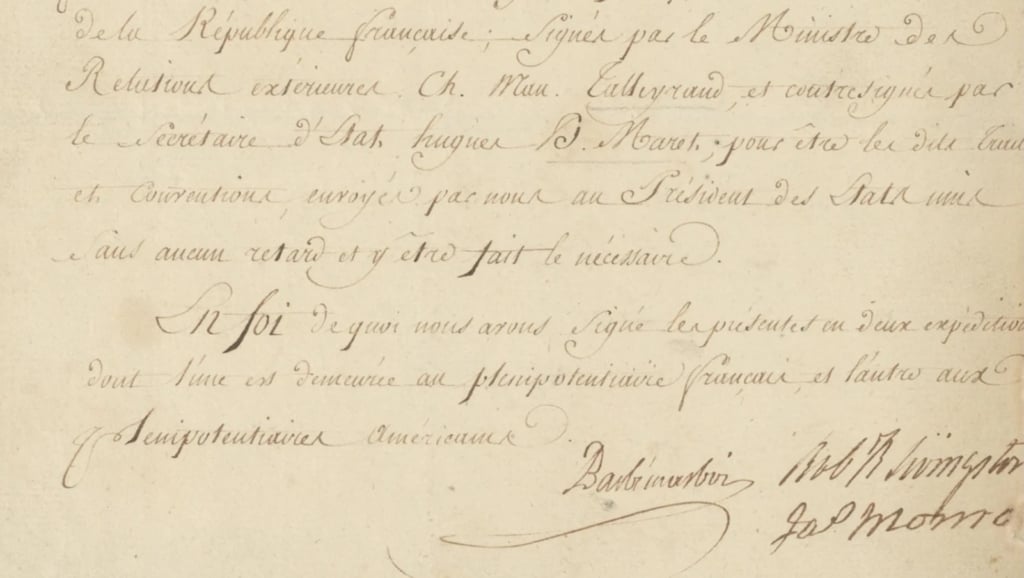
The French ratification of the Louisiana treaty and conventions was dated May 22nd and signed by Bonaparte, Foreign Minister Talleyrand, Minister of the Treasury Barbé de Marbois, and Hugues Bernard Maret, who, as the secretary of state, was responsible for promulgating laws and decrees. It was delivered to the representatives of the United States, Robert R. Livingston and James Monroe, who here sign to acknowledge receipt of the treaty to be sent to President Thomas Jefferson “without delay.”
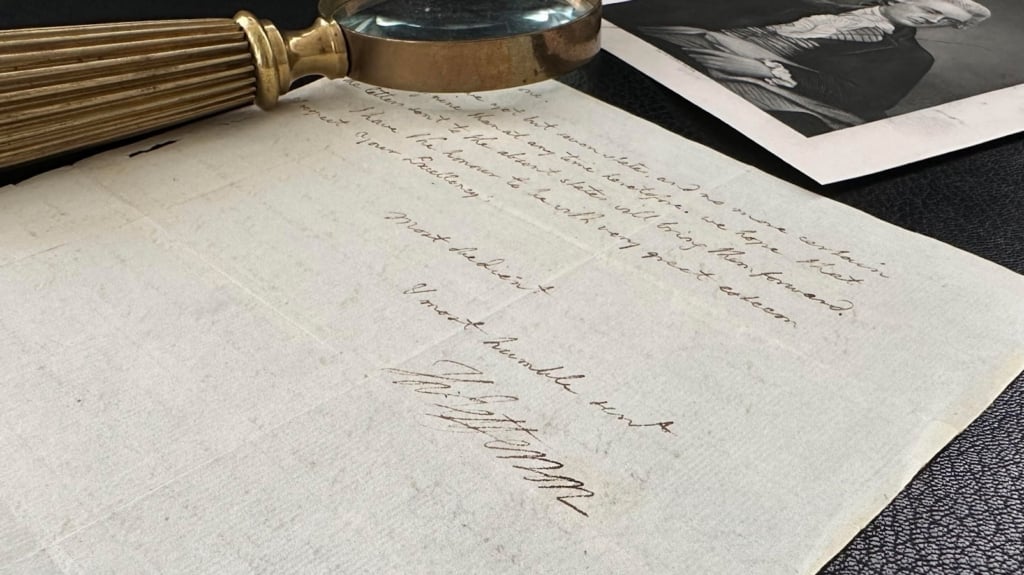
Historic manuscript DS signed “Jas. Monroe,” “Rob. R. Livingston,” and “Barbé Marbois,” in French, Paris, May 23, 1803, being the monumental document recording France’s sale to the US of Louisiana, just approved by Napoleon Bonaparte and the French government.
“Today, May 23, 1803, we Barbé-Marbois, Minister of the Public Treasury named by the French People as Minister Plenipotentiary, and Robert R. Livingston, Minister Plenipotentiary of the United States of America, and James Monroe, Minister Plenipotentiary and envoy extraordinaire of the said States, at a meeting in one of the rooms of the Hotel du Public Treasury in Paris, Citizen Barbé-Marbois transmitted to us, Robert Livingston and James Monroe: 1. The treaty concluded and signed by us on 10 Floreal an 11 (30 April 1803) and the two conventions concluded and signed by us on the same date. Said treaty and conventions in three separate instruments, written on vellum parchment and bearing the grand seal of the French Republic imprinted in red wax, ratified by the First Consul [Napoleon] of the French Republic, signed by the Minister of Foreign Affairs, Ch. Mau. Talleyrand, and countersigned by the Secretary of State Hugues B. Maret; therefore the said treaty and conventions are to be sent by us to the President of the United States without delay and for him to take the necessary steps. For which we have signed the present document in two copies, one for the French ambassador and one for the American ambassadors.” With loss to one letter of Monroe’s signature.
It is interesting to note that Barbé Marbois, who played a key role in negotiating the Louisiana Purchase Treaty and delivered the signed ratification, was former ambassador to the United States and had lived in the U.S. for years, spoke English, and married an American. He was well connected in the U.S. and was elected a Foreign Honorary Member to both the American Academy of Arts and Sciences (John Hancock and John Adams were also members), and the American Philosophical Society (Thomas Jefferson was also a member, and the two dealt extensively). He was a logical choice to negotiate the treaty.
There was some delay in getting the ratified treaty to the United States, and Jefferson did not see the treaty until early July 1803. When news of the sale reached the United States, people were incredulous and mostly elated. President Jefferson, however, was in a quandary. He had always advocated strict adherence to the letter of the Constitution, yet there was no provision empowering him to purchase territory. Given the public support for the purchase and the obvious value of Louisiana to the future growth of the United States, however, Jefferson decided to ignore the legalistic interpretation of the Constitution and forgo the passage of a Constitutional amendment to validate the purchase. This decision contributed to the principle of implied powers of the federal government.
Because the treaty stipulated that the American ratification must be concluded by October 30, Jefferson hurriedly convened a special session of Congress on October 17. The United States Senate consented to ratification of the treaty with a vote of 24 to 7 on October 20. On the following day, October 21, 1803, the Senate authorized Jefferson to exchange the ratification document with France, take possession of the territory and establish a temporary government.
In very good condition, with repaired loss to the right edge, truncating the final letter of Monroe’s signature.
This document, central to one of the most significant moments in American history, is one of the most important we have ever carried. It is from the famed collection of The Karpeles Manuscript Library, from which it was rescued during a fire in 2019.

Frame, Display, Preserve
Each frame is custom constructed, using only proper museum archival materials. This includes:The finest frames, tailored to match the document you have chosen. These can period style, antiqued, gilded, wood, etc. Fabric mats, including silk and satin, as well as museum mat board with hand painted bevels. Attachment of the document to the matting to ensure its protection. This "hinging" is done according to archival standards. Protective "glass," or Tru Vue Optium Acrylic glazing, which is shatter resistant, 99% UV protective, and anti-reflective. You benefit from our decades of experience in designing and creating beautiful, compelling, and protective framed historical documents.
Learn more about our Framing Services