







A Late Medieval Psalter-Breviary, Likely from South Western France or the Adjacent Pyrenees, and Made for the Use of an Itinerant Franciscan Friar


15th century, of Franciscan Use, in Latin, illuminated manuscript on vellum
A near complete book, last sold in 2009 and since then in an American collection
In the Middle Ages, the celebration of the Mass required a prayer book. This was known as a Breviary and contained psalms and hymns, the readings from Sacred Scripture and the writings of the Fathers, the...


A near complete book, last sold in 2009 and since then in an American collection
In the Middle Ages, the celebration of the Mass required a prayer book. This was known as a Breviary and contained psalms and hymns, the readings from Sacred Scripture and the writings of the Fathers, the prayers and the responses, all combined to form the canonical hours of the divine office of prayer that was recited daily. Originally, this required many books. However, in the later Middle Ages, the desire to give the word of God to individuals who were unable to attend church, and to enable them to recite the canonical hours privately, led to the combination of all of this holy information into one book- the breviary. This book was also used by smaller churches.
A Psalter-Breviary combines the Psalter (the 150 Psalms, often with canticles and a litany) with the core texts of the Divine Office – hymns, antiphons, responsories, and readings for the liturgical hours (Matins, Lauds, Prime, Terce, Sext, None, Vespers, Compline). Rather than needing separate service books, a cleric or friar could carry one compact volume containing everything needed to perform the Office privately or on the road.
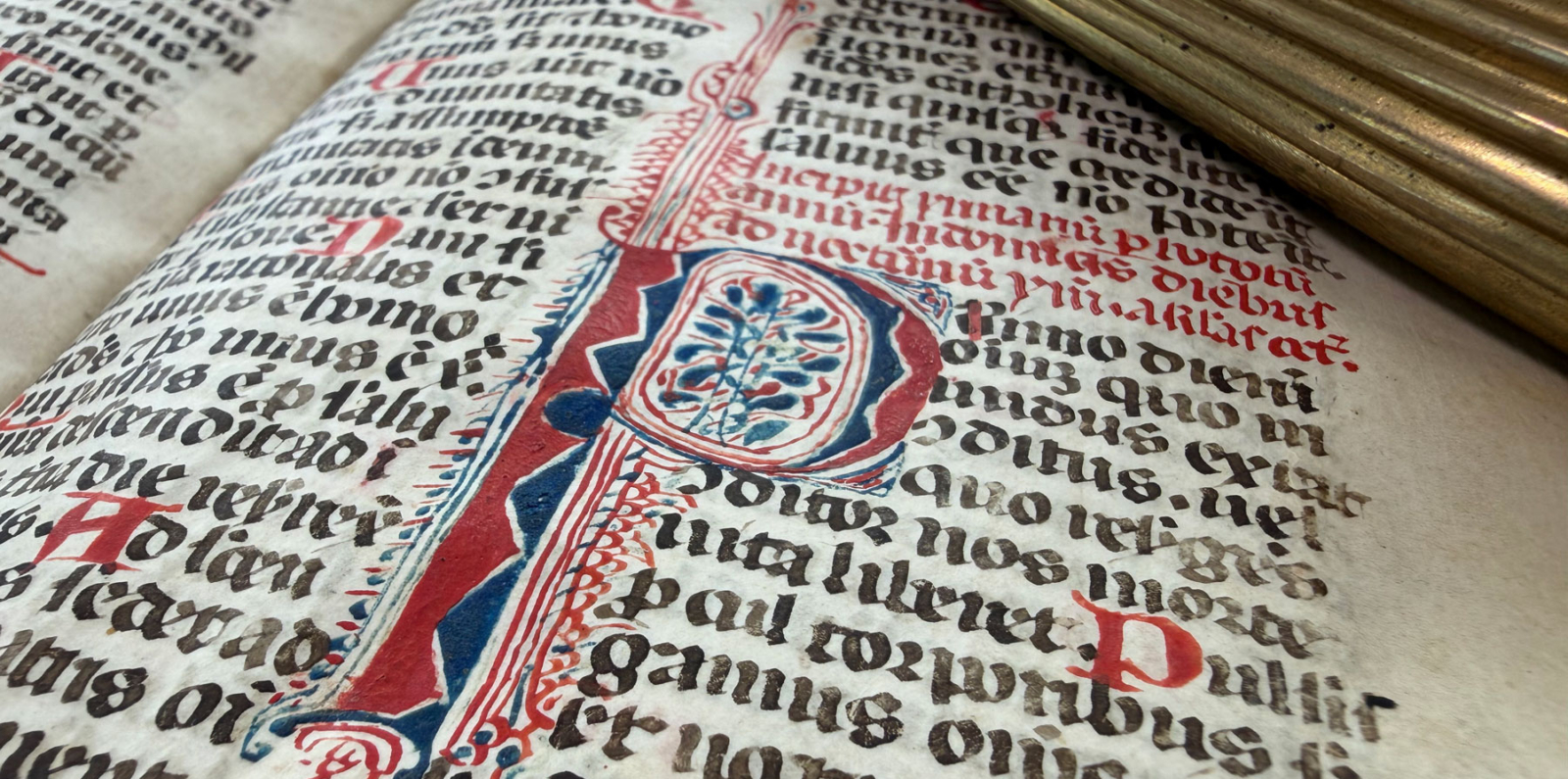
278 leaves, (wanting 2 leaves from the Calendar, with January-February, March-April not there), a single quire from beginning of Psalter with Psalms 1-3 and almost all of Psalm 4 (the last 5 lines of Psalm 4 erased from the head of the first column of fol. 7r), as well as single leaves from the second and 19th quires, and at least 2 leaves from the 22nd quire, textual losses show that there is probably a quire missing after the present 21st quire, collation: i4, ii11, iii-xviii10, xix9, xx-xxii10, xxiii8 (wants originally first and 5th leaf), xxiv-xxviii10, xxix7 (last a cancelled blank), some catchwords, main text in double columns of 30 lines of a squat and rounded French textura bookhand (that probably provincial, supporting the suggestion that this volume was written in south-western France on the border with Spain), capitals infilled with red, red rubrics, blue paraph marks, one- and 2-line initials in red or dark blue, occasional larger initials (usually opening Psalm readings) in red and blue penstrokes with blank vellum lines left between them, enclosing simple foliate designs and with penwork filling the adjacent margins (one leaf with a large penwork roundel in margin as part of penwork border decoration, enclosing a blue fleur-de-lys with concentric red circles), spaces left for some rubrics, a few later marginal additions and small erasures, trimmed at edges, slightly cockled throughout, slight worm damage in places, a few spots and stains, else in good condition, 170 by 130mm.; modern binding meant to resemble a 15th- or early 16th-century choirbook leaf.
Provenance:
1. This Psalter-Breviary was made for use by an itinerant Franciscan friar (note saint in red in the Calendar, noting his Octave, his Translatio and his nativity, where in the latter he is called “nostri Francisci”, and also prominently in Litany; and other Franciscan saints, such as St. Clare of Assisi in red in the Calendar, she also in the Litany), and hence its diminutive and portable size so that it could accompany him on his travels. The original owner appears to have travelled around proselytising in south western France and perhaps the adjacent Pyrenees (with SS. Fronto of Périgueux and Gerald of Aurillac added in near contemporary hand to Calendar for October; and the same hand adding St Aemilian of Cogolla, patron saint of La Rioja in the Spanish foothills of the Pyrenees, and with his major shrine in the nearby twin Augustinian monasteries of San Millán de la Cogolla, to November: Aemilian is a rare saint to find in any media, and the Metropolitan Museum of Art in New York holds an ivory plaque from the top of an 11th-century reliquary of the saint in its collection in the Cloisters).
Text:
This volume comprises: a Calendar; the Tabula adventus, opening “In anno illo in quo natalis domini dominica venerit. Secundum sequentem tabulam …”; the Psalter, opening with Psalm 5 (with the last 5 lines of Psalm 4 erased from the head of the first column of fol. 7r), followed by hymns; the Breviary, followed by a Litany of Saints; further Biblical and Patristric readings, and ending with a table of such readings for various Sundays in red ink.

Frame, Display, Preserve
Each frame is custom constructed, using only proper museum archival materials. This includes:The finest frames, tailored to match the document you have chosen. These can period style, antiqued, gilded, wood, etc. Fabric mats, including silk and satin, as well as museum mat board with hand painted bevels. Attachment of the document to the matting to ensure its protection. This "hinging" is done according to archival standards. Protective "glass," or Tru Vue Optium Acrylic glazing, which is shatter resistant, 99% UV protective, and anti-reflective. You benefit from our decades of experience in designing and creating beautiful, compelling, and protective framed historical documents.
Learn more about our Framing Services


