




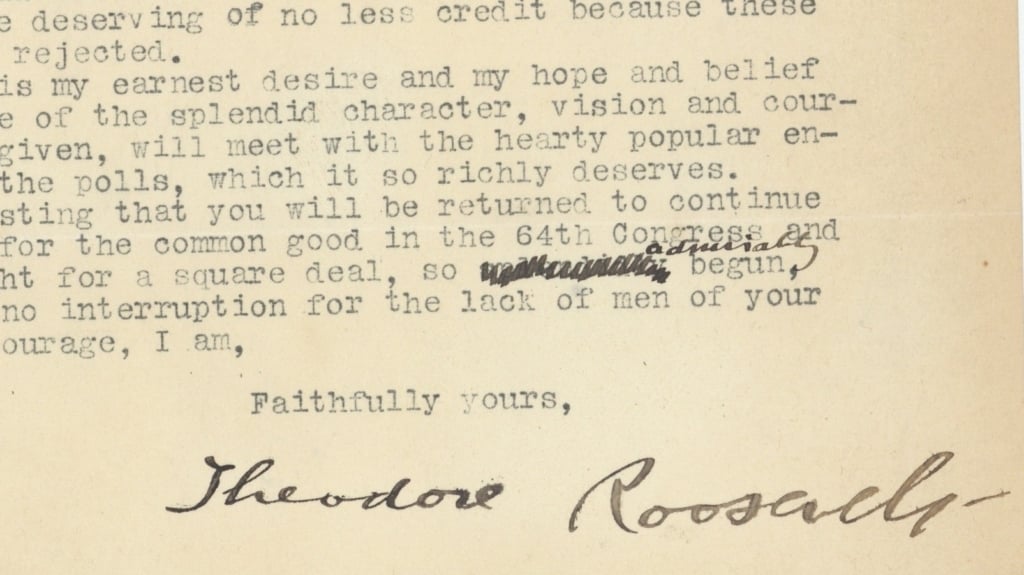
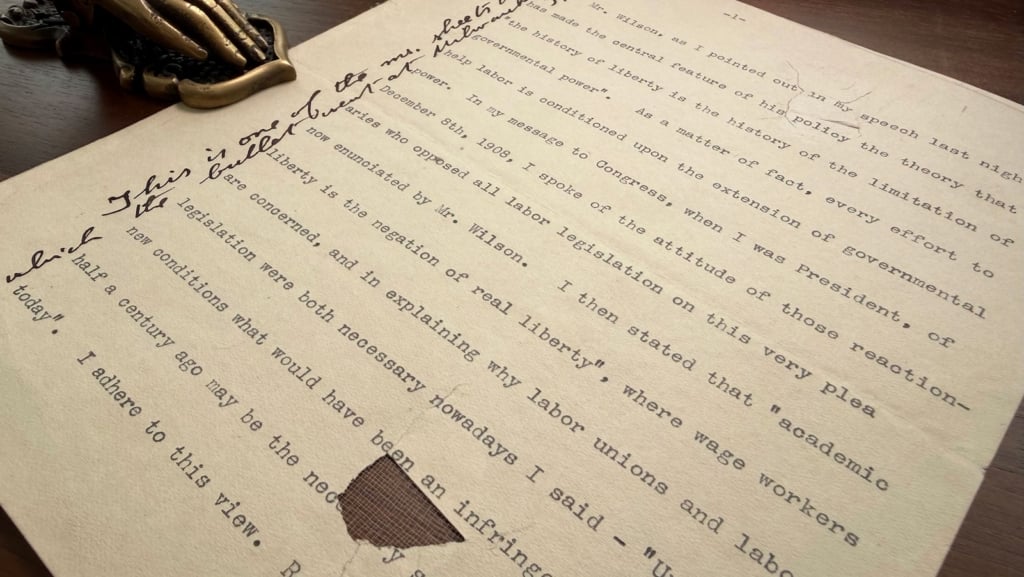


The Raab Collection has discovered and acquired an extraordinary piece of American history: Page 1 of the speech held in Theodore Roosevelt’s pocket that slowed the bullet of a would-be assassin and saved his life on October 14, 1912.
Nathan Raab was interviewed on the Inspired by History podcast about this discovery, which has been in a private collection for nearly a century, alongside Roosevelt’s own annotated copy of the speech he ended up giving after he was shot and before he was rushed to a hospital in Chicago. Listen to the interview below or via your podcast player of choice. Or, if you prefer, read this lightly edited transcript of the conversation with photos and embedded links to more resources.
Today, we’re talking about something quite special and incredibly significant in American political history. Two pieces really, but let’s start with the manuscript that literally changed the course of American history. How so?
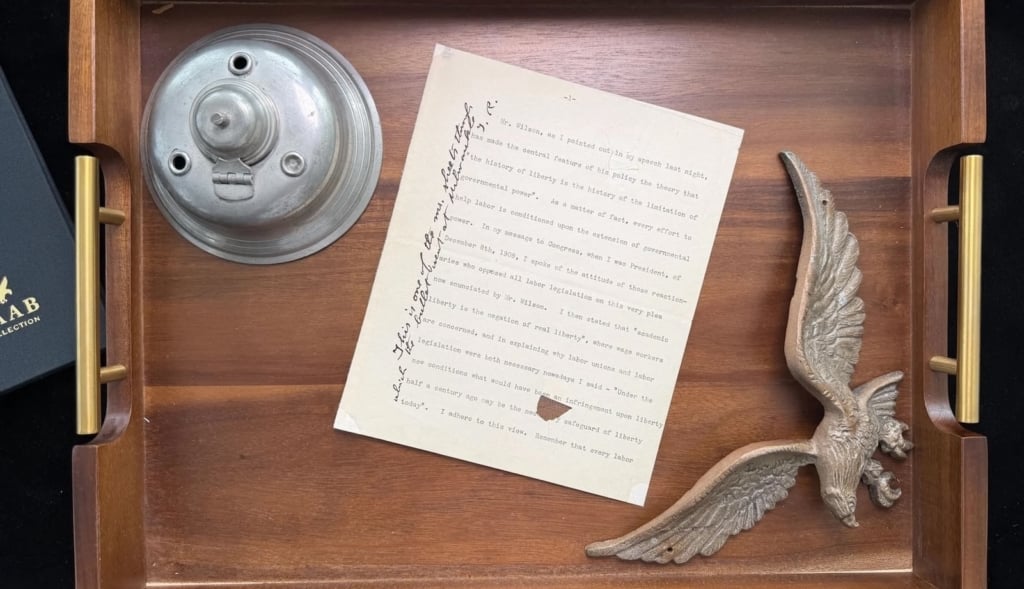
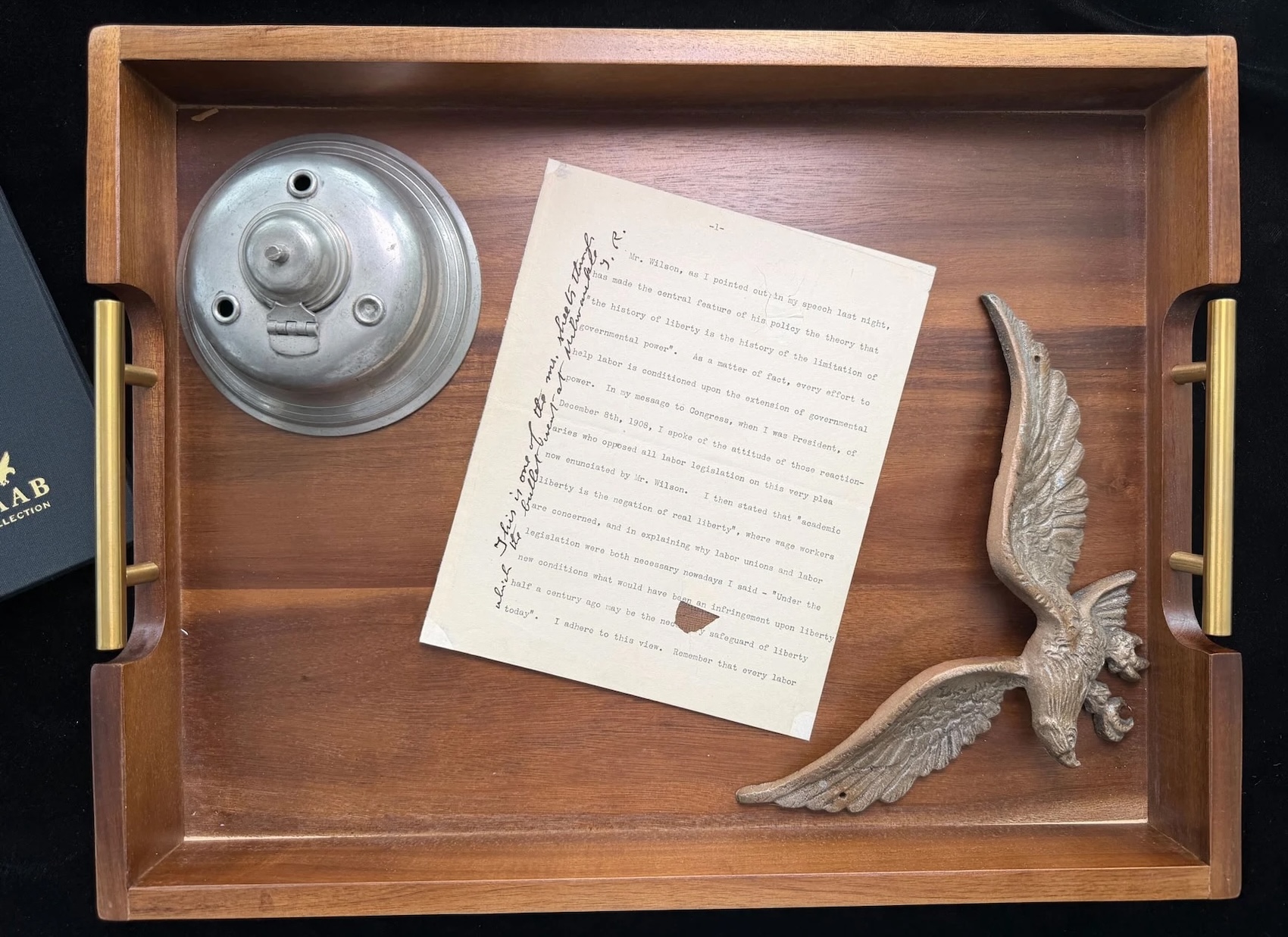
On October 14th, 1912, Theodore Roosevelt was on the campaign trail in Milwaukee, Wisconsin, trying to win back the presidency. He had that day tucked into his vest pocket the manuscript of a speech he intended to give. However, an assassin took aim at him, discharging a bullet which tore into his vest, into the manuscript, and into his body. The manuscript was credited with buffering the shot enough to save him. And pieces of the original manuscript still exist. Nathan Raab just found one. Nate, can you give us a brief description of what this item looks like physically?
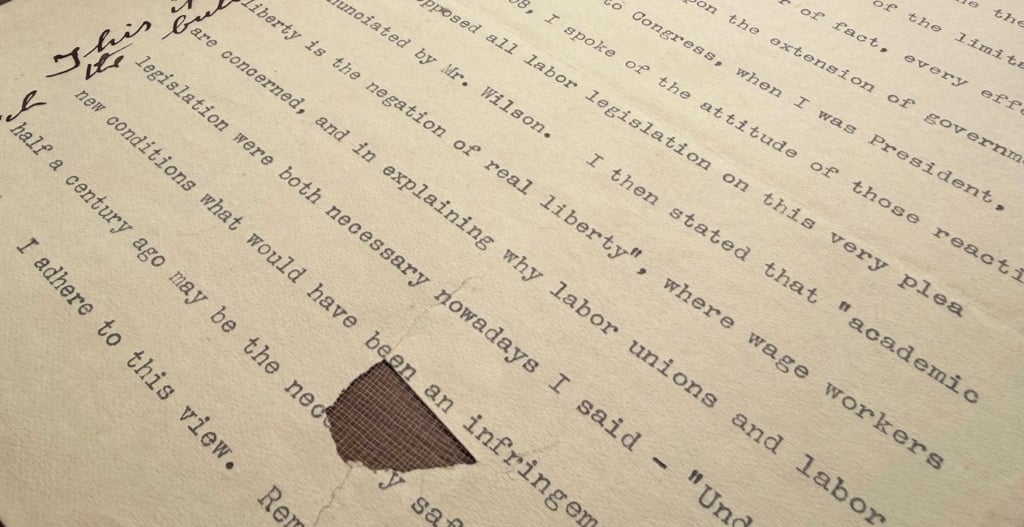
Nathan: It’s a rather unimposing small piece of paper, looks like, you know, if you were to give a speech and were to type it out on an old typewriter, approximately 8 x 10, maybe slightly smaller. This particular one is labeled 1. It was page 1 of the speech, but it has a couple things that most speeches don’t have. In this case, it has two bullet holes. Two bullet holes that a bullet went through on their way to piercing the body of President Theodore Roosevelt. The reason there are two is because the speech was folded up in his pocket, and so it went through one side and then the other side, the other part of the fold.
These sheets of paper were among a handful that were part of this speech that helped save his life, that slowed the path of the bullet, along with the glasses case, and literally saved Roosevelt’s life.
So then at some point after the speech or when he was better, he annotated and signed this piece and gave it away to a friend or something along those lines?
Nathan: Well, I think it was a symbol of his survival, a symbol of his perseverance. You know, the story of the American presidency is tied to the story of assassination and has been since Abraham Lincoln was killed in 1865, which changed the course of the recovery from the Civil War and further divided a nation that was already divided.
The idea of assassination, the attack against our chief executive, and the desire for an orderly transfer of power, really the thread between the Lincoln assassination and the Kennedy assassination is a quite fascinating one. It’s really embedded in the psyche of this nation, and Theodore Roosevelt sits really comfortably in the middle of those two successful assassinations. This was an unsuccessful attempt. Unsuccessful because, in part, of this sheet of paper. After the attempt, he got up there, and he continued to give a speech. Can you imagine that happening today? No. I mean, the president would be whisked away, and rightfully so. But, in this case, I’m not sure they thought, “Oh, maybe there’s a second person,” or, they figured, “Okay, well, we got the guy.”
Roosevelt continued to give a speech, then sat down at the end and said, “Okay, I’m ready for the doctor.” And these pieces of paper became symbols of his resilience and the resilience of the presidency, and he gave them away to very close friends, family members, and an even smaller number – I’m aware of two other sales, one of which came through us 20 or so years ago – two other sales of these sheets, these leaves of his speech. One was acquired by Malcolm Forbes and was sold by Christie’s in the Forbes Collection, at least two decades ago. The other came through us. The difference here is this is page 1, and it’s the only one that has come up for sale, and probably the only one that exists, that has Roosevelt’s handwriting on it, wherein he’s identified what it is, so it contains the signed identification of it by the victim himself. Just fascinating.
That’s really incredible. How did this discovery take place? Do you know anything about how long it was in a collection?
Nathan: It was put together by someone who may have known Roosevelt. I suspect the person did know Roosevelt. It was put together by a prominent family in the immediate area of Roosevelt’s New York home, probably around the same time or shortly after the assassination attempt itself, which would help explain the presence of so many interesting pieces relating to this, something that was quite personal and important to Roosevelt himself, the kind of important material that one doesn’t see routinely pop up on the market.
And then at some point, that original family gave it to a very close family friend in whose collection it has remained for the better part of 75 or so years. I don’t believe that its existence was known, and it’s never been offered for sale before.
I ask you this all the time because it never gets old, but what is it like to hold a piece like this – a bullet-riddled piece of history–in your hands?
Nathan: I mean, anytime you can see something that no one else has ever seen before, something that’s super important, it’s pretty exciting. It’s a reminder that the important stuff is still out there to discover. We haven’t gotten to the bottom of everything.
I think about it sometimes in comparison to the exploration of the seabed. There are plenty of things yet to discover down there and it just takes patience, knowledge, and a little bit of luck to uncover these pieces. But they’re out there. They’re hiding away in people’s attics, basements, file cabinets. Some are known, some are unknown, even to the families that have them. And we’re often on the front lines of these. So, yeah, to hold one of the pieces of paper that saved Roosevelt’s life, the most important one perhaps, with his handwriting identifying it as such, bullet holes still there. I mean, it’s pretty cool. Doesn’t get much cooler.
Saved his life and also changed the course of history. Had he died that day, didn’t run in the November election, who’s to say who would’ve become President, because he was a third-party candidate. He split the Republican ticket.
Nathan: Yes. Of course, in the scope of that one election, it would’ve made a difference, but in the broader scope of the American story, yet another president or former president would’ve been assassinated. One who was outspoken, important, deeply consequential, who’d been on the American political scene for, at that point, close to 20 years. It would’ve had far-reaching implications for how we looked on the presidency and the president’s safety. And it was only because of this speech and a handful of other items, really just fortune, that he didn’t die that day.
I confess I had no memory that Theodore Roosevelt had been an assassination target, and then there’s this really cool and gruesome story, a second part to it, that he gives the speech anyway. He’s bleeding, I guess he knows it’s not a mortal wound, so he’s, like, on with the show, and he ends up giving a different speech.
Nathan: Yeah. The final speech differs from the prepared one because he had just been shot. He literally had the bullet, and he was bleeding. He must have known that it wasn’t fatal, or … I can’t say he didn’t care, but certainly had been willing to risk the potential complications. I mean, was it Garfield who was shot, but it took days for him to die? Months, right? It just took forever. He didn’t die immediately, and yet the bullet eventually killed him. Well, the bullet or the attempts to remove the bullet killed him. Just fascinating stuff.
The final speech he gave, the core of it, I think, was essentially the same. He goes at length into the motivations of the person that shot him, talks about political violence, cool stuff, relevance to today, of course, in a world where political violence is very much in the news and decried by both sides of the aisle. A reminder that our country has faced difficult times where there was political violence in previous iterations, and this one fortunately turned out well for Roosevelt.
At the beginning of our conversation, I referenced that there were two pieces. So we talked about the manuscript that’s got the bullet holes, and then you have also discovered and acquired Roosevelt’s own hand-corrected copy of the actual speech he ends up giving. Tell me about that.
Nathan: All right. Follow me here. Roosevelt, at the time, something I did not know, just that earlier that year had hired a stenographer, a personal stenographer, to walk around and take down whatever he said that he felt he wanted taken down. Obviously, not everything, but the man was actively at work on this day. And we know that for two reasons.
The first reason is he was a former footballer, an athletic, strong, bigger guy, certainly bigger than Roosevelt who was, although strong, not big. And he was the first on scene, according to Roosevelt, to tackle the assassin and presumably prevent him from doing more damage, which he did.
The man’s in custody, the hubbub has died down. Theodore Roosevelt gets up to give the speech, and the stenographer is back to his job. By the way, I think I need a stenographer to walk around and type down everything I say.
You can use an iPhone for that these days.
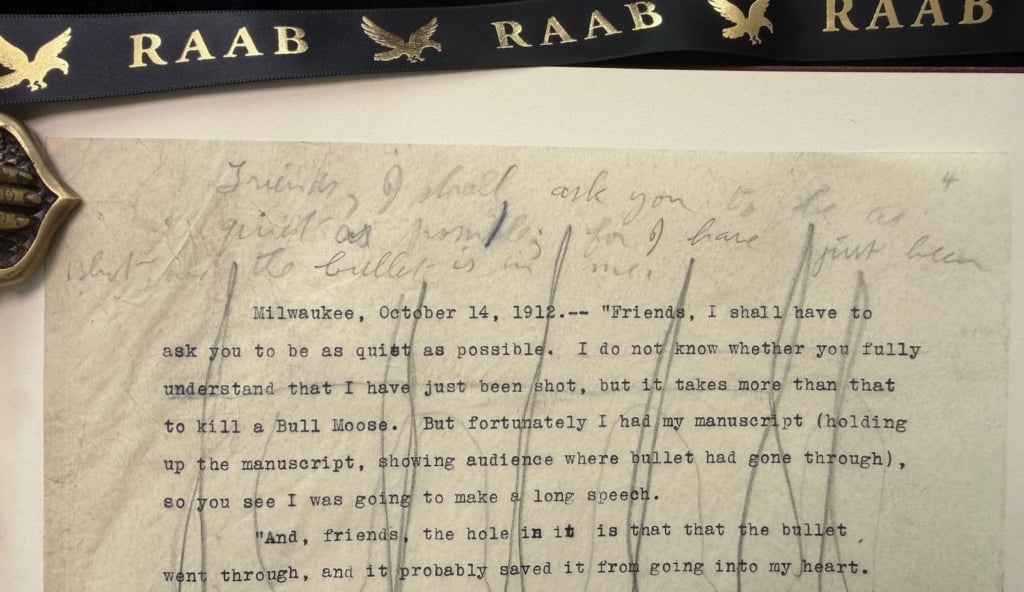
Nathan: I guess so. Stenographer’s back on his job, writes down some form of shorthand of the speech and then goes home, presumably within hours – because the purpose of creating this was to give to the press and distribute – and types out the speech, including, he cuts out of newspapers, articles that are quoted. It’s really kind of the first rough draft of Roosevelt’s speech as he actually gave it, including references to the assassination, the assassin, the now famous things that he said: “There, friends, I shall ask you to be as quiet as possible for I have just been shot and the bullet is in me.”
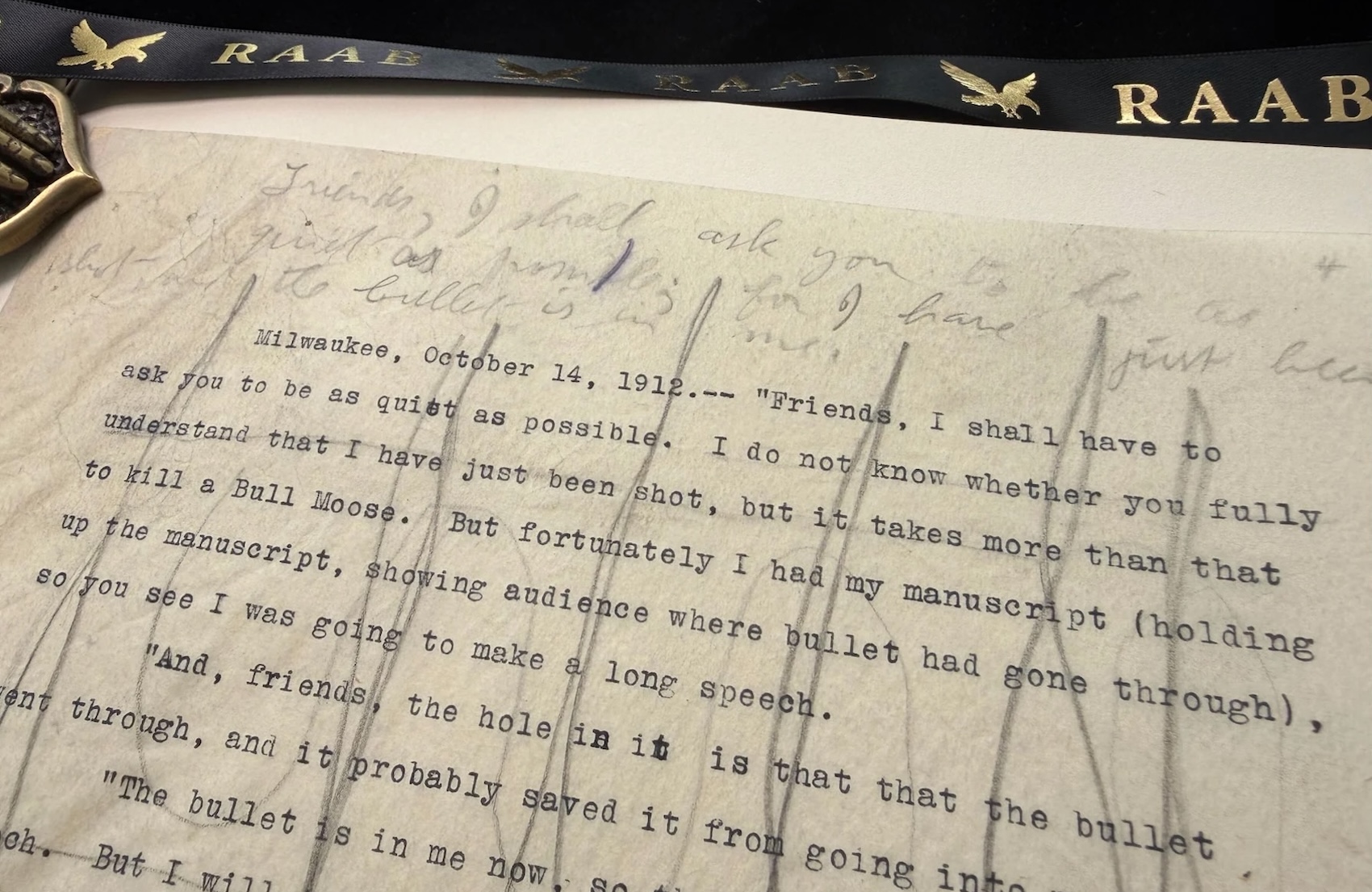
It’s recognition that he had been shot in the bullet remained in him, but Roosevelt said this. Obviously, it wasn’t in his prepared speech because he didn’t know he was going to be shot, but he did say it. This man, Elbert Martin, goes and creates this first official version of this speech and gives it to Roosevelt to edit.
Roosevelt writes a number of things on it. It’s heavily edited, meant to represent his final version of the speech. It’s the version of the speech he wanted to get out. A fascinating document, in which you really see him acknowledging the things that happened on that day. There are references in there to what he did.
Roosevelt did not want extensive language in there about what he personally was doing. So for instance, Martin had written, “Colonel Roosevelt then unbuttoned coat and vest and showed his white shirt badly stained with blood.” He also crosses out: “Now, friends, I’m going to be as quiet as possible, even if I’m not able to give the challenge of the bull moose quite as loudly as usual.” He obviously didn’t want that in the speech, he crosses it out. And then the speech ends: “Friends, I thank you for being so quiet. I am ready for the doctors now.” Another famous line, the casualness with which he greeted an assassination attempt; and Roosevelt has changed quiet to patient, and deleted the very final sentence.
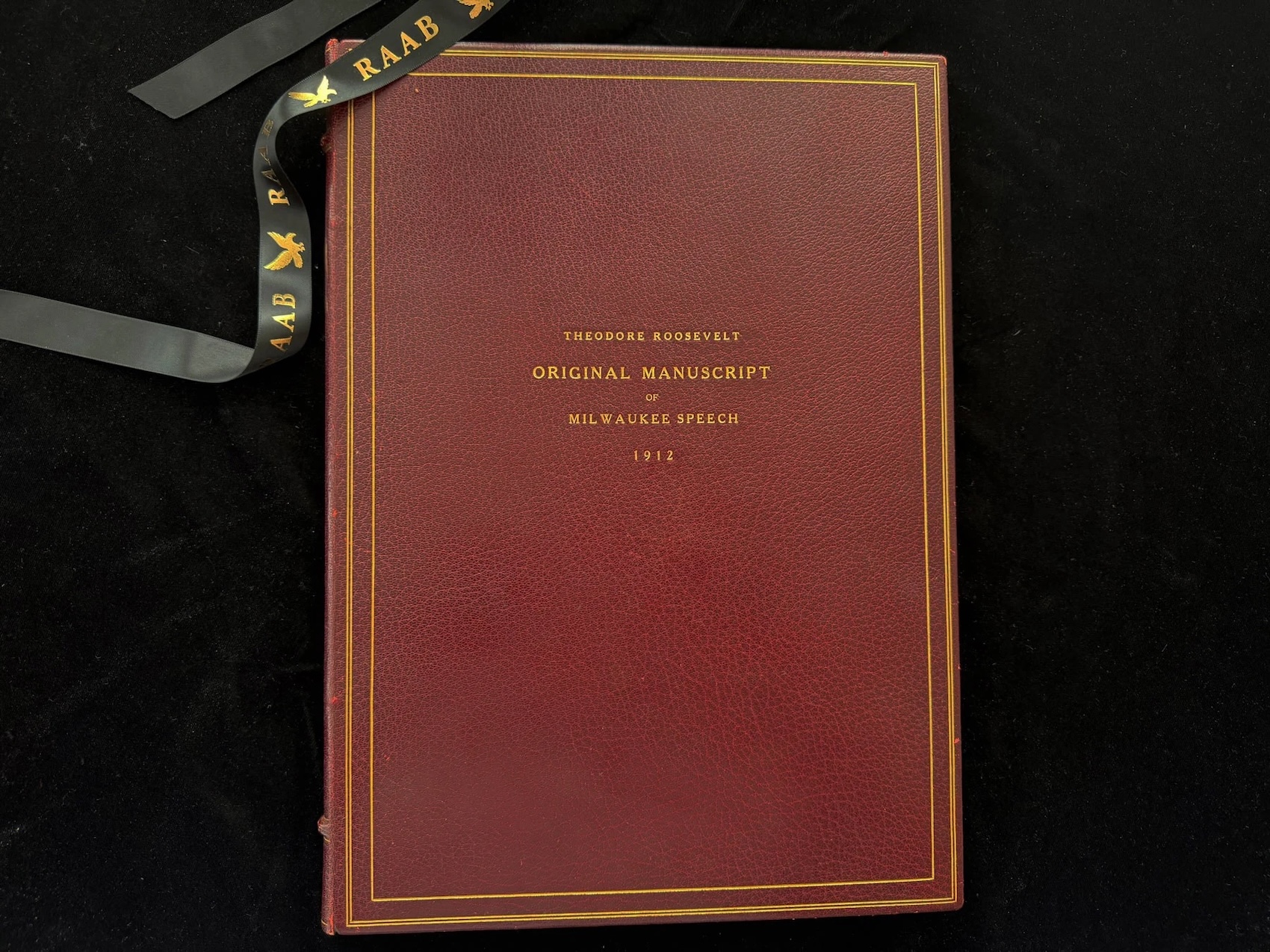
That’s one of 100 plus edits that are made within this document, and he gives it back to Martin. And then Martin types up a final version, which you can still find in the Martin papers. But this edited version, with Theodore Roosevelt’s own edits, which show his mind, where his mind was at after the speech. Presumably, he was lying in a hospital bed or lying in a bed somewhere and recovering. I imagine this was done that very day unless they felt he was not well enough to do it and then the day after, but it would have been immediately after. This was meant to be distributed.
What this family collected was both the page of the manuscript that saved his life and the speech that he gave after because his life was saved, the first official version of it with his own amendments to it and some rather important ones. At the very top of the thing, he’s written out, “Friends, I shall ask you to be as quiet as possible for I’ve just been shot and the bullet is in me.” Amazing.
And these notes, his notes, they’ve been in a collection for over a hundred years. They’re not known to scholars.
Nathan: Certainly not to my knowledge. I found no reference to them. I found no evidence of their publication. I was not able to find this exact text anywhere. The edited version appears. Roosevelt’s edits are accepted by Martin and they do appear in one version that I found, which was not easy to find. It’s not the most widely circulated one. But yeah, to my knowledge, these are unpublished.
Sounds like this was a real research rabbit hole.
Nathan: It was exciting when I sort of connected the dots and realized because when you’re presented with these pieces of paper outside of context, putting together the pieces of the puzzle, you’re not only figuring out what it is, you’re figuring out why was it created.
In a world where I can go online and I can search what Roosevelt said, this is a known speech. Why was this created, and why does it differ from the published version? Really you’re piecing together the specific things, finding the divergences in the two speeches and figuring out, well, is there evidence of this version that I have somewhere? And if so, why? You’re trying to figure out why something was created. What is its journey from creation to here, and what is its birth story, so to speak? Why does it exist? And, in this case, it was exciting to find out, well, this was typed out by Elbert Martin, his stenographer and bodyguard – he wasn’t hired as a bodyguard, but he served in that capacity – and this was Roosevelt’s attempt to memorialize the speech as he wanted it to be memorialized.
Here we are again proving Larry McMurtry right that anything can be anywhere. There are historical treasures like this one yet to be discovered. How cool that you get to be on the front lines of that. Thanks for sharing it with us.
To learn more about collecting Theodore Roosevelt signed documents, visit our dedicated Roosevelt page. More episodes of Inspired by History are available here, or on your podcast player of choice.
