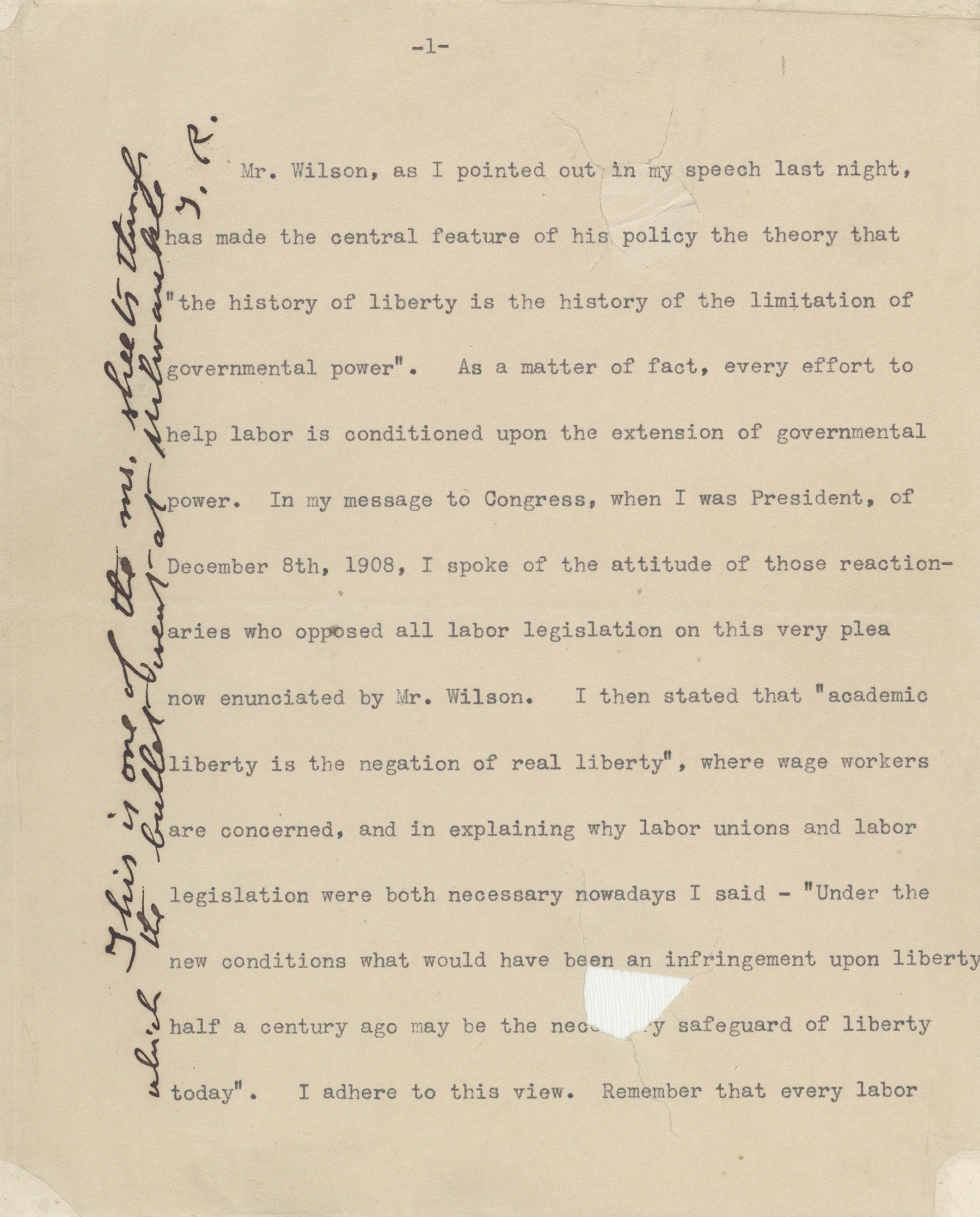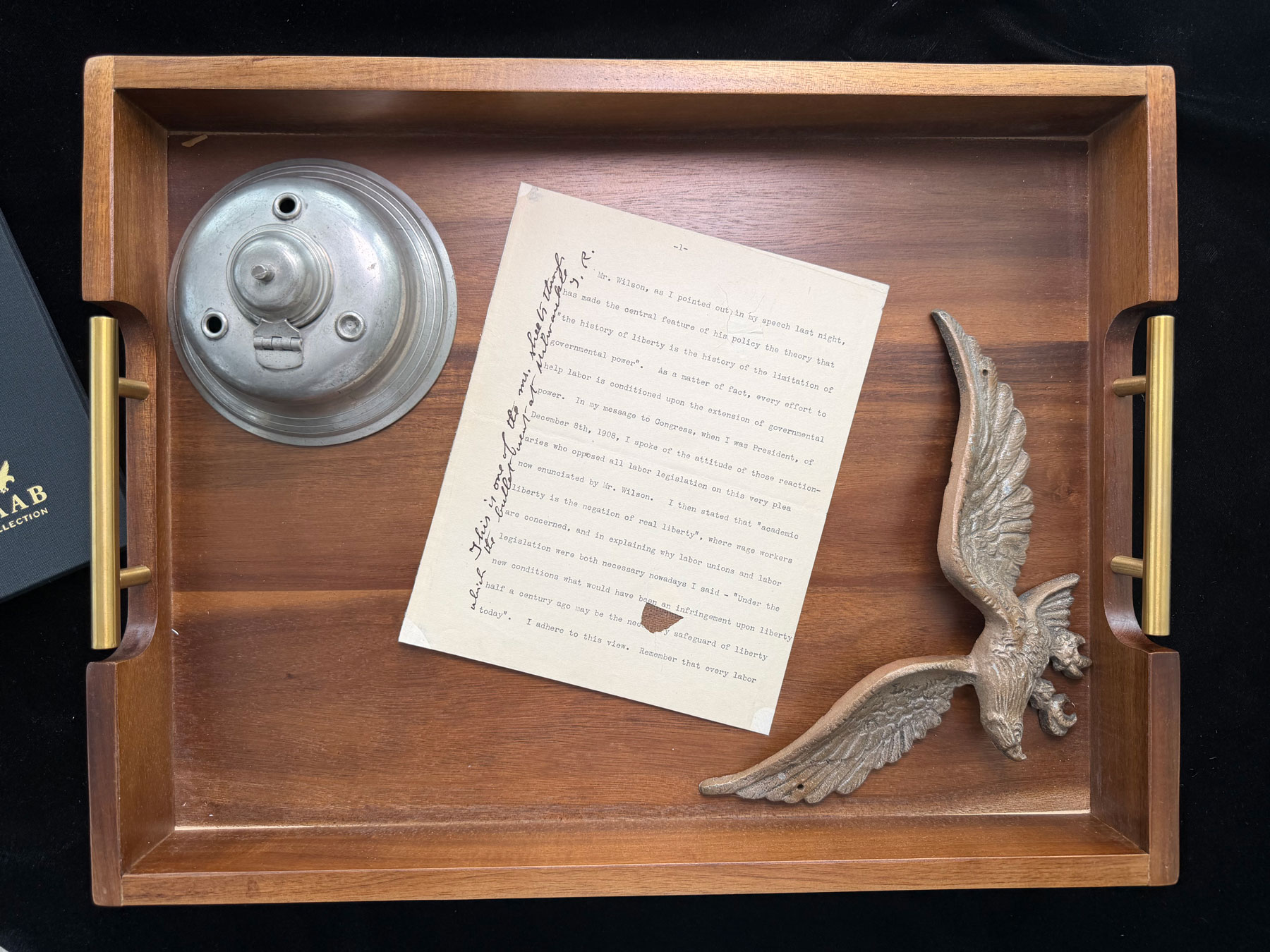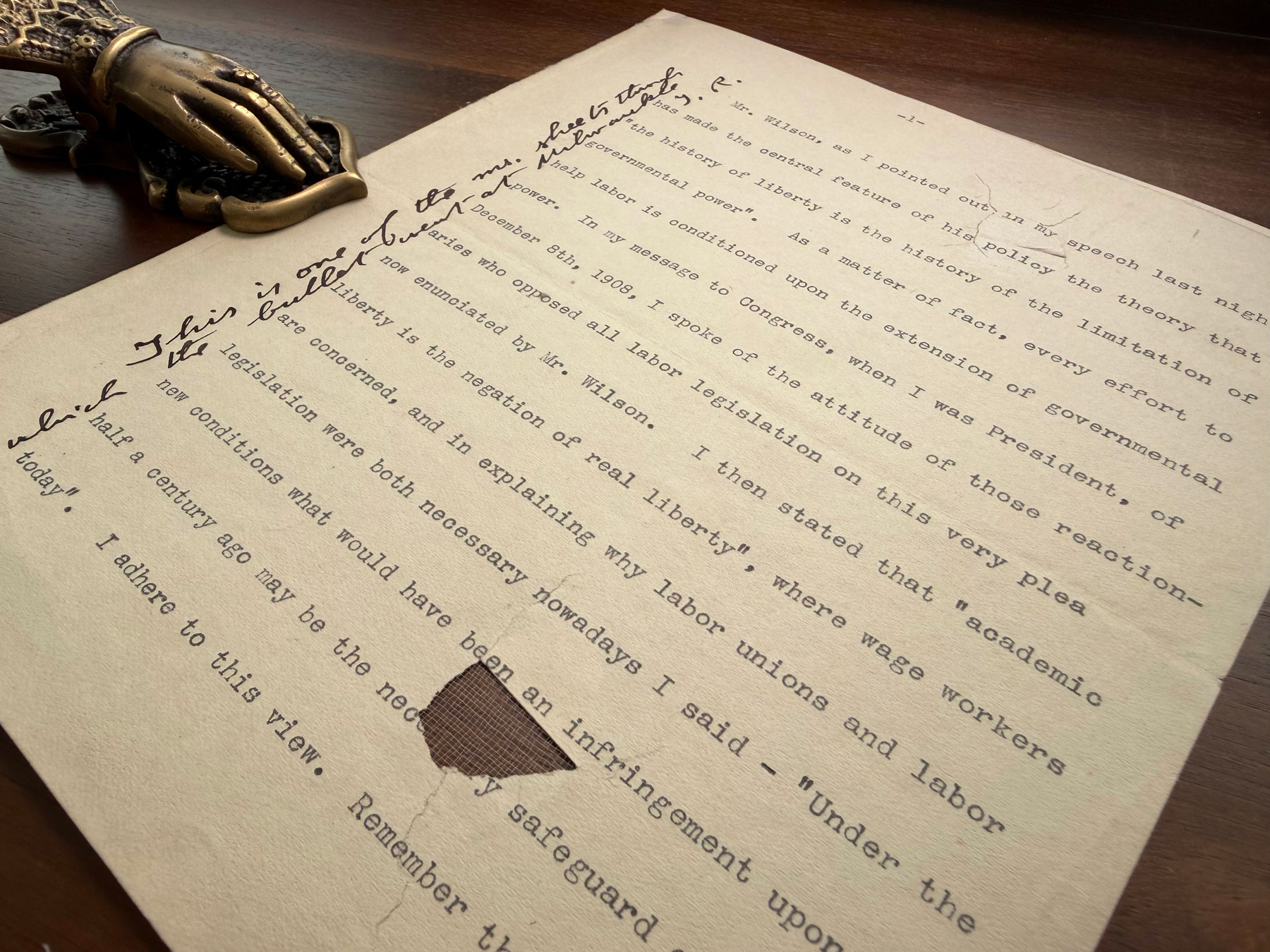




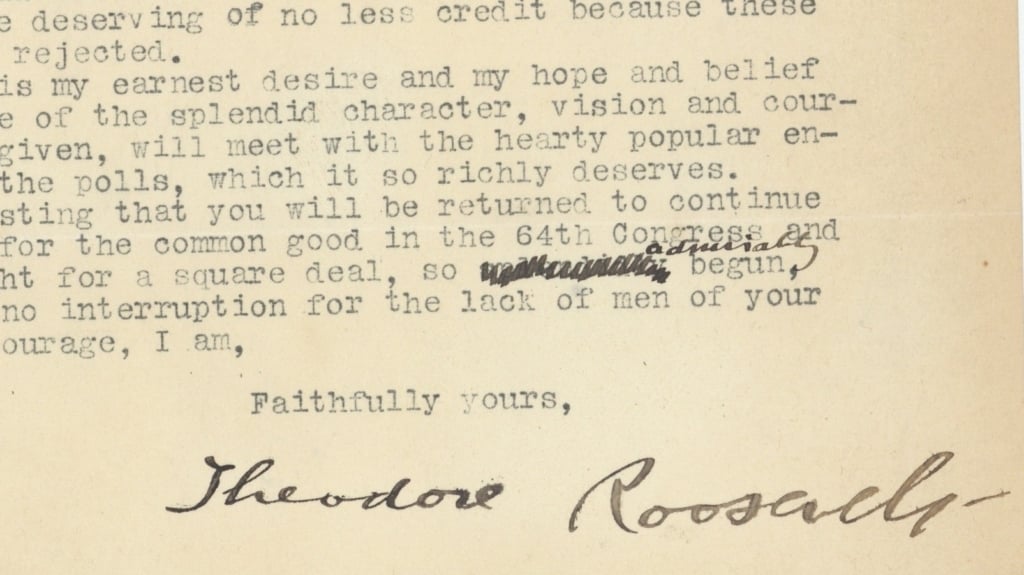
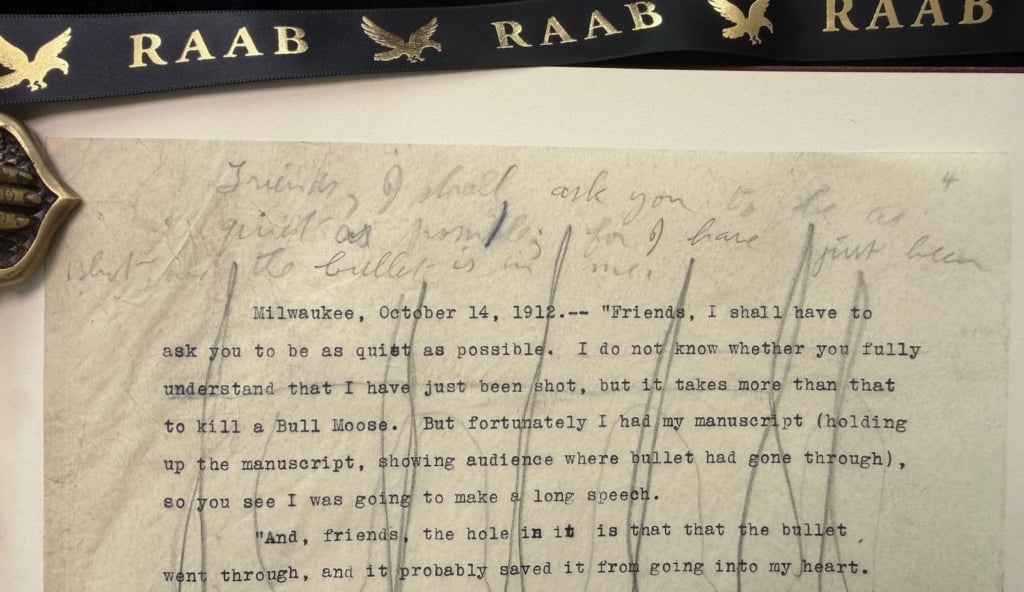
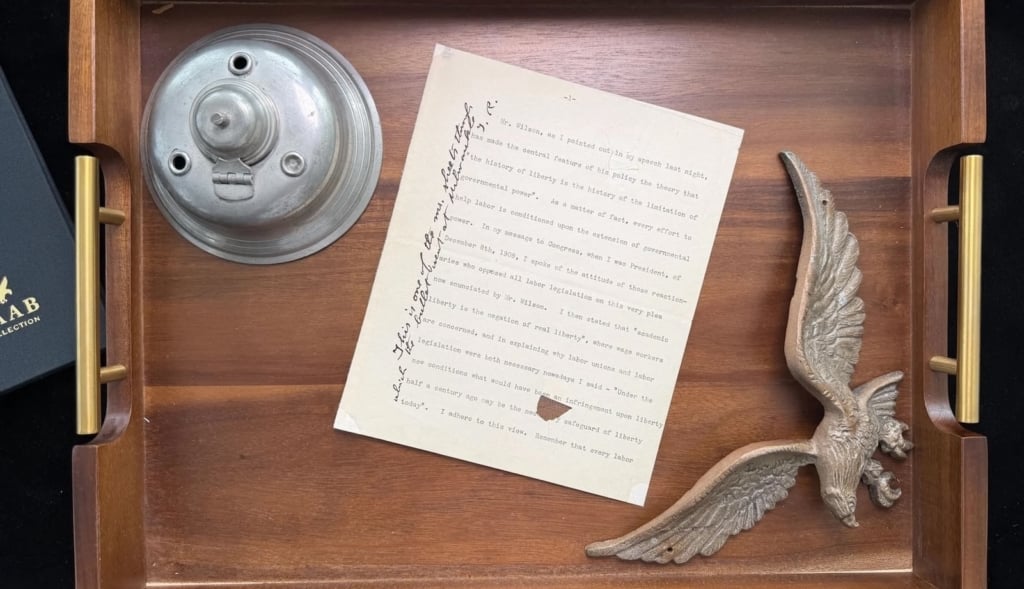


Theodore Roosevelt: “This is one of the manuscript sheets through which the bullet went at Milwaukee. TR”
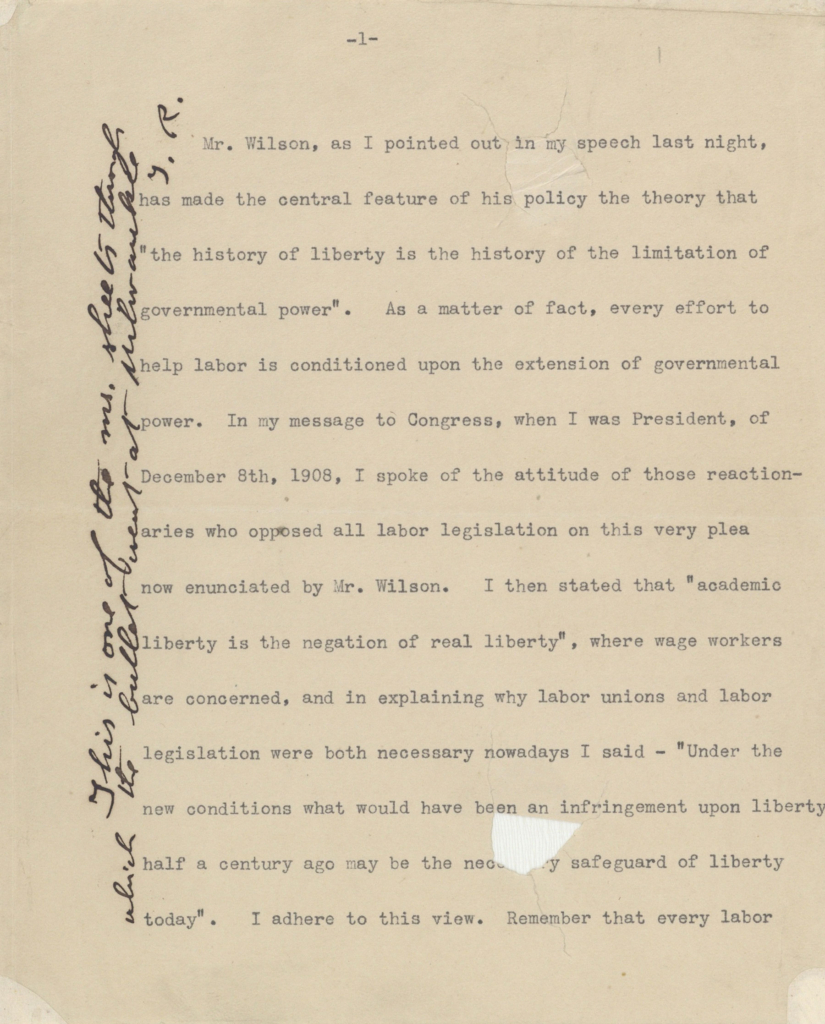
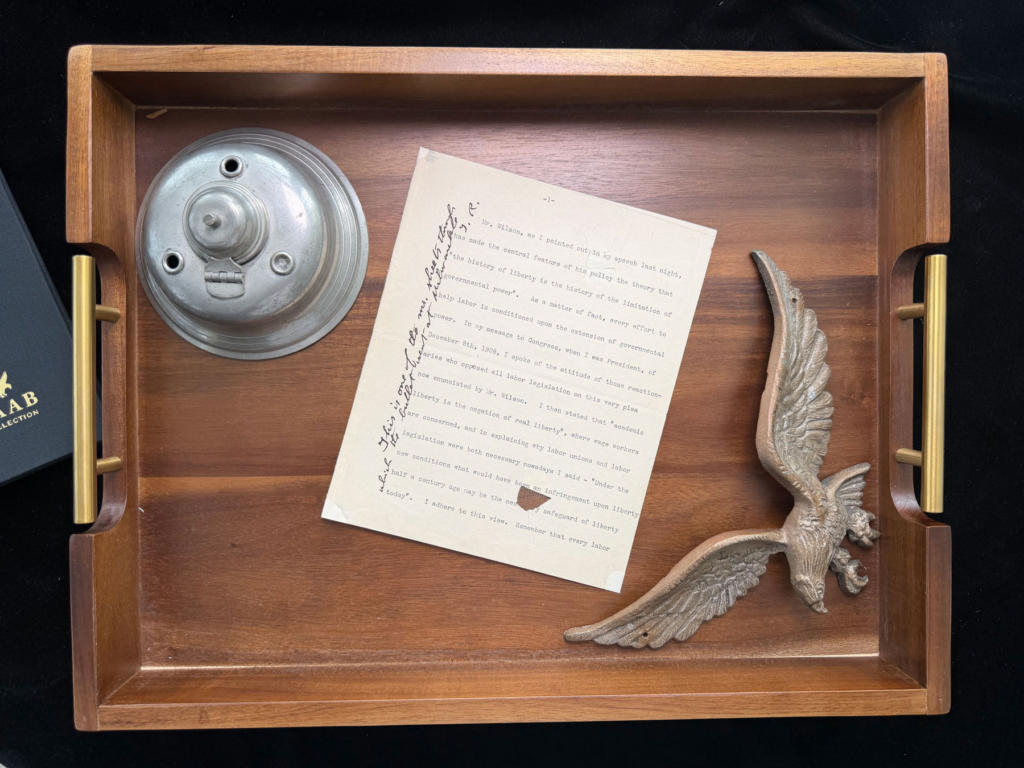

Marked "Page 1" of the speech that saved his life, the only example known to contain his handwriting on it, not known to have survived and never before offered for sale
In a private collection since shortly after the assassination attempt itself
Public records show that leaves of this speech have only reached the market 2 other times, and none have Roosevelt’s handwritten identification on them
Listen to the Inspired by History podcast
On September 5, 1901, President...


In a private collection since shortly after the assassination attempt itself
Public records show that leaves of this speech have only reached the market 2 other times, and none have Roosevelt’s handwritten identification on them
Listen to the Inspired by History podcast
On September 5, 1901, President William McKinley delivered a speech at the Pan-American Exposition in Buffalo, New York. Also in attendance that day was Leon Czolgosz. The following day the President was shot and by Czolgosz and he died a week later. McKinley’s assassination made Theodore Roosevelt president. Eleven years later, Roosevelt, now running as the Progressive Party candidate for the presidency, was the victim of the same act of violence.
John Schrank was born in Bavaria and emigrated to America at the age of 13. His parents died soon after and Schrank came to work for his uncle, a New York tavern owner and landlord. Later, he drifted around the East Coast, becoming profoundly religious and a Bible preacher whose debating skills were well-known around his neighborhood’s watering holes and public parks. He spent a great deal of time walking around city streets at night.
On October 14, 1912, Roosevelt arrived in Milwaukee at the end of a campaign visit to the area. Schrank stood toward the head of a crowd waving to him as he attempted to enter his car, shooting him at close range. Schrank, claiming to have been motivated to kill by the ghost of assassinated President McKinley, said he wanted to dissuade future third term hopefuls. He wounded Roosevelt, who was saved only by a folded 60-plus page speech that was tucked inside his vest pocket, as well as a metal spectacle case, both of which slowed and deflected the bullet away from sensitive chest areas and the heart.
Roosevelt went on to make a moving and significant campaign speech, though not the one he had prepared and was carrying. Speaking extemporaneously, he quieted the crowd by reminding them that it was hard to speak given that he had just been shot. He started by addressing his being shot: “First of all, I want to say this about myself: I have altogether too important things to think of to feel any concern over my own death…I am telling you the literal truth when I say that my concern is for many other things…I am not thinking of my life or of anything connected with me personally. I am thinking of the movement.” He continued about his cause: “ I am in this cause with my whole heart and soul. I believe that the Progressive movement is making life a little easier for all our people; a movement to try to take the burdens off the men and especially the women and children of this country. I am absorbed in the success of that movement.” He made light of the wound, using a term associated with the Progressive Party: “It takes more than that to kill a Bull Moose.” He pleaded for honesty in government: “I cannot tell you of what infinitesimal importance I regard this incident as compared with the great issues at stake in this campaign, and I ask it not for my sake, not the least in the world, but for the sake of common country.” He ended with a call for “social and industrial justice.” And all this time, he held the speech that had helped save his life. However, as brave as he was, his campaign was finished and he was hospitalized in Chicago for 8 days.
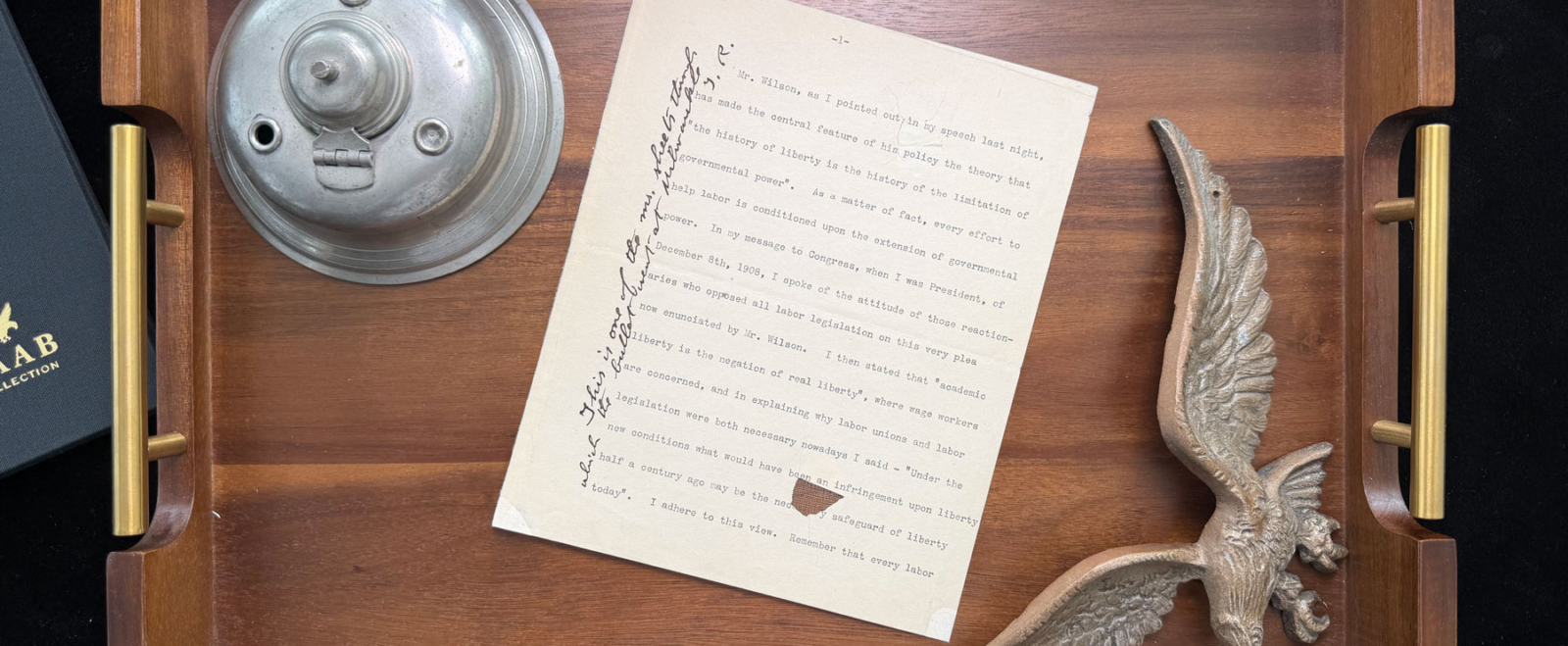
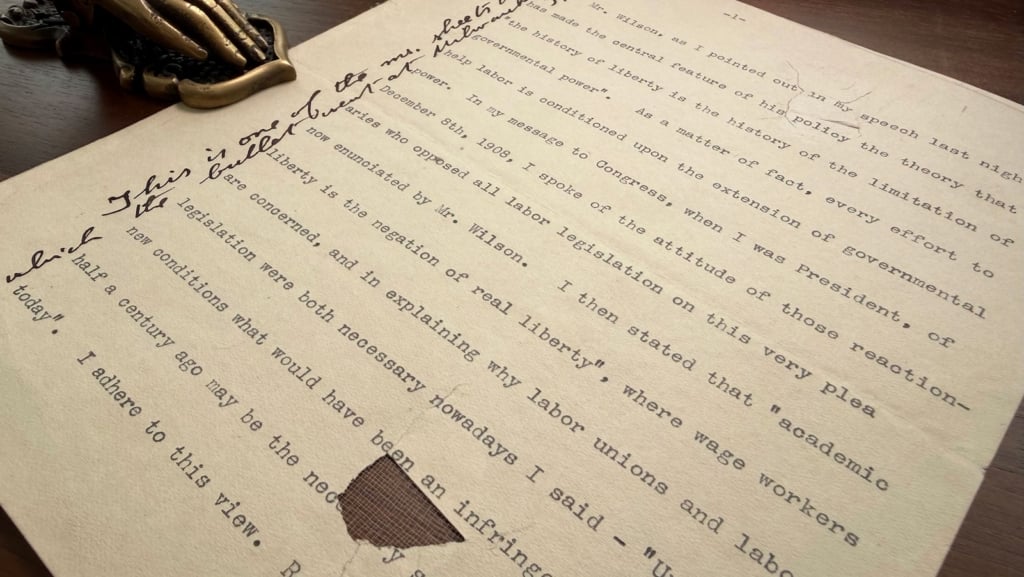
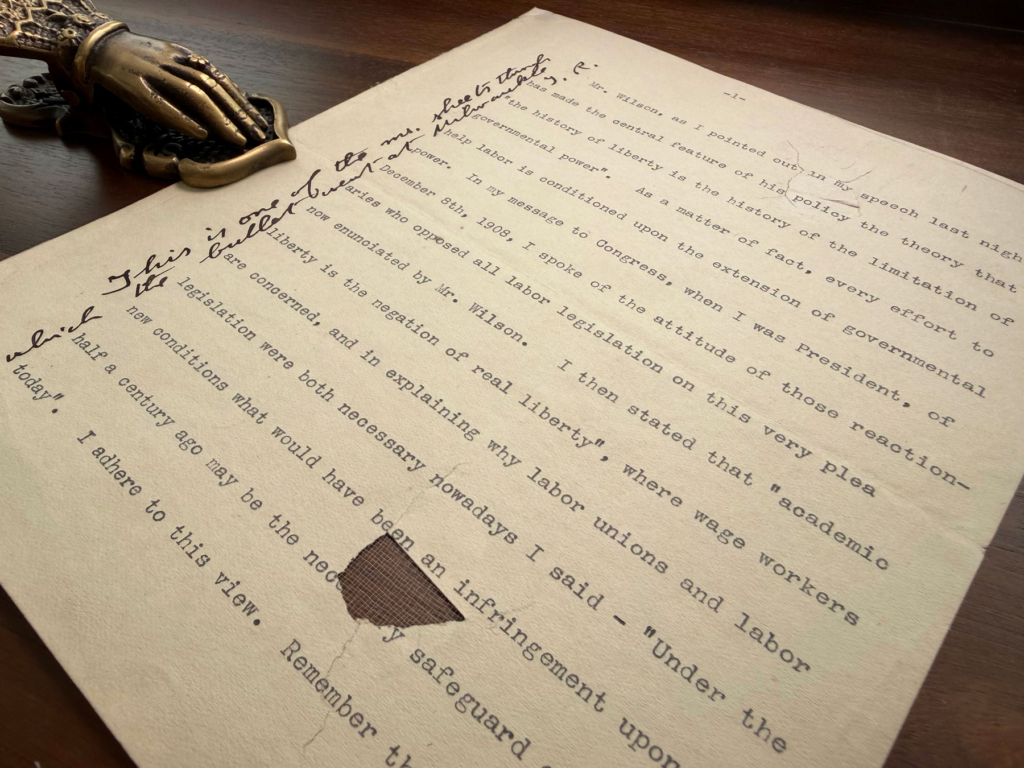
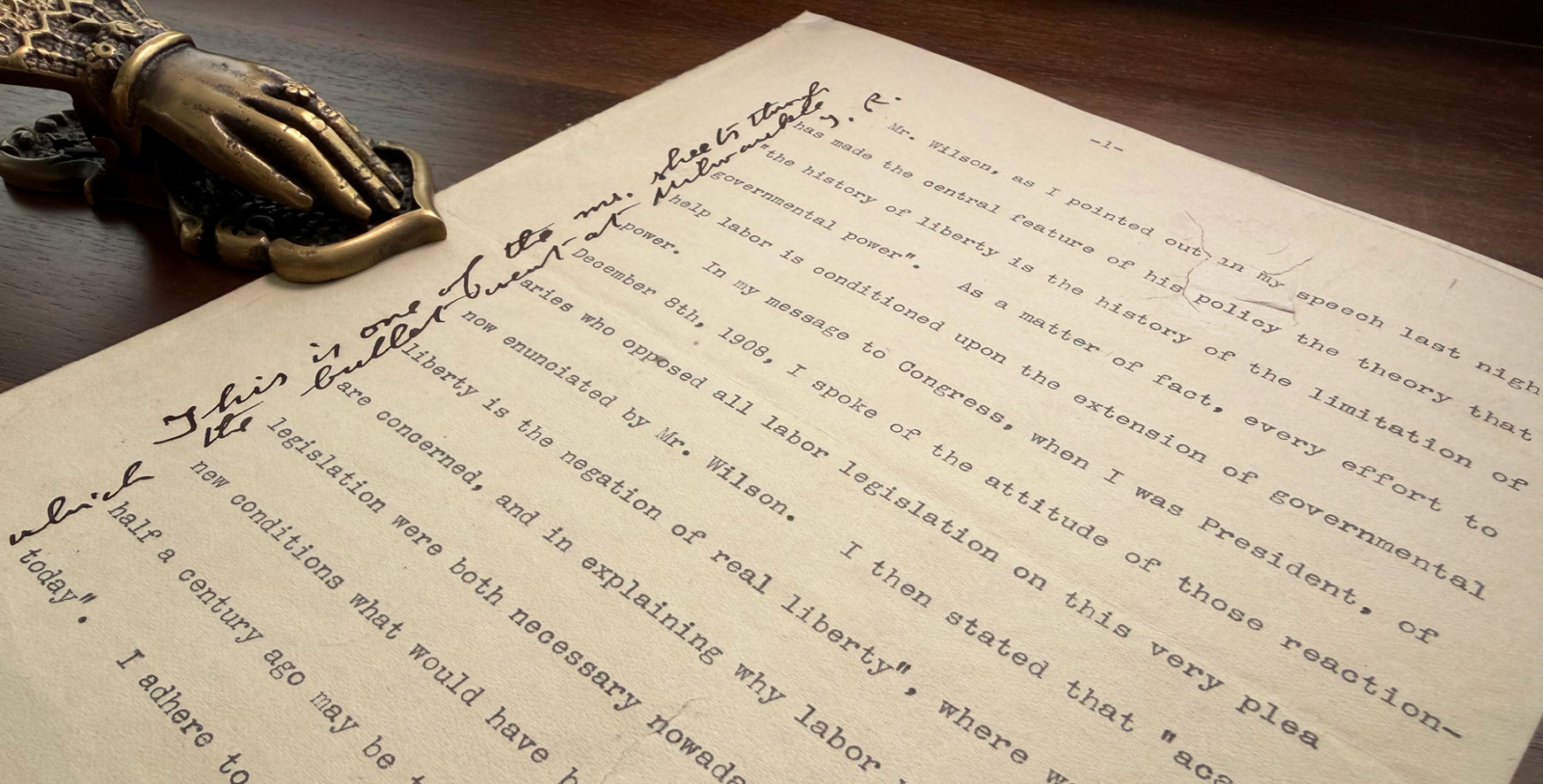
Autograph document signed being the marked page “1” of the typed speech that Roosevelt carried in his pocket in Milwaukee on October 14, 1912, originally folded once horizontally. In TR’s hand: “This is one of the manuscript sheets through which the bullet went at Milwaukee. TR”
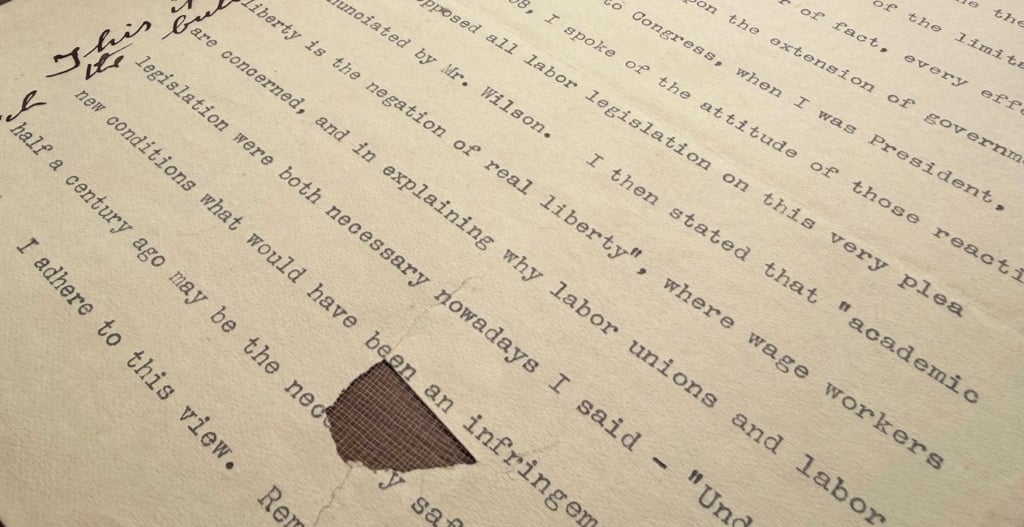
The sheet exhibits two bullet holes – one at the top and one at the bottom. The page reads, “Mr. Wilson, as I pointed out in my speech last night, has made the central feature of his policy the theory that “the history of liberty is the history of the limitation of governmental power”. As a matter of fact, every effort to help labor is conditioned upon the extension of governmental power. In my message to Congress, when I was President, of December 8th, 1908, I spoke of the attitude of those reactionaries who opposed all labor legislation on this very plea now enunciated by Mr. Wilson. I then stated that “academic liberty is the negation of real liberty”, where wage workers are concerned, and in explaining why labor unions and labor legislation were both necessary nowadays I said – “Under the new conditions what would have been an infringement upon liberty half a century ago may be the necessary safeguard of liberty today”. I adhere to this view. Remember that every labor…” Silking on verso.
Public records disclose no other leaf from this historic speech having sold bearing any markings of Roosevelt himself. Indeed they disclose only two other sales of these treasured pages going back to 1975. The most recent, which originally sold with Raab decades ago, sold at public sale in 2022 for $106,000. That contained only a notation on the verso from a campaign aide. This is marked page 1, perhaps of a section of the speech. The final delivered speech varies differs greatly from the prepared remarks. Other pages that come up for sale carried later page numbers.
This is the finest example imaginable: notated and signed by Roosevelt himself, never having reached the market.

Frame, Display, Preserve
Each frame is custom constructed, using only proper museum archival materials. This includes:The finest frames, tailored to match the document you have chosen. These can period style, antiqued, gilded, wood, etc. Fabric mats, including silk and satin, as well as museum mat board with hand painted bevels. Attachment of the document to the matting to ensure its protection. This "hinging" is done according to archival standards. Protective "glass," or Tru Vue Optium Acrylic glazing, which is shatter resistant, 99% UV protective, and anti-reflective. You benefit from our decades of experience in designing and creating beautiful, compelling, and protective framed historical documents.
Learn more about our Framing Services