



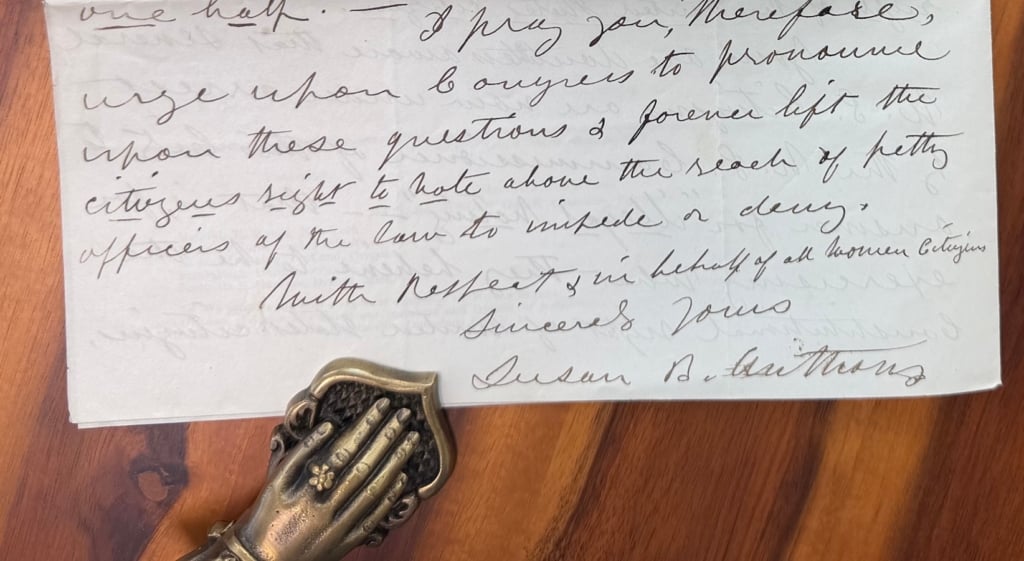


Previously unpublished and unknown to scholars, Susan B. Anthony’s original handwritten plea to President Grant on “behalf of all Women Citizens” is a discovery that not only adds to the historical record, but also manifests suffragist sentiments regarding unmet Revolutionary-era promises of representation and citizenship.
Nathan Raab was interviewed on the Inspired by History podcast about this remarkable letter. Listen to the interview below or via your podcast player of choice. Or, if you prefer, read this lightly edited transcript of the conversation with photos and embedded links to more resources.
Today we’re talking about a newly discovered letter written by Susan B. Anthony only one week after she was arrested for illegally voting in the 1872 election. Not only that, but this letter is addressed to President Ulysses S. Grant, and she does not hold back. Her letter is full of rhetorical fire, offering almost a real-time look at her thoughts and feelings at an incredible moment in history: scary, exciting, I don’t know what. Nate, what were your thoughts when you first read it, and how did it come to you?
Natthan: My thoughts when I first read it were, “This is incredible. I mean, this is the best Susan B. Anthony letter I’ve ever seen, for sale or otherwise.” It’s full of personality. It’s full of defiance. It’s full of anger and frustration. One can imagine the environment in which she wrote this, when she had just been arrested, when her companions in the struggle for the right to vote, the right for equal citizenship, were sitting in a prison cell, and that their efforts to act as American citizens, a right that we take for granted today and that women take for granted – that my daughter will be able to, and that my wife has today, and that you have today – a right that we take for granted, was being not only actively denied to them, but their efforts to exercise it were being punished with prison time as if the right to act as a citizen were itself a crime.
I approach everything that we first see with some amount of skepticism. Is this real? Is this authentic? Is it a copy? And when you get something like this, which is a true American treasure, you have an obligation as the seller and the expert to raise that antenna even higher. To make a bold claim is to put yourself out there, and so my first reaction, which is, in a sense the most telling one, was, “I can’t believe this exists. Who even knew?”
How did it come to us? This was a wedding gift from a husband to a wife more than 50 years ago. The husband and the wife have since got divorced, but she kept this powerful letter, this marriage gift, and the time came for her to find it a new home. And when she did, we were there. We recognized the importance of it immediately and made a strong offer to be able to acquire it.
What a cool gift.
Nathan: Yeah, right. Can you imagine? I mean, it’s a thoughtful gift, you know? The reality is most people don’t even know that you can buy these things, but obviously this man wandered into the right shop at the right time and saw this. It’s remarkable.
The content of the letter is pretty amazing. Anthony is very pointed with the President about her conviction that voting is fundamental to citizenship. If she’s a citizen, then she should be able to vote. To her, it was very clear. Do any of her phrases or arguments stand out to you?
Nathan: Well, first let’s look at the way she writes letters. She has this habit, which I’ve seen elsewhere employed, but never so much and so defiantly as in this letter, of underlining important phrases, where she’s trying to make a really strong point to the reader. First of all, she underlines and puts in quotation marks, “illegal voting.” She clearly feels that it wasn’t illegal. She feels that she is acting in compliance with the Constitution, and that the laws are unjust, that the Constitution guaranteed her the right to vote, and that when she did that, she was simply exercising her rights, as she writes and underlines, “fundamental rights of the United States citizen.”
One of the pieces that really stuck out to me was drawing the distinction between being an American citizen and being a British citizen. She writes and underlines, “If to be a citizen is not to be a voter – then what better is a citizen of the U.S than a subject of the British Empire…”
She is drawing a distinction between the progress that the United States had made, which is entrenched in the Declaration of Independence, “We hold these truths to be self-evident, that all men are created equal.” Men, in her reading, meaning human. That the progress that we had made as a country in expanding rights and protecting them were in fact being undermined by the denial of the right of women to vote and act as equal citizens. And in fact, what good was it? Why should we have revolted against the evil King George III when really we’re no better than them?
She goes on to write, “If I am a citizen – I have full and free right of suffrage – If our government is a true republican form…” Again, she’s making a distinction between the royalty, a monarchy, and the American Republic.
She’s writing to President Grant, who I think she thinks of as close to an ally in this cause as any President could be at this time, and she’s saying, “You’re the President of these, these United States. Let’s act like the United States and not the monarchy, not the British Empire.”
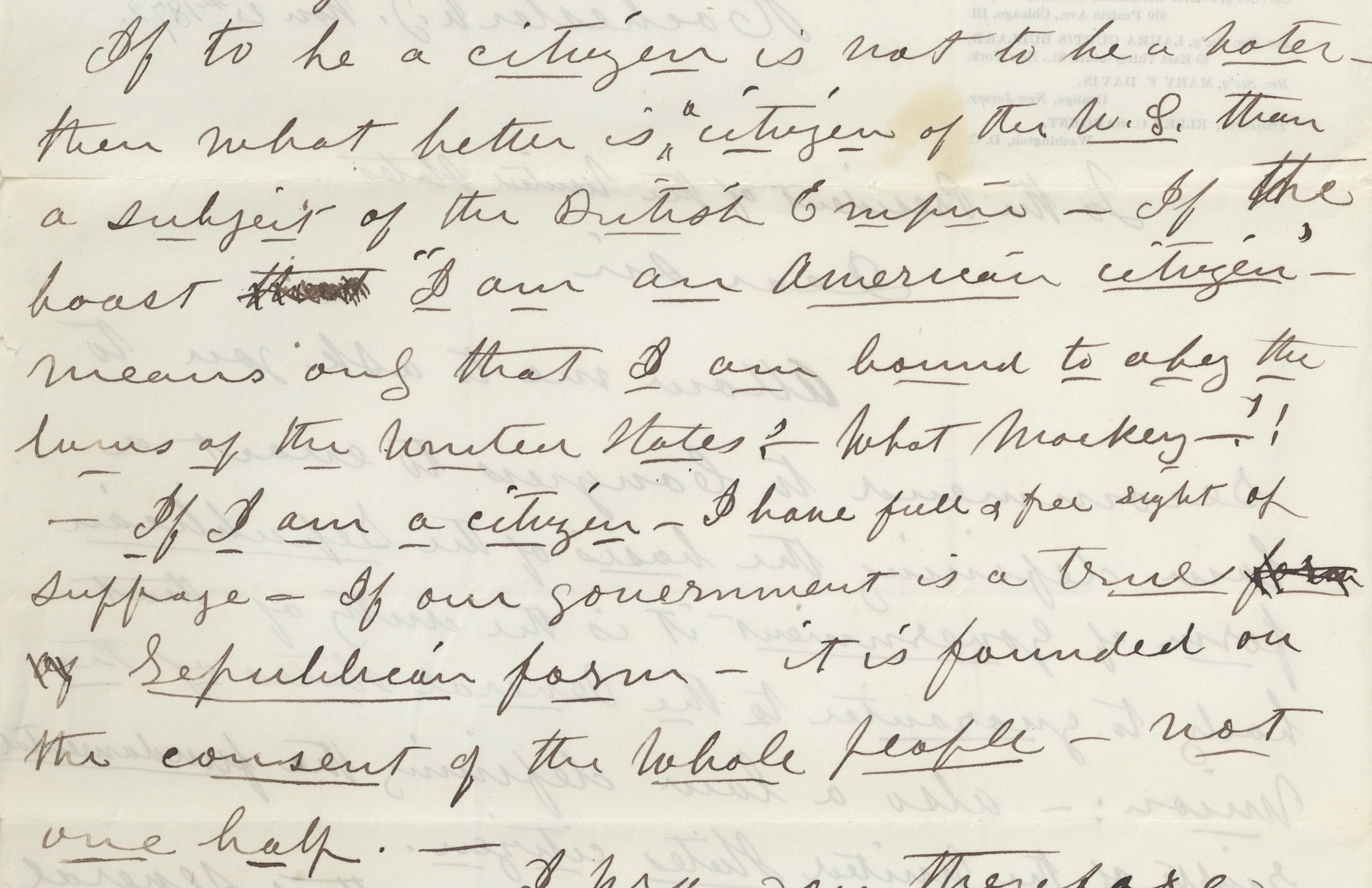
That was actually the exact quote I was going to read, because I thought it was really interesting that she’s 100 years away from the Revolution and making that comparison.
Nathan: I think the intent of the comparison goes to the heart of … I mean, what is it that differentiates a republic from a monarchy? It’s a popularly derived Constitution subject to amendment, voting of the people, and representation. It’s a government of laws by the people, for the people, as so famously put by Lincoln. And the government is not currently acting this way. I think that this was a letter designed for an audience of one.
The indignation that you feel in the letter, like, what good is this? What are we doing here? Like, why are we going through these, jumping through these hoops and putting on the facade of a republican form of government when in fact we’re not one? Or, another way to look at it is, she’s really summoning us to be our best selves, to live up to the ideals that were set forth in the Declaration, and that we purport to hold dear, and you can’t do that when only half of the country is represented, which wasn’t a universally held position.
She definitely feels like she’s arguing. The end of the letter, “With respect and on behalf of all Women Citizens,” is how she signs the letter. I definitely get the feeling that she feels like she’s carrying the flag for, statistically, more than half the country.

As far as you have determined, the letter was not sent to Grant, and so has escaped the historical record until now. Describe that research process.
Nathan: Well, there’s no record of this letter in any publications that I was able to find. There’s no reference to it in any of the Susan B. Anthony papers. Doesn’t appear in the Papers of Ulysses S. Grant as a received letter. And so you contact the relevant scholars involved that would know, that would be able to point you in the right direction.
Of course, you can’t say with certainty. Could Grant have received this letter, made no note of it, done nothing about it, filed it away only to have it lost before it’s recorded by history? Could Anthony have not publicized that she sent this letter, not told anyone else, not made reference to it in any kind of ledger? Could both of those things happen at the same time? I can’t say it couldn’t have. I can say that’s not the most likely set of events. The most likely set of events is that she wrote this letter, and the letter kind of feels a little bit like, there’s a couple cross-outs — which isn’t necessarily proof that it would’ve been a draft, but in conjunction with its lack of appearance elsewhere, it might point to that.
I imagine that Anthony wrote this letter as an emotional plea to the President in a moment of emotion, and perhaps thought, “This is the right message, but I need to think about the best way to do this.” What you see over the course of the next few months are petitions written to Grant on behalf of the women, which are signed by multiple women, but it’s possible that they made a decision collectively to approach this in a more coordinated fashion.
And it could just be that she felt, “Hey, I need to take a deep breath.” But what you’re getting in this letter is Anthony’s unfiltered thoughts, feelings, wishes in the face of one of the more challenging moments in her life, and certainly a setback in the fight for women to vote legally. I should say legally because they did vote. It’s just their votes didn’t count, and they were arrested for it. But this is obviously a very important moment in the suffragette movement, and you can feel that in this letter.
I was going to ask if you had any theories about why it went unsent, and wondering if, like you just said, maybe a lawyer or her sister or somebody said, “Wow, this is strong language. Maybe not this, maybe something else.”
Nathan: I don’t know the answer to that. It’s not a known episode. I think this will be something that historians can discuss and debate. I see our role as finding these important pieces of history, and, of course, I can speculate, but ultimately, the only people who know the answer to this question have long since died. I think what you’re getting from this, what I take away from a much bigger picture, are two main things. First of all, if this isn’t evidence that history is yet to be discovered, I don’t know what is. This is a perfect example or demonstration of hidden history coming to light and adding to the historical record in a material way.
This is a perfect example or demonstration of hidden history coming to light and adding to the historical record in a material way.
And it’s also, reading the letter, you can’t ignore the obvious fact that these events that we read about dispassionately in books are really emotional, powerful moments for the people who are living through them. This is Susan B. Anthony writing to the President of the United States using language that we can charitably call impassioned.
I often say that, for us, the people that buy these artifacts, these pieces of history, the collectors that get to experience them and live through the lives of these great figures, this is an emotional journey, and that emotion is sort of the core of that journey. But it’s a reminder that for the people living through them, it’s also an emotional journey, and we get to share in that.
So some lucky person’s going to be able to read this letter, put this letter on his or her wall, and live, even if just for a moment while reading the letter, through Susan B. Anthony’s diligent, impassioned, defiant words to the President.
To learn more about these two very important figures in American history, visit our dedicated Susan B. Anthony and Ulysses S. Grant pages.
More episodes of Inspired by History are available here, or on your podcast player of choice. Of particular interest may be this episode on women’s history, featuring a document signed by both Susan B. Anthony and Elizabeth Cady Stanton at the dawn of the women’s rights movement: “How Susan B. Anthony and Elizabeth Cady Stanton Paved the Way For Women’s Suffrage.”