






Albert Einstein, Reaffirming E=MC2, Does Not Think the Radiation Must Power This Process and Is Skeptical that Radium Breakdown is the Source of Power of the Sun and Stars
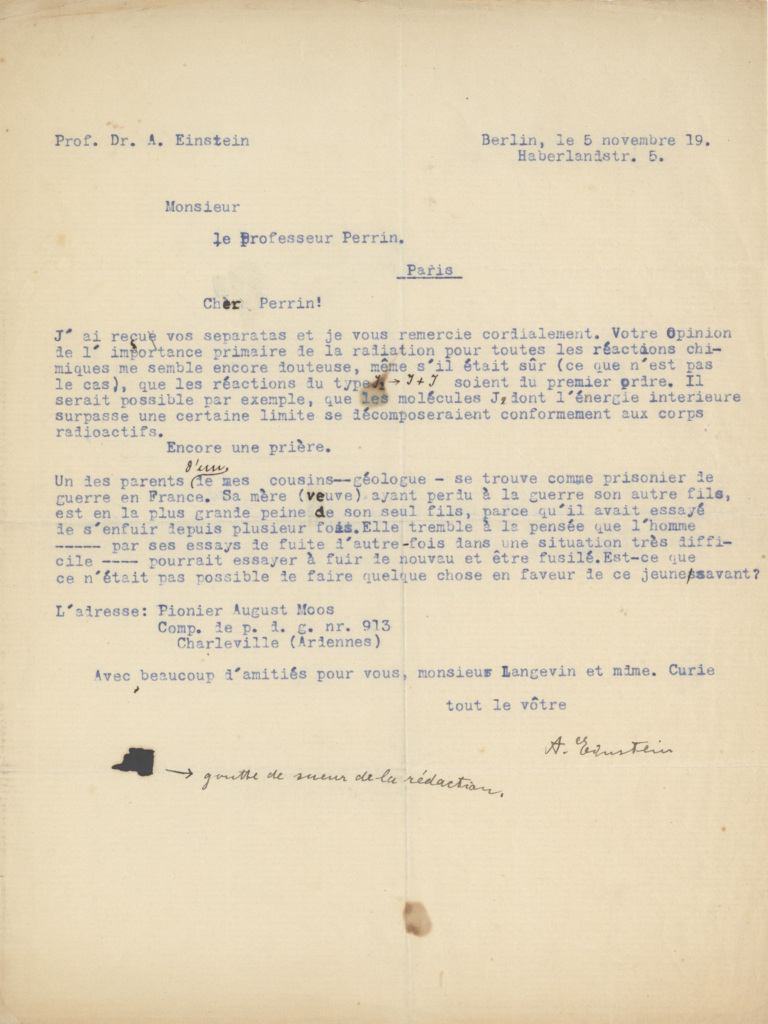

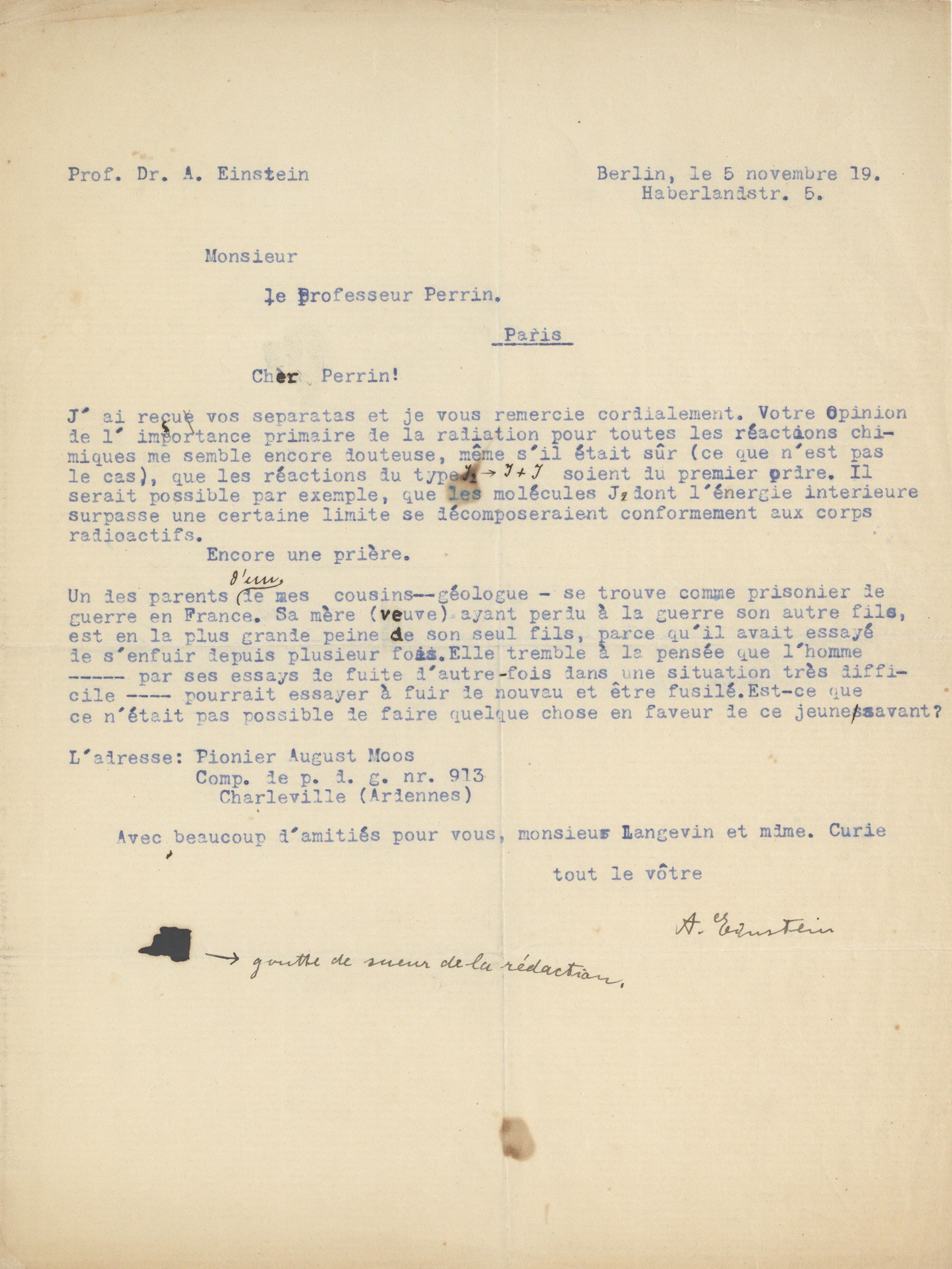
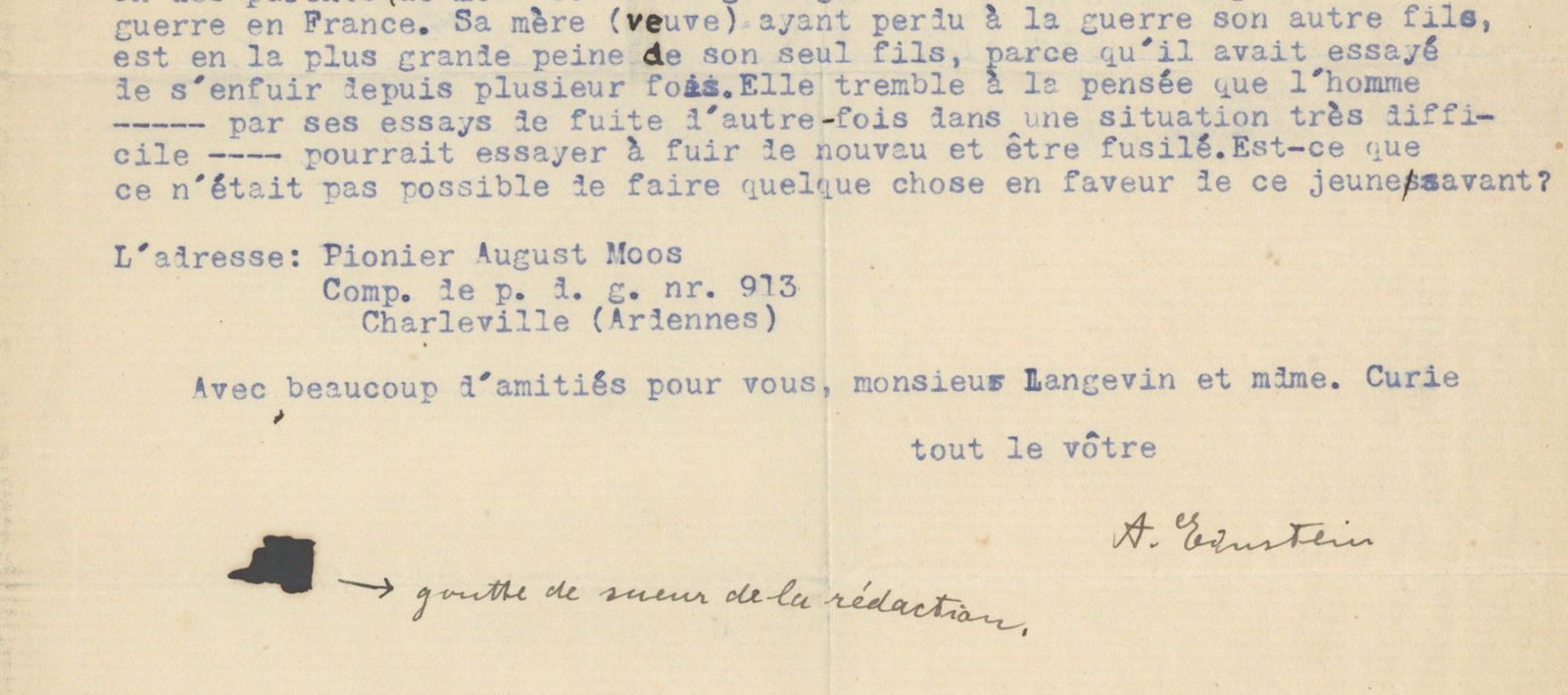
Einstein writes the chemical equation for the breakdown of molecules into atoms in his own hand, the source of energy in E=MC2
- Currency:
- USD
- GBP
- JPY
- EUR
- CNY
 This currency selector is for viewing only.
The Raab Collection only accepts USD payments at checkout.
Exchange rates are updated hourly. Rates may be inaccurate.

A remarkable letter before his great fame, referencing and shown to Marie Curie
Einstein, who helped free so many from the jaws of Nazism, makes an impassioned plea for a World War I German POW in France, who would escape but later die in the Holocaust
In 1905, while a young...


A remarkable letter before his great fame, referencing and shown to Marie Curie
Einstein, who helped free so many from the jaws of Nazism, makes an impassioned plea for a World War I German POW in France, who would escape but later die in the Holocaust
In 1905, while a young patent clerk and physicist in Bern, Switzerland, Albert Einstein obtained his doctorate and published a paper that explained his newly developed Special Theory of Relativity. This unlocked many mysteries of the universe, and introduced the world to the idea equating mass and the speed of light with energy, which we know today as e=mc2. Einstein’s insight, and one element that distanced his work from that of Newton, was to recognize that mc2 was the proper energy of mass, the energy associated with that mass, and was independent of its motion. Mass must be measured in this way as resting mass. This was a foundation of e=mc2. The breakdown of molecules therefore released energy. This energy is often used by cells to perform work, such as powering movement.
In the early years of the 20th century, thanks to the development of mass spectrographs, science had acquired the capacity to “weigh” atoms with extreme precision. Indeed, Einstein provided the theoretical explanation for Brownian motion, while French Chemist Perrin experimentally verified Einstein’s theory, solidifying the evidence for the existence of atoms.
Scientists, among them Perrin, noted that when comparing the mass of a helium nuclei to that of the four elementary nuclei it was made of, there was a slight discrepancy—one helium atom was slightly lighter than four hydrogen atoms; in other words the whole was smaller than the sum of the parts. Where did the missing mass go? Einstein knew the answer: in accordance with his famous E=mc² equation, a tiny fraction of the mass had been transformed into a formidable quantity of energy.
The French mathematician Paul Langevin understood the formidable source of energy that resulted from these “transmutations.” But it was Jean Perrin, a professor of physical chemistry in Paris, who first proposed in 1919 that the fusion of hydrogen into helium was the energy source of the Sun and stars, accounting for the billions of years of sunshine past and the billions of years to come.
During this time, radiation studies too were in their infancy. Marie Curie famously decided to do her thesis on radiation, recently discovered in uranium by Henri Becquerel. She found that an ore containing uranium was far more radioactive than could be explained by its uranium content. This led her and her husband, Pierre, to the discovery of a new element that was 400 times more radioactive than uranium. In 1898 it was added to the Periodic Table as polonium, named after Curie’s birth country.
Then Curie discovered an even more radioactive element, radium, and, through observation of radium, made a fundamental discovery: Radiation wasn’t dependent on the organisation of atoms at the molecular level; something was happening inside the atom itself. The atom was not, as scientists believed at the time, inert, indivisible, or even solid.
This discovery led to an overlapping one: At the time, people did not know what powered the Sun. Many however thought it was Radium. Perrin was one of those who believed this. His hypothesis, borrowing from E=MC2, was that radiation, in the form of Radium, was emanating from bodies like earth, causing the breakdown of molecules on the Sun, and that the breakdown was powering the Sun and other stars. In 1919, Perrin sent to Einstein his new publication proposing this theory.
Einstein’s response notes the breakdown of molecules and the released energy can likely be accomplished by other means than radiation. He uses the mathematical equation for the breakdown of one molecule into atoms. He references a first order reaction, a chemical reaction where the rate of the reaction is directly proportional to the concentration of only one reactant. In simpler terms, if you double the concentration of that reactant, you double the reaction rate. A common example is radioactive decay.
And he gives his best to the Madame Curie. Einstein had last met in Paris with Perrin, Pierre Langevin, Professor of Experimental Physics at the Collège de France, and Curie, then Professor of Physics at the Sorbonne, on the occasion of Einstein’s lecture to the French Physical Society in late March 1913. They first met at the Solvay Congress in Brussels in autumn 1911.
At the same time, Einstein, who helped so many Jews escape Germany during World War II, had a distant cousin, the geologist August Moos, who had volunteered in the German infantry at the start of the First World War in 1914. After being taken prisoner in 1915, he made several attempts to escape which resulted in a sentence that prevented his release after the armistice of 1918. His mother asked for help from Einstein, who turned to his friend Perrin, as well as mathematician and statesman Paul Painlevé, asking them to intercede. Moos was finally released in February 1920. He would work as an oil geologist in the interwar period, before being tragically arrested due to his Jewish heritage under the Nazi regime. Moos would die in the Buchenwald concentration camp during World War II.
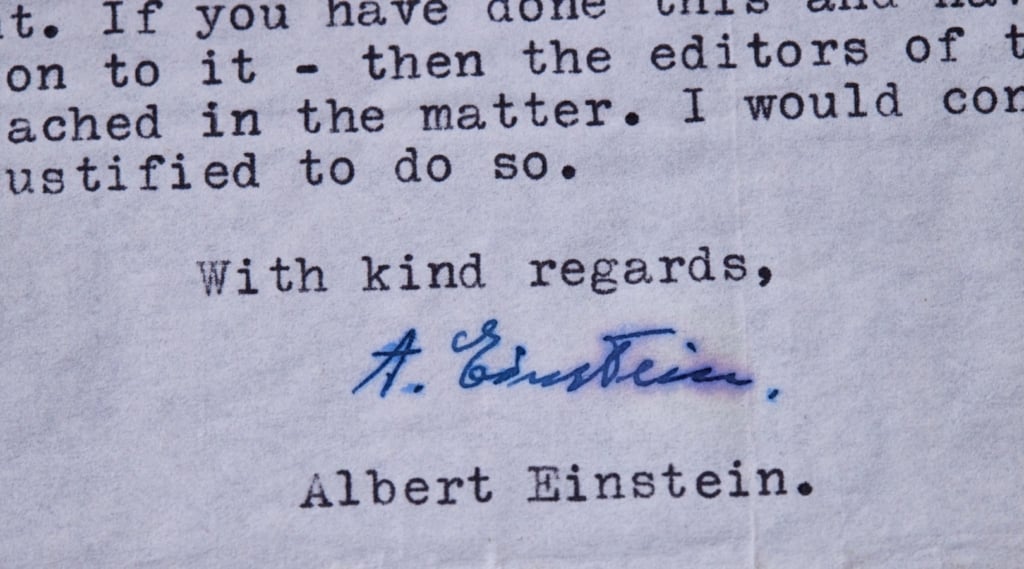
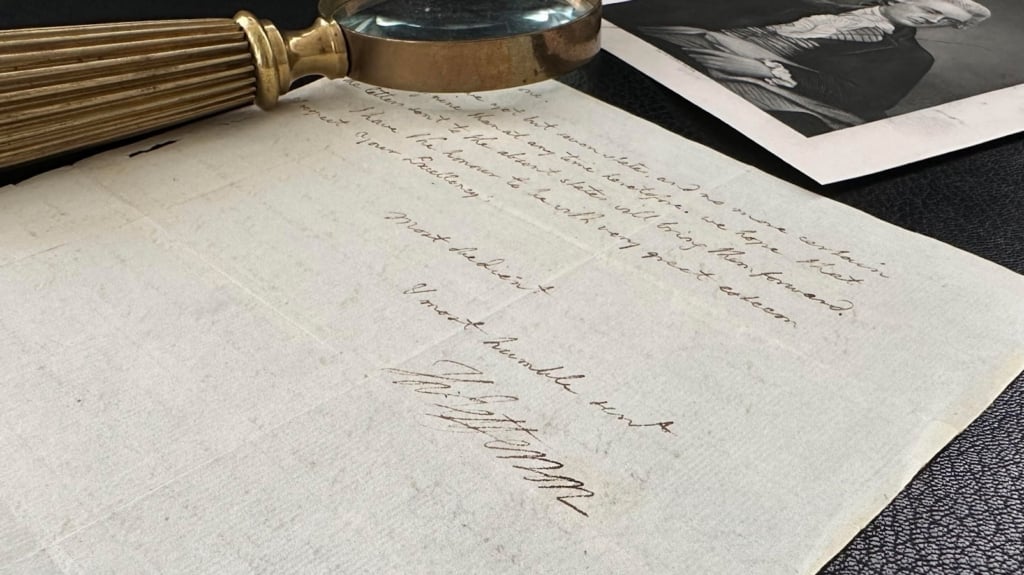
Typed letter signed, in French, signed “A. Einstein”, November 5, 1919, to Professor Jean Baptiste Perrin, who would go on to win the Nobel Prize for Physics in 1926 for his work on the atomic structure of matter. “Dear Perrin! I received your publications and thank you cordially. Your opinion of the primary importance of radiation for all chemical reactions still seems to me dubious, even if it was certain (which it is not) that reactions of the type J² – J+J [added by hand] are of the first order. It would be possible, for example, that J² molecules whose internal energy exceeds a certain limit would decompose in accordance with radioactive bodies.
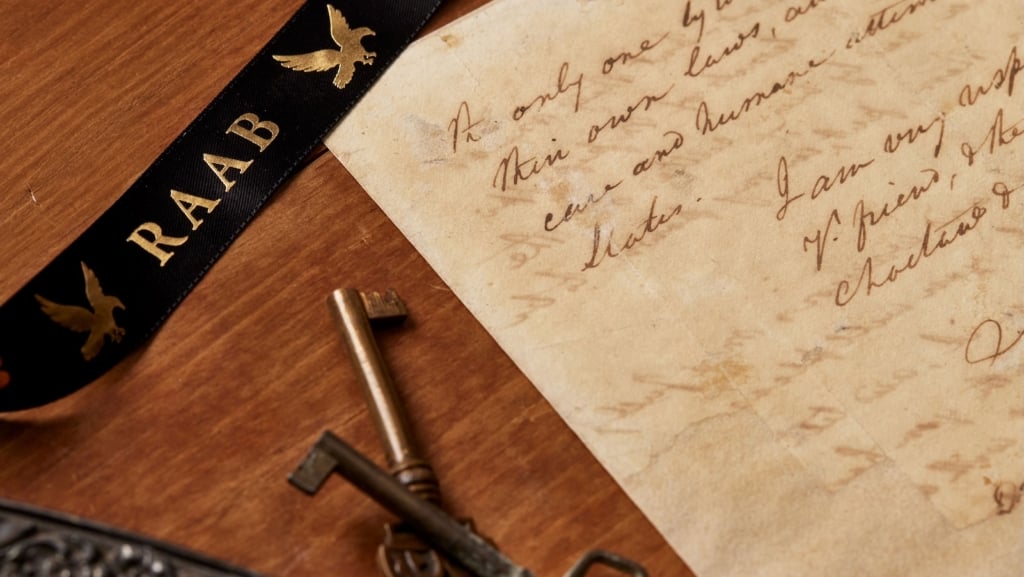
“One more prayer. One of the parents of one of my cousins—a geologist—is a prisoner of war in France. His (widowed) mother, having lost her other son in the war, is in the greatest pain for her only son, since he had tried to flee several times. She shudders at the thought that the man—through his old efforts to flee in a very difficult situation—might try to flee again and be shot. Wouldn’t it be possible to do something for this young scholar?” He goes on to give the address of August Moos, held in Charleville, Ardennes, and concludes by offering his “many friendships for you, Mr. Langevin and Madame Curie.” Below, he notes an ink spill, draws an arrow and writes, “drop of editorial sweat from editing.”
Perrin responded the very same day, confirming that he believed rays from Earth were breaking down molecules in the sun and that he assumed the first order nature of the reaction. In other words, he did not agree with Einstein that radiation was not breaking down molecules, releasing energy, and powering the sun. “I do indeed believe that I2 (Einstein used J but Perrin used I) decomposes like radioactive bodies (and I devoted a chapter of my work to this) but precisely on the conviction that radioactive bodies like I2 are decomposed by light (for radium, ultra-short X rays emanating from the Earth at λ = 10–11) (light which suddenly increases the internal energy). I read your letters to Mrs. Curie and to Langevin. They too send you their very best regards.” Perrin and [?]
In addition to this important family and political content, Einstein comments on a theory that Perrin had developed in which all chemical transformations (including radioactive decay) are triggered by radiation, calling it “dubious.” Also significant is the date: one day before the official report of Eddington’s expedition debuted before the Royal Society of London, confirming Einstein’s theory of general relativity. Widespread newspaper coverage of the results vaulted Einstein into immediate international fame. An altogether remarkable letter from one Nobel Prize winner to another, shown to yet a third, and using the chemical equation for the breakdown of molecules into atoms in his own hand.

Frame, Display, Preserve
Each frame is custom constructed, using only proper museum archival materials. This includes:The finest frames, tailored to match the document you have chosen. These can period style, antiqued, gilded, wood, etc. Fabric mats, including silk and satin, as well as museum mat board with hand painted bevels. Attachment of the document to the matting to ensure its protection. This "hinging" is done according to archival standards. Protective "glass," or Tru Vue Optium Acrylic glazing, which is shatter resistant, 99% UV protective, and anti-reflective. You benefit from our decades of experience in designing and creating beautiful, compelling, and protective framed historical documents.
Learn more about our Framing Services