







The Original Resolution of John Hancock and the Continental Congress Directing Benjamin Franklin to Draw Spain Into the Revolutionary War in 1776

"Join with the United States in a war against Great Britain”
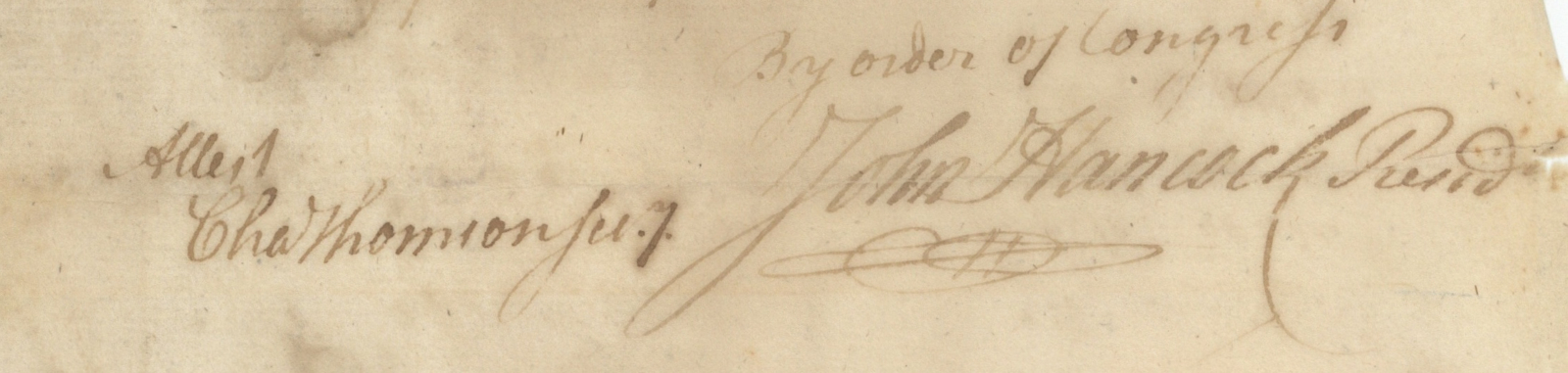
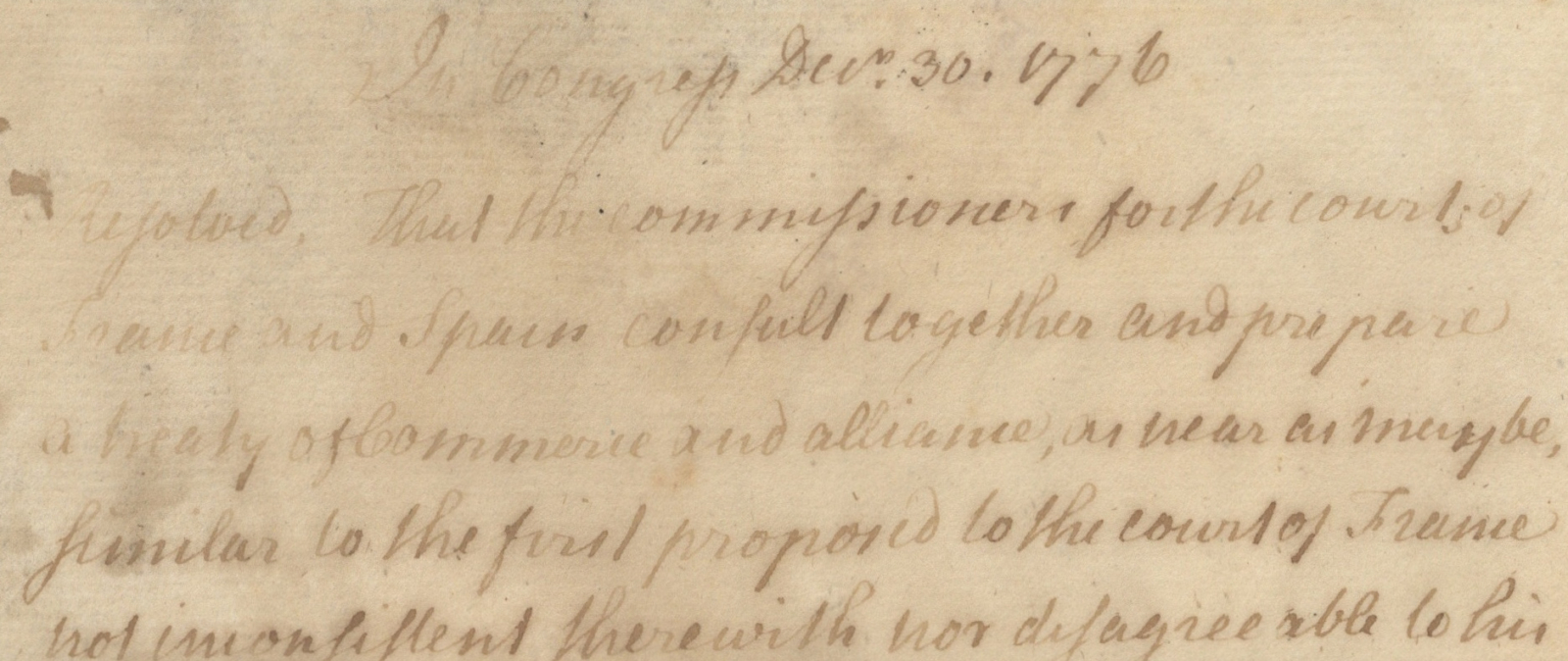
As President of Congress, Hancock instructs “the commissioners for the courts of France and Spain [both Franklin] consult together and prepare a Treaty of Commerce and Alliance…similar to the first proposed to the court of France”
A significant effort to expand the war, gain international recognition and defeat Britain
Documents...

As President of Congress, Hancock instructs “the commissioners for the courts of France and Spain [both Franklin] consult together and prepare a Treaty of Commerce and Alliance…similar to the first proposed to the court of France”
A significant effort to expand the war, gain international recognition and defeat Britain
Documents of such importance in early American history rarely reach the market, let alone one signed by a Founding Father
“The primary audience for the Declaration was the American public, but it was also meant to impress the courts of France and Spain that they could (and should) invest in the Revolution by sending money and ammunition. Congress sent Franklin across the ocean to convince the French to ally with the United States, and, as this document shows, the Spanish, too,” writes historian Robert G. Parkinson.
When news reached France of the Declaration of Independence of the thirteen colonies, it was perceived by many as the incarnation of the Enlightenment spirit against the tyranny of Britain. When Benjamin Franklin arrived in Paris as American minister to France on December 21, 1776, he found much sympathy for his cause and he himself was the “celebrated Dr. Franklin” from the beginning. The people gathered in crowds to see and acclaim him and shopkeepers rushed to their doors to catch a glimpse of him as he passed along the sidewalk. Perhaps no person in history has come to symbolize America as Franklin did in Paris. The official reaction to Franklin’s cause was, however, more restrained, as France did not wish to rush into a war with Britain or back a losing cause.
In France, Franklin acted as diplomat charged with convincing France to ally itself with America and to fund the Revolution; he was purchasing agent to acquire ships and war supplies to be sent home; head recruiter seeking experienced or promising officers for the Continental Army; loan negotiator to obtain monies the virtually bankrupt Congress; intelligence strategist handling information in the chess game between the American, French, British and Spanish governments; funds disburser for the American acquisitions effort; and generally act as the main representative of the new United States in Europe. Just two weeks after his arrival, Franklin formally requested French aid. King Louis XVI approved a response to them and on January 13, 1777 they received a verbal promise of two million livres. In March 1777, Franklin established himself at Passy, a charming village outside Paris where he remained throughout his French mission. In early June, he received the first proceeds from the French, an advance of one million livres, which they immediately deposited with a private banker that the United States used in Paris, Ferdinand Grand. This would prove a prototype, as in the future private entities would be utilized by the French government to provide clandestine aid in the way of secret arms, supplies and funds to the Americans. But for the present, the aid was meagre and halting.
The Continental Congress meanwhile worked overtime to make their struggle a European one, seeking to draw the other powers into conflict against Britain.
In 1776, Spain was almost 20 years into the reign of King Charles III, a member of the royal House of Bourbon. Charles was one of the European rulers who subscribed to Enlightened absolutism. Like Louis XVI in France and Catherine the Great in Russia, he held supreme authority but introduced some of the new ideas about society and progressive government that had emerged in recent philosophy. Like other European countries, Spain was vying for a global empire. Having allied with France in the Seven Years’ (French and Indian) War, Spain lost control of Florida but gained Louisiana in the peace settlement of 1763.
As soon as the American colonies began their rebellion, Spanish officials considered how this new war might benefit their empire. Though not formally allied, Spain determined to give the American revolutionaries its military support – including muskets and gunpowder – and also supplied the revolutionaries with significant financial aid, plus desperately needed supplies, blankets, shoes, and currency. In fact, some of the first imported weapons purchased by New Englanders came from Spain.
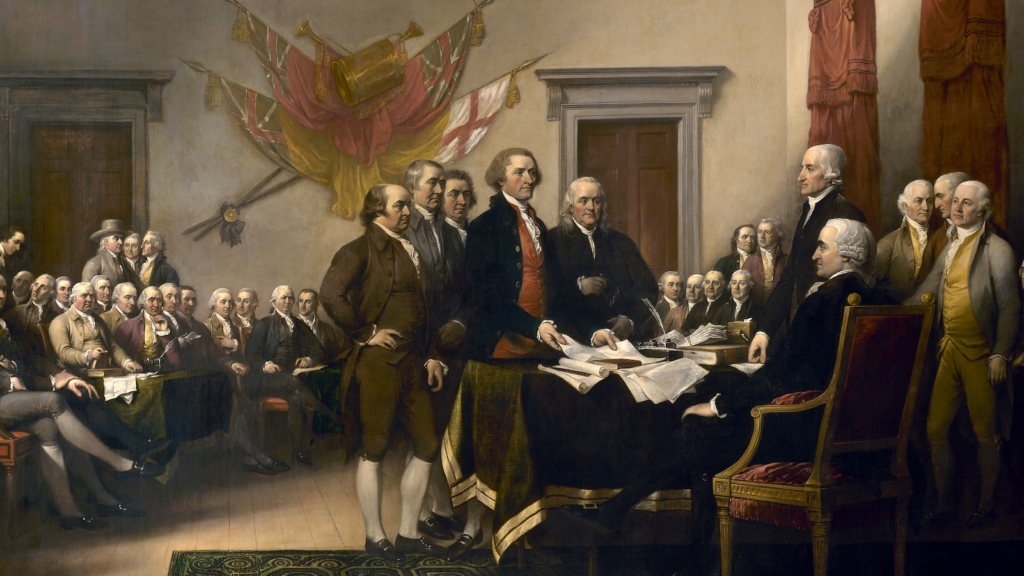
In a resolution in June 1776, the Continental Congress authorized the pursuit of foreign alliances, and a Model Treaty was drafted to seek alliances with nations. Following the formal Declaration of Independence in July 1776, Congress sent representatives to negotiate with European powers, the most important of whom was Franklin, arriving in late 1776.
On December 28 the Commissioners in France, including Franklin, wrote to Spanish Ambassador Conde de Aranda to notify him that they had been instructed to conduct preliminary efforts “to conduct friendship with the court of Spain,” such as they had done in France.
On December 30, 1776, Congress passed a resolution instructing its commissioners in Europe to prepare a treaty and seek an alliance with Spain. Such an alliance was a very high priority (ranking with the hoped-for alliance with France), and it contained an offer of military assistance: If Spain declared war on Great Britain, the United States would assist Spain in capturing the port of Pensacola and all of West Florida. In return, American inhabitants would be granted free navigation of the Mississippi River and use of the port of Pensacola. Moreover, if Spain’s foe, Portugal, had expelled or taken American ships, the Americans would declare war on Portugal as part of its treaty obligations.
In January, they sent to Benjamin Franklin his credentials as “commissioner, giving and granting to him the said Benjamin Franklin full power to communicate, treat, agree and conclude with his most Catholic Majesty the King of Spain or with such person or persons as shall by him be for that purpose authorised, of and upon a true and sincere friendship.” So now Franklin was minister of the new nation to both France and Spain. This letter included a copy of the December 30 resolution passed in Congress. This reached him in March and was presented to Spain in early April.
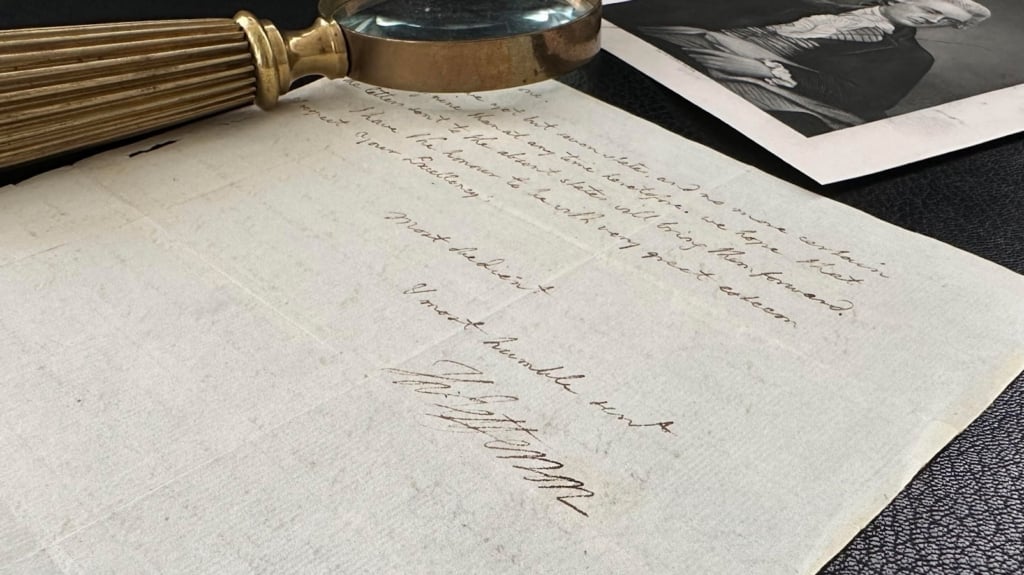
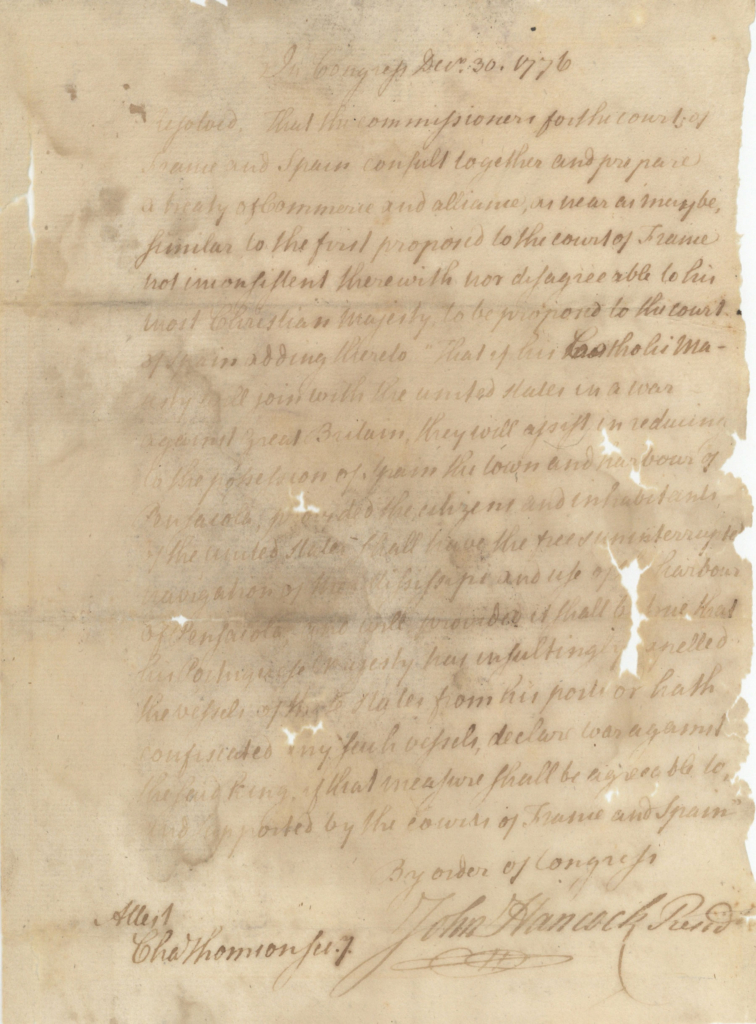
This is the original of that resolution, a copy of which was sent to Franklin and presented to Spain. He wrote to them on April 7, “I beg leave to lay before his Catholic Majesty, through the Hands of your Excellency, the Propositions contain’d in a Resolution of Congress, dated Dec. 30. 1776, viz.”
This is that very resolution.
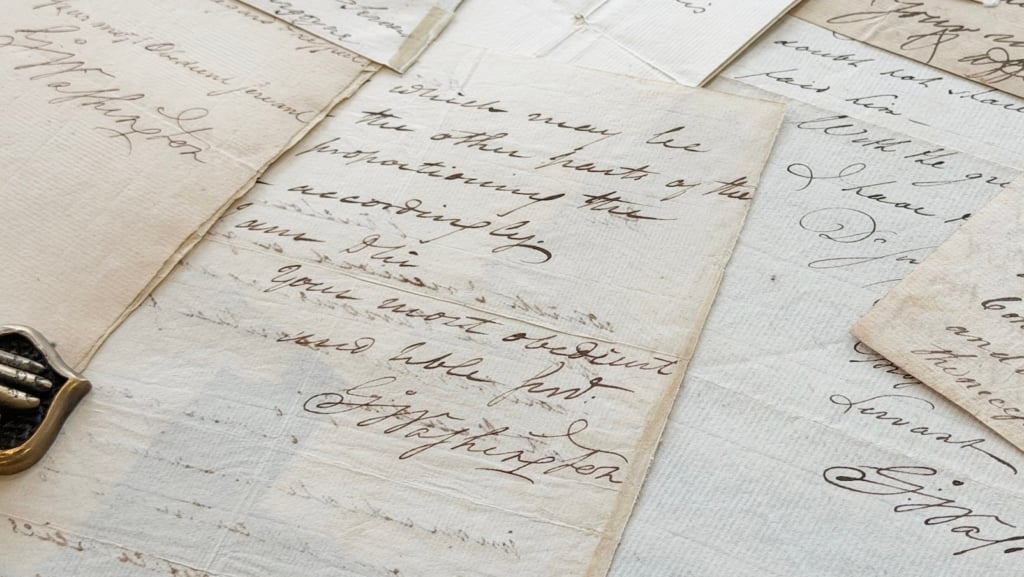
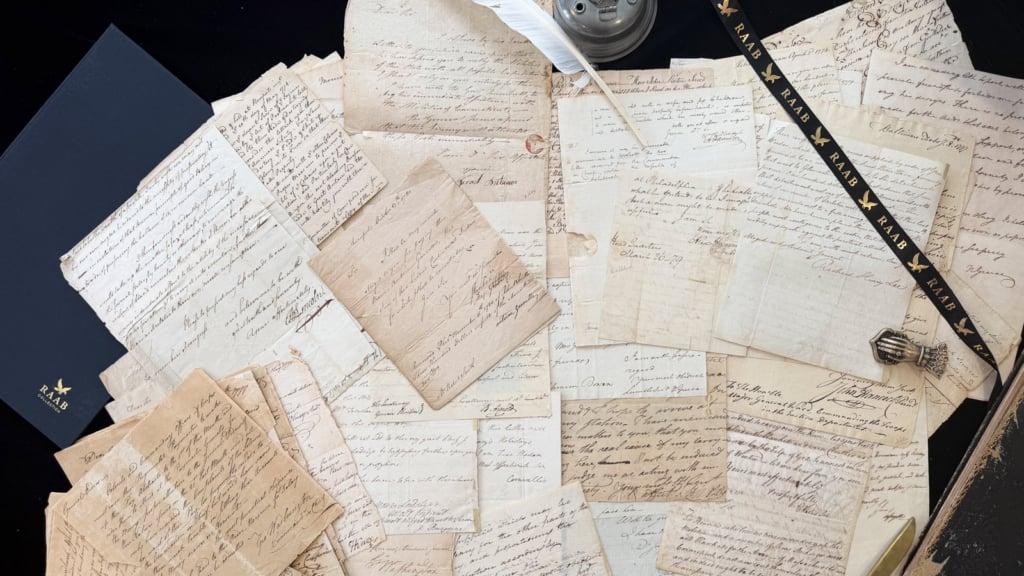
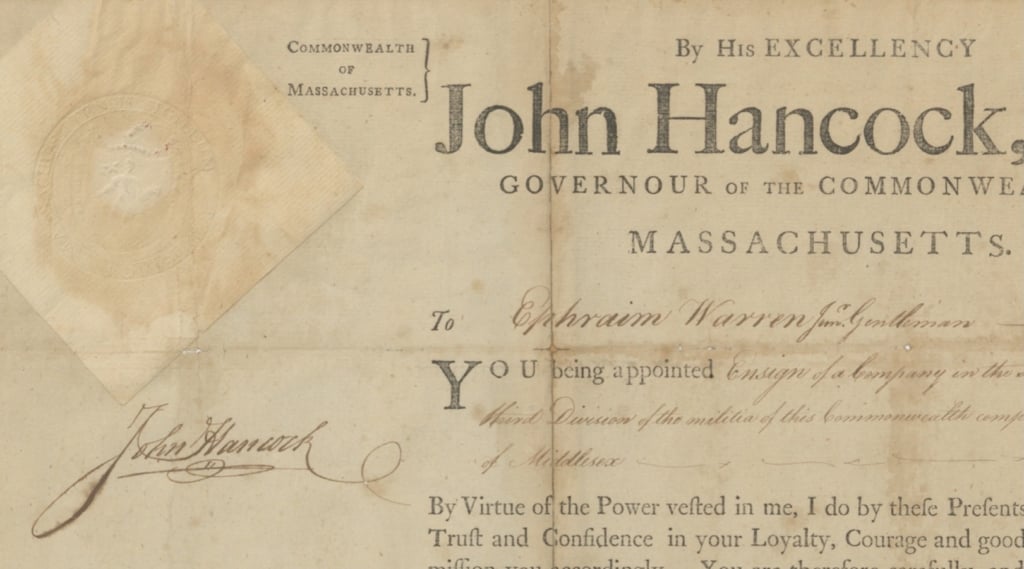
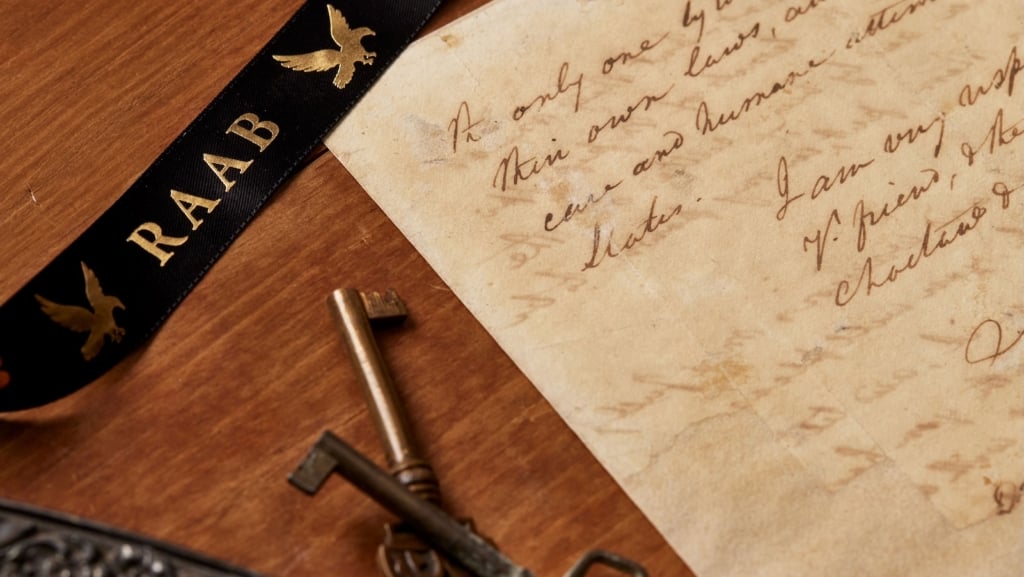
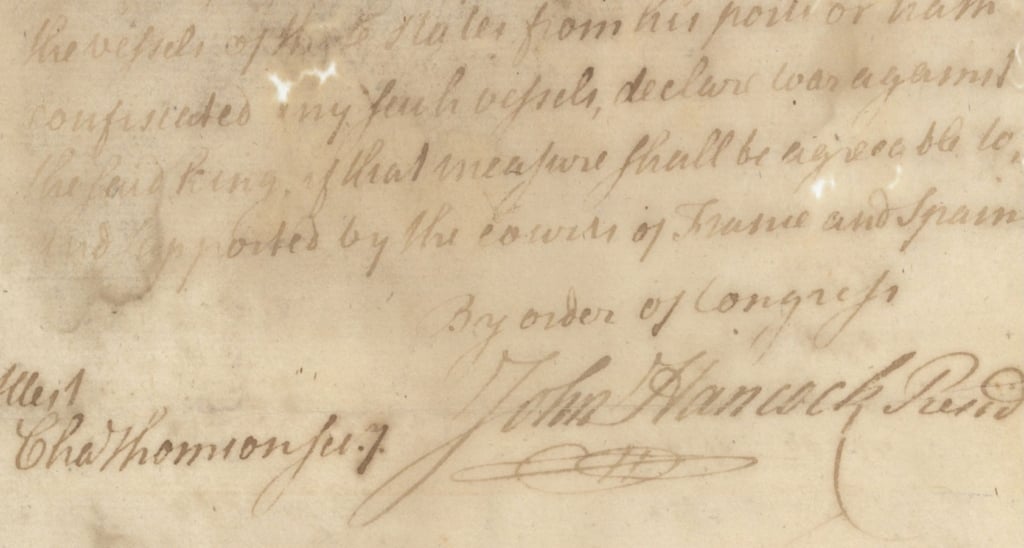
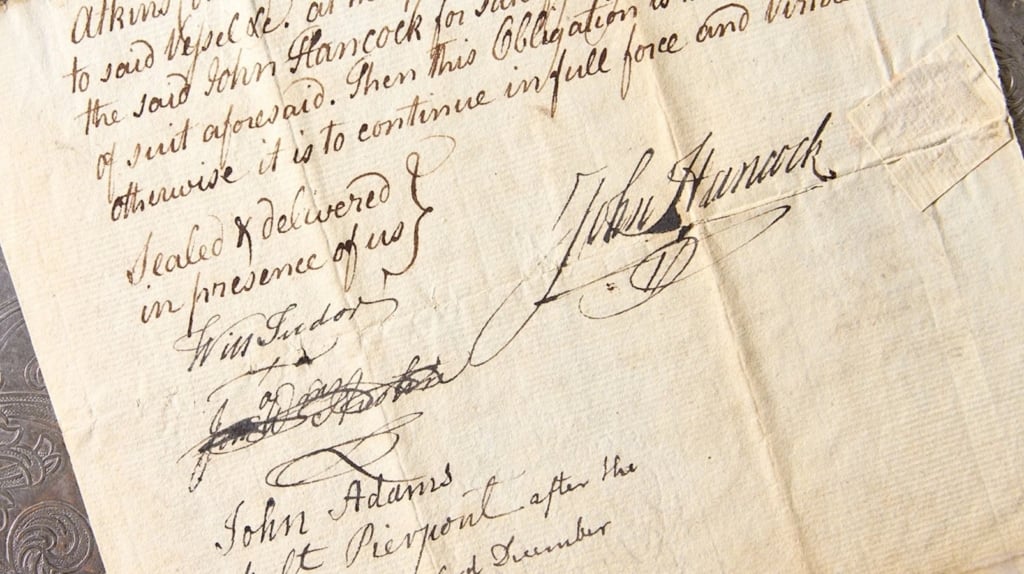
Manuscript document signed, Baltimore (where Congress was then sitting), December 30, 1776, being a resolution of the Continental Congress, penned in the hand of Secretary Charles Thomson and signed at the conclusion by John Hancock, appealing to Spain to join the war against Great Britain. The treaty was intended to be a commercial and military alliance. The resolution stated: “Resolved, That the commissioners for the courts of France and Spain consult together and prepare a Treaty of Commerce and Alliance, as near as may be similar to the first proposed to the court of France, not inconsistent therewith nor disagreeable to His Most Christian Majesty, to be proposed to the Court, adding thereto ‘that if his Catholic Majesty will join with the United States in a war against Great Britain, they will assist in reducing to the possession of Spain the town and harbour of Pensacola, provided the citizens and inhabitants of the United States shall have free and uninterrupted navigation of the Mississippi and the use of the harbour of Pensacola. Provided it shall be true that his Portuguese Majesty has insultingly expelled the vessels of these states from his ports, or hath confiscated any such vessels, declare war against the said king, if that measure shall be agreeable to and supported by the Courts of France and Spain. By order of Congress, John Hancock Presid’t.” The document is attested to and signed by Charles Thomson. Some loss at edges not affecting text. A few internal paper losses not affecting text. Paper thin. Signatures strong.
Resolutions of Congress signed by Hancock of this importance are true rarities, this being the most significant one we have had, or even seen.
Spain could not yet agree to a formal treaty, but in December 1776, Spain’s King Charles III had issued a royal order for the governors of Louisiana and Cuba to open Spanish ports to American merchant ships. This action began a period of extended covert aid, as Spanish officials secretly supplied weapons and supplies to the Americans.
Spain had other priorities and regions competing for its attention, including the Spanish-Portuguese War of 1776-1777 over their own South American colonies and borders. In 1779, although Spain did not formally go to war as an ally of the American revolutionaries, it signed the Treaty of Aranjuez with France, agreeing to support the French and wage war against Great Britain in return for several former Spanish territories then under British and French control. Thus was Spain a formal part of the American Revolutionary War.
Spain chose to support the American revolutionaries by allying with France primarily out of global political strategy. Three places played into their thinking: Menorca, an island off the coast of Spain in the Mediterranean; Gibraltar, a point in southern Spain guarding the entrance to the Mediterranean; and the large region of the Mississippi Valley known as Louisiana. In 1776, as the result of centuries of conflict, the British controlled Menorca and Gibraltar – key to Spain’s defense of its coast – and the French held Louisiana – a potentially lucrative source of raw materials. When France agreed to return Louisiana as part of an alliance, Spain entered the war on the Franco-American side.
In 1783, with the signing of the Treaty of Paris, Spain officially recognized the independence of the United States.

Frame, Display, Preserve
Each frame is custom constructed, using only proper museum archival materials. This includes:The finest frames, tailored to match the document you have chosen. These can period style, antiqued, gilded, wood, etc. Fabric mats, including silk and satin, as well as museum mat board with hand painted bevels. Attachment of the document to the matting to ensure its protection. This "hinging" is done according to archival standards. Protective "glass," or Tru Vue Optium Acrylic glazing, which is shatter resistant, 99% UV protective, and anti-reflective. You benefit from our decades of experience in designing and creating beautiful, compelling, and protective framed historical documents.
Learn more about our Framing Services
