





Abraham Lincoln Receives Pay for Arguing a Case in Front of the Supreme Court of Illinois
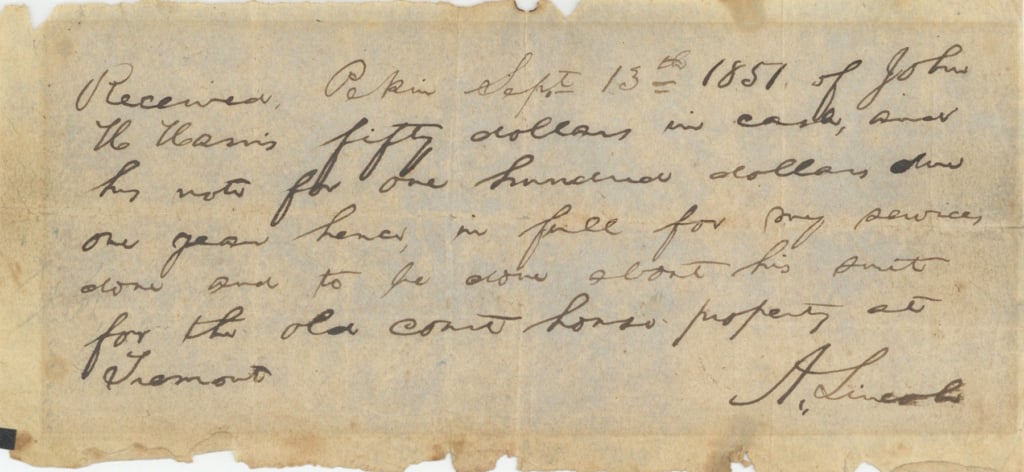

A very rare receipt for his legal services
- Currency:
- USD
- GBP
- JPY
- EUR
- CNY
 This currency selector is for viewing only.
The Raab Collection only accepts USD payments at checkout.
Exchange rates are updated hourly. Rates may be inaccurate.
This is our first such document
John H. Harris was a hatter in New York and then in South Carolina. In 1833 he came to Illinois to scout the land and in 1835 he returned with a group of prospective settlers from New York, who established themselves in what became the...


This is our first such document
John H. Harris was a hatter in New York and then in South Carolina. In 1833 he came to Illinois to scout the land and in 1835 he returned with a group of prospective settlers from New York, who established themselves in what became the town of Tremont. Harris laid out the village, built a schoolhouse, and built a church. He was clearly a major local booster and land developer. When there was a possibility for Tremont to become the county seat of Tazewell County in 1836, John Harris donated 20 acres of land, and the citizens raised $2,000 to bring the county seat to the town. Harris married Catharine Montross in 1815, with whom he had four children before her death. In 1843, he married Sarah Holder, with whom he had one child. In 1860, Harris was a farmer living in Tremont with his second wife and their son, and he owned $5,000 in real estate and $400 in personal property.
Abraham Lincoln represented Harris in three cases in the Tazewell County Circuit Court, two of which he won and one of which Lincoln lost and appealed to the Illinois Supreme Court. This is the famous case of Harris v. Shaw.
In 1850 Harris brought suit in the Tazewell County Circuit Court to obtain compensation by reason of the removal of the county seat of Tazewell County from Tremont to Pekin. This was because of his gift of the piece of ground in the public square of Tremont to the county on the condition that the county seat be located there. The judgment of the Court was against Harris, and he carried the case to the Supreme Court of the State of Illinois. He employed Lincoln as his attorney.
The Supreme Court case was heard on Jan. 24th and 25th, 1851, in the city of Springfield. It was taken under advisement by the Court. Almost a year later, February 4, 1852, the Supreme Court finally affirmed the judgment of the lower court, on the premise that in no part of the contract between Harris and the County was it stated that the county seat should remain forever as located. So Lincoln lost this case. As for Lincoln’s fee, for the case and appeal he received $50 in cash upfront and a promissory note for another $100 due a year later — a total fee of $150 for the case. It is interesting to note that Lincoln had argued a similar case shortly before Harris v Shaw. This one was Adams et al. v the County of Logan, and he had represented the County – and won.
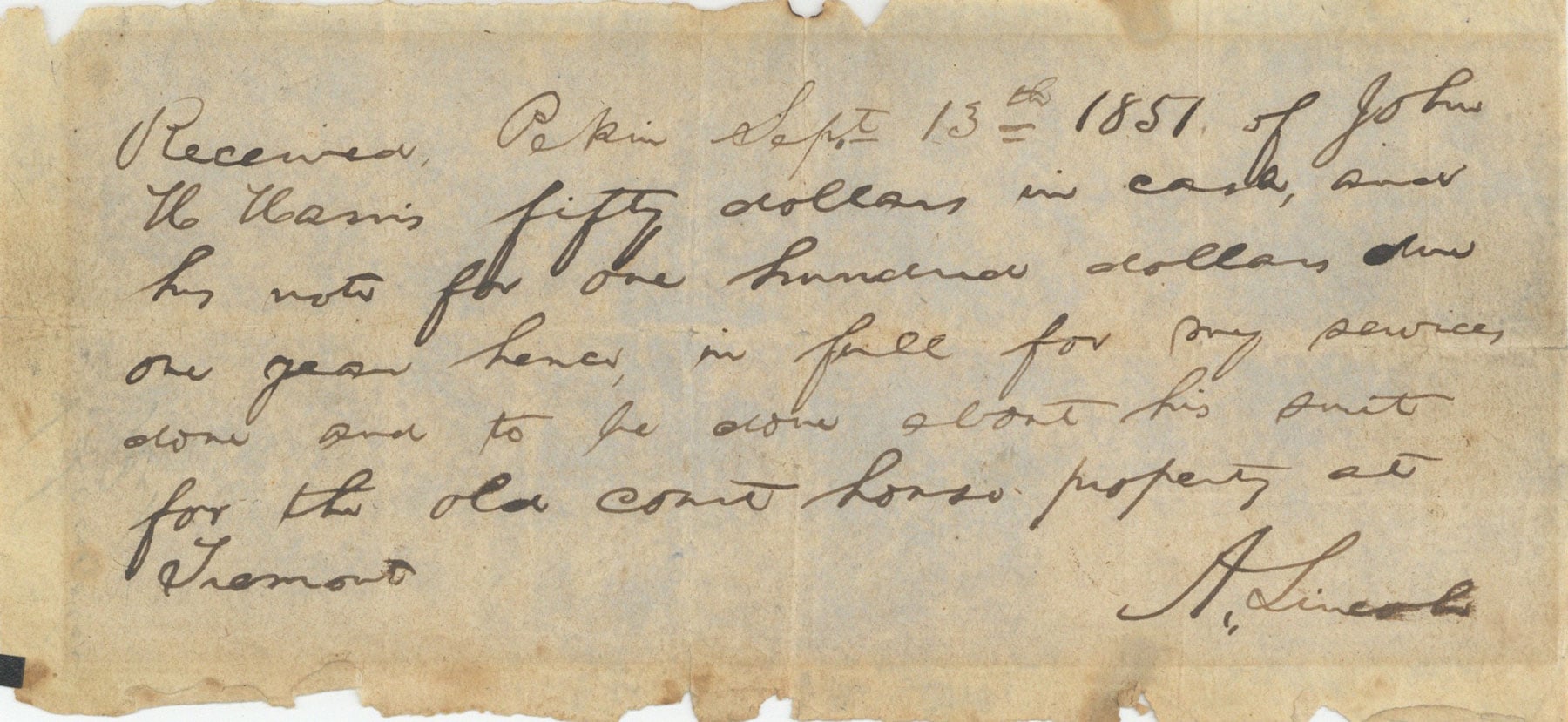
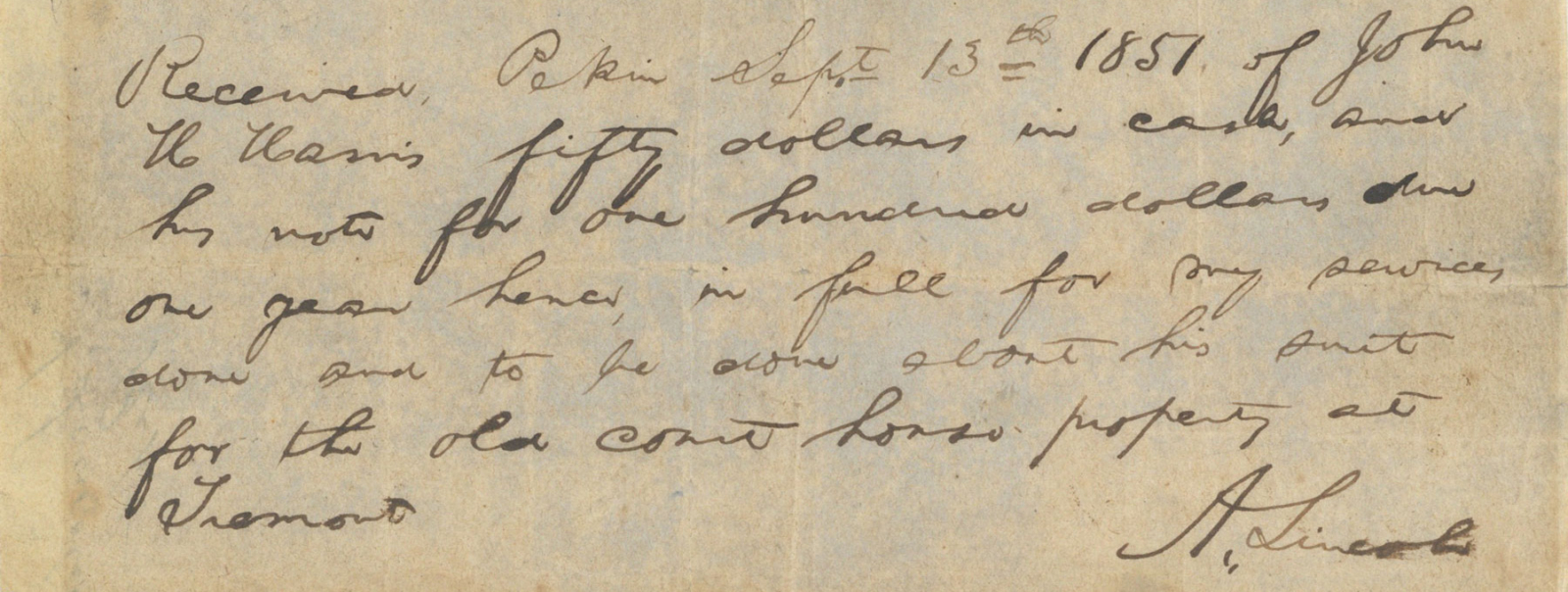
This is a very rare receipt for Lincoln’s legal services. It is our first. Autograph document signed, Pekin, Ill., September 13, 1851. “Received, Pekin Sept. 13th 1851, of John H. Harris fifty dollars in cash, and his note for one hundred dollars due one year hence, in full for my services done and to be done about his suit for the old court house property at Tremont. A. Lincoln.”
In another, earlier case in which Harris used Lincoln’s legal services, Harris sued a Mr. Dean in an action of debt. The ruled against Harris, and Harris retained Lincoln and appealed to the Tazewell County Circuit Court. A jury found for Harris and awarded him $19.95.

Frame, Display, Preserve
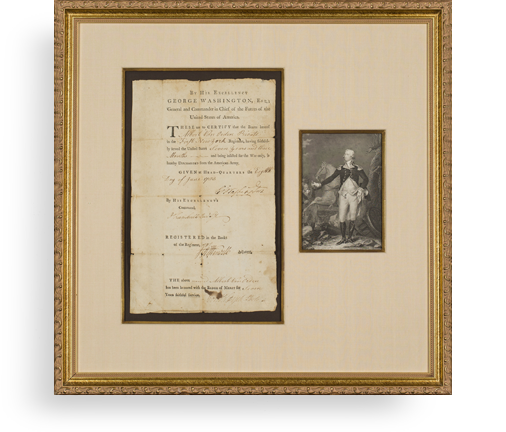
Each frame is custom constructed, using only proper museum archival materials. This includes:The finest frames, tailored to match the document you have chosen. These can period style, antiqued, gilded, wood, etc. Fabric mats, including silk and satin, as well as museum mat board with hand painted bevels. Attachment of the document to the matting to ensure its protection. This "hinging" is done according to archival standards. Protective "glass," or Tru Vue Optium Acrylic glazing, which is shatter resistant, 99% UV protective, and anti-reflective. You benefit from our decades of experience in designing and creating beautiful, compelling, and protective framed historical documents.
Learn more about our Framing Services