






One of the Famed Franklin-Cushing Copies of the Great Benjamin Franklin Letter Announcing the Franco-American Treaty of 1778, Predating the Notification to Congress


Only 3 of these famous copies are known to have survived, one sent to Canada to foment rebellion and now in the British Library; the other at the Massachusetts Historical Society
The first of these to have reached the market
This contemporary copy was part of a coordinated effort to quickly spread the news of the alliance, prepare the armed forces and cause rebellion in British Canada
It represents perhaps the earliest documentary proof of the French alliance in the New...


The first of these to have reached the market
This contemporary copy was part of a coordinated effort to quickly spread the news of the alliance, prepare the armed forces and cause rebellion in British Canada
It represents perhaps the earliest documentary proof of the French alliance in the New World
In the hand of New York Commissary and prominent merchant Peter Curtenius; Acquired from the Curtenius heirs and not previously known to exist
In September 1776, the Continental Congress appointed Benjamin Franklin, Silas Deane, and Arthur Lee as joint commissioners to negotiate a treaty with France. Franklin was, at that time, the most famous American in the world. His reputation was based on his scientific, literary and political accomplishments, and he was a natural choice for such a crucial mission. He quickly became a celebrated figure in Paris – the toast of the city. Deane was the first American diplomat; in early 1776, he was sent to France by Congress in a semi-official capacity, as a secret agent to induce the French government to lend financial aid to the colonies. He was also to purchase munitions and supplies for Congress with money and credit from selling American commodities, and was to receive a 5% commission for this. Deane, often advancing his own funds, organized shipments of arms and munitions to America, thus helping finance the war, and enlisted the services of a number of Continental officers, among whom were Lafayette, DeKalb and Von Steuben. So he was already familiar with the French, and was well liked by them. Lee was the brother of Richard Henry Lee, who introduced the resolution in the Continental Congress declaring American independence.
The three labored throughout 1777 to secure French recognition and assistance, but made little progress. Then in early December news reached Paris of the American victory at Saratoga, and it was celebrated in Paris as if the French themselves had gained the triumph. The French decided the time was right to enter into serious negotiations, and on February 6, 1778 treaties of alliance and commerce between the United States and France were signed by Alexander Gerard on behalf of the King of France and by all three American commissioners. The Treaty of Alliance required that neither France nor the United States would agree to a separate peace with Great Britain, and that American independence must be a condition of any future peace agreement. These provisions were extraordinary accomplishments for the American negotiators, as they guaranteed that France would be with the United States until the end. The Treaty of Amity and Commerce promoted trade and commercial ties between the two nations, which meant that the Americans would benefit from much-needed funds and munitions of war. French intervention proved to be critical to the success of the American Revolution.
Franklin wanted the news to get to America. And the news was eagerly anticipated. Below is a timeline of the events as reconstructed from the Secrety Journals of Congress, the Letters of the Members of Congress (Smith), and Founders.gov.
February 6 – Franklin and Silas Deane to the President of Congress, informing him that they have concluded the treaties with France. Two vessels would be sent with the information, including one being shepherded by Simeone Deane, which, though leaving March 8, would arrive first.
February 27 – Franklin writes to Samuel Cooper and Thomas Cushing privately announcing the Treaty. The Franklin Papers publishes a copy (apparently contemporaneous) now at the University of California. The Cushing letter would be copied on delivery for notice to a few parties and propaganda in Canada.
March 8 – The Sensible, with Simeon Deane bearing the Cooper / Cushing letters and Treaty, departs from Brest
April 12-15 – Simeon Deane, aboard The Sensible, arrives at Falmouth. He will travel to Boston and then to Congress bearing the news then overland to York and Congress. He carries the Cooper and Cushing notes, which he evidently deposits in Boston.
April 19 – Samuel Cooper received Franklin’s letter and gives public thanks. Presumably Cushing does as well on this date.
April 25 – William Gordon writes George Washington, referencing the news via the Cushing and Cooper letters and the making of copies of Cushing’s letter. The Treaty is not public. “Dr Cooper had a letter from Dr Franklin which he shewed me, & from that I gather’d that He & I together had no small hand in forwarding the affair….However goods will be cheaper & the value of money rise. Upon the arriva⟨l of the⟩ news I mentioned to Genl Ward that methods should be taken to forward the news into Canada. He accordingly sent to Col. Allen to the eastward a copy of Dr Franklins letter to the Honle Thos Cushing Esqr., & mentioned his sending off a runner with the like to Canada immediately.
April 30 – James Lovell, with Congress at York: “We have read a letter written by a friend (Govr. Johnston – in UK) dated House of Commons Feb. 13th. in which we are told that “you had concluded a Treaty wth. France and Spain which was on the Water towards us.” This early letter from someone in UK was secondhand and dealt in gossip. It was not considered conclusive.
May 1 – Henry Laurens, Congress President – “We hourly expect confirmatory accounts of a Treaty between France & the United States of America by which our Sovereignty & Independence are acknowledged & guaranteed.”
May 2 – Simeon Deane reaches Congress with news of the Treaty announced
May 3 – John Banister in York with Congress to Theodorick Bland, Jr. – “By an Express, of yesterday, sent by the board of War, I wrote Mr. Davis all the News preceding that date. Before he got away a Messenger arrived from France charged with the most important Papers from our Commissioners at Paris containing a Treaty of alliance, and a Treaty of alliance and Commerce, between the Court of France and America. By these Treaties our Independence is made a grand Object on the Part of the King of France who has with great liberality that he takes no advantage of the present Situation of the States, but has made the same Treaty with them as if they had been in the most flourishing Prosperity.”
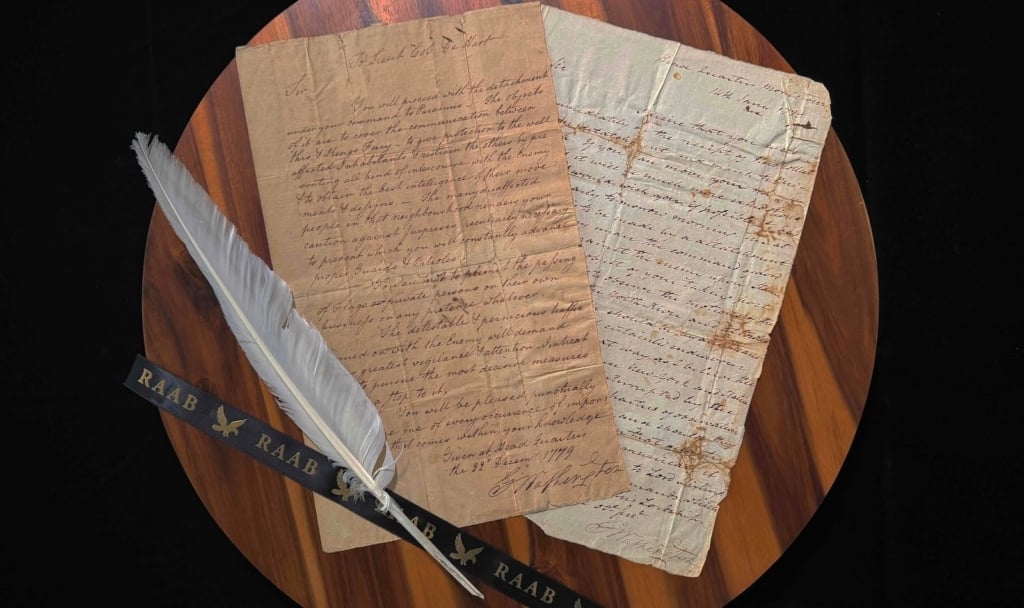
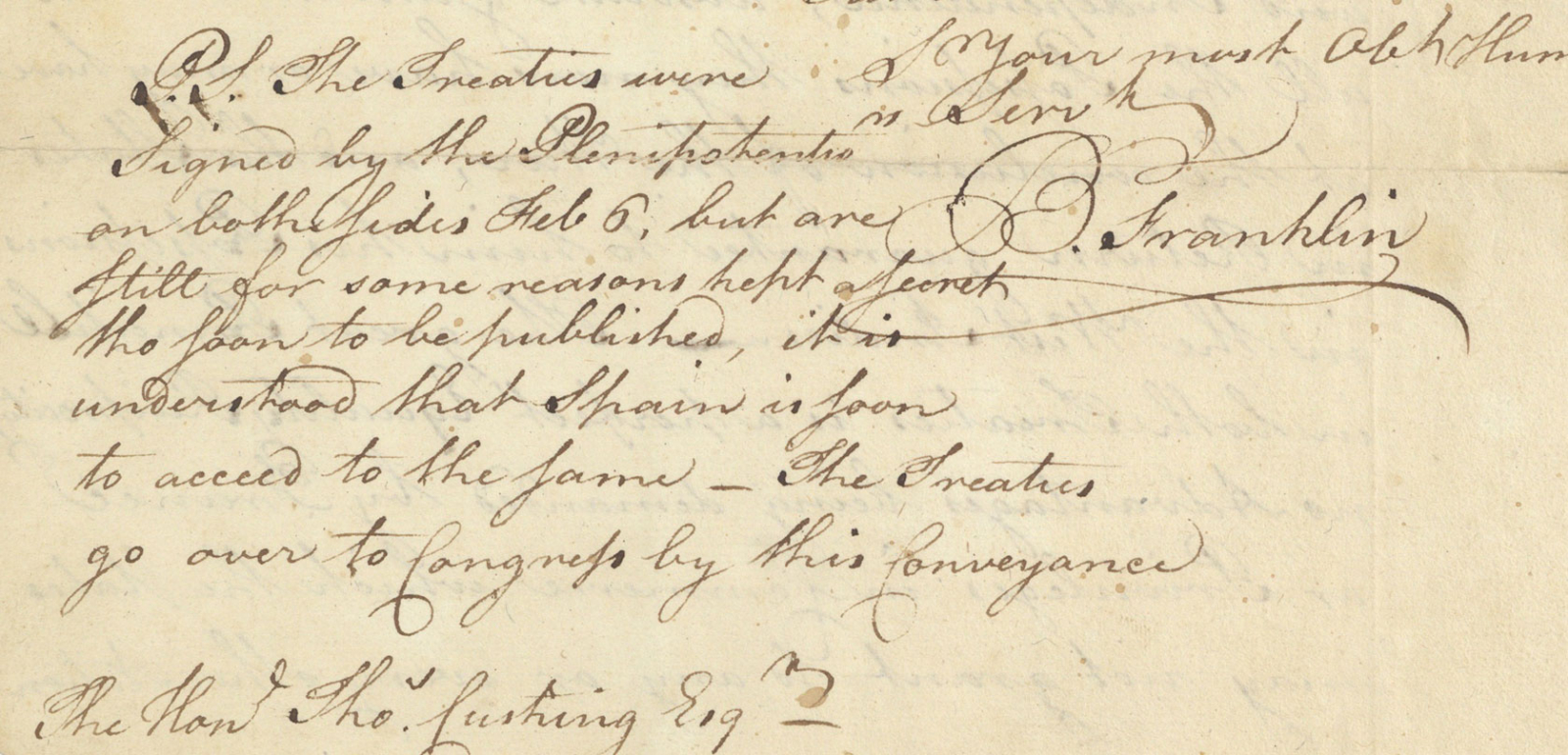
Autograph letter signed, Passy, February 27, to Thomas Cushing, contemporary copy in the hand of Peter Curtenius, evidently part of the effort mentioned to Washington on April 25 to create copies of the Cushing letter.
“Sir, I received your Favour by Mr. Austin, with your most agreeable Congratulations on the Success of the American Arms in the Northern Department. In return give me leave to congratulate you on the Success of our Negotiations here, in the Completion of two Treaties with his most Christian Majesty, the one of Amity and Commerce, on the Plan of that projected in Congress with some good Additions; the other of Alliance, for mutual Defence, in which the most Christian King agrees to make common Cause with the United States, if England attempts to obstruct the Commerce of his Subjects with them; and guarantees to the United States their Liberty, Sovereignty and Independence, absolute and unlimited, with all the Possessions they now have or may have at the Conclusion of the War; and the States in return guarantee to him his Possessions in the West Indies. The great Principle in both Treaties is a perfect Equality and Reciprocity, no Advantages being demanded by France, or Privileges in Commerce which the States may not grant to any or every other Nation. In short the King has treated with us generously and magnanimously, taking no Advantage of our present Difficulties, to exact Terms which we should not willingly grant when establish’d in Prosperity and Power. I may add that he has acted wisely, as wishing the Friendship contracted by these Treaties may be durable, which probably it might not be, if a contrary Conduct had been observed. Several of our American Ships with Stores for the Congress are now about Sailing under the Protection of a French Squadron. England is in great Consternation, and the Minister, on the 17th Inst. confessing in a long Speech that all his Measures had been wrong and that Peace was necessary, propos’d two Bills for quieting America; but they are full of Artifice and Deceit, and will I am confident be treated accordingly by our Country…. B. Franklin
“ps. The Treaties were signed by the Plenipotentiaries on both sides, Feb. 6. but are still for some reasons kept a Secret, tho’ soon to be publish’d. It is understood that Spain is soon to accede to the same. The Treaties go over to Congress by this Conveyance.”
The original of this letter is at Yale, and there are other contemporary copies in the British Library and Massachusetts Historical Society. This is thus an extraordinary and virtually unique memento of the arrival of the news announcing the French-American Treaty of Alliance.

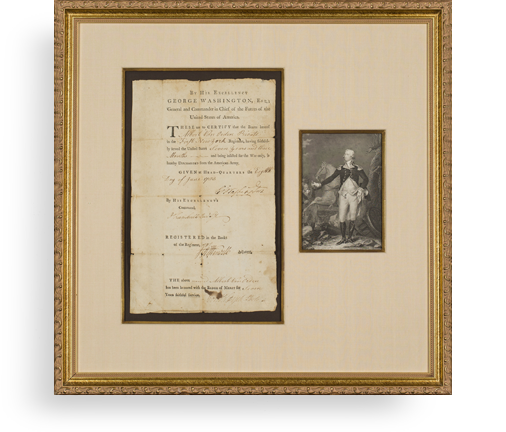
Frame, Display, Preserve
Each frame is custom constructed, using only proper museum archival materials. This includes:The finest frames, tailored to match the document you have chosen. These can period style, antiqued, gilded, wood, etc. Fabric mats, including silk and satin, as well as museum mat board with hand painted bevels. Attachment of the document to the matting to ensure its protection. This "hinging" is done according to archival standards. Protective "glass," or Tru Vue Optium Acrylic glazing, which is shatter resistant, 99% UV protective, and anti-reflective. You benefit from our decades of experience in designing and creating beautiful, compelling, and protective framed historical documents.
Learn more about our Framing Services

