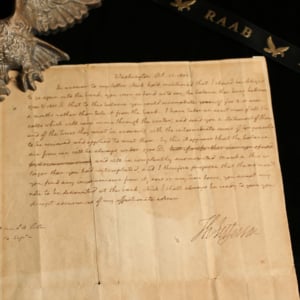




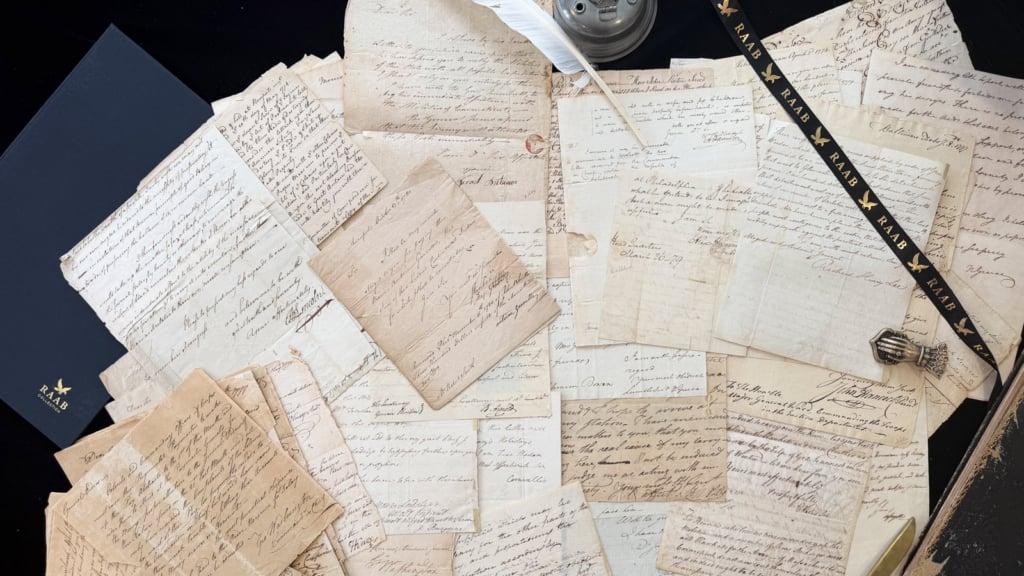
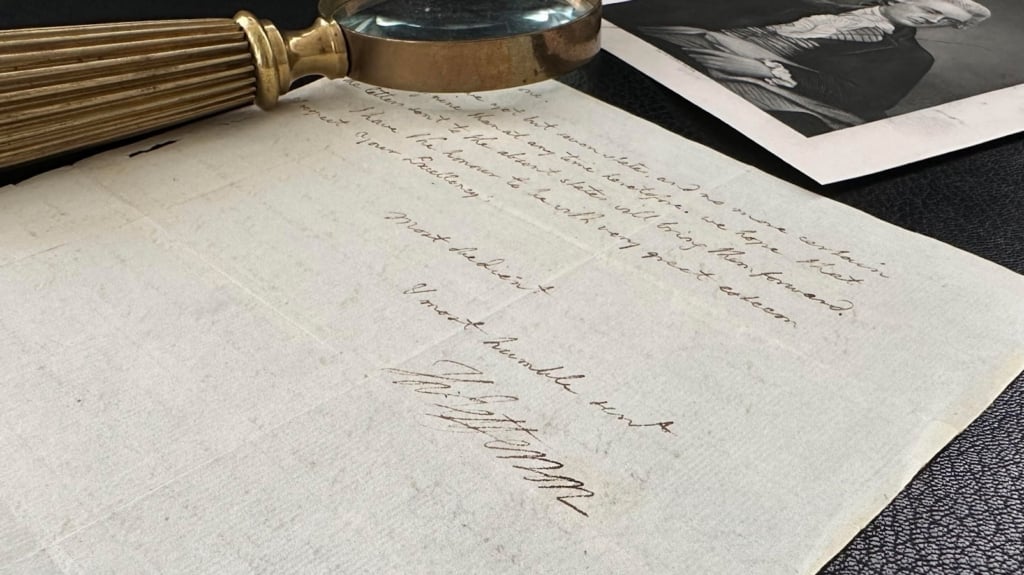


The Raab Collection has acquired a manuscript diary in the hand of Founding Father John Jay documenting every one of his diplomatic meetings in London as he hammered out the Jay Treaty. It was acquired from Jay descendants and has never been offered for sale before.
Nathan Raab was interviewed on the Inspired by History podcast about the significance of this discovery and its potential for spurring new scholarship with regard to America’s first international treaty. Listen to the interview below or via your podcast player of choice. Or, if you prefer, read this lightly edited transcript of the conversation with photos and embedded links to more resources.
Today we’re discussing an incredible artifact, the kind of historical discovery that may make some headlines and even more importantly, will add to the historical record and advance scholarship of the post-Revolutionary period. There’s so much to ask. Nate, can you remind us what the Jay Treaty was and why it was needed?
Nathan: The Jay Treaty was the Washington Administration’s first major foray into international diplomacy. So the Revolutionary War ends, British troops leave, and Americans go through the process of building a government, building a system of governance, which is centered around the Constitutional Convention and then the Constitution.
Congress meets for the first time and begins enacting laws that govern the nation. And little by little, the Secretaries take their positions. Alexander Hamilton, Thomas Jefferson, Timothy Pickering. But there are lingering issues that stem from the end of the Revolution. There’s antagonism surrounding British presence in Northwest forts. There are debts that are owed between the two countries, and there’s continued impressment of American soldiers, American sailors, on the seas. And so, the short way to answer that question is that it was resolving issues left over from the treaty that ended the Revolutionary War.
It was America’s first opportunity under George Washington and that administration to flex its muscles internationally and to engage in the time-honored tradition of diplomacy.

When I hear John Jay, I think of The Federalist Papers, because he, along with Hamilton and James Madison authored those essays, but what was Jay’s official role in the early US government?
Nathan: Jay was a judicial figure. He was the first Chief Justice of the Supreme Court. He’s a widely respected figure in that capacity.
He was Chief Justice when he went to London to work on this treaty?
Nathan: Yes, he was Chief Justice serving from 1789 until his return from this trip when he, after negotiating the Jay Treaty, stepped down. So technically, yes, he was Chief Justice while he was in London negotiating the Jay Treaty.
Was this manuscript a known thing, and where has it been for 230 years?
Nathan: The answer to the first question is it appears in no publication, no book, no scholarship record. It appears to be completely unknown to the scholarship community, and it is completely unknown to the collecting community.
It has never been offered for sale before, and the reason is because it’s been passed down amongst the heirs of John Jay, the family of John Jay, his descendants, since it was written in 1794.

Tell us about the content. You’ve told me it’s quite voluminous, many pages, lots of names and places and that kind of thing. What can you tell me about it?
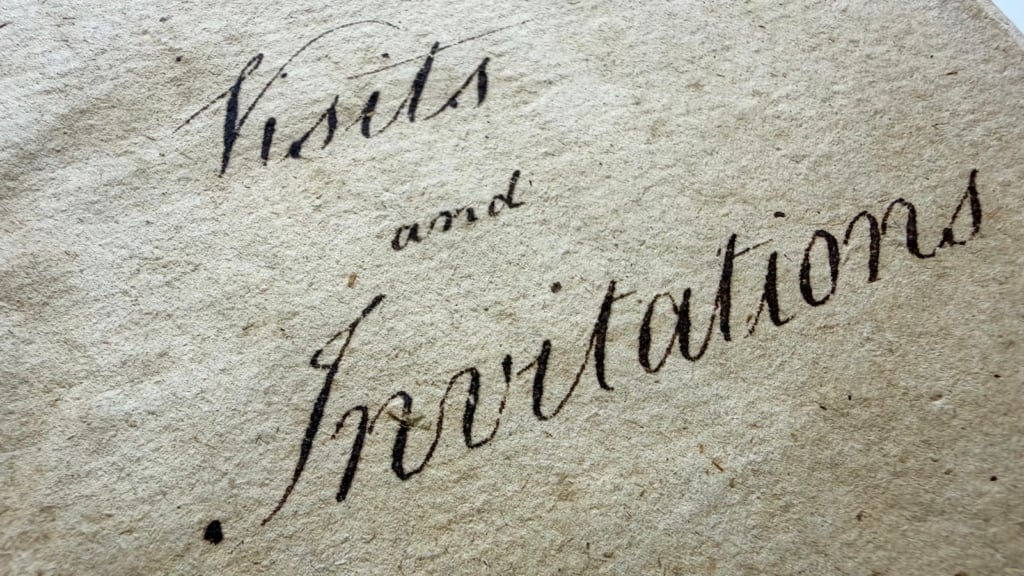
Nathan: It’s really a fascinating opportunity to part the curtains and look into what Jay’s life was like on a day-to-day basis as he was negotiating the treaty, as he was meeting with friends, colleagues, political allies, negotiating partners. And what you see is, day-to-day, a list of Jay’s visits and invitations that were issued to him and invitations that he issued to others.
So Jay breaks the book up into three sections. One is what he calls visits. The other is a two-part section: Invitations. Invitations from him and invitations to him. Each one of the entries, the vast majority of the entries, contain either addresses or dates. So it really allows you to track it in real time. And what’s fascinating is, it starts the day he arrived. He arrives June 15th, and the first entry is June 15th. The final entry is timed, more or less, for when he departed. It’s kind of its own little capsule. It’s a discreet unit unto itself. And you can literally flip through the book and you can see what Jay was doing on such and such a date, who he was meeting with. You can imagine why, you can, in many cases, see where it happened. It’s just fascinating.
Looking through the names, there’s lots of royals, there’s the Prime Minister, Archbishop of Canterbury, but also people like Jeremy Bentham. Angelica Schuyler Church, Hamilton’s sister-in-law, who’s so famous now. Really just an incredible array of people that he’s meeting with.
Nathan: The people he met with were so diverse. They were the Churches – the Schuyler- Churches, who were friends, but also important allies in his negotiation. He needed contacts. When he got there, he met people who introduced him to other people. He met with important merchant companies, both English and American, who had business to be done and who would play an important role in the implementation of the treaty.
Some of the friends he met with are well known. He met with John Singleton Copley. He met with Benjamin West. These are people who lived in London and were friends of his. He met with them to learn more. And then of course, he’s meeting with members of the Prime Minister’s cabinet. He’s meeting with the Prime Minister. His primary negotiating partner in this was Lord Grenville. He meets with Lord Grenville a number of times.
He’s very active in the abolition community. So he meets with a number of members of the English abolition movement. First and foremost, William Wilberforce, with whom he met a number of times. He was among the figures with whom he met the most. There is a wide variety of people. He met with men, he met with women, and he made meticulous notes of all of these that we are only learning about now.

What went through your mind when you held this manuscript in your hands for the first time?
Nathan: Just a sense of awe, you really do get the sense that you are seeing something that no one else has seen, and you’re seeing it for the first time and the potential of the thing. I’ll avoid using curse words, but a holy s moment, like, I can’t believe I’m holding this and that it survived.
Then you go about the process of researching and kind of dotting the i’s and crossing the t’s. But that same awe remains. I mean, I feel it now just discussing it, the potential to truly understand what was going on there in a deeper, more complete way that will materially add to the historical record. This is not a casual edition, this is a material edition, and to have it be in Jay’s hand, it’s just fascinating.
You’ve done a lot of research on it, and you’ve said it’s very dense. Can you envision how it’ll be used by scholars?
Nathan: Each one of these meetings served a purpose. I would say most of them served a purpose, a really concrete, potentially knowable purpose. These daily diaries from Founding Fathers just do not come up for sale. I’ve never seen another, I’m not aware of another. They’re in institutions. Occasionally a leaf from a diary will show up, one page disconnected from the context, and those will reach high numbers. But I am not aware of any complete diary.
There’s not a page missing from this. It starts in the beginning and goes to the end, and the completeness will really allow for a thorough investigation. What was Jay doing on this day? Why was he meeting with this person? Is there a connection? What can we learn? Look how many times he met with such and such a person. What does that mean? Is there something that this diary can teach us about an event that came after? I can’t anticipate what scholars will make of this because there are so many potential discoveries looking within on a political, diplomatic, social, cultural level. I mean, just the number of meetings he had with abolitionists is itself fascinating to me. He continued to meet with Lord Grenville regularly after the treaty was signed. Comparing this with known correspondence, known meetings, will allow us to tie up loose ends and add new ones.
I imagine that for anyone who’s doing any work on John Jay or the Jay Treaty, this will just be a goldmine of new information.
Nathan: How could you study the negotiation process of the Jay Treaty without this diary? You couldn’t. I suppose you could, but it wouldn’t be complete. Any fulsome investigation of the process of the negotiation of the Jay Treaty by Jay must include the diary. You couldn’t do it without it.
Now, as a dealer, what is your experience with John Jay documents and letters? Are they uncommon?
Nathan: The Jay Family had one other Jay letter, to his son, which they had retained and which we acquired. In general, Jay letters are not super common. They do exist. We do like them, people do buy them. I would say up until this, I would’ve sought out material signed as and related to his work as Chief Justice. And we have had the first appointment of an Associate Justice, a vellum document, an appointment signed by George Washington and John Jay.
But no, his letters are not as common. They do show up. They are desirable, and there can be money involved. But having a letter is sort of comparing apples and oranges. Comparing a letter at all with this. Jay kept this diary for nearly a year and wrote in it. I imagine him carrying it around to these various meetings or coming home to his desk and filling it out. It was a working document for him.

In one of our last podcasts, you and I talked about two newly discovered Washington letters, musing about whether or not the America 250 anniversary might prompt big historical discoveries like that related to the Revolution, and voila, here’s yet another. Did you think you’d find something like this?
Nathan: I never think I’m going to find these things. That’s what makes it so exciting. I mean, how could you predict? People say, do you find stuff, or does stuff find you? And the answer is, stuff finds us. How could I possibly predict finding this or the letters? Every day is a potential new find. And this is exciting. It’s hard to get around the fact that this is super cool, but completely unexpected.
Who do you see buying a diary like this?
Nathan: Sometimes I have a clear vision of who the buyer might be, not the specific person. We buy everything outright, we buy on spec. We speculate that because we have an interest in it that some other potential buyer will, and we’re largely correct. The logic is, if we love it, someone else will too. With something like this, the universe is big.
Does an institution buy this for its research value? Is it the kind of acquisition that a major institution, major library, might want? For obvious reasons that it has genuine research potential on a subject of great and important interest in American history? Or does a private collector, seeing its clear historical importance and rarity, buy it?
I think that there are a number of potential buyers. The world is wide open. My confidence is that we will find somebody who loves it and cherishes it and takes care of it so that it survives through future generations.
It never ceases to amaze me when a document or a book or an artifact like this makes its way from somebody’s closet or attic, where it hasn’t been seen by anyone outside the family in 200 years, into the public realm. It’s a real gift to history. Thanks for sharing it with us.