





The Jay Treaty Diary: the Great Surviving Record – How the United States Negotiated Its First International Treaty
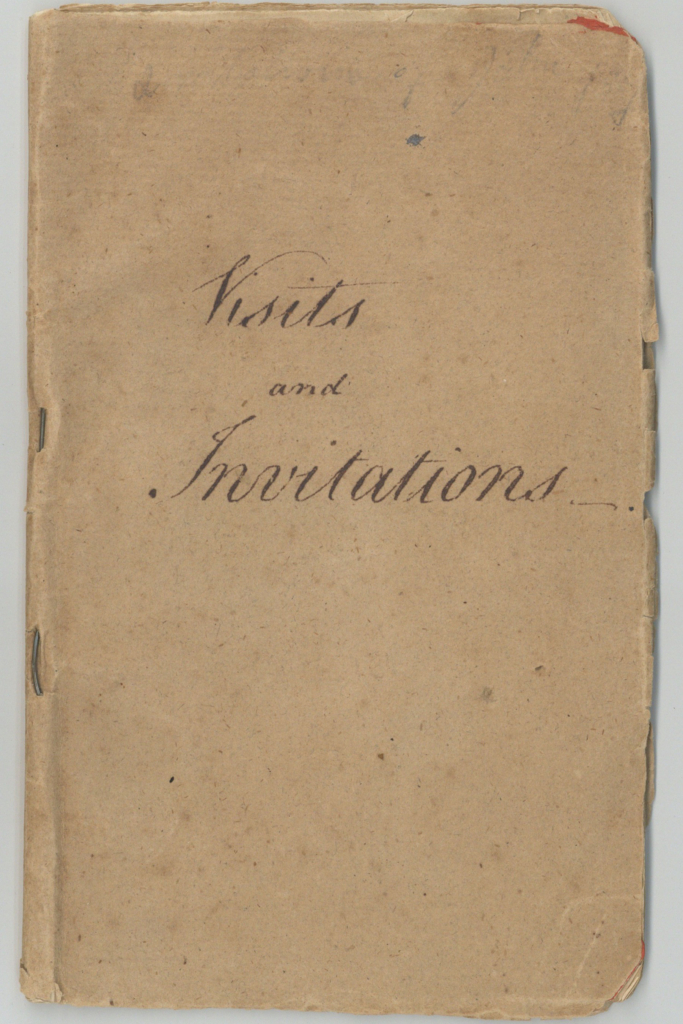


Newly discovered and never previously offered for sale
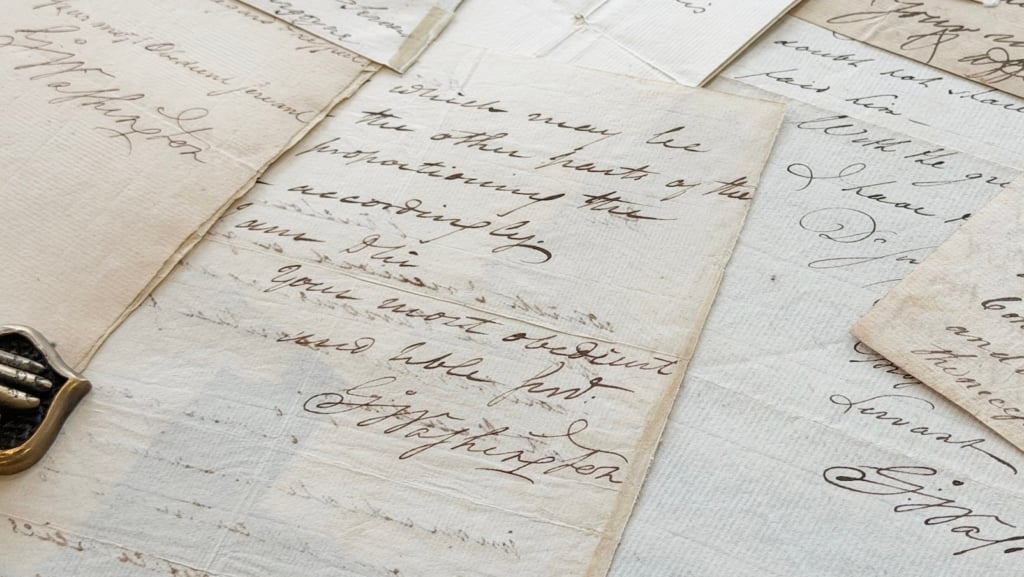
In the hand of the negotiator, John Jay himself, who at the time was also Chief Justice of the Supreme Court, complete and passed down through the Jay family, and offered for sale here for the first time
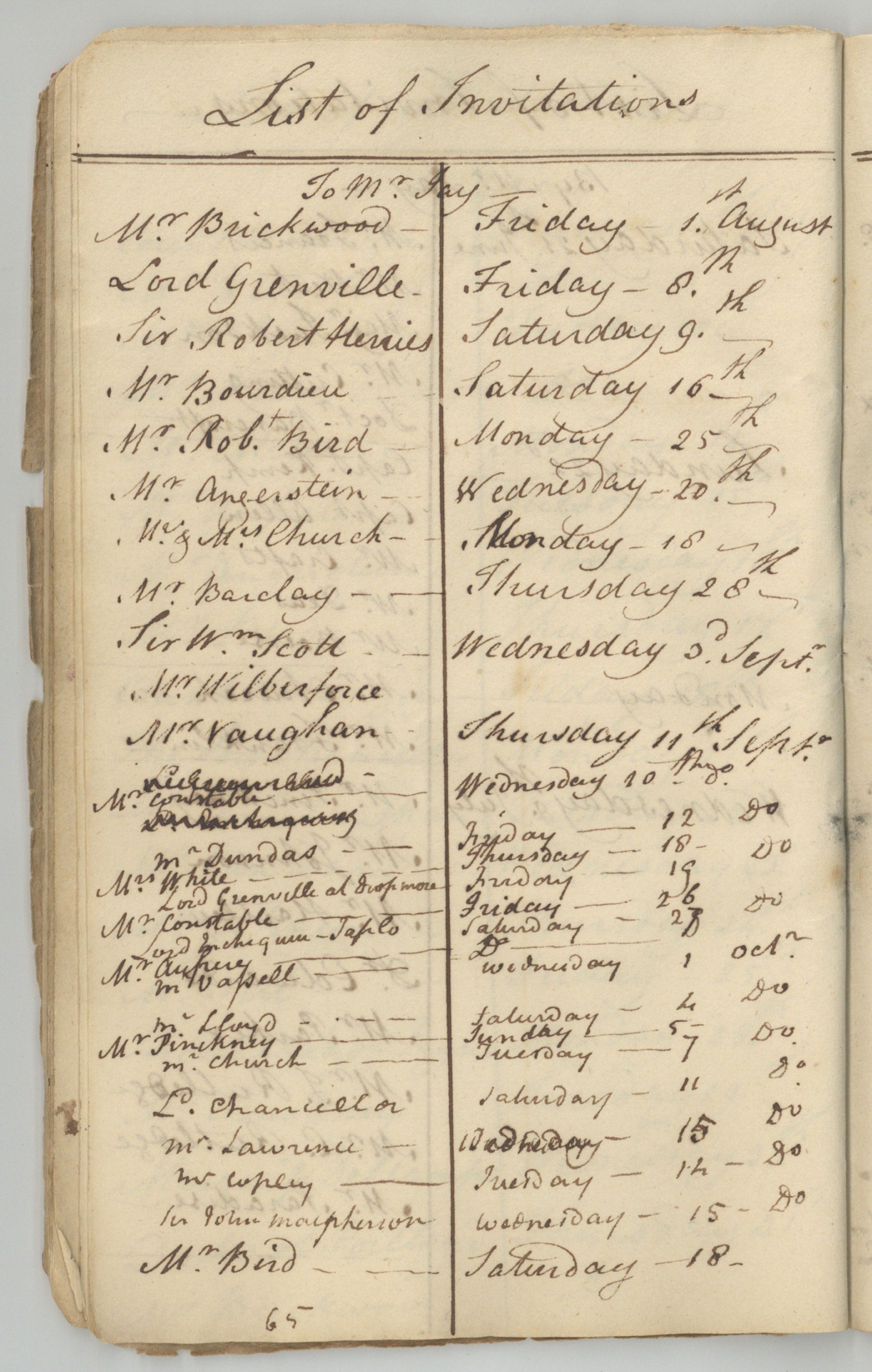
Listing up to 1,000 separate meetings with well hundreds of individuals, many if...

In the hand of the negotiator, John Jay himself, who at the time was also Chief Justice of the Supreme Court, complete and passed down through the Jay family, and offered for sale here for the first time
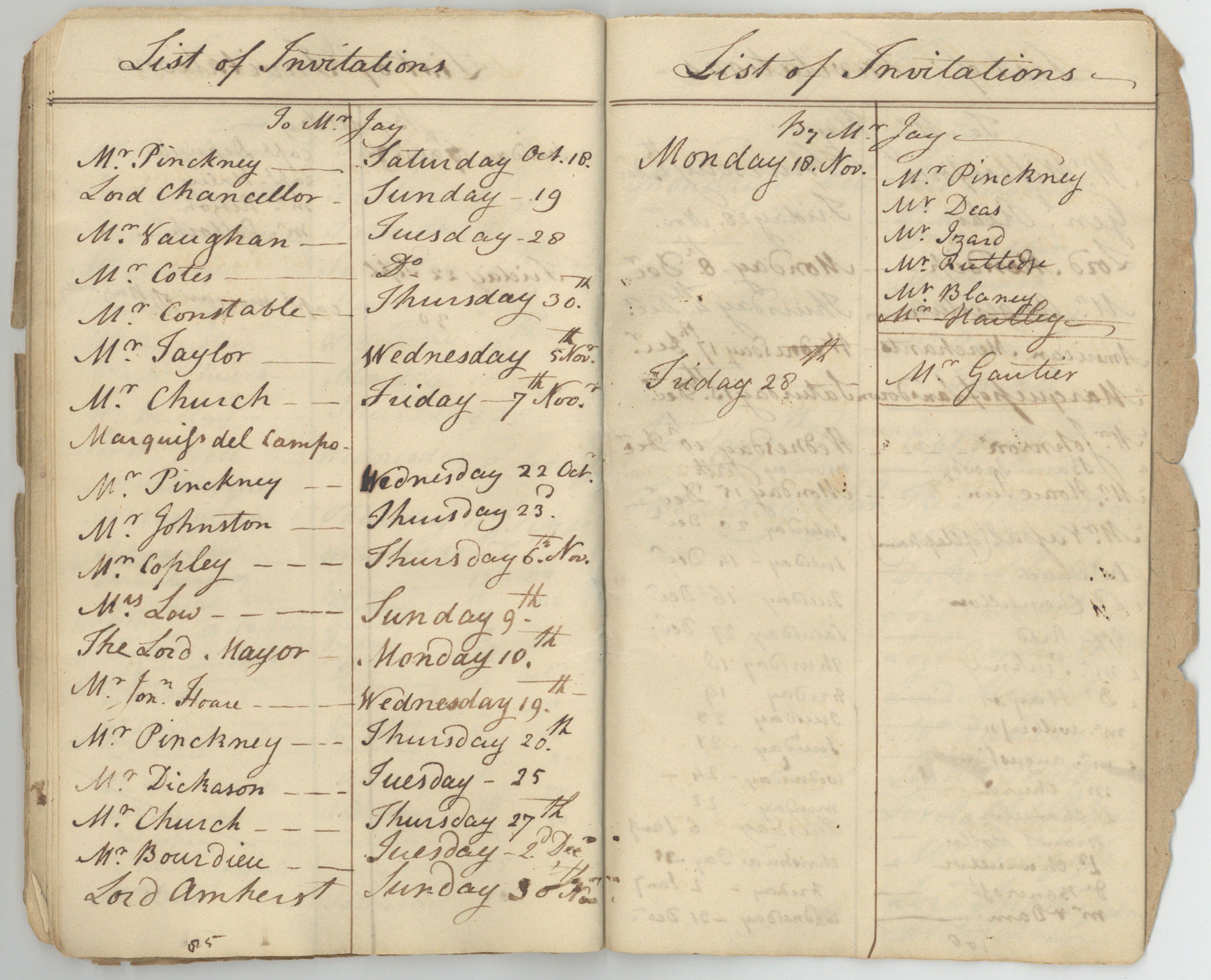
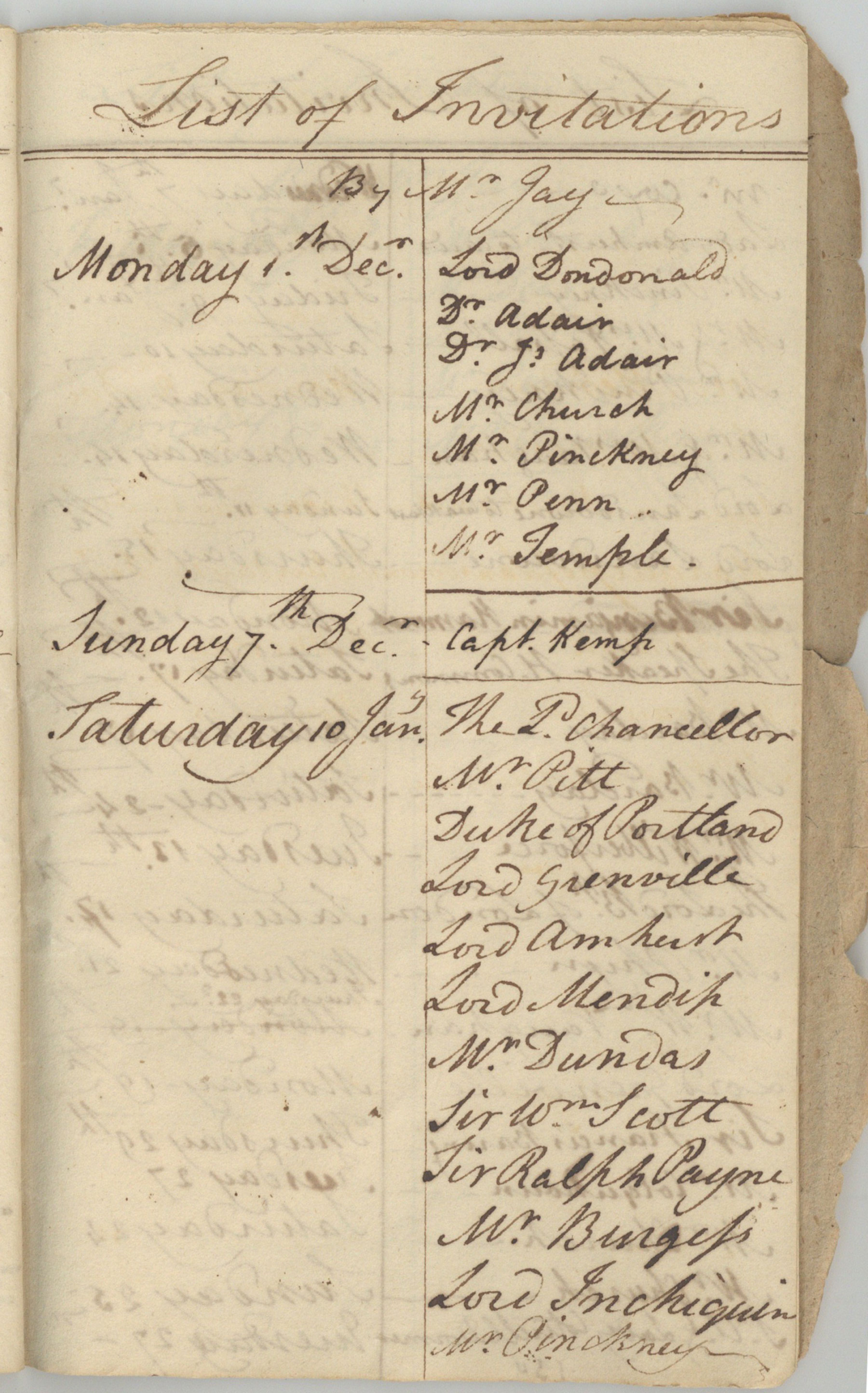
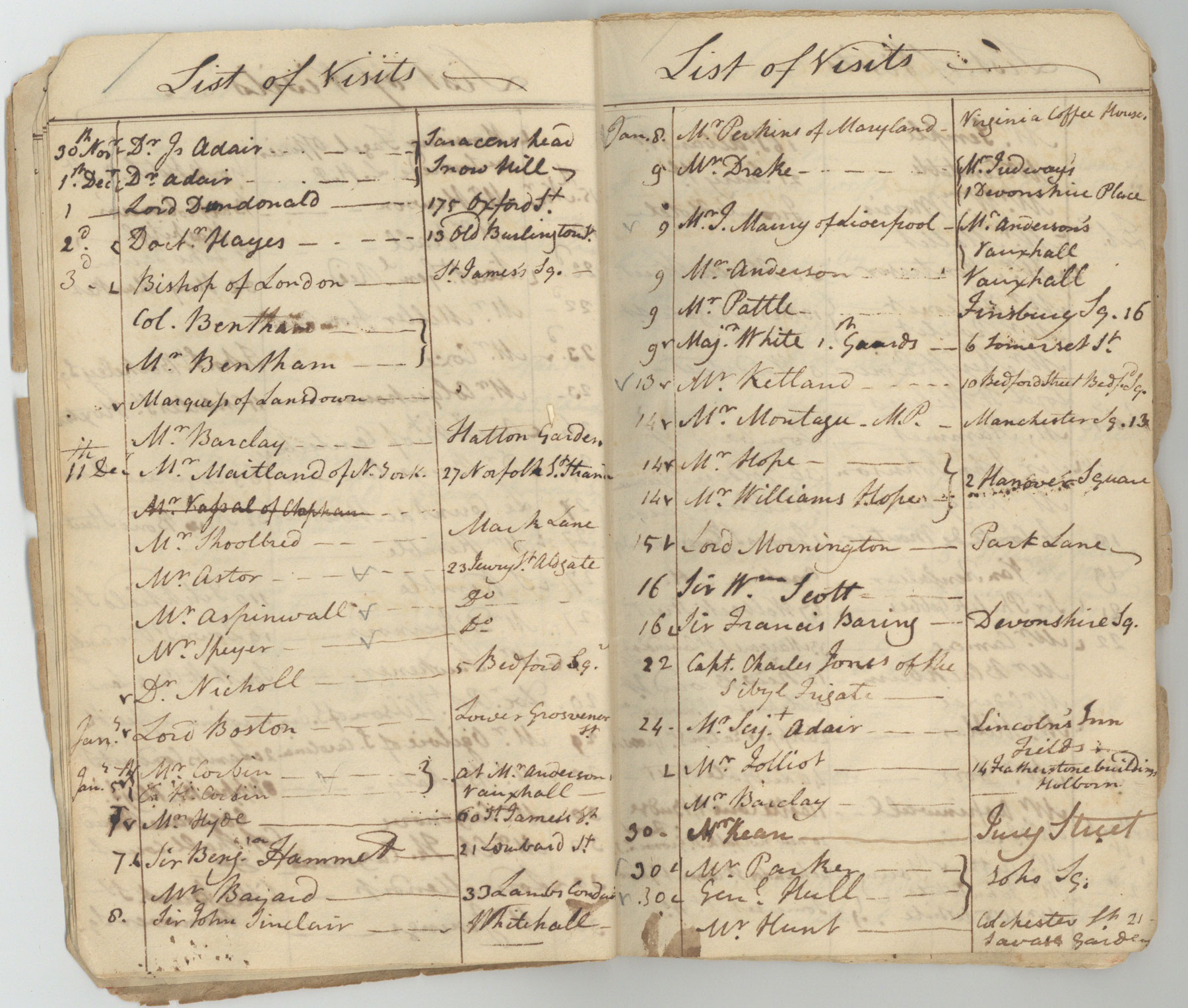
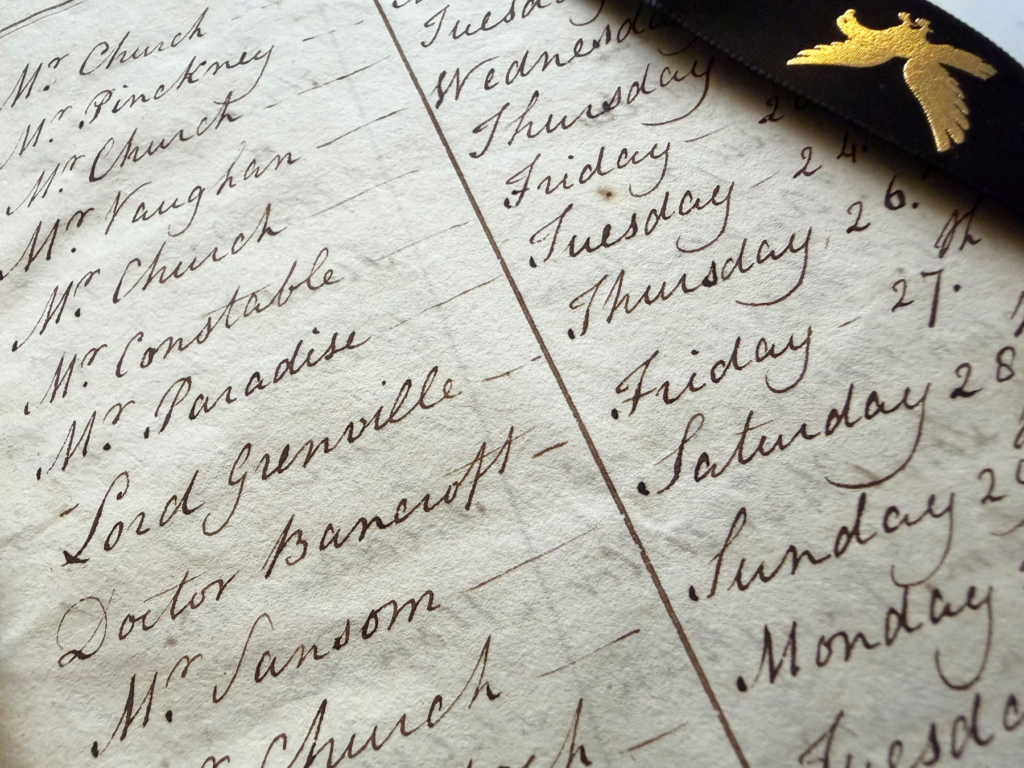
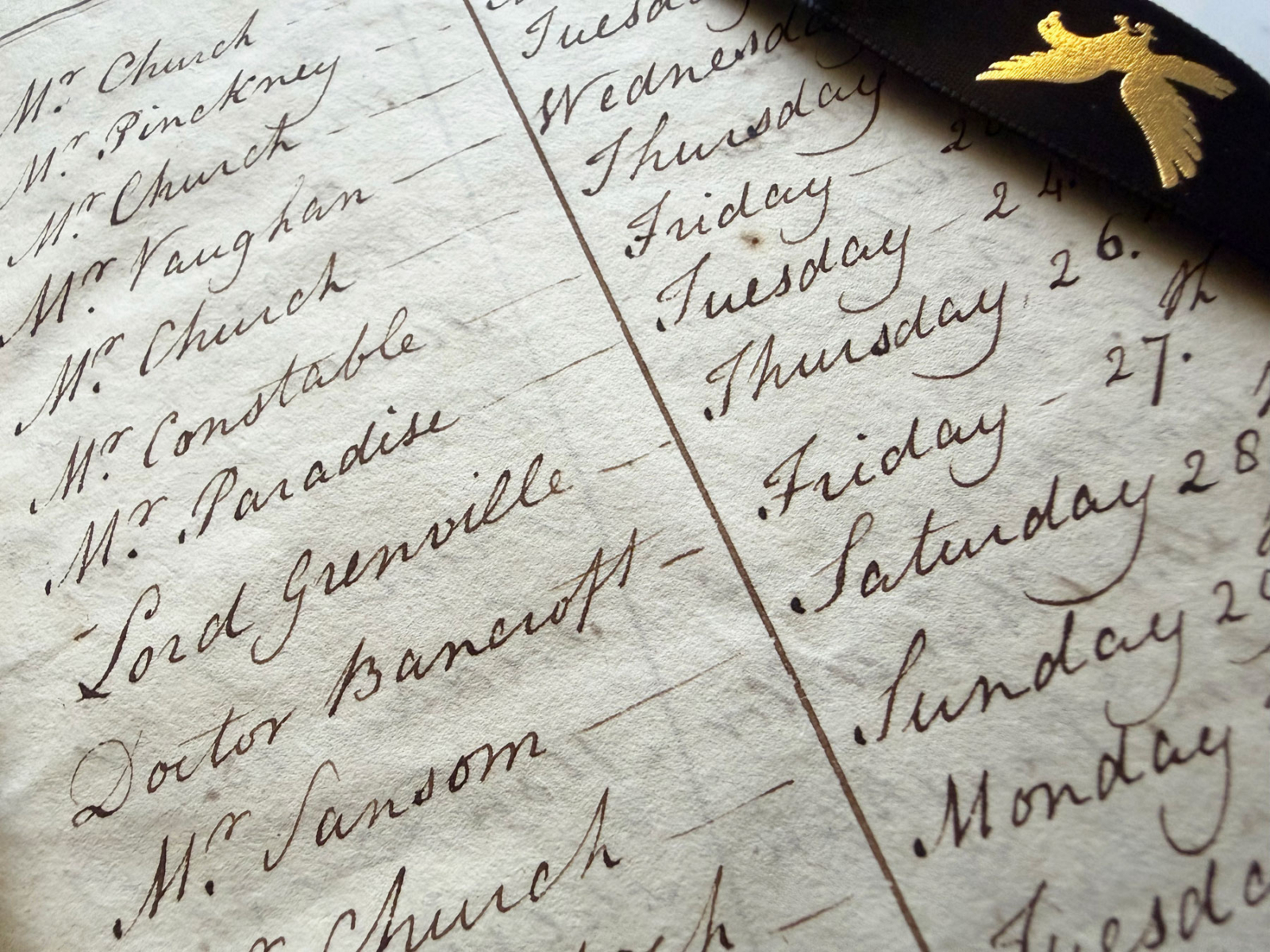
Listing up to 1,000 separate meetings with well hundreds of individuals, many if not most of the meetings newly disclosed here, showing day by day planning by and influence on negotiator John Jay
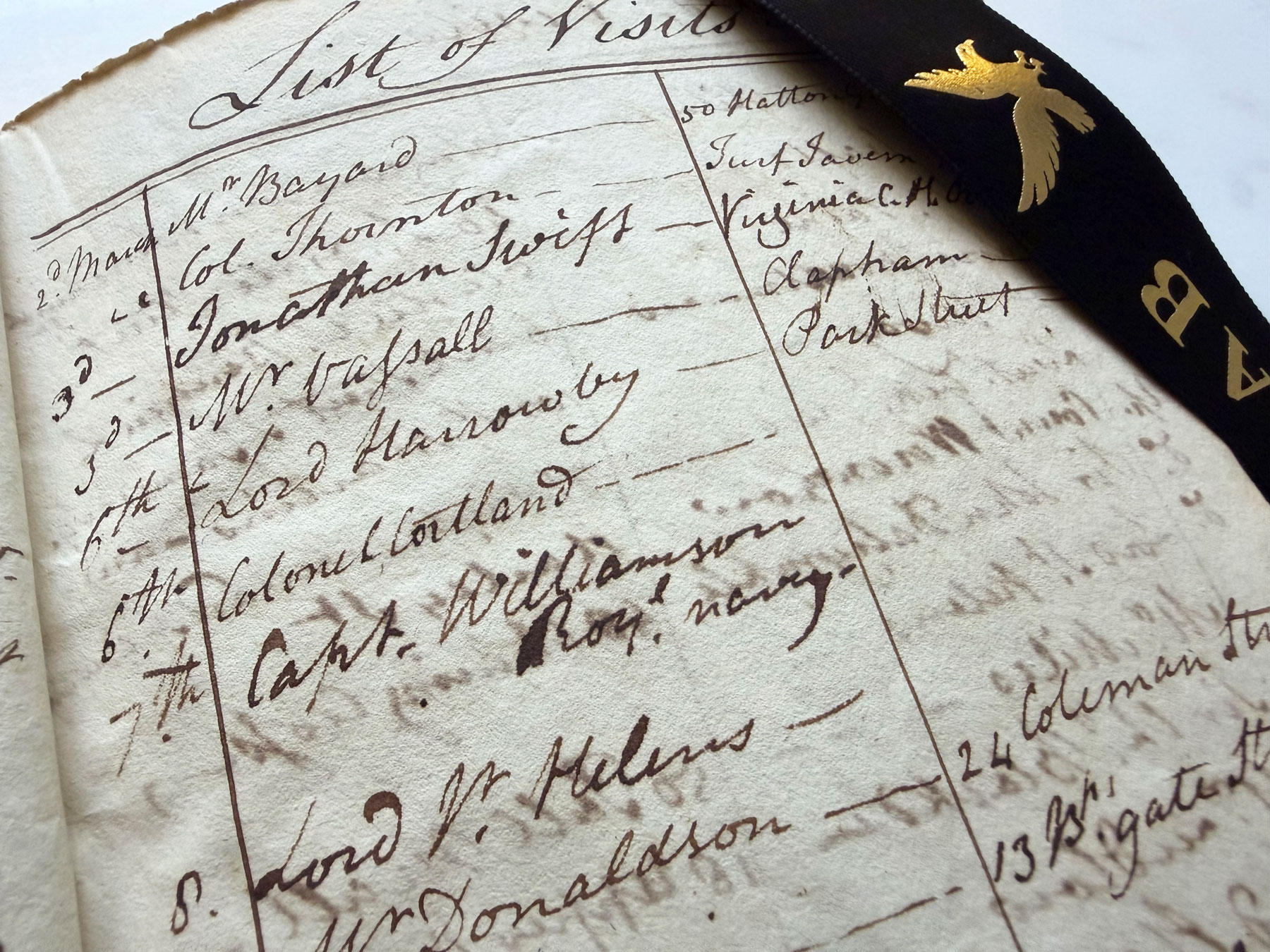
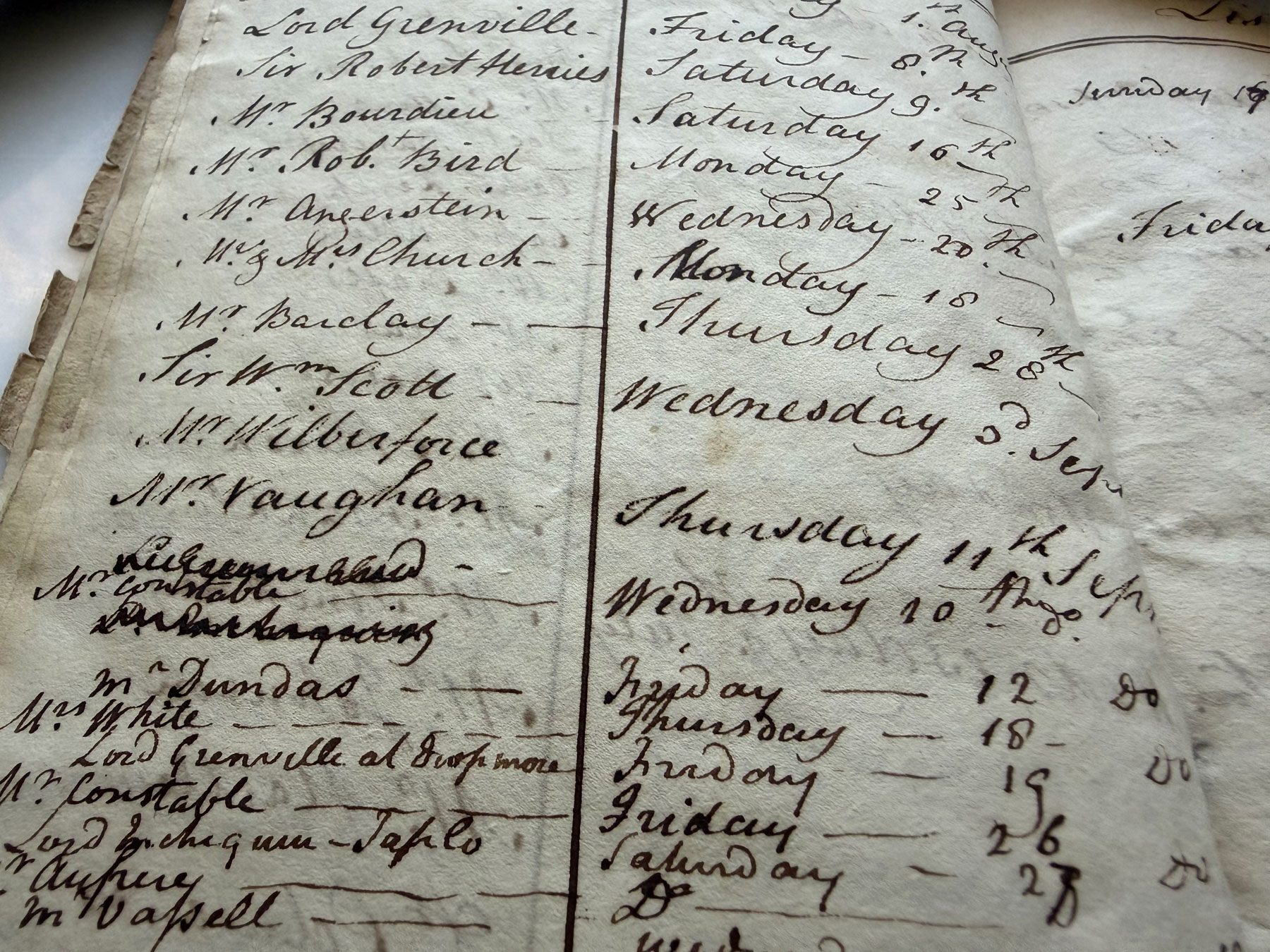
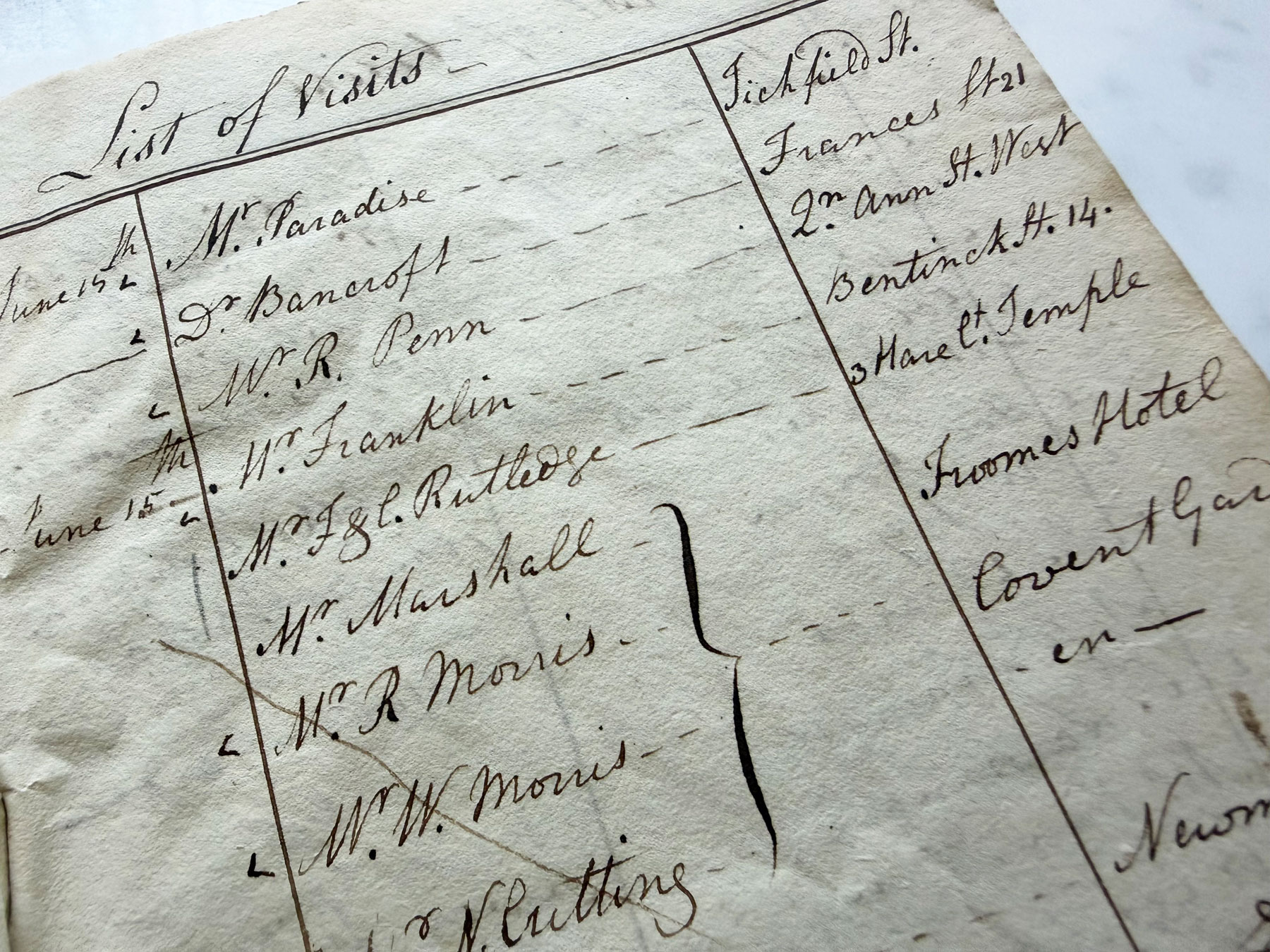
The entries, with meetings attendees, dates, and with corresponding location, give the most complete account to date of the efforts by Jay and are a fascinating glimpse into how America went about its major effort at international diplomacy under the Constitution
Diaries and other such first complete hand accounts of the Founding Fathers are in institutions; we are not aware of any other having reached the public market ever
Hear more on the Inspired by History podcast:
John Jay was appointed special envoy to Great Britain in 1794 at a moment when Anglo-American relations had become dangerously unstable and many feared that the United States might be drawn into war. Since the peace of 1783, major disputes with Britain had never been resolved: British troops still occupied western frontier posts they had agreed to evacuate, British agents continued supplying Native groups fighting American expansion in the Northwest, and British naval policy increasingly threatened American commerce after the outbreak of war between Britain and France. As Britain widened its definition of contraband and revived old wartime doctrines allowing seizure of neutral ships trading with enemy colonies, hundreds of American vessels were captured, cargoes condemned, and sailors mistreated or impressed, creating intense public anger in the United States. At the same time, domestic politics sharpened the crisis: many Republicans wanted commercial retaliation or embargoes, while George Washington and leading Federalists believed that negotiation offered the only realistic way to protect American interests without risking a conflict the young republic was unprepared to fight. Washington considered several possible envoys, including Alexander Hamilton, Thomas Jefferson, and John Adams, but Jay’s prior diplomatic experience made him the strongest candidate, even though he remained politically controversial, especially among Southern and Western senators who distrusted his earlier views on British debts, western posts, and navigation questions. Hamilton ultimately withdrew himself and urged that the mission be entrusted to Jay alone. Jay accepted reluctantly, fully aware that success would be difficult and that failure—or even compromise—would provoke criticism. The Senate confirmed him only after bitter debate, and he departed in May 1794 with broad discretionary instructions: seek compensation for American maritime losses, press Britain to fulfill outstanding obligations from the peace treaty, establish clearer protections for neutral trade, and, if possible, secure a broader commercial agreement—all while preserving peace and preventing the crisis from pushing the United States into open conflict.
The result would be the first international treaty under the new Constitution.
The Jay Treaty, officially titled the Treaty of Amity, Commerce, and Navigation, was a 1794 agreement between the United States and Great Britain designed to resolve lingering disputes from the American Revolution and avert another war. Negotiated by Chief Justice John Jay at the direction of President George Washington, the treaty sought to address several pressing issues: British forces still occupying frontier forts in the Northwest Territory, the seizure of American ships trading with France, unpaid prewar debts owed to British creditors, and unsettled boundary questions along the U.S.–Canada border. Under the treaty’s terms, Britain agreed to evacuate its western forts by 1796, and both nations established joint commissions to settle outstanding debts, boundary disputes, and maritime claims. In return, the United States granted Britain most-favored-nation trading status and limited access to American markets while receiving modest rights to trade in the British West Indies. Although the treaty helped secure peace and stabilize Anglo-American relations, it failed to address key grievances such as impressment of American sailors, fueling fierce domestic controversy. Federalists defended the treaty as a necessary act of diplomacy, while Jeffersonian Republicans denounced it as a betrayal of the Revolution’s ideals. Despite the uproar, the treaty narrowly won Senate approval in 1795, laid the groundwork for a decade of stable relations with Britain, and marked one of the earliest major tests of executive authority in foreign affairs under the new Constitution.
The Senate approved the Jay Treaty on June 24, 1795, and the United States ratified it on August 14, 1795. After Britain’s ratification on October 28, 1795, the two countries exchanged ratifications in London that same day.
The following is the brilliant summary created by the Papers of John Jay at Columbia University, which is reprinted here with minor amendments for brevity. All the events and people mentioned here are featured in the book, along with scores or hundreds of other meetings, which exist only in this diary.
“After a crossing of twenty-five days, Jay arrived at Falmouth on the evening of June 8, 1794. Accompanying Jay was his secretary, the painter John Trumbull; his eighteen-year-old son, Peter Augustus Jay; and his enslaved manservant, Peter (or Peet) Williams….Trumbull, who had served under Washington, was the son of Connecticut Governor Jonathan Trumbull Sr. He had important connections with Benjamin West, with whom he had studied. Peter Augustus, who was about to start studying law, proved to be charming and popular, a way for people to do favors for Jay by looking after his son….
“Awaiting Jay in London was the American Minister to Great Britain, Thomas Pinckney. Jay was sensitive to the fact that Pinckney may have resented his mission and made sure to consult Pinckney throughout the negotiation.
“Jay’s mission and his presence in London were immediately noted by both the government and the opposition press, usually to promote their respective political positions….
[The standard accounts of the Jay Treaty negotiations depict] a series of private one-on-one meetings with British Foreign Secretary William Grenville, resulting in the signing of the treaty on November 19, 1794. However, Jay’s letters and dispatches, his son Peter Augustus’s diary and letters, invitations and calling cards, newspaper accounts, and John Trumbull’s memoirs, reveal a more complicated series of events. Jay was reunited with the Shelburne circle that descended from William Petty FitzMaurice, 1st Marquess of Lansdowne. The circle surrounding William Petty FitzMaurice, 1st Marquess of Lansdowne—often still called the Shelburne circle from his earlier title—was one of late eighteenth-century Britain’s most intellectually ambitious political networks: it brought together aristocrats, economists, reformers, diplomats, merchants, and imperial thinkers who favored a flexible, commercially minded vision of empire rather than rigid coercion. Emerging most clearly during and after the negotiations ending the American Revolutionary War, the group included men sympathetic to freer trade, administrative reform, and pragmatic accommodation with the new United States, and it remained influential in London even after Shelburne became Lansdowne. By the time John Jay arrived in 1794, many figures in that orbit—whether directly tied to Lansdowne or shaped by its outlook—still formed an important conversational environment for diplomacy, offering Jay access to elite opinion outside formal ministry channels while reinforcing the idea that Anglo-American relations could be stabilized through law, commerce, and negotiated adjustment rather than continued imperial hostility.
Life in London
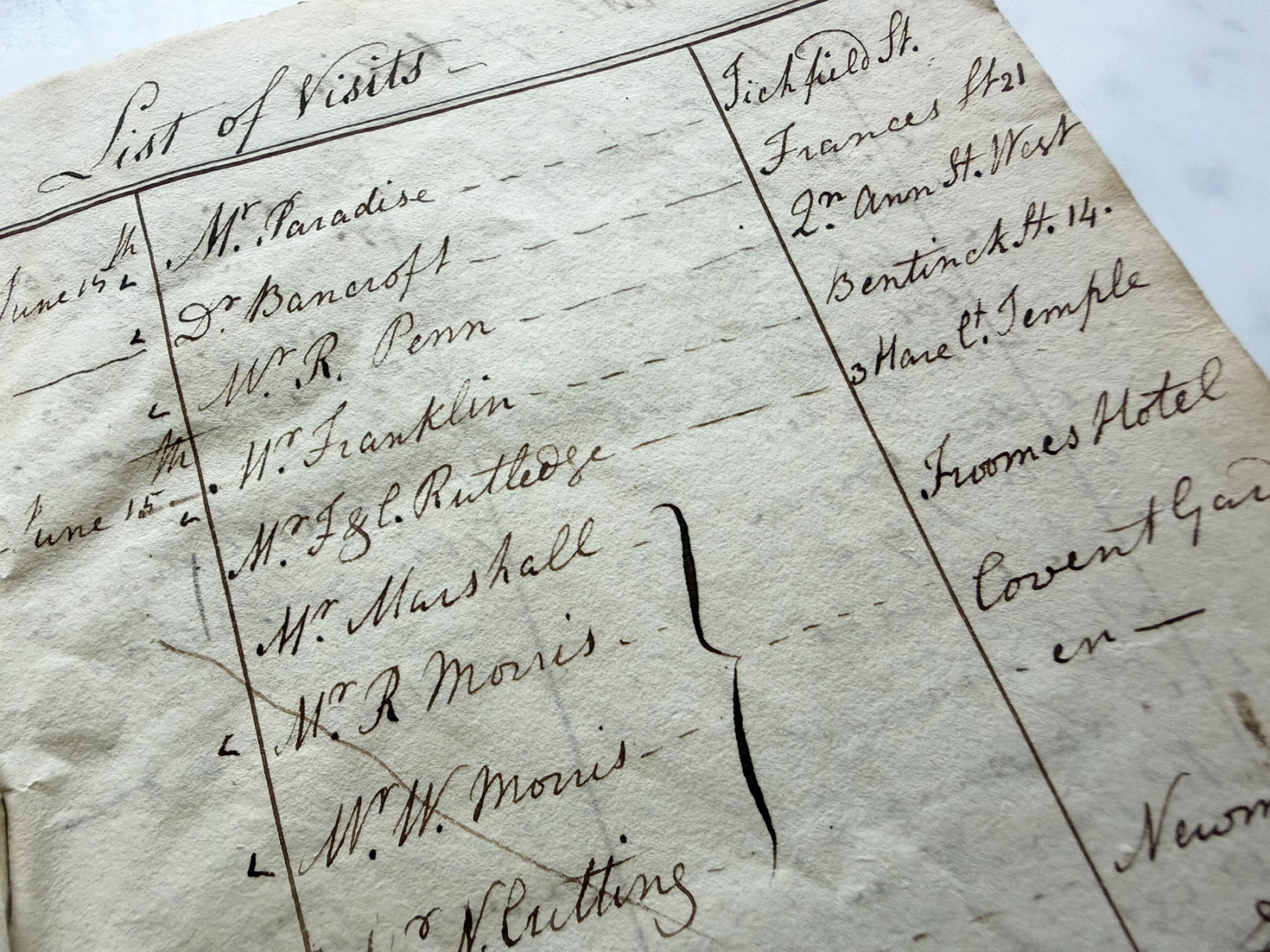
We have previously been able to piece together Jay’s negotiation timeline through Peter’s journal, “surviving calling cards; invitations to play cards, attend the theater, and dine; and lists of calls made and received show the mixture of business and pleasure in their socializing. John Julius Angerstein, John Sinclair, Jeremy and Samuel Bentham, Joseph Banks, Richard and Mary Penn, Charles Blagden, Benjamin West, John Singleton Copley, Thomas Brand Hollis, Elizabeth Montagu, Baron and Lady Inchiquin, John and Lucy Paradise, Ralph Payne and Lady Frances Payne make frequent appearances, as well as Lord Amherst and Lady Amherst. Cabinet ministers and the international diplomatic corps are represented. And, of course, the merchants and bankers with an interest in the outcome of the treaty and the American trade predominate: merchants such as John and Alexander Anderson (West Indies, slave trade), John Blackburn, John Brickwood, Patrick Colquhoun; Alderman Harvey Christian Combe and Joseph Delafield, brewers; the Murray family, Effingham Lawrence, James Bourdieu, and William Manning; bankers, such as David Barclay, Alexander and Francis Baring, Thomas Coutts, William Curtis, Robert Herries, and representatives of Hope & Co. and Bird, Savage, & Bird. These companies would play key roles in the treaty implementation. [Meetings with all of these men and firms are referenced throughout the diary.]
“Soon after Jay’s arrival in Falmouth, he notified the Foreign Secretary William Grenville and the American Minister, Thomas Pinckney, and began the trip to London, which he reached on June 15. Three days later, he presented his commission to Grenville… On 20 June, Jay presented Grenville his general power, after which the two men arranged [their first formal] meeting on June 27…. [This meeting is in the diary]
“On 18 July, Jay wrote Hamilton: “Shortly after my arrival I dined with Lord Grenville [This meeting is in the diary]; the cabinet Minister were present, but not a Single Foreigner. On Monday next I am to dine with the Lord Chancellor, & on next Friday with Mr. Pitt [This meeting is in the diary]. I mention these Facts to explain what I mean by favorable appearances. I think it best that they should remain unmentioned for the present and they make no part of my Communications to Mr. Randolph or others. This is not the Season for such communications—they may be misinterpreted, tho’ not by you.” Peter’s diary makes mention of multiple dinners with Pitt and other cabinet members, both during the treaty negotiations and afterward.
“Mid-September 1794 proved a crucial point in the negotiations, as the treaty was at this time two separate treaties—one to settle differences of the Treaty of Peace and the other to resolve commercial issues. Peter Augustus recorded in his diary that on 12 Sept., “We dined with Mr. Dundas at Wimbleton in company with Mr. Pitt, the Lord Chancellor [Lord Loughborough], & Lord Macartney [This meeting is in the diary] who has lately arrived from China, & who told us many interesting facts relating to that country”. A week later, Jay and his son spent the weekend at Grenville’s seat at Dropmore [This meeting is in the diary]. Among those who dined with them there were Loughborough, Lord Mornington, Lord and Lady Inchiquin, Lord and Lady Boston, Count Starhemberg, and a Miss Eardley. Shortly thereafter, the plan for the conjoined treaty appears to have been made.
“October brought about another critical juncture. The issues of legal rights and the introduction of evidence from one nation to the other would be important in the arbitration of the claims cases. Loughborough invited Jay to dine [This meeting is in the diary], with Peter and Trumbull, asking that he arrive early in order to discuss the matter on the 11th. Pitt was also in attendance.
Old Friends and Radical Politics
“Among the Jays’s first visitors on their arrival in London were John and Angelica Schuyler Church. Angelica, now famous as the sister-in-law of Alexander Hamilton, was a daughter of General Philip Schuyler, a friend and kinsman of Jay (their mothers were cousins), and one of his chief political supporters. She was known for her kindness to Americans in London…
“Shortly after his arrival, Jay received a letter from Sarah Vaughan, the wife of politician Benjamin Vaughan. Jay became friends with the Vaughans during the peace negotiations….
Wilberforce and Abolition
“Politics, personal interests, and official business often overlapped. In his diary of July 7, 1794, William Wilberforce records dining [with Jay] at the home of Quaker merchant banker Samuel Hoare Jr. [This meeting is in the diary] Hoare shared Wilberforce’s political and ethical beliefs. An independently minded Whig, Wilberforce was a member of Parliament and intimate ally of Pitt’s, and had become increasingly critical of the British war with France—despite his relationship with Pitt—while his evangelicalism and opposition to the slave trade grew. The dinner was held specifically to introduce Jay and Wilberforce. He found the Jay party to have “Simplicity of manners—” and to be “very pleasing well inform’d Men—”. Peter’s diary records dining with Wilberforce several times, and the two men continued to meet in other circumstances. On December 22, [This meeting is in the diary] Wilberforce records having breakfast with Jay “tête–à–tête” and “heard openly his opinion in Politics Friend to Peace— Many American War Anecdotes— He swore when grew more easy—.” The two would continue to correspond on social issues well into the nineteenth century.
“Aside from entertaining, Jay made sure to perform favors and dispense advice to his acquaintances, old and new. Peter’s diary records numerous dinners and theater visits with the Penns and Lord Amherst, and Jay offered advice to both parties on the status of the properties that they had possessed in North America….
“Similarly, Lord and Lady Amherst initiated a social relationship with the Jays through invitations and the gift of a well-known engraving that depicted Lord Amherst as commander-in-chief of British forces during the Seven Years’ War….
The United States’ diplomatic relationship with France and the presence of James Monroe as minister there put Jay in the position to help those seeking information on missing friends and relatives and to aid in returning them to England. For example, Richard Wellesley, the Earl of Mornington, soon to be Governor-General of India, enlisted Jay’s service in an attempt to bring home his sister Anne Fitzroy and brother Henry Wellesley , who had been captured by the French when attempting to return from Portugal. In an effort to release the pair, Jay apparently offered informal advice to Mornington and also passed along letters—though not in an official capacity. These endeavors were seemingly successful, as Mornington’s siblings managed to return to England in January 1795.
“Jay’s hopes for a quick return to America were not realized as two developments thwarted any hope of a speedy settlement: the first being the creation of a coalition between Pitt and the Portland Whigs in July and the second being the ongoing war with France. The Treaty would not be signed until November 19, 1794. Jay decided against a dangerous winter voyage and spent the rest of his stay in London setting up the Spoliation Commission with Samuel Bayard and John Trumbull, all the while continuing a busy social schedule. Jay would not be able to leave London until April 1795.
The Jay diary
The Jay diary provides an unprecedented look into the negotiations and strategy of the first ever Treaty entered into under the US Constitution, in the hand of the first negotiator, and it contains all the above and countless more events and people. It has never been published and it has remained in the family until now.
It allows us to track Jay’s actions from the moment he arrived in England (the first date is June 15) until he left in mid 1795 (the last date is April 9).
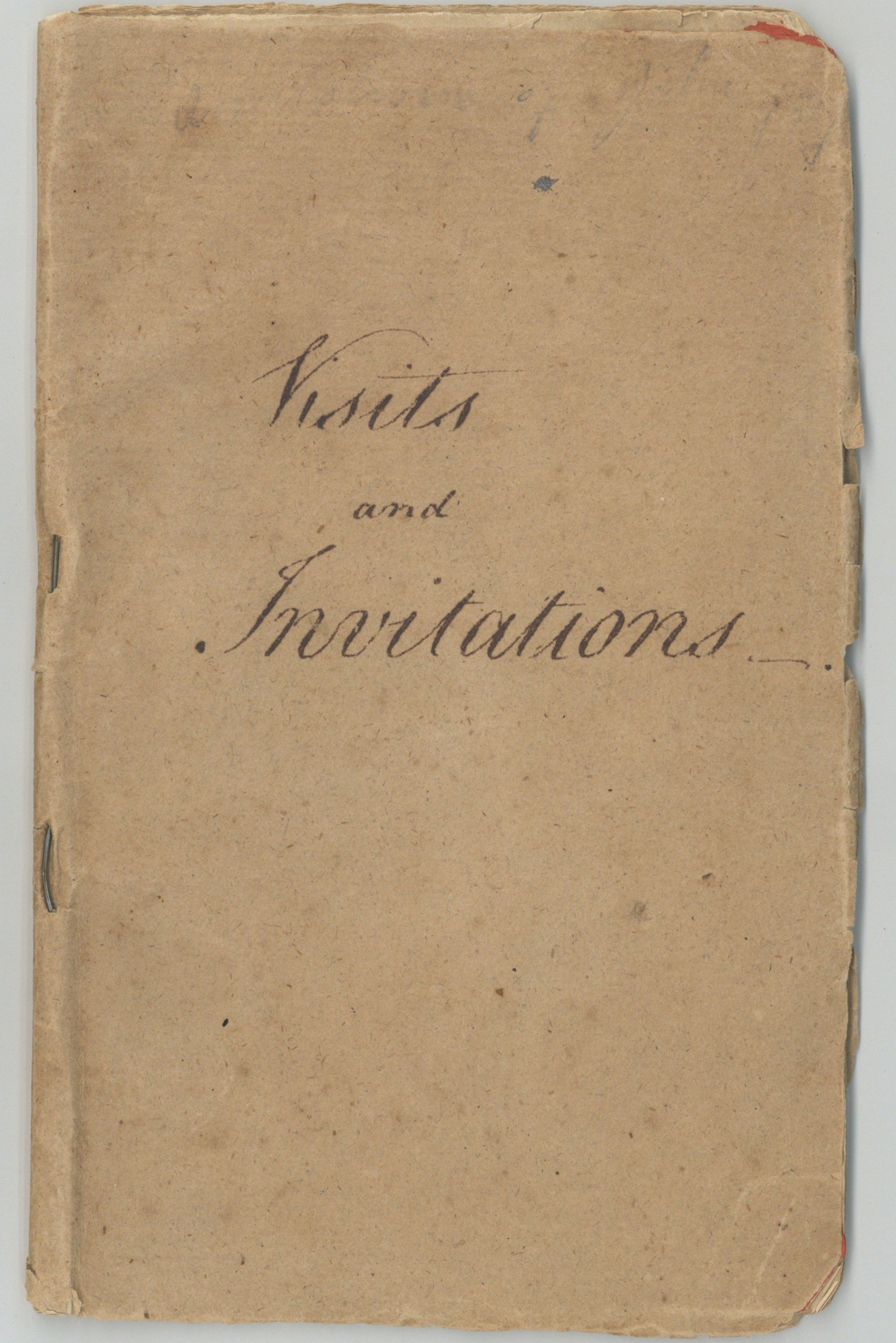
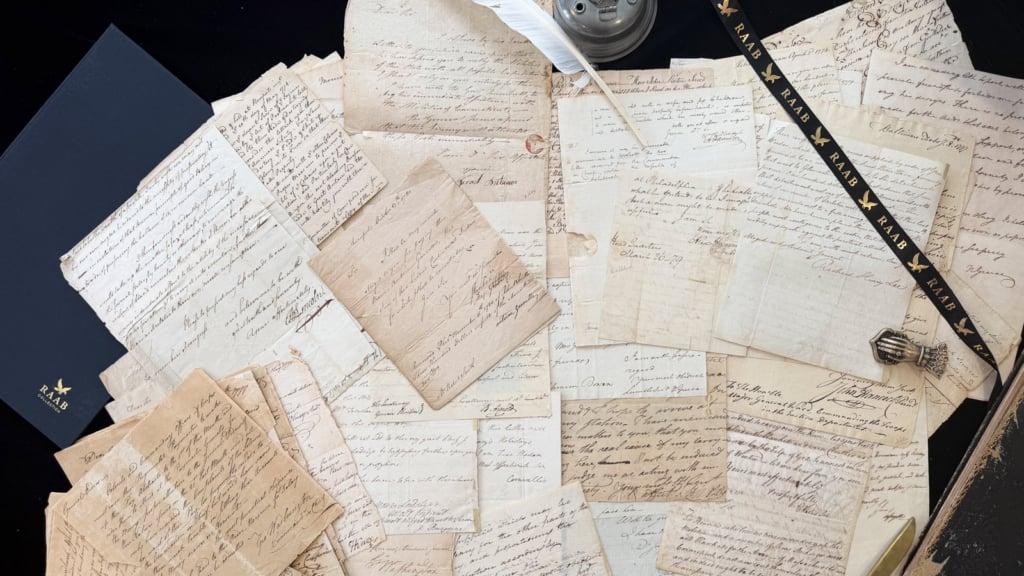
18 leaves, 36 pages, nearly all full, single gathering, 12mo (18 cm). Watermark extending through first four and final four leaves, bound by two staples.
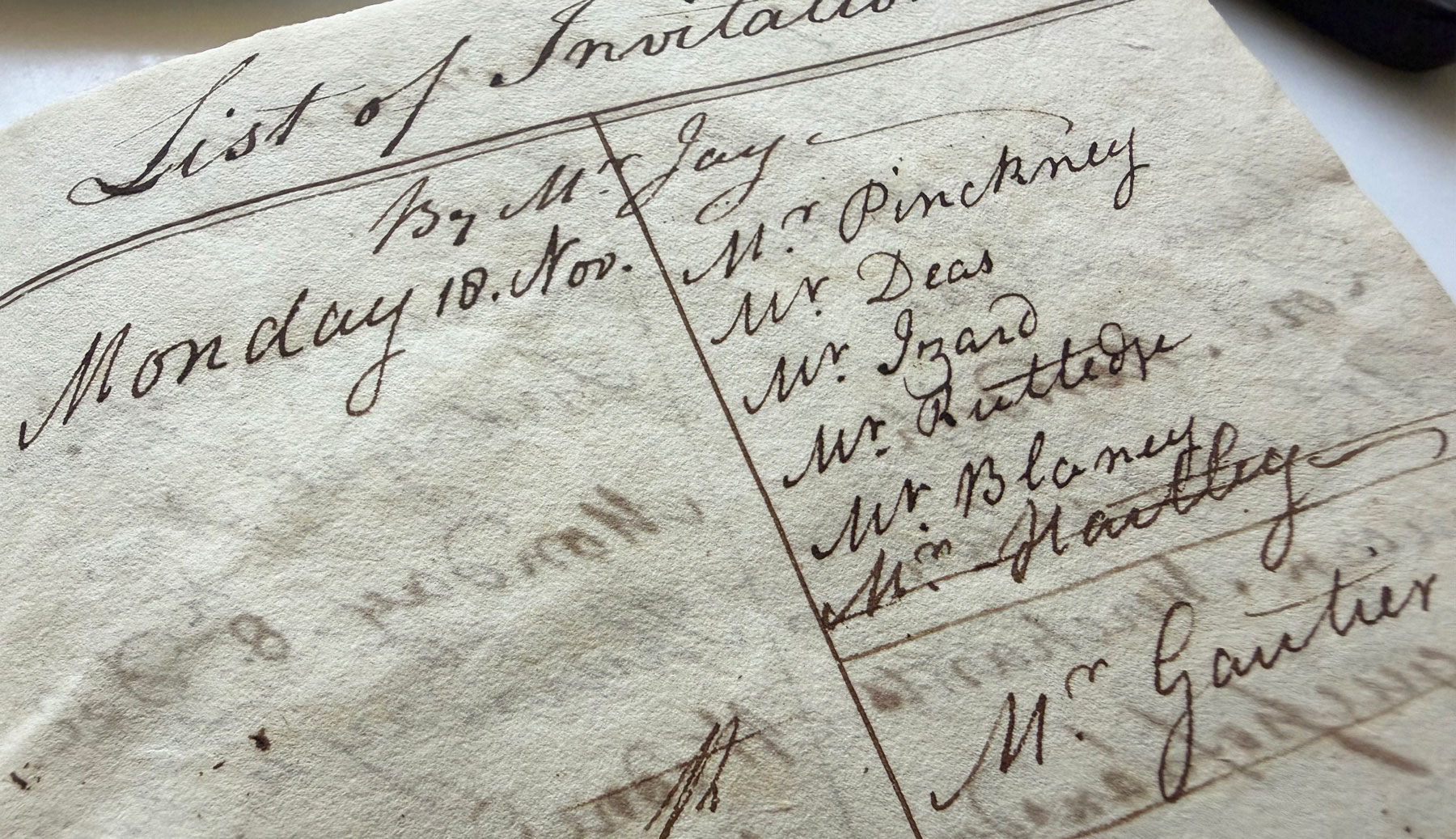
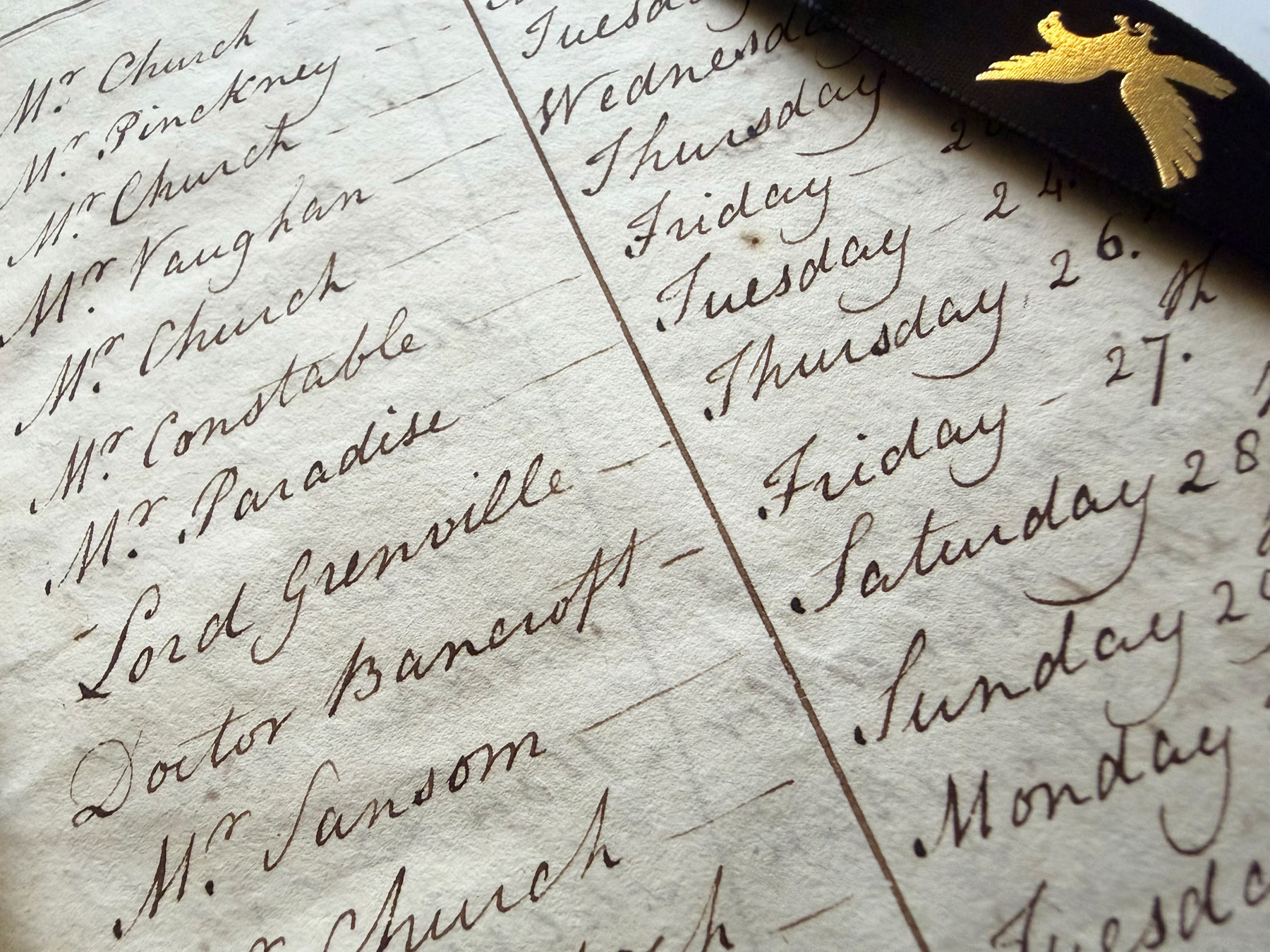
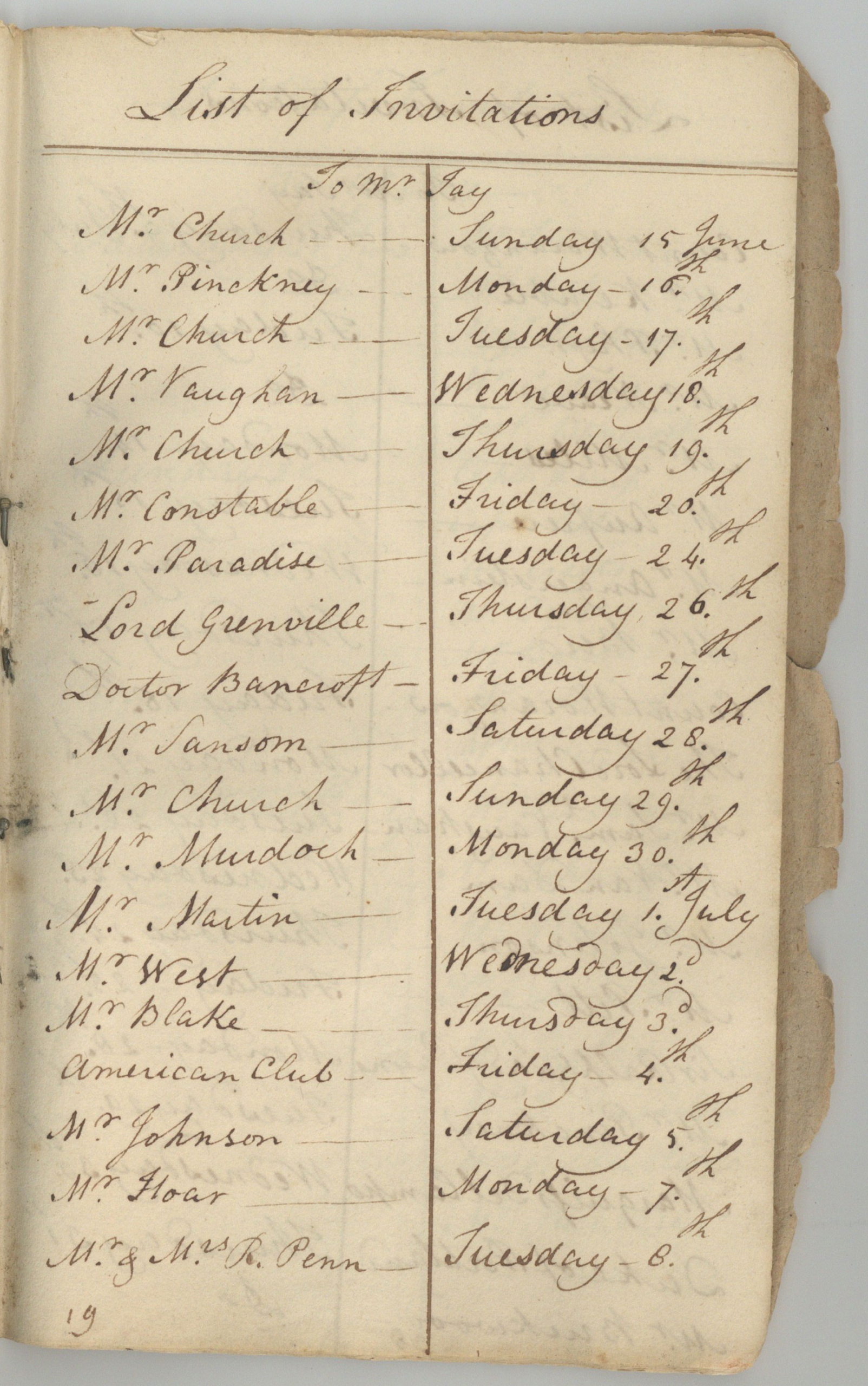
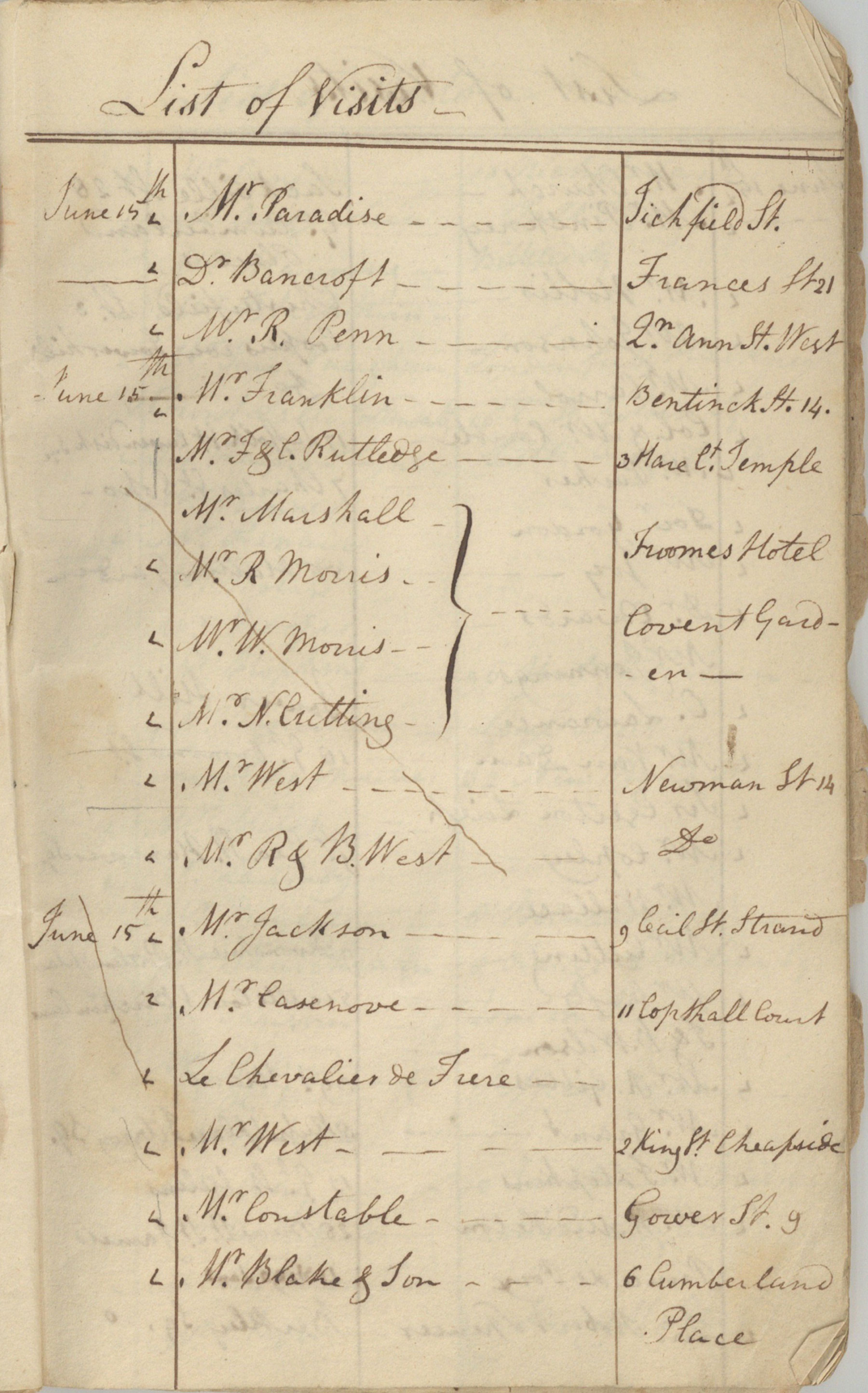
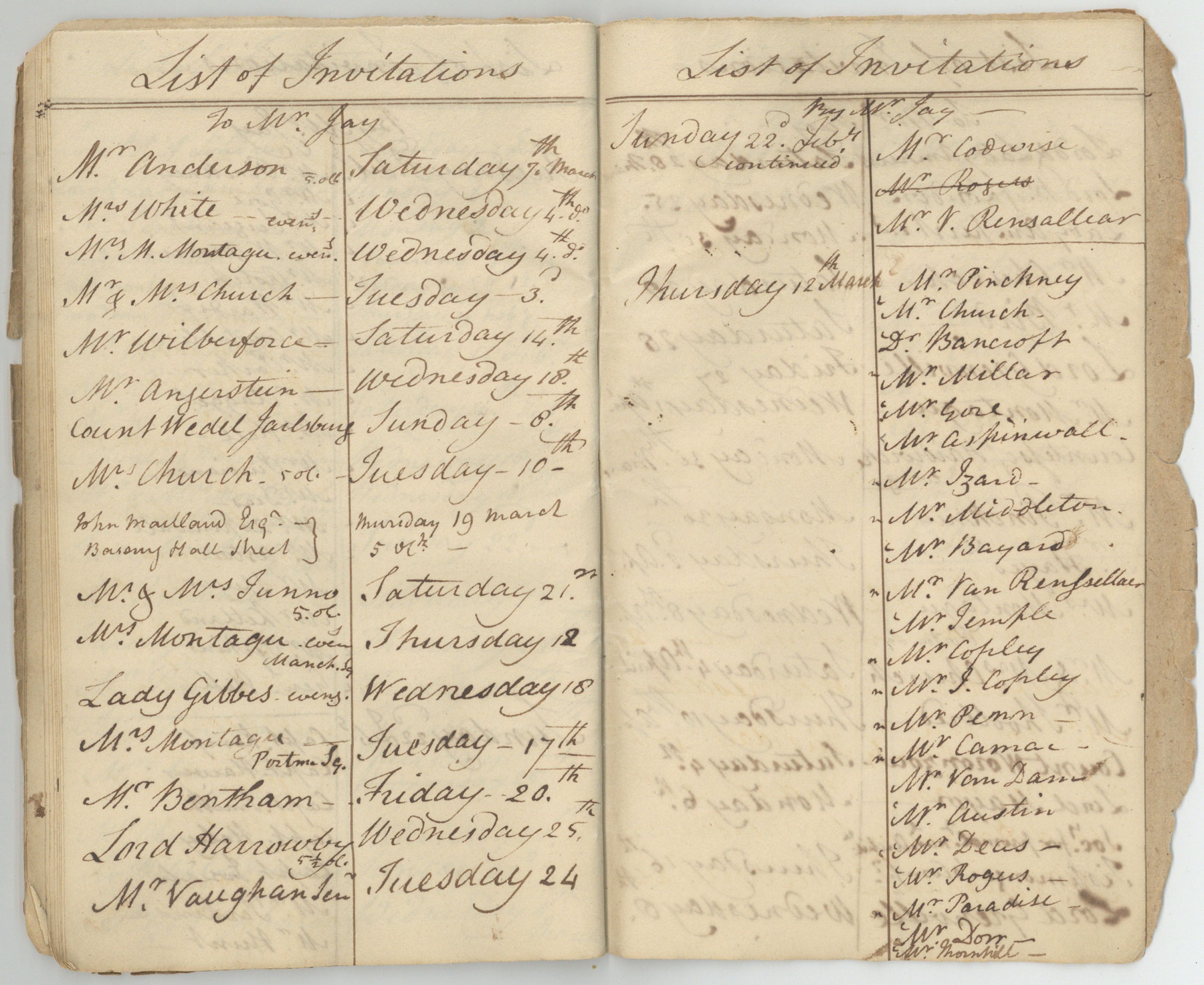
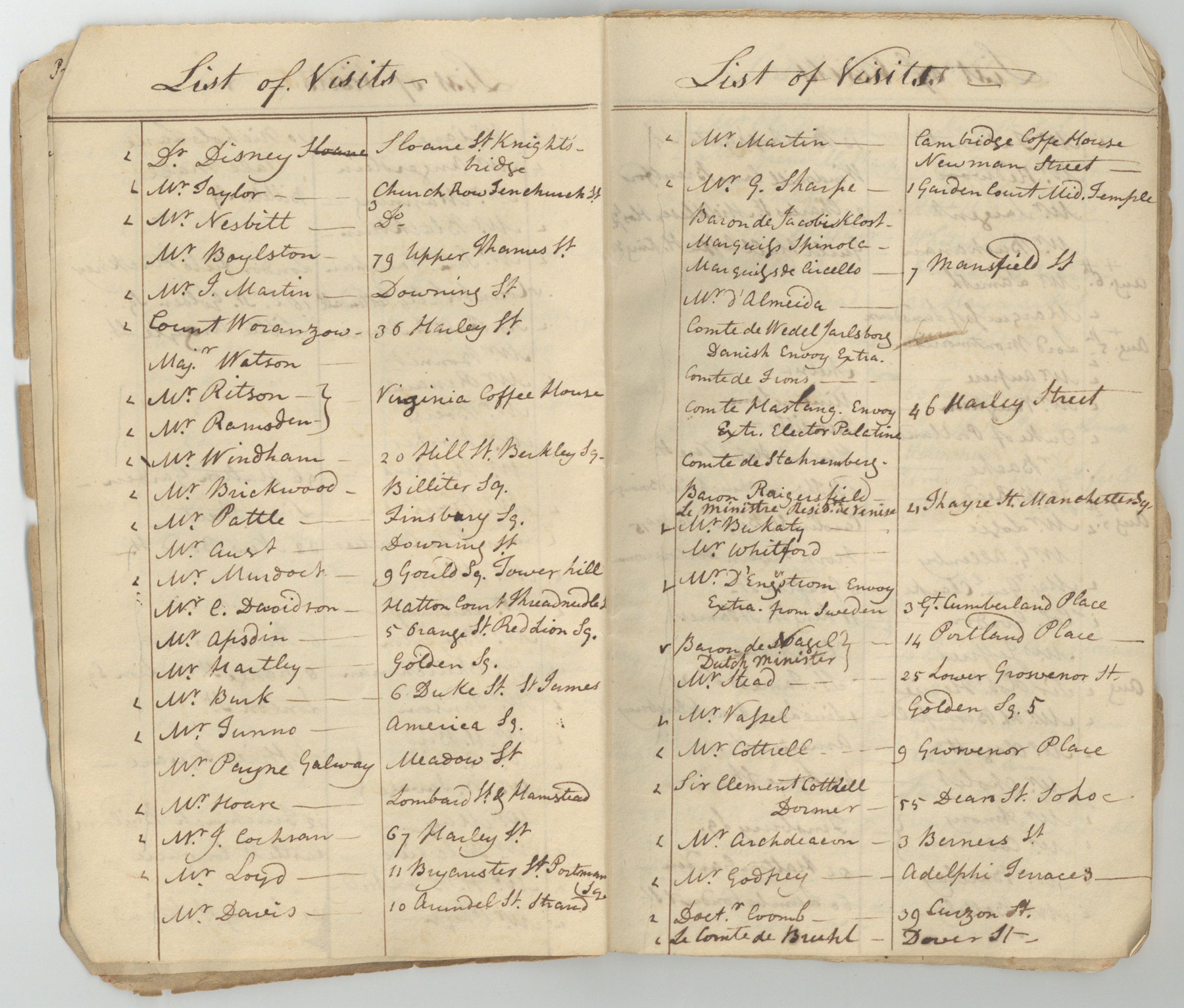
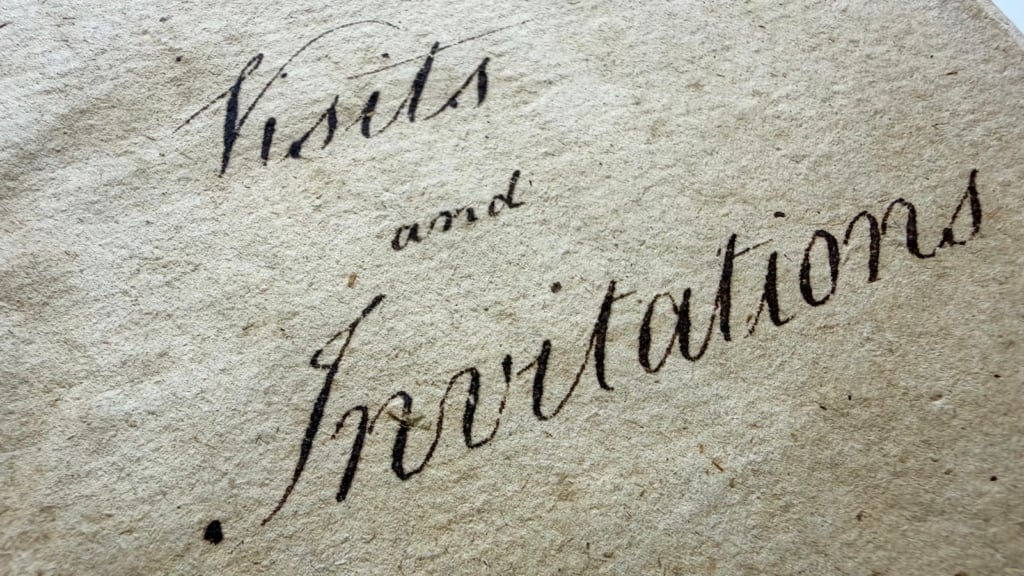
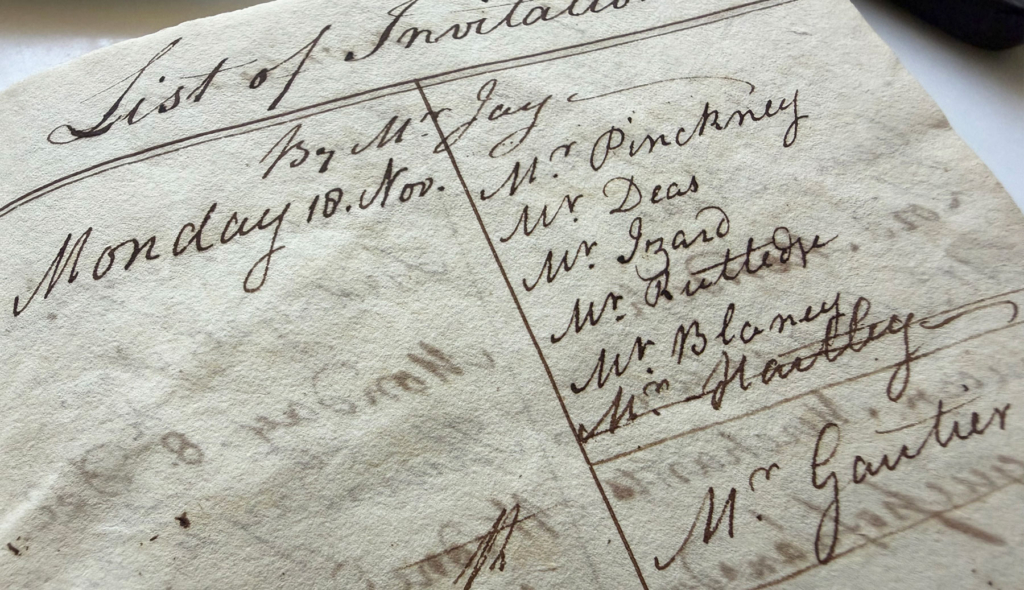
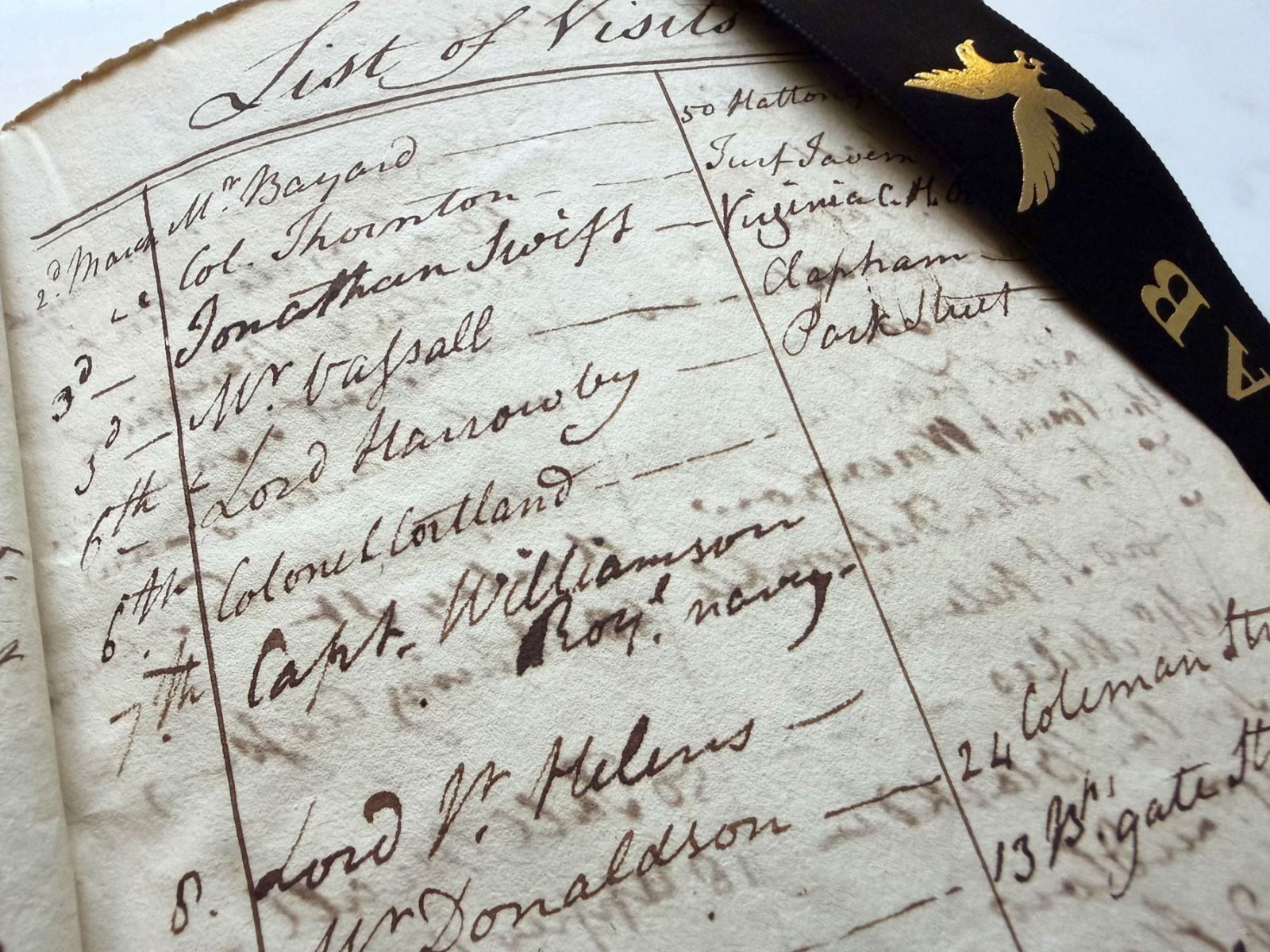
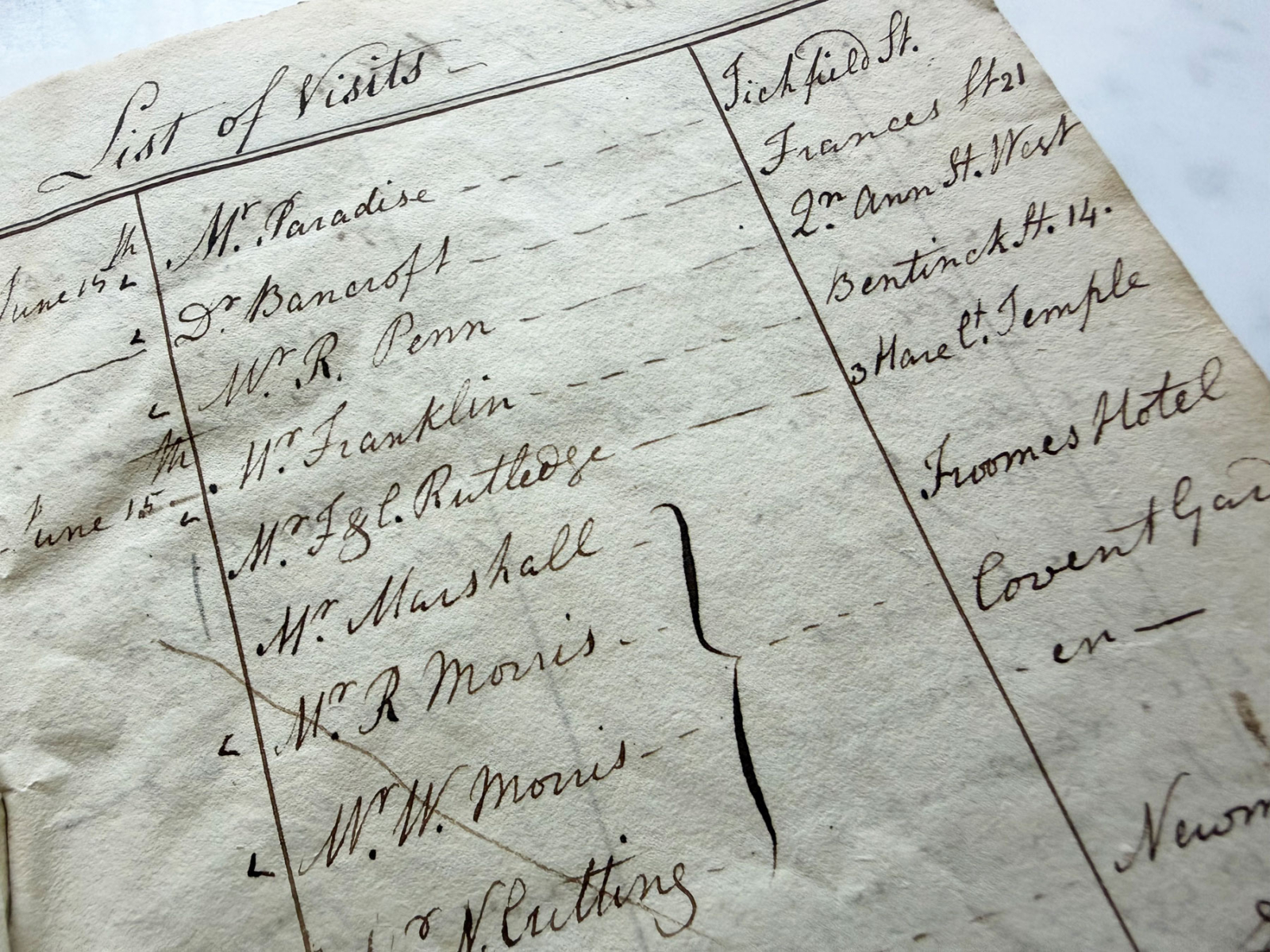
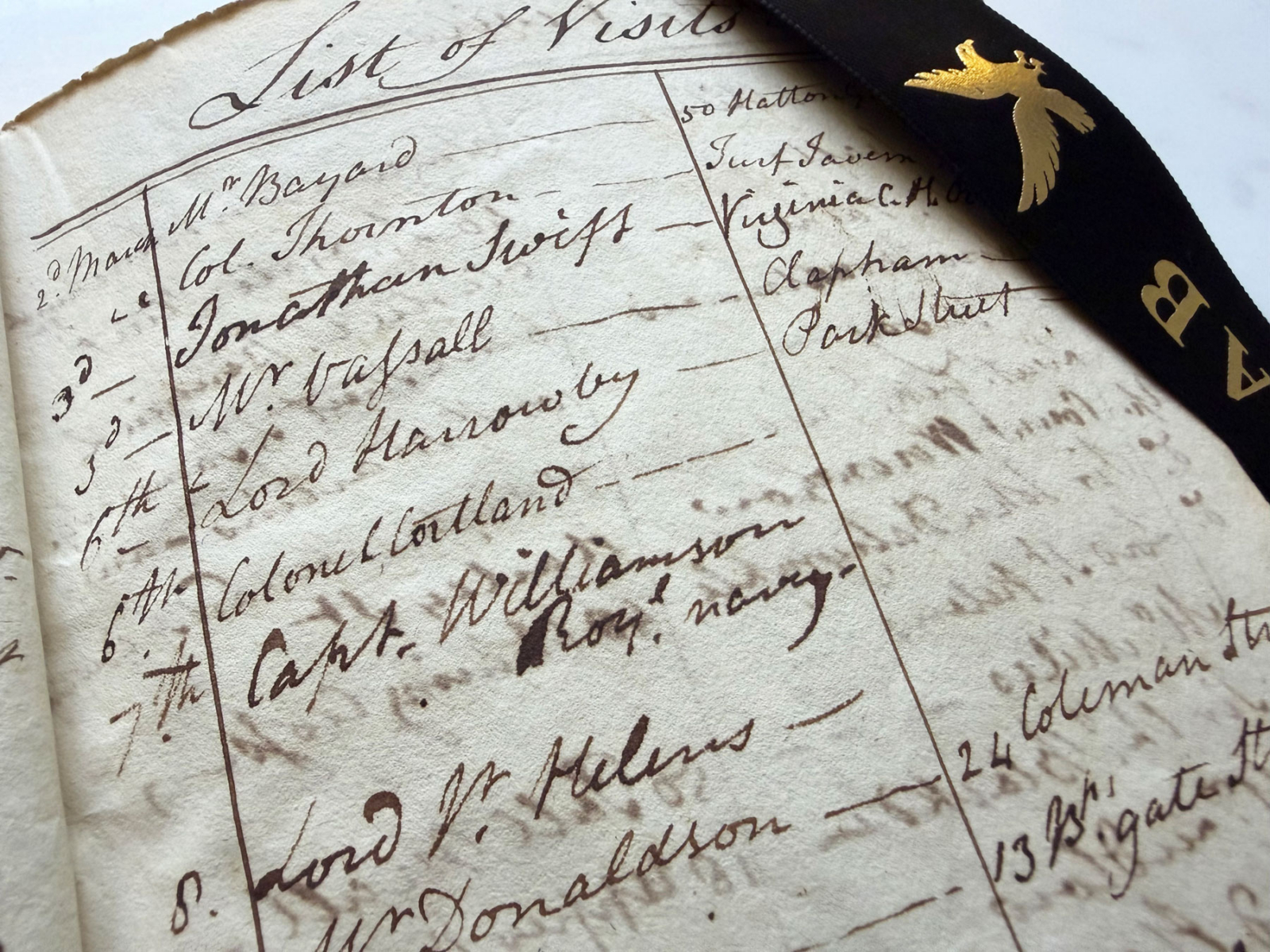
Jay has divided the book into 3 separate sections: “Visits;” Invitations issued to Jay; Invitations issued by Jay. The latter two are accompanied by dates throughout. The “visits” are at the start undated, though Jay soon found it necessary to include dates.
From our present vantage point, we can further divide the book into 3 stages:
– Arrival and introduction into London society
– Intense negotiations
– Post Treaty
Jay’s arrival – From John Singleton Copley to Thomas Pinckney to Robert Morris to Lord Grenville, etc…
Jay’s first days are a fascinating glimpse into his efforts to commence the negotiation: meet friends, make connections, gather intelligence and announce his arrival to his partners. His pace appears frenetic. There are close to 1,000 meetings listed in this book.
He met the first day with close friend John Barker Church, who would remain a close political ally and negotiating partner. The second day, he met with Thomas Pinckney, the American representative in London, on this arrival and would meet with him regularly. Within 10 days, he had the above mentioned meeting with Lord Grenville. The book notes that the invitation arrived on the 26th.
The first month or so shows the breadth of his many contacts. He met with Robert Morris, to whom he gave intelligence and updates to carry back with him to the US. He had diplomatic contacts. The book reveals he met many times with Semyon Vorontsov, Russian ambassador at London, a major diplomatic figure whom Jay regularly encountered in elite diplomatic circles.
Within a week of his arrival, he had met Benjamin West, the great painter, inviting him to visit on June 21. He received visits from a variety of people, friends and others who greeted him. In some cases, he met with close friends, like William Penn, Jr., Nathaniel Cutting, Edward Bancroft, John Singleton Copley, Granville Shape, etc… They offered connections to political and social life in London that would prove instrumental for Jay.
He celebrated July 4 with the American Club in London. And met with Messrs. Hoard and Wilberforce on the 7th.
And he met with many merchants and those with economic interests in the outcome, such as the firm of Bird, Savage and Bird, which offered their financial support and played a role in the implementation of the final treaty.
Negotiation – From The Lord Chancellor to Lord Grenville to the London diplomatic to the commercial and merchant interests to Prime Minister Pitt, etc.
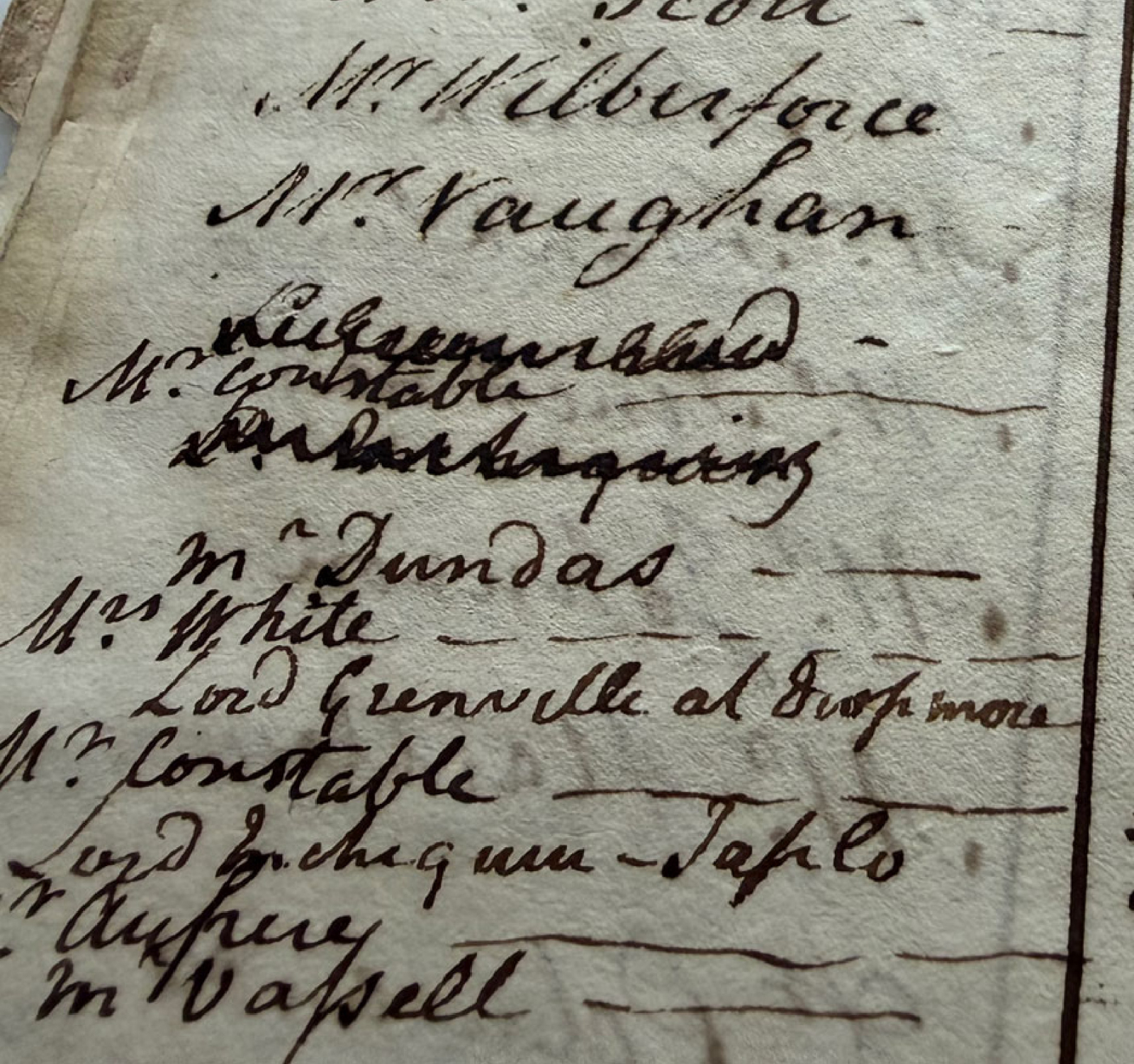
By July, the pace of negotiations quickens. He meets with George John Spencer, a British cabinet member. On July 21, he receives an invite from Lord Loughborough, The Lord Chancellor; then on July 25, he receives an invite from the Prime Minister, William Pitt the Younger; then on the 31st from the Duke of Portland, William Cavendish-Bentinck, senior cabinet member under Pitt. He meets with William Windham, another member of Pitt’s cabinet. And there are at least 5 separate references to meetings with Lord Grenville, his immediate negotiating partner.
At some point in mid summer, you see the extent to which he attempts to make this an international affair, arranging meetings in short succession with Baron de Jacobi Klost, envoy and minister plenipotentiary from the King of Prussia, Marquis de Circello, envoy extraordinary and plenipotentiary from the Kingdom of the Two Sicilies, Marchese Cristoforo Vincenzo de Spinola, envoy extraordinary and minister plenipotentiary from the Republic of Genoa, João d’Almeida de Mello e Castro, Portugal’s minister to Great Britain, Count Frederik Christian Wedel-Jarlsberg, minister extraordinary from the Kingdom of Denmark and Norway, Count de Haslang, envoy extraordinary from Bavaria and the Elector Palatine, Baron Raigersfield of Venice, Lars von Engeström, Swedish minister, Baron van Nagell van Ampsen, ambassador extraordinary and plenipotentiary from the States-General (Netherlands), Aloys Friedrich, Graf von Bruhl, privy councilor and envoy of the Elector of Savoy
Because Jay has listed dates for those invitations he received and those he extended, as well as “visits,” which starting in August are dated, you can track them all side by side and watch for the flow of negotiations. Indeed a full examination would require consulting all 3 sections. For example, on August 5 he meets with Cabinet member the Duke of Portland at Picaddily, William Petty FitzMaurice, 1st Marquess of Lansdowne, a major figure and former prime minister on August 6, and on August 8 receives an invitation from Lord Grenville. That same week he meets with merchants David Barclay, Robert Herries, and others. As the pace quickens, on September 5, he references an invitation from Thomas Pinckney, on the 11th an invitation from the Lord Chancellor and the 19th a meeting with Lord Grenville at Dropmore.
The final month before the Treaty saw him meeting with a variety of people. He met 3 times with Pinckney, twice with Church, once with Copley. He met with the Lord Chancellor, and the Lord Mayor.
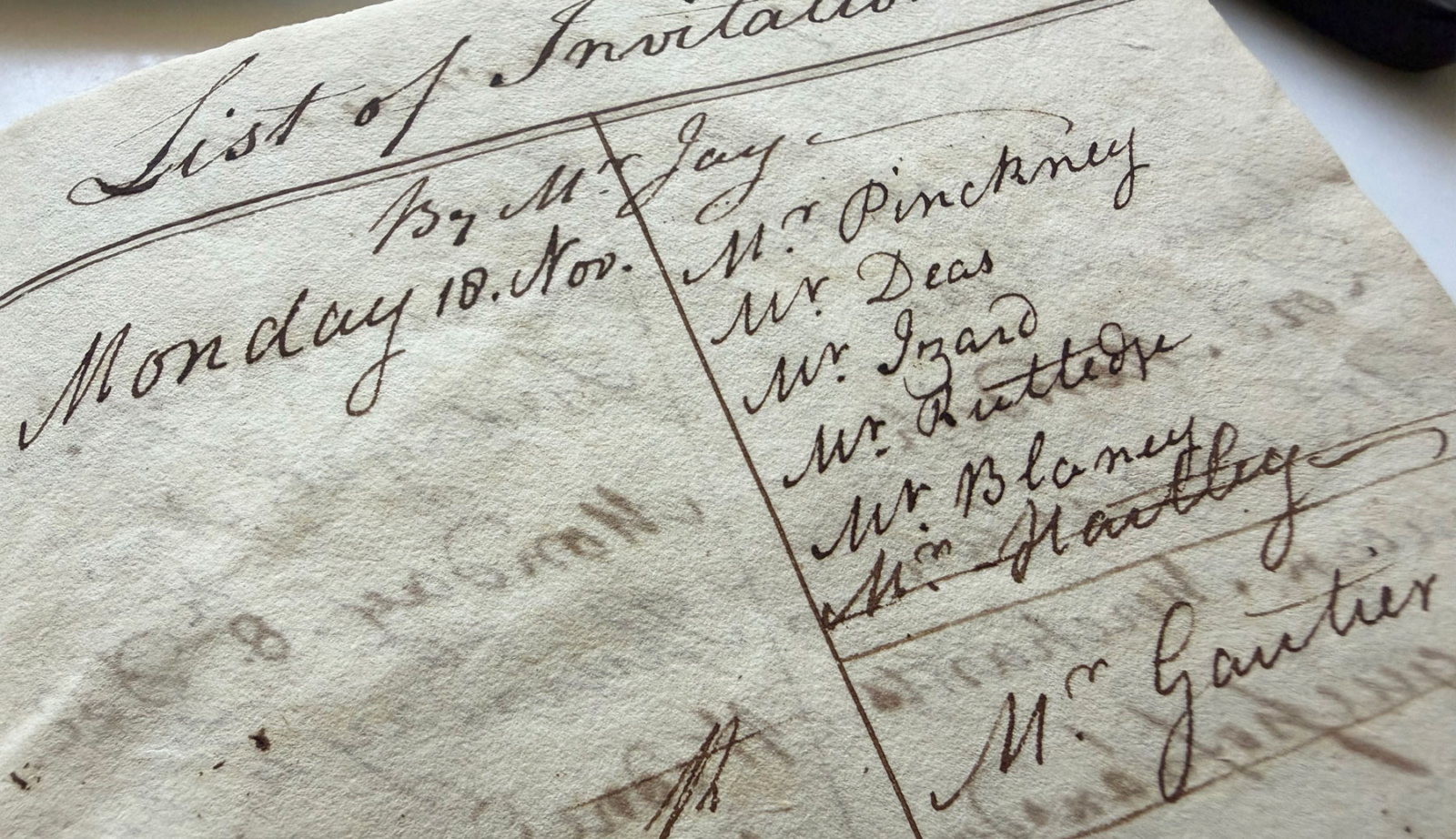
And on November 18, the day before the signing, he summoned to his offices Pinckney, Merchant William Deas, former Commissioner Ralph Izard, Mr. Rutledge, the latter a collection of South Carolina men who had merchant interests. He met with Pinckney the day after, showing the close collaboration of the men.
After the treaty
After the Treaty was signed, he turned to implementing it. He continued to meet with British negotiators like the Lord Chancellor and Lord Grenville, as well as his partners, like Pinckney. He met with American merchants and representatives of the abolitionist cause.
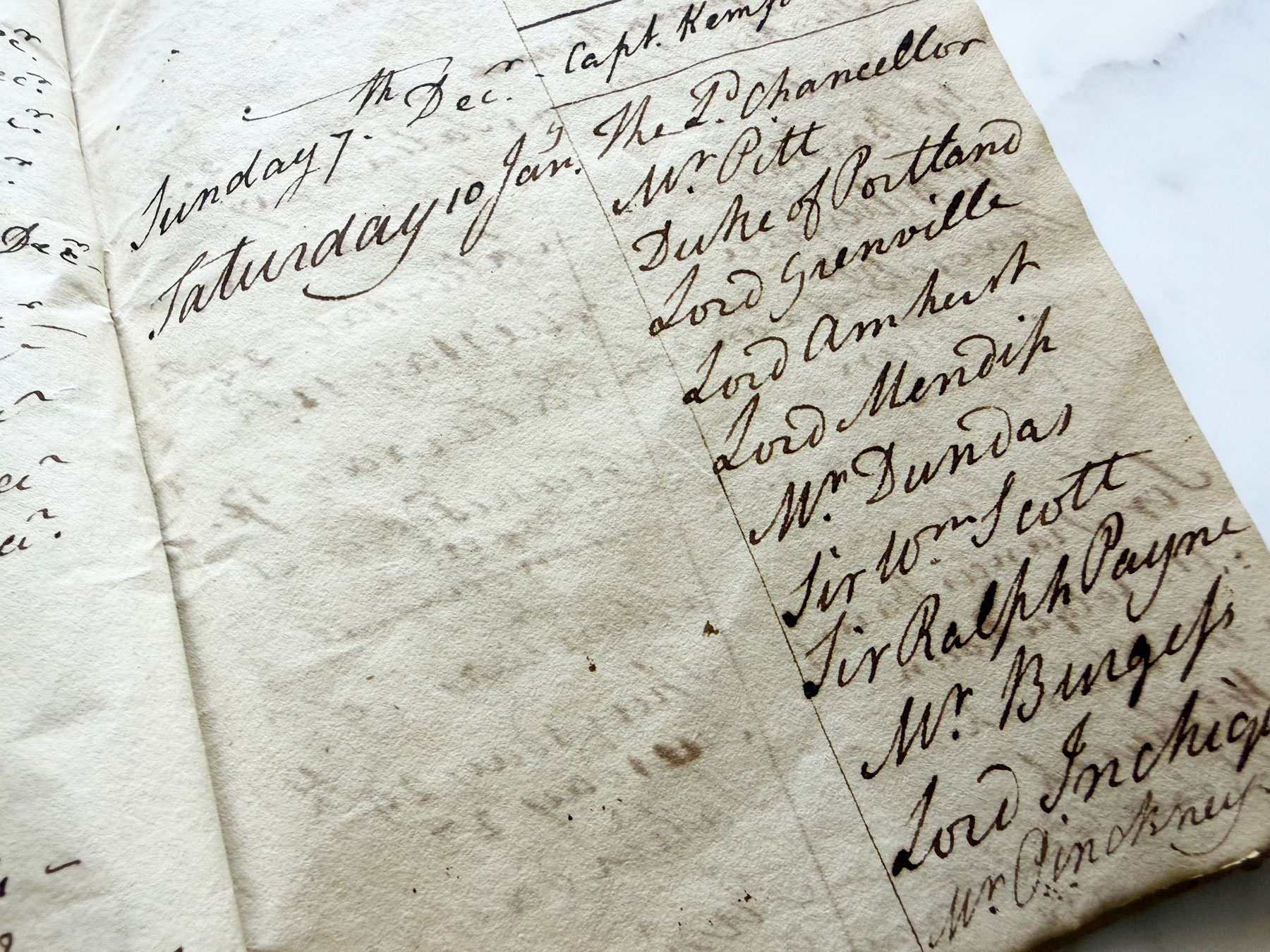
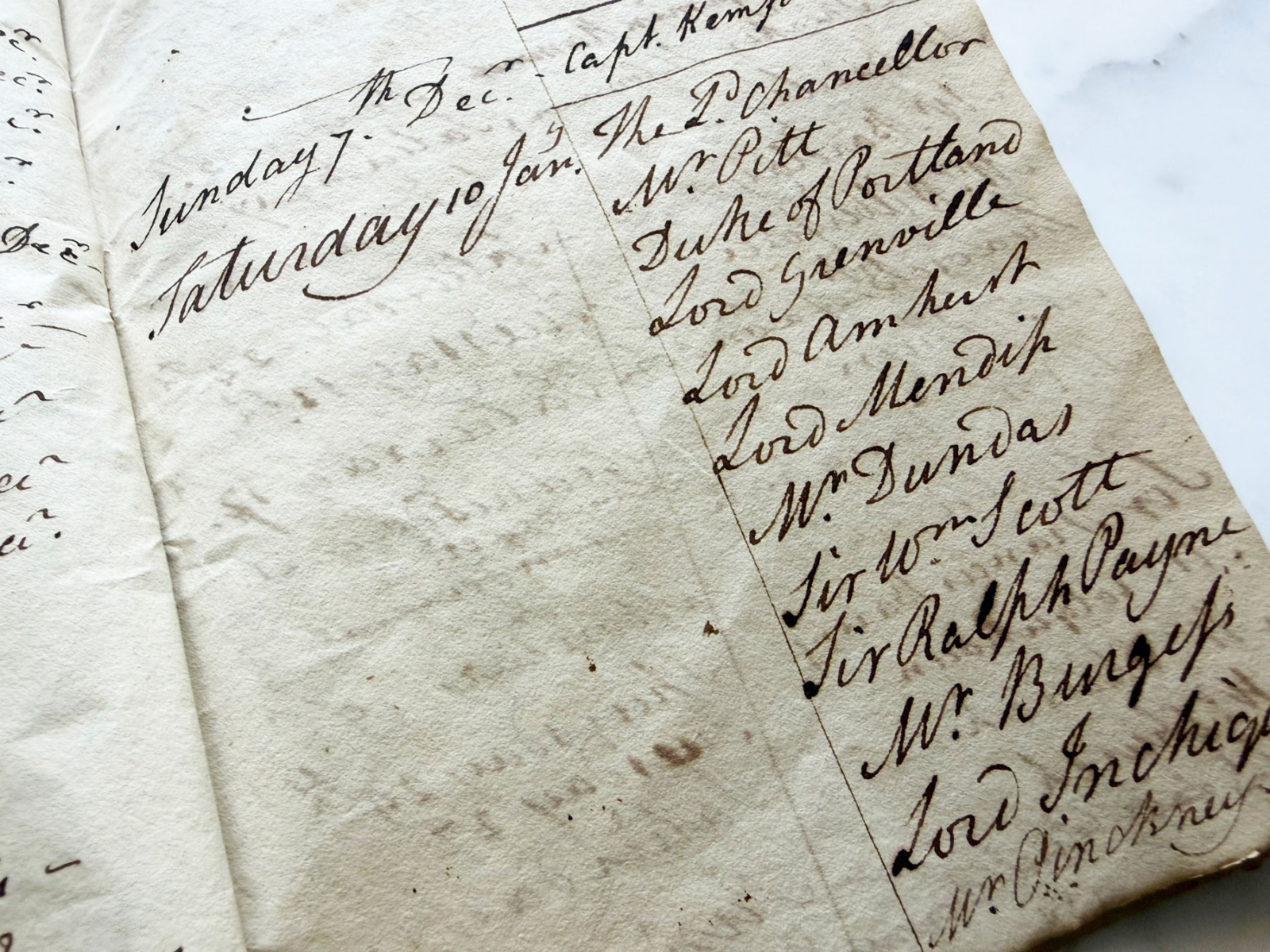
For instance, in December and January, he met with the Lord Chancellor (Dec. 16 and 25), Wilberforce (Dec. 4 and 23), Pinckney (Dec. 1 and 18) and “American Merchants” (Dec. 17). January 10 was quite the day, evidently representing a meeting with the Privy Chancellor, Prime Minister Pitt, the Duke of Portland, Lord Amherst, Mr. Dundas, Lord Inchigquin, and Thomas Pinckney.
Jay appears very interested in the abolition movement and met with several of its English proponents, Wilberforce being only one.
Other fascinating meetings in this stretch include the Bishop of London, Lord Mornington, the future Governor-General of India, and the Archbishop of Canterbury, and merchant Sir Francis Baring.
Interestingly, he would continue to meet with Grenville, his name last appearing on April 8.
Settling Claims – Samuel Bayard, William Wilberforce and Jeremy Bentham
Christopher Gore, William Scott, and Samuel Bayard were directly involved in settling claims associated with the Jay Treaty. He met routinely with them. On March 12, for instance, he issued several invitations, including to Gore, Pinckney, Church, Izard, and Bayard. To show the breadth of his schedule, that same week he met with William Wilberforce and Jeremy Bentham (he also met with Bentham a few times).
Jay’s final month consisted of meetings with Grenville, Montago, Pinckney, Amherst, the Bishop of London, Count Woronzow, the Lord Mayor, and many others.
His last engagement was an invitation from Lord Amherst on April 9.
As he is recorded to have left on April 8, it is possible he did not make that.

Frame, Display, Preserve
Each frame is custom constructed, using only proper museum archival materials. This includes:The finest frames, tailored to match the document you have chosen. These can period style, antiqued, gilded, wood, etc. Fabric mats, including silk and satin, as well as museum mat board with hand painted bevels. Attachment of the document to the matting to ensure its protection. This "hinging" is done according to archival standards. Protective "glass," or Tru Vue Optium Acrylic glazing, which is shatter resistant, 99% UV protective, and anti-reflective. You benefit from our decades of experience in designing and creating beautiful, compelling, and protective framed historical documents.
Learn more about our Framing Services