







Thomas Jefferson Bids Farewell to His Beloved Europe to Return Home to Monticello: He Announces He is Leaving France and Setting Sail to Return to the United States, Where He Would Take Up the Position of Secretary of State for President Washington

Written the day he left the Continent, less than 2 months after the storming of the Bastille and the outbreak of Revolution in Europe: he would never return to Europe
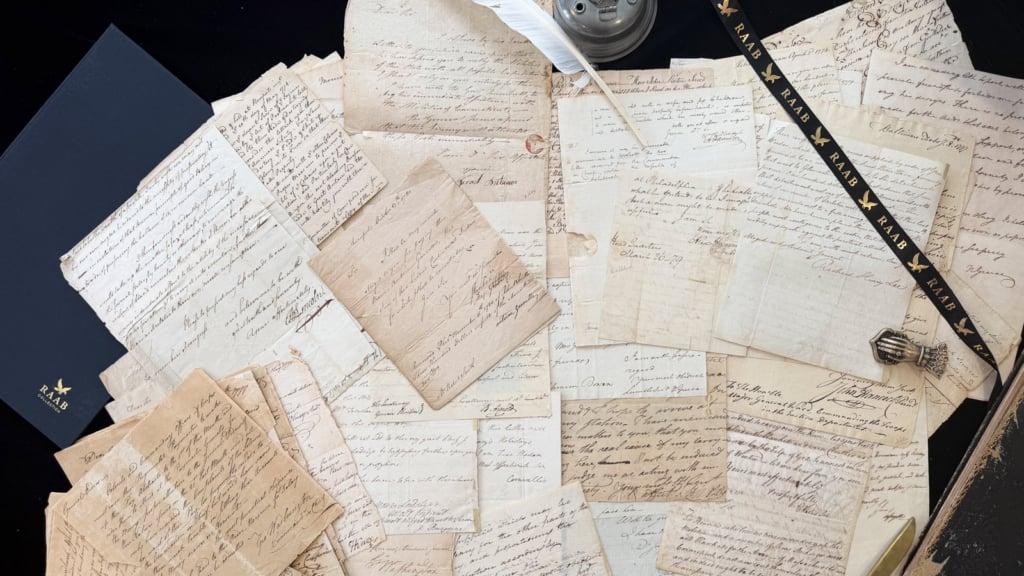
The letter, last sold in the 1960s, details Jefferson’s efforts to reduce his huge and onerous debt
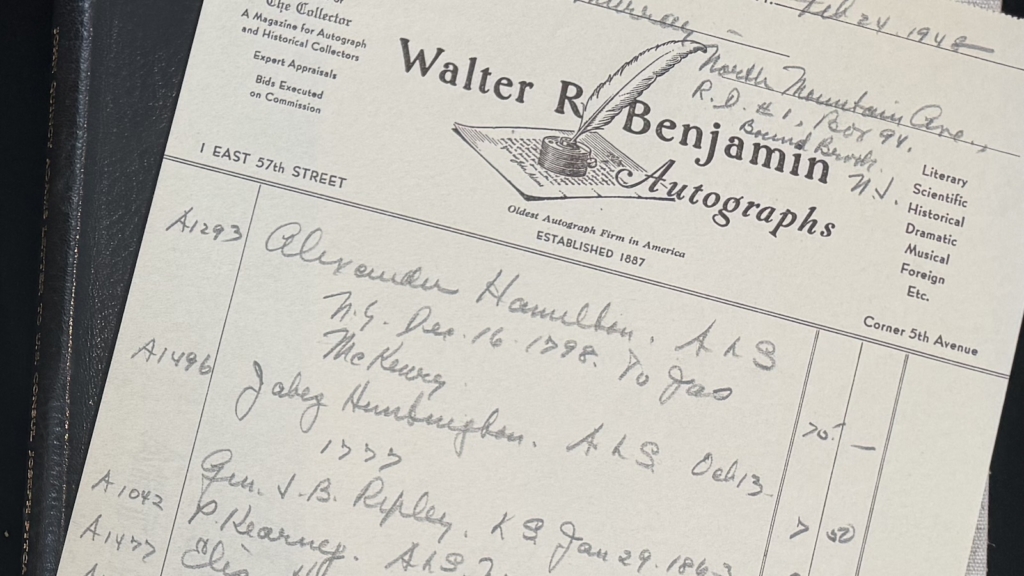
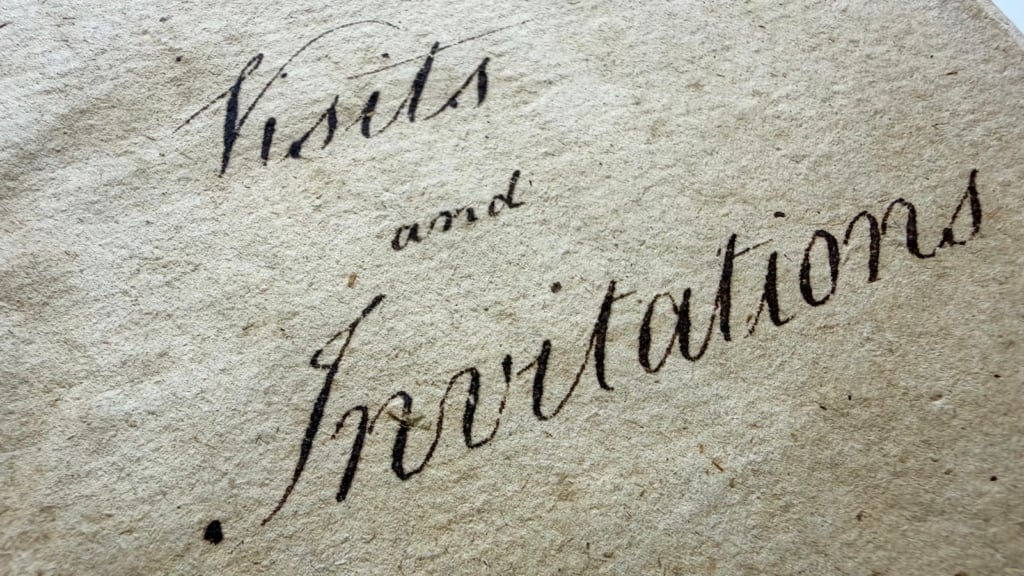
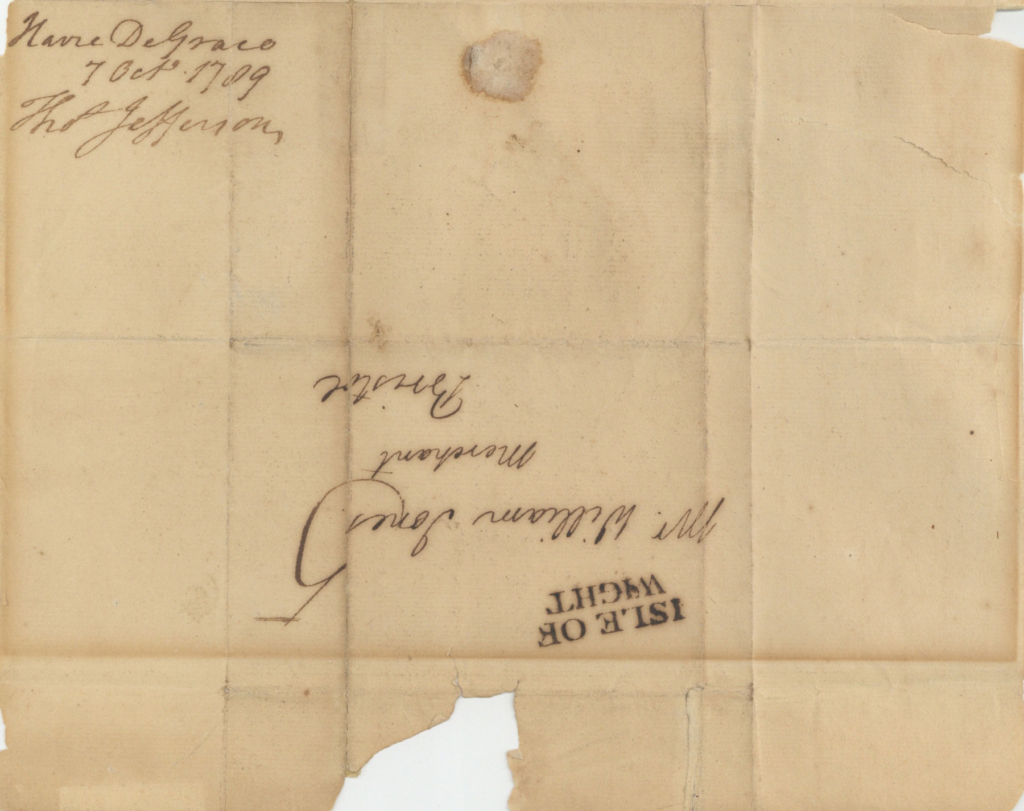
Complete with its original address panel showing transit through the Isle of Wight, it was obtained from the notable Mabel Zahn back in the 1960s, and has been in a private collection ever since
...

The letter, last sold in the 1960s, details Jefferson’s efforts to reduce his huge and onerous debt
Complete with its original address panel showing transit through the Isle of Wight, it was obtained from the notable Mabel Zahn back in the 1960s, and has been in a private collection ever since
Listen to the Inspired by History podcast
In 1784, Thomas Jefferson was appointed Minister Plenipotentiary to France, and the following year was assigned the duty of succeeding Benjamin Franklin as Minister to France. There he promoted American commercial interests, and was deeply influenced by French culture, architecture, and Enlightenment thought. While in France, Jefferson became a regular companion of Lafayette, and Jefferson used his influence with Lafayette to procure trade agreements with France. As the French Revolution began, Jefferson allowed his Paris residence to be used for meetings by Lafayette and other revolutionary leaders. He was in Paris during the storming of the Bastille on July 14, 1789, and he consulted with Lafayette as Lafayette drafted the Declaration of the Rights of Man.
During these years he also immersed himself in European intellectual life, acquiring books, art, and scientific knowledge that reflected his Enlightenment ideals and later shaped American cultural institutions. Although burdened by personal financial concerns and eager to return home, Jefferson left France in 1789 with a deepened commitment to republican government and an experience of revolution that would profoundly influence his actions as Secretary of State and his evolving views on liberty, diplomacy, and international commerce.
Witnessing the inequalities and fiscal decay of the French monarchy reinforced his belief that hereditary privilege and concentrated power were incompatible with liberty, strengthening his commitment to agrarian republicanism and decentralized government once he returned to the United States.
His experience abroad also influenced American diplomacy and partisan politics. In France, Jefferson came to distrust British commercial dominance and developed a strong preference for France as a natural republican ally, a stance that later clashed directly with Alexander Hamilton’s Anglophile economic and foreign-policy outlook. These differences crystallized in Washington’s cabinet, contributing to the emergence of the first party system, with Jefferson leading what became the Democratic-Republican opposition to Federalist centralization, public debt, and close ties to Britain.
Jefferson’s journey home was longer than he anticipated. Jefferson requested a leave of absence from John Jay, secretary for foreign affairs, on November 1788 and hoped to leave Paris by April 1789. However, uncertainties in the US government, now in a state of transition, postponed Jay’s reply until 9 March 1789. Jay’s letter did not reach Jefferson until late July. Official leave was granted in June, but Jefferson did not receive the notice until August.
Acknowledging this, Jefferson wrote to President Washington himself in May: “I expected that letter would have been received in time to be decided on by the government than existing. I know now that it would arrive when there was no Congress, and consequently that it must have awaited your arrival at New York. I hope you found the request not an unreasonable one.”
Jefferson left Paris for the United States on September 26, 1789, for what he anticipated would be a short visit to deal with financial matters. But the same day Jefferson left Paris, the U.S. Senate confirmed his appointment as Secretary of State in George Washington’s new administration, a position Jefferson did not learn about until months later.
Nathaniel Cutter’s diary gives us the details of his outbound transit. Cutter was in charge of taking Jefferson from the Continent to the stop station in the UK.
“Oct. 7th…”Before twelve were all safely stow’d on board the Passage Boat. At half past 12. Came out by the Pier-head, with a fine Southernly Breeze….Thursday 8th. Octo. At 8. A.M. saw the Isle of Wight, bearing from No. to N.N.W. Wind moderates and set into Rain…”
So he departed the European continent with family and friends late on October 7, leaving from Le Havre aboard the ship Clermont. From Le Havre on the 7th, he wrote two letters, the last ones he would ever write while in France and indeed while on the European continent in his entire life.
On November 23, 1789, Jefferson arrived in Norfolk, Virginia. It was only upon his arrival that he learned of his appointment by President Washington. He was initially reluctant to accept the role, as he had hoped to retire to his home, Monticello, and manage his private affairs. He formally accepted the position in February 1790 and assumed his duties in March 1790. He would remain in that post until 1793.
Jefferson lived in debt through a majority of his life. Despite his wealth, he was ill-equipped to manage his finances. He lived beyond his means, spending vast amounts of money on material goods. In addition to his own debt, he had inherited a huge debt from his father-in-law, John Wayles, upon Wayles’ death in 1773; the debt, owed largely to British merchants like Farrell & Jones of Bristol, was tied to Wayles’ large estate, and was for goods and slaves.
Jefferson spent much of his life struggling to pay it off, seeking debt repayment agreements from creditors (he offered the agent of Farell & Jones a bond and had been refused), selling land, and selling some 70 slaves. The division of the Wayles estate, intended to manage the debts, inadvertently made Jefferson and his brothers-in-law personally liable for their shares.
On May 17, 1789. Jefferson wrote William Jones (surviving agent) again, discussing a proposition in which he may pay off his debt, and mentioning he will be coming back to Virginia to settle his financial affairs. “…My anxiety to get these two debts fixed and put under a certain & regular course of payment is such, that I have asked of our government a leave of absence for six months from Paris, during which I shall go to Virginia. I have been for some time in daily & hourly expectation of receiving this permission…Within a week after receiving that permission I shall sail for Virginia; and be there two months and the principal object of this letter is to intreat you to give full power to Mr. Hanson or any person you please to settle this matter.”
But none of the settlements that Jefferson struggled so honorably to make ever really discharged the burden of debt that hung over him. “I am miserable till I shall owe not a shilling,” he once wrote. And always the burden grew greater.
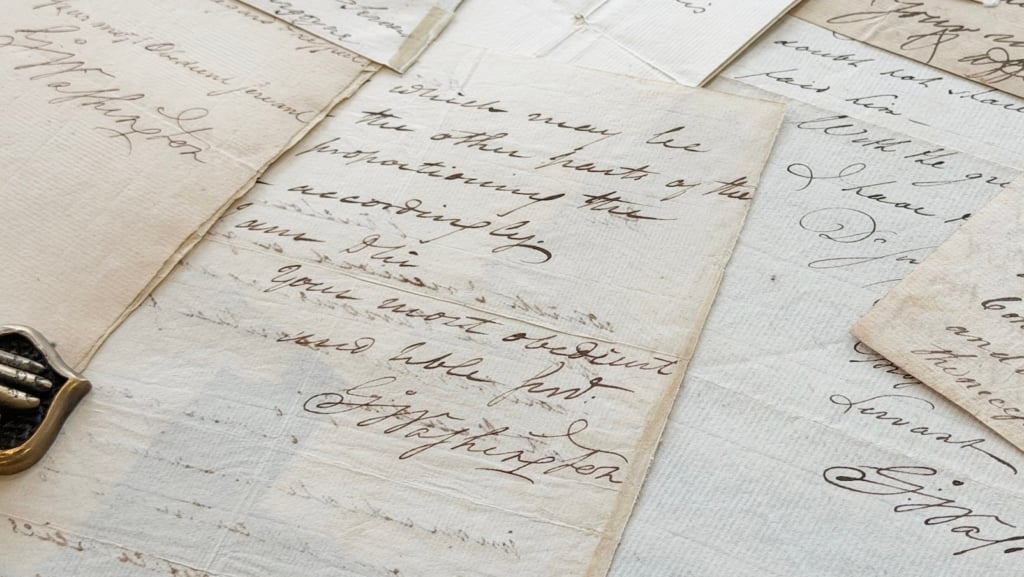
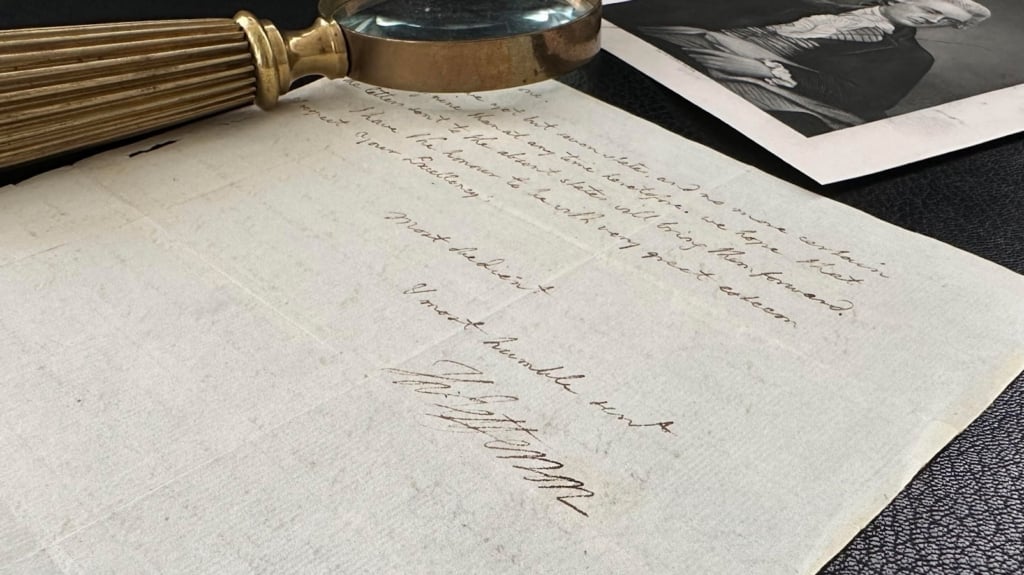
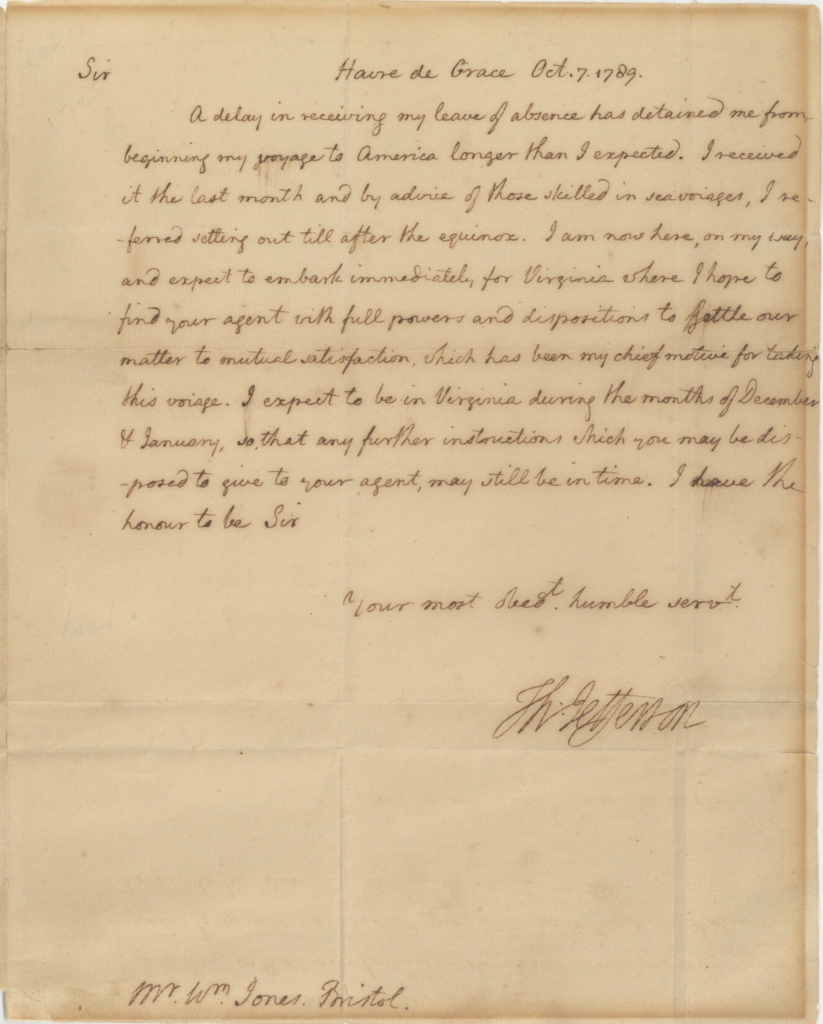
Autograph letter signed, Havre de Grace, October 7. 1789, to William Jones, being one of the two letters Jefferson wrote on his last day in France. It is his farewell to France after his long service there, mentions his returning to Virginia, and also deals with his financial problems. “A delay in receiving my leave of absence has detained me from beginning my voyage to America longer than I expected. I received it the last month and by advice of those skilled in sea voyages I deferred setting out till after the equinox. I am now here, on my way, and expect to embark immediately for Virginia where I hope to find your agent with full powers and dispositions to settle our matter to mutual satisfaction, which has been my chief motive for taking this voyage. I expect to be in Virginia during the months of December and January, so that any further instructions which you may be disposed to give to your agent, may still be in time. I have the honor to be Sir Your most obedt. humble servt., Th: Jefferson.”
The papers of Thomas Jefferson list only two letters that Jefferson wrote from the Continent on that day, the very day he left for the United States. The other is in a public institution.
This letter was obtained from the legendary Mabel Zahn back in the 1960s, and has been in a private collection ever since.
In February of 1790, Jefferson did as he promised and signed a new instrument arranging for debt payment. “When any sales of lands or slaves shall be made by either of the said executors for payment of the said instalments, the said Richard Hanson (Jones’ agent) shall receive the bonds and collect the money due thereon: but these shall not be considered as paiments till he shall actually have received the money: Nevertheless when he shall have in hands bonds enough from either of the parties to pay all the instalments of that party remaining unpaid, such party shall not be called on for such instalments till both the obligors and their securities named in such bonds shall have failed to pay on due and full presentation.”
After Jefferson’s death, his family lost Monticello due to these overwhelming financial obligations. Jefferson’s debt was estimated by his grandson and executor of his estate, Thomas Jefferson Randolph, to have been upwards of $107,000, a staggering amount of money in the early nineteenth century.

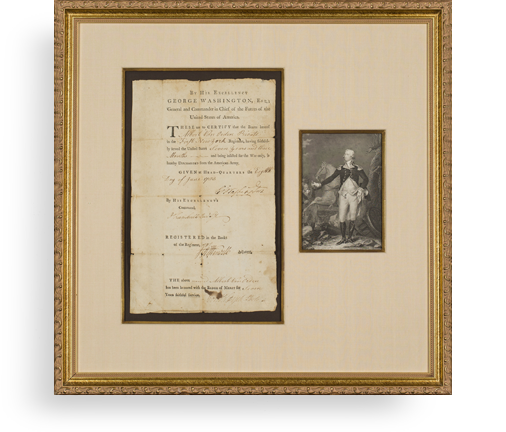
Frame, Display, Preserve
Each frame is custom constructed, using only proper museum archival materials. This includes:The finest frames, tailored to match the document you have chosen. These can period style, antiqued, gilded, wood, etc. Fabric mats, including silk and satin, as well as museum mat board with hand painted bevels. Attachment of the document to the matting to ensure its protection. This "hinging" is done according to archival standards. Protective "glass," or Tru Vue Optium Acrylic glazing, which is shatter resistant, 99% UV protective, and anti-reflective. You benefit from our decades of experience in designing and creating beautiful, compelling, and protective framed historical documents.
Learn more about our Framing Services

