






In the Lead-up to the Nullification Crisis, President Andrew Jackson Defends American Industry in the Face of Foreign Competition and Argues Against American Tariff Protectionism
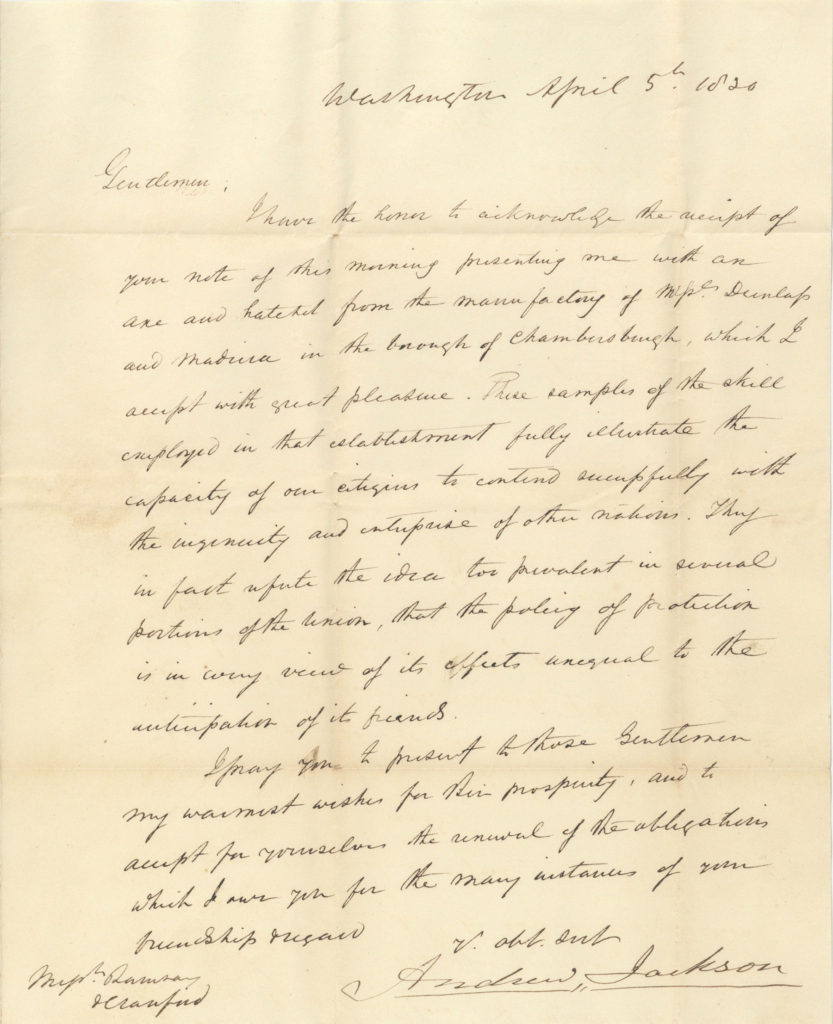


This famous letter was published in 1830 and amidst the fires of the tariff debates
“These examples of the skill employed in that establishment fully illustrate the capacity of our citizens to contend successfully with the ingenuity and enterprise of other nations. They in fact refute the idea too prevalent in several portions of the union, that the policy of protection is in every view of its...


“These examples of the skill employed in that establishment fully illustrate the capacity of our citizens to contend successfully with the ingenuity and enterprise of other nations. They in fact refute the idea too prevalent in several portions of the union, that the policy of protection is in every view of its effects unequal to the anticipation of its friends.”
A series of tariffs began just after the War of 1812, when the blockade of Europe led British manufacturers to offer goods in America at low prices that American manufacturers often could not match. A protective tariff was passed by Congress in 1816, and its rates would be increased in 1824. Southern states contended that the tariffs were unconstitutional and opposed them, as they would have to pay more for goods, while the Northern states mainly favored them because they helped strengthen their industrial-based economy. Andrew Jackson opposed tariffs and the implicit message they gave that American industry could not compete with European manufacturers without the roadblock of tariffs.
Tariffs became a major issue in Jackson’s presidency. In 1828, in a scheme to prevent passage of still higher tariffs, while at the same time appealing to Jackson’s supporters in the North, Southerners joined former president Martin Van Buren in crafting a tariff bill that would also weigh heavily on materials imported by the New England states. It was believed that President John Quincy Adams’s supporters in New England would uniformly oppose the bill for this reason and that the Southern legislators could then withdraw their support, killing the legislation while blaming it on the New Englanders. The goal was to write a bill so bad that it would never pass but would help Van Buren and the Southerners while hurting the Adams-Henry Clay coalition. But the anti-tariff members of Congress erred and the bill passed. The 1828 tariff was signed by President Adams. The expectation of the tariff’s opponents was that with the election of Jackson in 1828, the tariff would be blocked or significantly reduced. But Jackson in 1829 said the 1828 tariff was constitutional. In response, the most radical faction in South Carolina began to advocate that the state itself declare the tariff null and void within South Carolina. In Washington, an open split on the issue occurred between Jackson and Vice-President John C. Calhoun. This led to the famous nullification crisis. On July 14, 1832, Jackson signed into law the Tariff of 1832, which made some reductions in tariff rates.
In 1830, the issue continued to boil. The Webster–Hayne debate was a debate between Senator Daniel Webster of Massachusetts and Senator Robert Y. Hayne of South Carolina that took place on January 19–27, 1830 on the topic of protectionist tariffs. The heated speeches were unplanned and stemmed from the debate over a resolution by Connecticut Senator Samuel A. Foot calling for the temporary suspension of further land surveying until land already on the market was sold (to effectively stop the introduction of new lands onto the market). Webster’s “Second Reply to Hayne” was generally regarded as “the most eloquent speech ever delivered in Congress.”
The firm of Dunlop and Madeira had recently opened a factory in Chambersburg, Pennsylvania manufacturing tools such as axes. Their products were highly considered, and are still much appreciated by collectors today. Jackson was sent two of their axes by two members of Congress.
On April 5, 1830, they wrote sending the axes to the President: “By the desire of our friends and constituents, James Dunlop, Bsq. and Mr. George A. Madeira, we present you the axe and hatchet herewith sent. Messrs. Dunlop and Madeira are gentlemen of the first respectability, who have laudably established “Lemnos Factory,” in the Borough of Chambersburgb, Pennsylvania, where they manufacture edge and other tools to a considerable extent—famishing almost every implement of iron, for which we have been hitherto indebted to foreigners, of the best qualitv, and at a low rate. It is a gratifying spectacle to see our country, from year to year, developing the capacity to supply the material for any given manufacture, and her citizens displaying the ingenuity and enterprise necessary to a successful rivalry with the workshops of other nations. Although iron was smelted from ore almost simultaneously with our earliest settlements, and contributed largely to the accommodation of the citizen; yet its conversion, in our own country, to the more convenient purposes of life, is of comparatively recent date; and we think it a source of gratulation that manufactories, under the protection and influence of the present system, are progressing in improvement, so as to have already demonstated that we are competent to the production of whatever may be required, either for utility or luxury…. Your most obd’t serv’ts. W. RAMSEY, T. HARTLEY CRAWFORD.”
Jackson responded in this letter, which was published at the time to stoke the fires of the tariff debate:
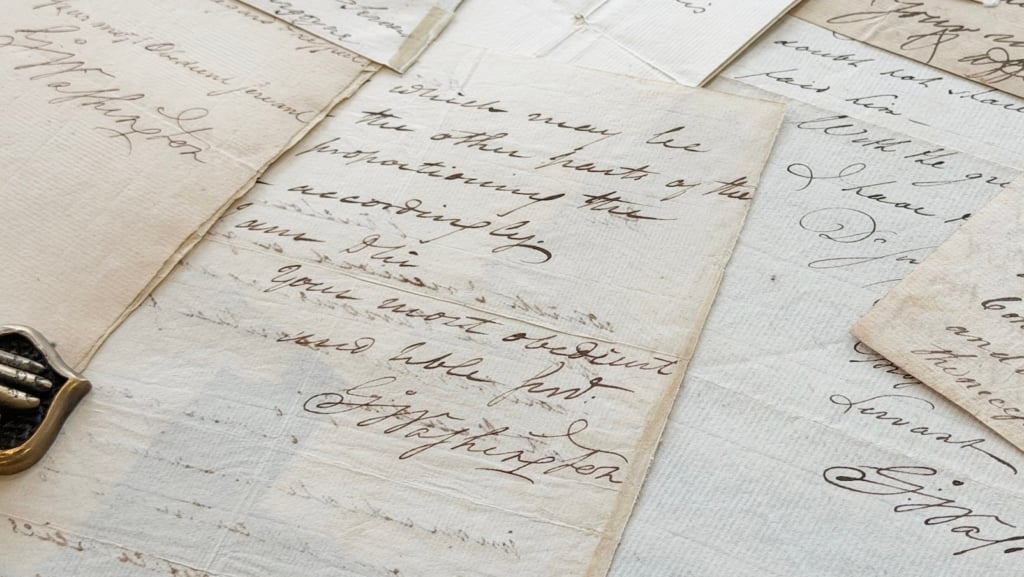
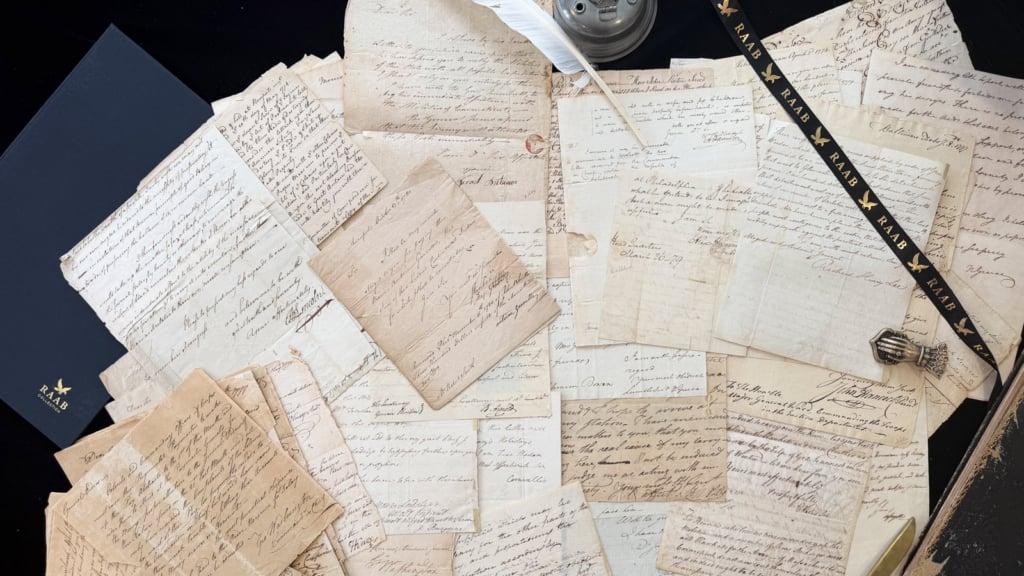
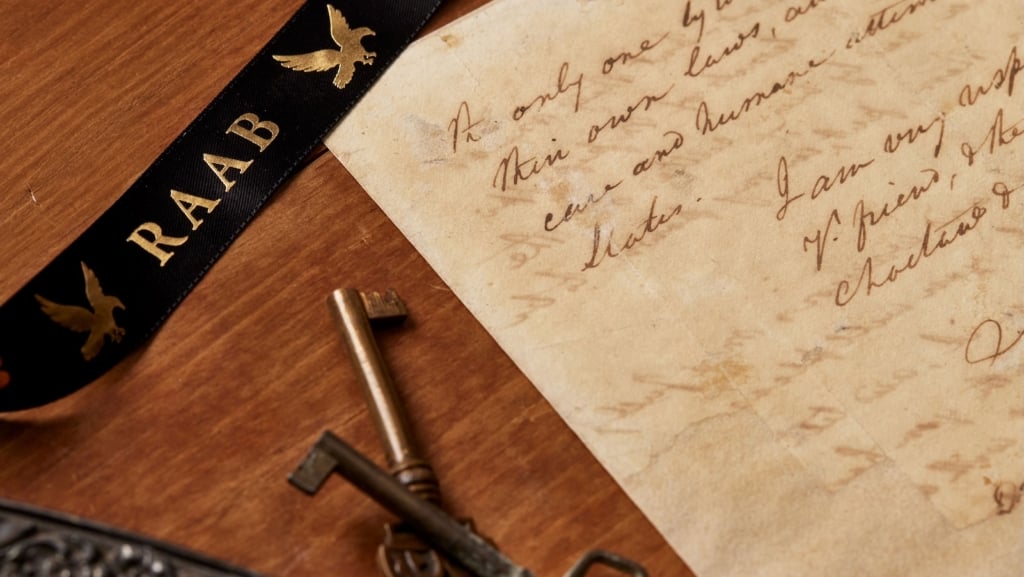
Letter signed, as President, Washington, April 5, 1830, to “Messrs. Ramsey & Crawford, Members of Congress”, lauding American industry, opposing protective tariffs, and articulating the anti-tariff case by maintaining that U.S. industries could compete with European industries without the tariffs. He also states that the policy of tariffs is unequal to the expectations of its supporters.
“I have the honor to acknowledge the receipt of your note of this morning presenting me an axe and hatchet from the manufactory of Messrs. Dunlop and Madeira in the borough of Chambersburgh, which I accept with great pleasure. These examples of the skill employed in that establishment fully illustrate the capacity of our citizens to contend successfully with the ingenuity and enterprise of other nations. They in fact refute the idea too prevalent in several portions of the union that the policy of protection is in every view of its effects unequal to the anticipation of its friends.
“I pray you to present to those gentlemen my warmest wishes for their prosperity, and to accept for yourselves the renewal of the obligations which i owe you for the many instances of your friendship and regard.” The address panel in Jackson’s hand is still present.
This is a remarkable defense by President Jackson on one of the major issues of his presidency, directly touching on the question of tariffs and the strength of American industry. It articulates his position in an important and forthright way, in addition to maintaining that tariffs don’t help and only disappoint their advocates.

Frame, Display, Preserve
Each frame is custom constructed, using only proper museum archival materials. This includes:The finest frames, tailored to match the document you have chosen. These can period style, antiqued, gilded, wood, etc. Fabric mats, including silk and satin, as well as museum mat board with hand painted bevels. Attachment of the document to the matting to ensure its protection. This "hinging" is done according to archival standards. Protective "glass," or Tru Vue Optium Acrylic glazing, which is shatter resistant, 99% UV protective, and anti-reflective. You benefit from our decades of experience in designing and creating beautiful, compelling, and protective framed historical documents.
Learn more about our Framing Services

