






From the Seat of the Constitutional Convention in 1787: Benjamin Franklin, as President of Pennsylvania, Grants Land in the Commonwealth to a Veteran for His Services in the Revolutionary War


The soldier, Lt. John Weidman, served under Washington in many battles and later spent three years as a POW
- Currency:
- USD
- GBP
- JPY
- EUR
- CNY
 This currency selector is for viewing only.
The Raab Collection only accepts USD payments at checkout.
Exchange rates are updated hourly. Rates may be inaccurate.

An increasingly uncommon document of Franklin and signed during the Convention, where he played such a prominent role
Printer, publisher, author, scientist, philosopher, public citizen, statesman, archetypal American. Franklin started with no capital in the young city of Philadelphia, and by 1730 he owned a major newspaper. He also published Poor Richard’s...


An increasingly uncommon document of Franklin and signed during the Convention, where he played such a prominent role
Printer, publisher, author, scientist, philosopher, public citizen, statesman, archetypal American. Franklin started with no capital in the young city of Philadelphia, and by 1730 he owned a major newspaper. He also published Poor Richard’s Almanac, which, with its pithy sayings espousing industry, frugality, and other virtues, attracted a large readership and made Franklin’s name a household word. He conducted experiments on electricity, and in his famous kite experiment demonstrated that lightning is an electrical discharge; he also invented the lightning rod. All of this brought him international recognition as a scientist. He served as deputy postmaster for the colonies (1753–74); it was here that he developed his famous concept that the colonies must hang together or hang separately. By 1776, Franklin became convinced that America must be independent, and served on the committee that wrote the Declaration of Independence. He was the American with the greatest stature overseas, and was the natural choice to go to France to negotiate a treaty of alliance. Lionized there, his efforts were crowned with success when a treaty was signed in 1778. He then helped negotiate the peace treaty with Great Britain, signed in Paris in 1783, which ended the Revolution. He returned to the U.S. in 1785.
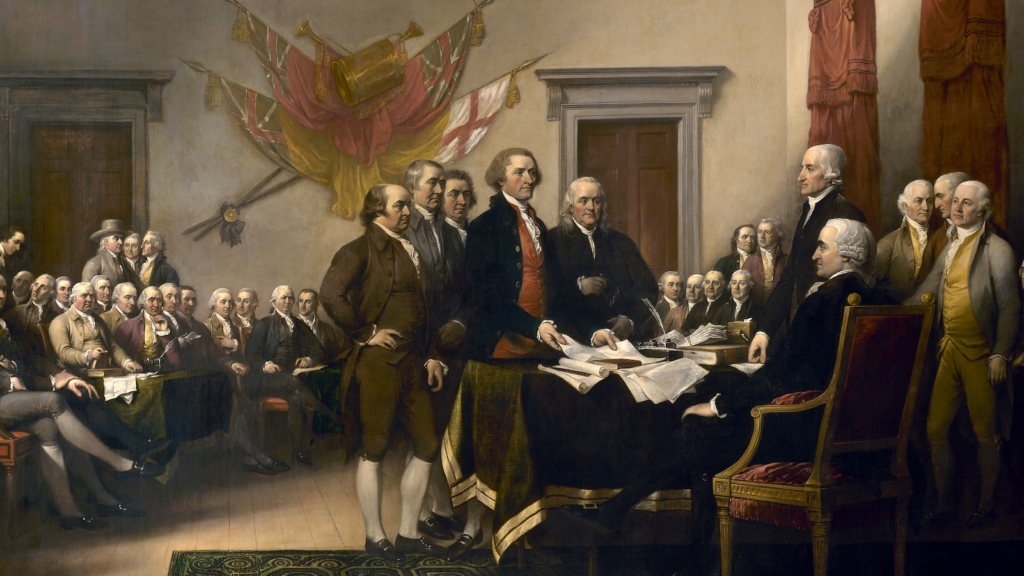
On October 18, 1785, Benjamin Franklin was unanimously elected the sixth President of the Supreme Executive Council of Pennsylvania (essentially he was governor). He held that office for over three years, longer than any other person at the time, and served the constitutional limit of three full terms. In 1787 he was elected President of the Pennsylvania Society for Promoting the Abolition of Slavery. And from May 28 though September 17, he served as a delegate to the Constitutional Convention held in Philadelphia, and he played a major role in the final document. At its conclusion, he signed the U.S. Constitution. His career was truly unparalleled.
Document Signed as President of the Supreme Executive Council of Pennsylvania, Philadelphia, June 8, 1787. A land grant documenting the transfer of 200 acres of land from the Commonwealth to one John Weidman, Lieutenant, being “in consideration of the services rendered…in the army of the United States.” The land was located in Westmoreland County, PA.
The document concludes “His Excellency Benjamin Franklin, Esq., President of the Supreme Executive Council, hath hereto set his hand and caused the state seal to be affixed.” The paper seal embossed with the official Seal of the State of Pennsylvania is present at upper left. The document is signed by Franklin in the left margin under the seal, “B. Franklin.” Countersigned by James Trimble Jr. as secretary.
During the Revolution, Weidman enlisted in 1776 and rose to the post of Lieutenant Adjutant-General. He served under George Washington during many battles. Captured by the British during the Battle of Brandywine on September 11, 1777, he remained a prisoner of war for over three years before being released in a prisoner exchange on December 30, 1780. He resigned from the army in 1781.
This is our first Franklin signed document from during the Constitutional Convention in some years.

Frame, Display, Preserve
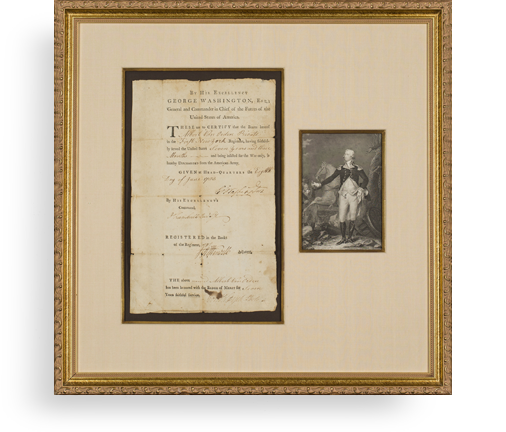
Each frame is custom constructed, using only proper museum archival materials. This includes:The finest frames, tailored to match the document you have chosen. These can period style, antiqued, gilded, wood, etc. Fabric mats, including silk and satin, as well as museum mat board with hand painted bevels. Attachment of the document to the matting to ensure its protection. This "hinging" is done according to archival standards. Protective "glass," or Tru Vue Optium Acrylic glazing, which is shatter resistant, 99% UV protective, and anti-reflective. You benefit from our decades of experience in designing and creating beautiful, compelling, and protective framed historical documents.
Learn more about our Framing Services
