






Ronald Reagan’s Original, Momentous “Are you Better Off” Speech, Including His Exhortations to “Make America Great Again”


The Original Handwritten Closing Statement to the American People for One of America's Great Speeches, His Closing Argument for his 1980 Debate Against Jimmy Carter, Which Changed American History
- Currency:
- USD
- GBP
- JPY
- EUR
- CNY
 This currency selector is for viewing only.
The Raab Collection only accepts USD payments at checkout.
Exchange rates are updated hourly. Rates may be inaccurate.

Acquired from the aide to whom it was given in the hours after the debate, it was not known to have survived
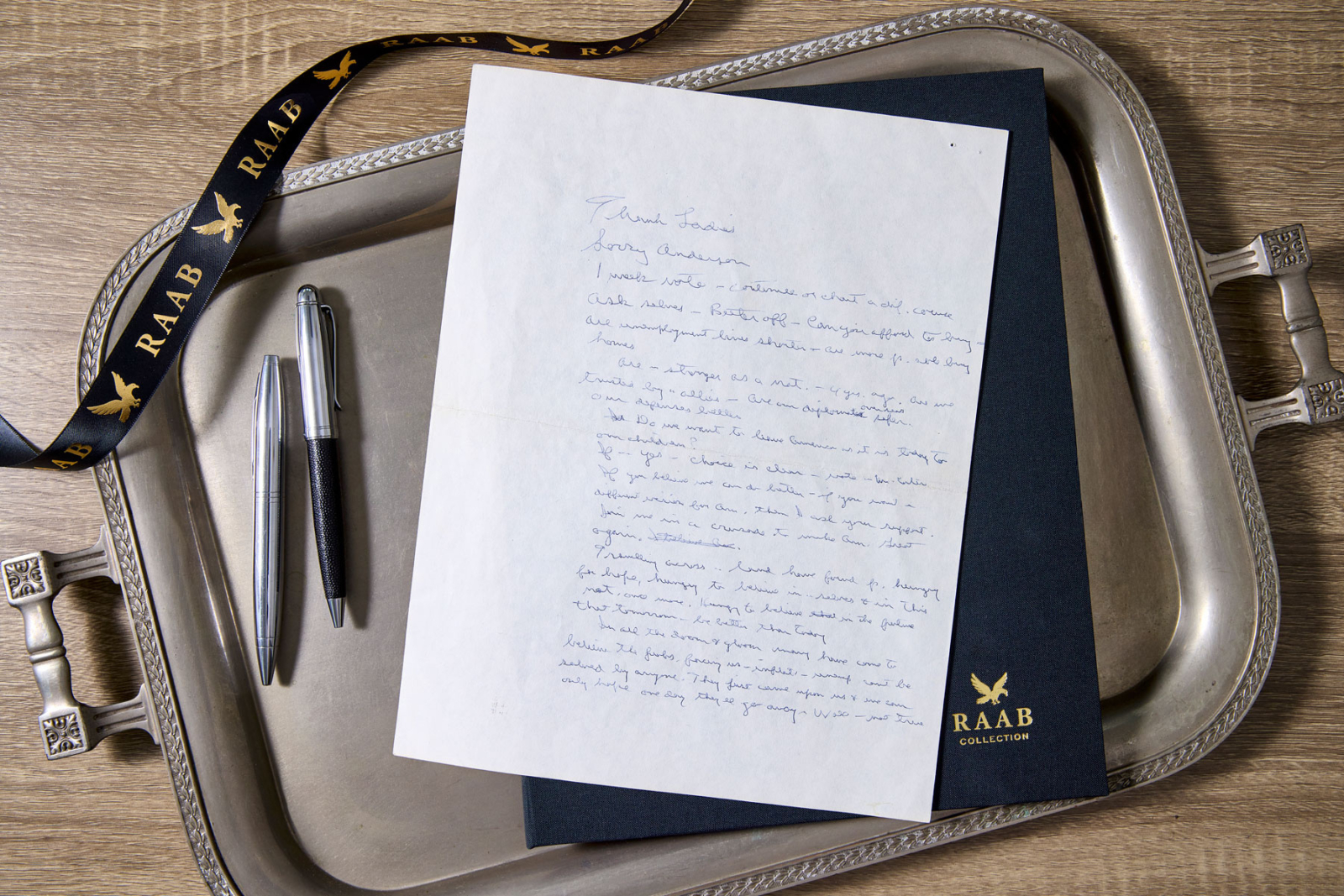
The handwritten speech, in talking points format, was the very one written by him, and used by him in the hours before the debate to memorize
“Is our...


Acquired from the aide to whom it was given in the hours after the debate, it was not known to have survived
The handwritten speech, in talking points format, was the very one written by him, and used by him in the hours before the debate to memorize
“Is our nation better off than it was four years ago? Are you better off”
Our research finds no similar Reagan debate speech, either in private hands or at the Reagan library
Featured on the Inspired by History podcast
Reagan’s speech remains one of the great political speeches ever given, and his election a turning point in American history, making this newly discovered manuscript one of the most important American documents ever offered for sale
On July 19, Ronald Reagan opened his presidential campaign with a tumultuous rally in Texas. There he proclaimed his famous campaign slogan, “Let’s Make America Great Again.” In his campaign, he called for a drastic cut in “big government” and pledged to deliver a balanced budget for the first time since 1969. Reagan also promised a restoration of the nation’s military strength, and to restore economic health by implementing his own economic policy, accompanied by a large reduction in tax rates. With respect to the economy, Reagan said, “A recession is when your neighbor loses his job. A depression is when you lose yours. And recovery is when Jimmy Carter loses his.” Reagan also announced, “Programs like education and others should be turned back to the states and local communities with the tax sources to fund them. I believe in states’ rights. I believe in people doing as much as they can at the community level and the private level.”
Meanwhile, President Jimmy Carter was burdened by a weak economy and the traumatic Iran hostage crisis. Inflation, high interest rates, and unemployment continued through the course of the campaign, and the ongoing hostage crisis in Iran became a seeming symbol of American impotence during the Carter years. John Anderson’s independent candidacy, aimed at eliciting support from liberals, was also seen as hurting Carter more than Reagan, especially in reliably Democratic states. Carter was criticized by his own aides for not having a “grand plan” for the recovery of the economy, nor did he ever make any campaign promises; he often criticized Reagan’s economic recovery plan, but did not create one of his own in response.
The presidential debate between Carter and Reagan was held in Cleveland on October 28, 1980, in the final week of the presidential campaign.
The League of Women Voters had initially scheduled four debates for the fall election season: three for the presidential candidates and one for the vice presidential hopefuls. The first had been held on 21 September and had pitted Regan against John Anderson, the Republican-turned-independent candidate for the Presidency. President Carter had refused to participate if Anderson was included, while Reagan had insisted that Anderson be present. The ensuing impasse saw the cancellation of a second presidential and the vice presidential debate. However, two weeks prior to the general election, The League of Women Voters dropped their insistence that Anderson be present.
According to Nielsen, 80.6 million tuned into the debate; it remained the largest television audience for a presidential debate until 2016. Going into the October 28 event, polling suggested that Carter appeared to have managed to turn a dismal summer into a close race for a second term. In the debate, over the course of 90 minutes, the candidates were asked eight questions with follow-ups, covering a range of topics: the use of American military power, inflation, the quality of life, the American hostages in Iran and international terrorism, nuclear arms control with the Soviet Union, Middle East oil dependency, and Social Security.
During the debate, Reagan posed what has become one of the most important campaign questions of all time: “Are you better off today than you were four years ago?” People felt that the answer to the question was a “no,” and in the final, crucial days of the campaign, Carter’s numbers tanked. On Election Day, Reagan won a huge popular vote and electoral victory. The “better off” question has been with us ever since.
The 1980 Carter-Reagan debate is most remembered for its conclusion. Each candidate had three minutes for closing remarks. President Carter was first. He confessed that he learned as he went along and did his best to lead the country during challenging times. “I’ve been President now for almost four years. I’ve had to make thousands of decisions, and each one of those decisions has been a learning process. I’ve seen the strength of my nation, and I’ve seen the crises it approached in a tentative way. And I’ve had to deal with those crises as best I could.” Carter said the presidency was “a lonely job”. It is lonely because as the President, “I alone have had to determine the interests of my country and the degree of involvement of my country” in the troubled areas of the world. He then highlighted the ideological differences between them. “I think it’s been a very constructive debate and I hope it’s helped to acquaint the American people with the sharp differences between myself and Governor Reagan…As I’ve studied the record between myself and Governor Reagan, I’ve been impressed with the stark differences that exist between us. I think the result of this debate indicates that that fact is true. I consider myself in the mainstream of my party. I consider myself in the mainstream even of the bipartisan list of presidents who served before me.”
Then Reagan gave his closing statement. It was one of those moments that came to define a presidential election and a presidency. Reagan delivered one of the most memorable lines in presidential debate history. He simply asked the American people a few basic pocketbook questions, chiefly among them was, “Are you better off than you were four years ago?”
Reagan said, “Next Tuesday all of you will go to the polls…it might be well if you would ask yourself, are you better off than you were four years ago? Is it easier for you to go and buy things in the stores than it was four years ago? Is there more or less unemployment in the country than there was four years ago? Is America as respected throughout the world as it was? Do you feel that our security is as safe, that we’re as strong as we were four years ago?…if you don’t think that this course that we’ve been on for the last four years is what you would like to see us follow for the next four, then I could suggest another choice that you have.”
Reagan finished by referring to the two themes of his campaign – his leading a crusade and the opportunity to make America great again: “I would like to have a crusade today…And it would be one to take Government off the backs of the great people of this country, and turn you loose again to do those things that I know you can do so well, because you did them and made this country great.”
The original manuscript
To help prepare for his encounter with Carter, Reagan had retained a seasoned debate task force, led by James Baker and assisted by Bill Caruthers, Frank Ursomarso, David Gergen and Frank Hodsoll. They were assisted by Reagan’s closest aide, Ed Meese, campaign manager, William Casey and pollster and chief strategist, Richard Wirthlin. On October 24 they gathered at Wexford, the former country retreat of Jack and Jackie Kennedy in rural Virginia, where the Reagans had been residing since September. To set the stage, they first played video excerpts of Carter’s 1976 debate with Gerald Ford.
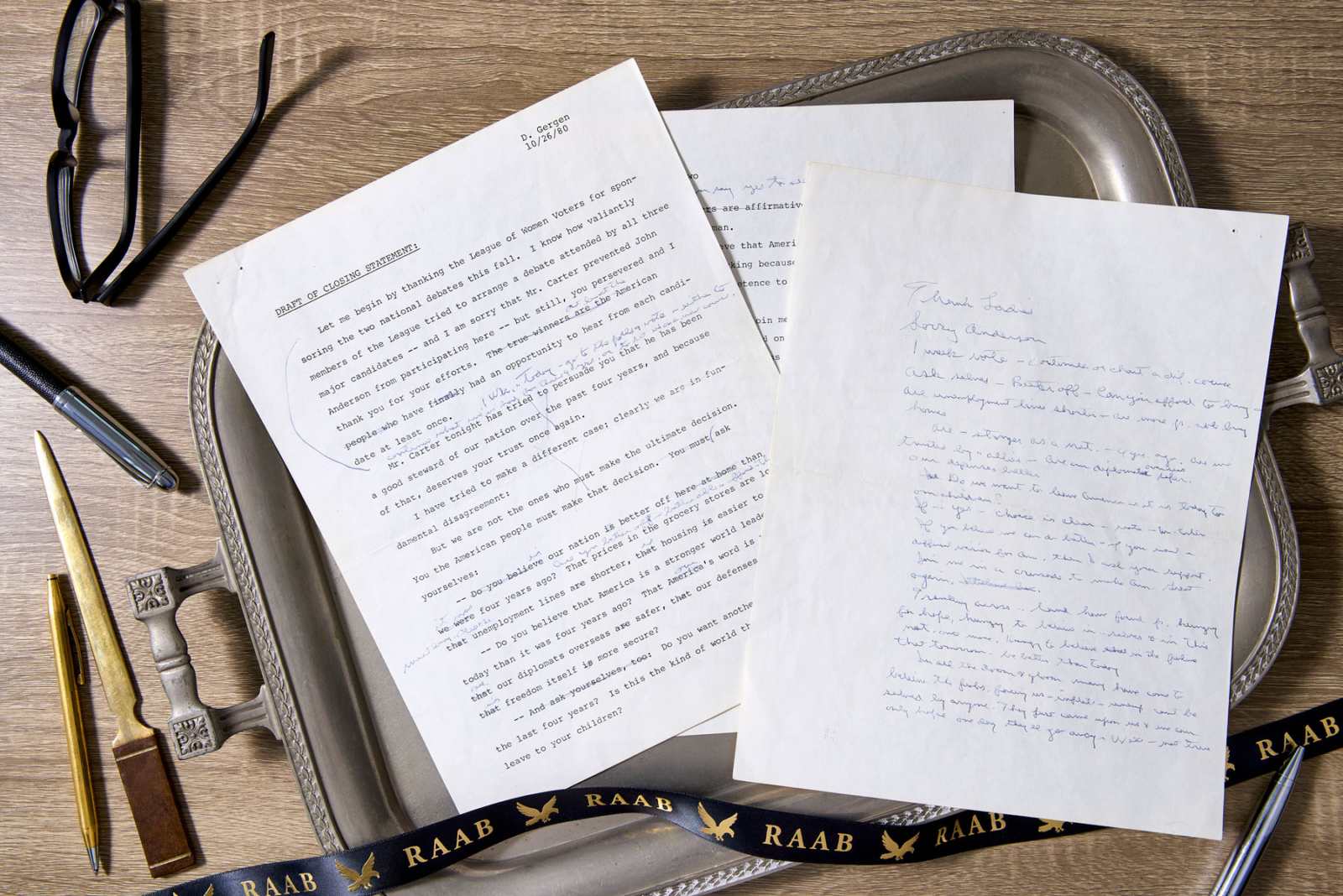
David Gergen was assigned to take a first pass at Reagan’s iconic closing statement. This he did October 26, and it was three pages long. It was presented to Reagan on October 27, and Reagan edited the pages by hand, and added his own handwritten talking points.
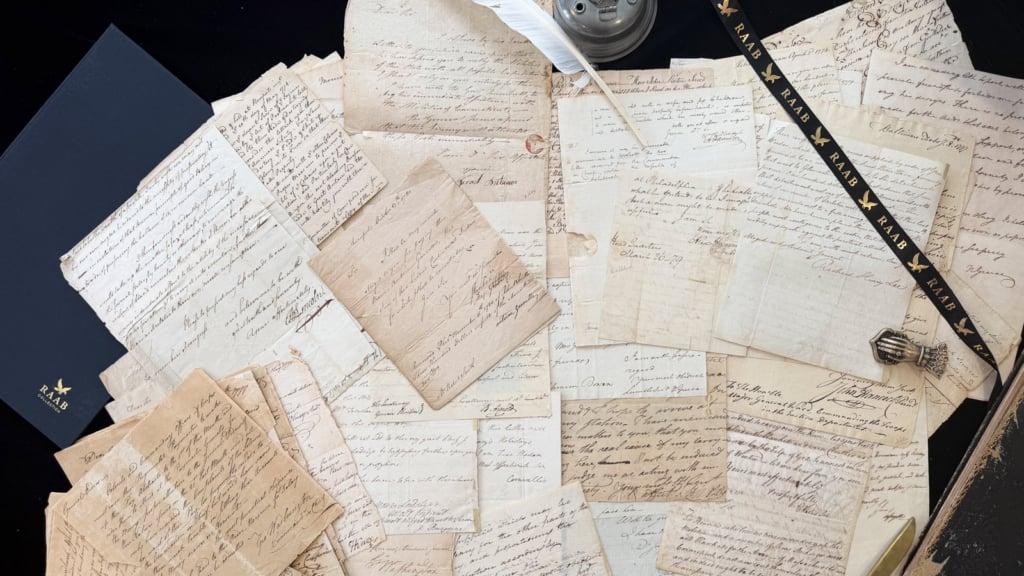
Document, with manuscript annotations by Reagan.
Here is the text of Gergen’s version of the debate closing statement, absent the text that Reagan himself crossed out but including the revisions he made.
“Let me begin by thanking the League of Women Voters for sponsoring the two national debates this fall. I know how valiantly members of the League tried to arrange a debate attended by all three major candidates – and I am sorry that Mr. Carter prevented John Anderson from participating here — but still, you persevered and I thank you for your efforts. At least the American people have finally had an opportunity to hear from each candidate at least once. 1 week today go to the polls and vote – either to continue what we’ve had for these 4 years or to set us on a new course.
“Is our nation better off than it was four years ago? Are you better off, to afford things? That prices in the grocery stores are lower…are the unemployment lines shorter, is housing easier to buy? Do you believe that America is a stronger world leader today than it was four years ago? That our word is respected. Are our diplomats overseas safer, our defenses better, is freedom itself more secure? Do you want another four years like the last four years? Is this the kind of world that you want to leave to your children?
“If you say yes to all these questions, then your choice is clear. Mr. Carter is your man. But if you believe that America can do better — if you believe that America isn’t working because our national leadership lacks the vision and the competence to make it work — then I suggest another answer.
“Join me in a crusade to restore prosperity and hope to our beloved land once again. As I have traveled across this country in past weeks, I have seen not a people who are tired or suffering from malaise — as Mr. Carter believes — but a people bursting with a fresh eagerness to reshape the world in a better way. I seek the Presidency because I believe America can do better — that with better leadership and better ideas, we can unlock the enormous human energy of America.
“Exactly four years ago, Mr. Carter told us, “Those who created the economic mess of today should not be entrusted to clean it up.” I certainly agree with him tonight. The answer, however, is not simply to vote for new leaders. The answer is to vote for a new kind of leadership — leadership that believes the greatest strength of our land lies not in government but in the ideals and inspirations of our people. I want to be your President so that we can begin to restore to you your birthright as an American citizen — the right to grow up in freedom, the right to find a job and raise a family in peace, the right to shape your own destiny. We can achieve all of these things. We can make America better. We can make America loved and respected again.
“But to achieve these great goals, we must work together, united once again in common belief and common purpose — one nation under God, with liberty and justice for all. I ask you tonight to join me in that great cause. Give me your active support. Give me your prayers. Together, we shall forge a new beginning. Thank you and good evening.”
The official schedule of the debate prep shows this, in part:
October 24 – Reagan was presented with his debate briefing book to review
October 25 – Strategy sessions and policy reviews
October 26 – Policy briefings and a debate simulation. It was on this day that David Gergen began to type out a draft closing statement
October 27 – Reagan is presented with the closing statement to review.
October 28 – Nothing except a 3pm departure from Dulles
This shows that the review of the closing statement was the last substantive issue they were to review prior to the debate itself.
Either the 27th or the day after, Reagan turned over the final page of the Gergen draft and wrote his own speech, using the talking points format that he preferred. Reagan, accustomed to speaking in public, preferred general notes and not to have read from a formal speech.
Reagan’s handwritten speech
Autograph Manuscript, no date but likely October 27, 1980, entirely in his hand on the back page of the Gergen closing statement.
“Thanks ladies…1 week vote. Continue or chart a different course. Ask selves – better off? Can you afford to buy, are unemployment lines shorter, are you more able to buy homes? Are [we] stronger as a nation [than] four years ago? Are we trusted by allies, are our diplomats overseas safer, our defenses better? Do you want to leave America as it is today to our children?
“If yes, choice is clear, vote Mr. Carter. If you believe we can do better – if you want a different vision for America, then I ask your support. Join us in a crusade to make America great again. Traveling across the land, have found [people] hungry for hope, hungry to believe in selves, & in this nation once more. Hungry to believe in the future, that tomorrow will be better than today.
“In all the doom and gloom, many have come to believe the problems facing us – inflation, unemployment, can’t be solved by anyone. They just came upon us, and we can only hope one day they will go away. Well, not true.”
In the delivered address, Reagan used many of these exact themes. He called for a crusade, asked if people were better off now than four years ago, discussed the election and that he was offering people a choice, and spoke of America being great.
Provenance
On October 28, when Reagan checked into his hotel room, he brought with him his briefing book and these three sheets of paper. He reviewed them both before going on stage. They were present on his desk in the hour after the debate. When one aide later handled the material that was on his desk to clear that space, there was his briefing book and these 3 sheets of paper. As no sheets of paper, aside those required to take notes during the debate, were permitted on stage, this was, according to the aide, the final thing he reviewed to memorize before going in to the debate. Our research finds nothing similar either in private hands or at the Reagan library.
This was obtained by us from an aide to with close proximity to Reagan at the time of the debate. The Reagan library listings reveal memos between staff members, some perhaps continuing isolated edits by Reagan, other versions of the statement, and a draft with staff edits. We found nothing approaching the historical importance or extent of this piece.
There’s no doubt that the election of Reagan set the United States on a different course, and this debate made him president. Making this manuscript one of the most important political documents ever offered for sale.
Reagan biographer Craig Shirley, who featured the 1980 race in his book “Rendezvous with Destiny: Ronald Reagan and the Campaign That Changed America,” said the two slogans elevated the campaign to historic status: “This document by Reagan is so important because that debate altered the arc of history. The election was tied before the debate, but Reagan’s debate performance turned a loss or close win into a landslide of historic proportions, which gave him a mandate to cease the New Deal governing coalition and initiate Reagan’s own New Federalism,” said Shirley.

Frame, Display, Preserve
Each frame is custom constructed, using only proper museum archival materials. This includes:The finest frames, tailored to match the document you have chosen. These can period style, antiqued, gilded, wood, etc. Fabric mats, including silk and satin, as well as museum mat board with hand painted bevels. Attachment of the document to the matting to ensure its protection. This "hinging" is done according to archival standards. Protective "glass," or Tru Vue Optium Acrylic glazing, which is shatter resistant, 99% UV protective, and anti-reflective. You benefit from our decades of experience in designing and creating beautiful, compelling, and protective framed historical documents.
Learn more about our Framing Services


