






Thomas Jefferson, on the Eve of the Vice Presidency, Arranges to Collect Dividends from Stock Issued Under Alexander Hamilton’s Fiscal Plan

In a document signed twice, to which he affixed his personal seal, he does so as fiscal agent to his confidant and longtime friend, Ambassador William Short, then in Europe
- Currency:
- USD
- GBP
- JPY
- EUR
- CNY
 This currency selector is for viewing only.
The Raab Collection only accepts USD payments at checkout.
Exchange rates are updated hourly. Rates may be inaccurate.
One of the last acts of Jefferson’s private life before resuming high national elective office
A window into the practical administration of Hamilton’s funded debt and also signed by the Chief US Comptroller at the Reserve in Philadelphia
This extensive document last sold in 1976, when it was sold by...


One of the last acts of Jefferson’s private life before resuming high national elective office
A window into the practical administration of Hamilton’s funded debt and also signed by the Chief US Comptroller at the Reserve in Philadelphia
This extensive document last sold in 1976, when it was sold by legendary dealer Ralph Newman
Following the Revolutionary War, the new nation, its member states, and a great many of its citizens were deeply in debt. By 1790 the national debt stood at $54 million, and collectively the state governments owed creditors $25 million. Secretary of the Treasury Alexander Hamilton estimated the combined state and federal debt to international investors at almost $12 million. In January of 1790, he published his “Report on the Public Credit”, in which he argued that the financial health of the nation was essential to its prosperity; and to achieve this end, he proposed that all debts were to be paid at face value, and the Federal government would assume all of the war debts owed by the 13 states and the state debts would be paid out of the federal treasury. But rather than just pay the debt load off, he recommended the consolidation of the debts into new securities (stocks, or what we would today consider bonds) with public revenues specifically pledged to pay their interest. States received these certificates of federal debt from the U.S. Treasury, and subscribers could obtain and trade these securities also. Holders received a 6% stock issue, interest starting in 1791 and payable quarterly, equal to 2/3 the principal due. The final 1/3 came in the form of another 6% certificate of deferred interest that would start in 1801. Another stock certificate of 3% covered the interest due from December 31, 1789 to December 31, 1794. Hamilton’s plan proved to be a great success, wiping out a huge debt without a crippling lump sum payment, establishing the credit of the United States both domestically and internationally, encouraging American business, and tying the wealthy class to U.S. government investments. Many people believe that Hamilton essentially established the American financial system, a remarkable achievement.
With incumbent President George Washington having refused a third term in office, the 1796 election became the first U.S. presidential election in which political parties competed for the presidency. The Federalists coalesced behind John Adams and the Democratic-Republicans supported Thomas Jefferson. The campaign was a bitter one, with Federalists attempting to identify the Democratic-Republicans with the violence of the French Revolution and the Democratic-Republicans accusing the Federalists of favoring monarchism and aristocracy. Republicans sought to associate Adams with the policies developed by fellow Federalist Alexander Hamilton, which they declaimed were too much in favor of Great Britain and a centralized national government. In foreign policy, Republicans denounced the Federalists over the Jay Treaty, which had established a peace with Great Britain, though one that proved temporary. Adams supporters also accused Jefferson of being too pro-France. Adams was elected president, but under the rules in place at that time, Jefferson, receiving the second most votes, became his vice president. It was the first contested American presidential election, the first presidential election in which political parties played a dominant role, and the only presidential election in which a president and vice president were elected from opposing tickets.
William Short, a Virginia-born lawyer who disagreed with slavery, became an American diplomat during the first two decades of his country’s existence, before moving to Philadelphia and becoming a successful financier and philanthropist. Short also served as Jefferson’s protégé, and Jefferson was a strong supporter of his career. Jefferson considered Short his “adoptive son”, as well as being his Short’s mentor and friend. Short served as Jefferson’s private secretary when the latter was a peace commissioner in France, and remained in Europe to take on several other diplomatic posts, including as the U.S.’s chargé d’affaires in France during the French Revolution (1789–92), America’s fiscal agent in Europe (1790-1794), as America’s Minister to the Netherlands (1792), as a treaty commissioner to Spain (1794 to 1795), and others.
Short held significant investments in the new federal funded debt created under Alexander Hamilton’s Funding Act of 1790. These included substantial holdings of 6% stock originally subscribed through the Loan Office of Virginia, part of the national program that refinanced Revolutionary War obligations into consolidated U.S. securities. Because Short remained overseas, the certificates representing his claims, including Certificate No. 2424 for $15,342.18, bearing 6% interest from October 1, 1793, were physically lodged at the Treasury Office in Philadelphia, as required for absentee holders.

But Short’s power of attorney of April 2, 1793 empowered Jefferson to act fully in his stead. With Short still abroad and interest continuing to accrue, Jefferson now took the further step of appointing John Barnes of Philadelphia—a respected merchant and Jefferson’s own financial factotum—as Short’s substitute attorney for receiving dividends and giving the required receipts. It is likely he did so either because of his soon-to-be busy schedule upon taking office as Vice President, which was imminent, or because he felt it a conflict to be acting in both capacities.
John Steele was a North Carolina statesman and financial administrator who became one of the early federal government’s most respected fiscal officers. Born in Salisbury, he served in the state legislature and the North Carolina conventions that debated the U.S. Constitution, before being elected to the U.S. House of Representatives in the early 1790s, where he aligned with the Federalists on fiscal policy. In 1796 George Washington appointed him Comptroller of the Treasury, making Steele the nation’s chief accounting officer responsible for supervising revenue collection, settling government accounts, and overseeing fiscal compliance across all departments. He served in that powerful role through the administrations of Washington, Adams, and early Jefferson, earning a reputation for integrity, precision, and political moderation.
This document stands at a pivotal moment: Jefferson had just returned from Monticello and would assume the vice presidency in early March. His financial stewardship for Short represents:
– one of the last acts of Jefferson’s private life before resuming high elective national office;
– a window into the practical administration of Hamilton’s funded debt;
– a rare glimpse of Jefferson’s trusted circle, especially Barnes, who would later handle Jefferson’s finances during Jefferson’s presidency.
Surviving examples of Jefferson’s legally executed financial instruments involving federal debt, local acknowledgment, and Treasury endorsement on the same document, are scarce.
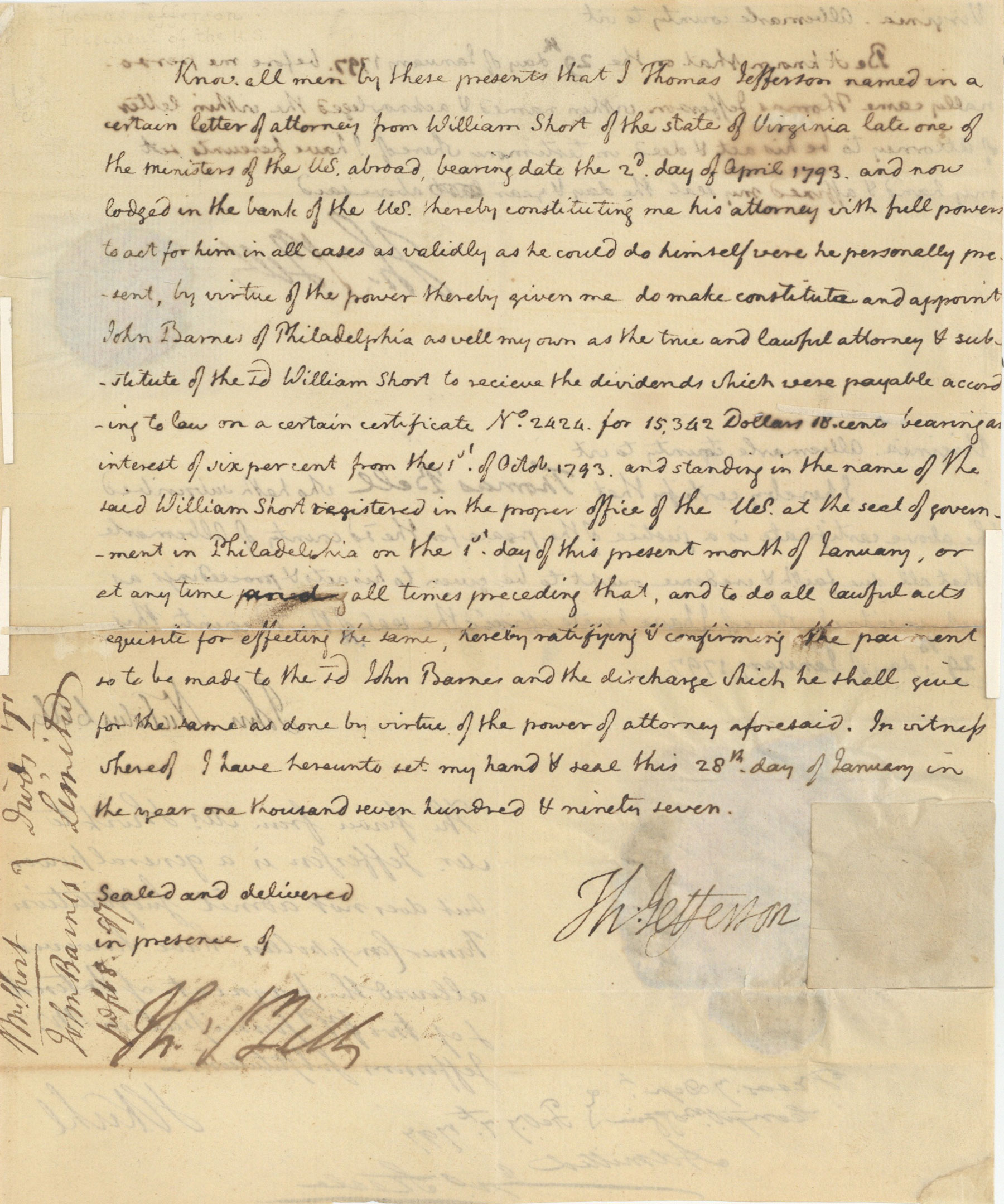
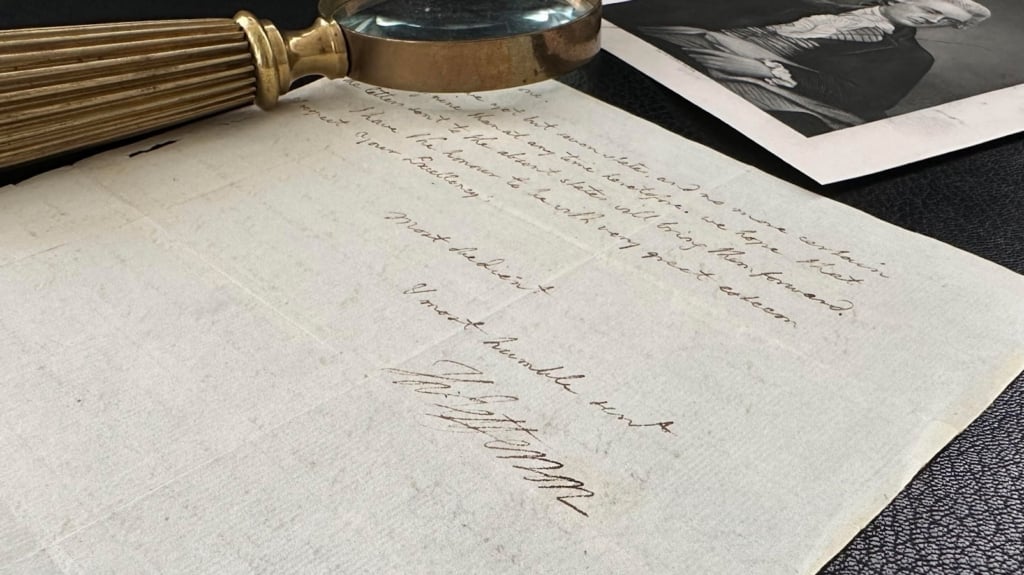
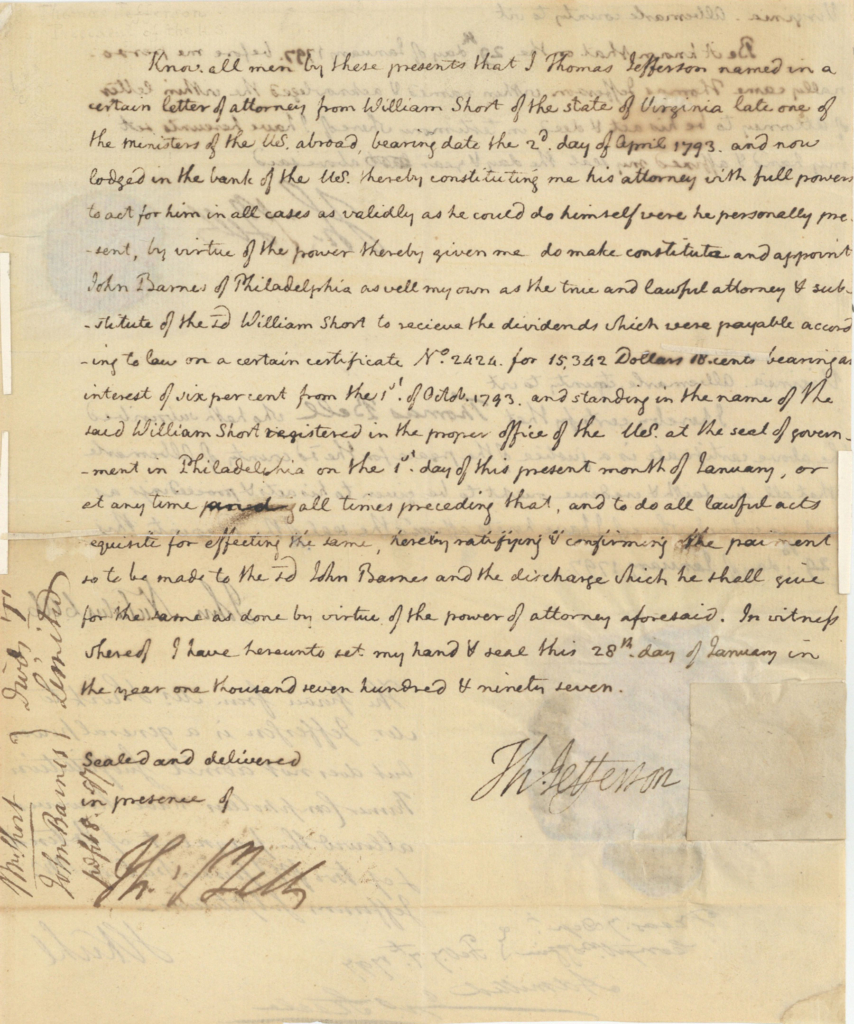
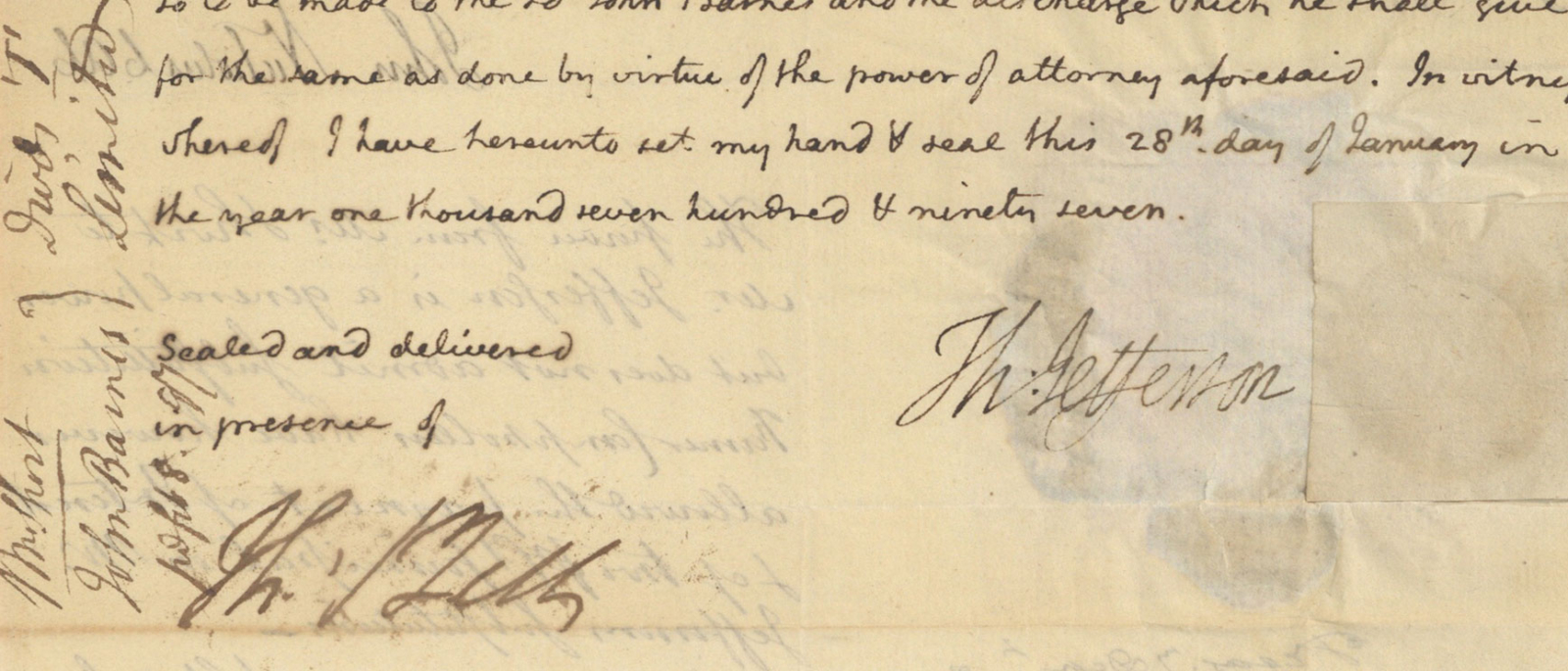
In this document, Jefferson names Barnes to act as Jefferson’s substitute under the power of attorney given Jefferson by Short. Autograph document signed, January 28 and 29, 1797, signed two times, once in the first person and once in the third. “Know all men by these presents that I Thomas Jefferson named in a certain letter of attorney from William Short of the state of Virginia late one of the Ministers of the U. S. abroad, bearing date the 2d day of April 1793, and now lodged in the bank of the U. S., hereby constituting me his attorney with full power to act for him in all cases as validly as he could do himself were he personally present, by virtue of the power thereby given me do make, constitute, and appoint John Barnes of Philadelphia as well my own as the true and lawful attorney & substitute of the said William Short, to receive the dividends which were payable according to law on a certain certificate No. 2424 for 15,342 dollars 18 cents bearing an interest of six per cent from the 1st of Octob. 1793 and standing in the name of the said William Short registered in the proper office of the U. S. at the seat of government in Philadelphia on the 1st day of this present month of January, or at any time passed all times preceeding that, and to do all lawful acts requisite for effecting the same, hereby ratifying & confirming the payment so to me made to the said John Barnes, and the discharge which he shall give for the same as done by virtue of the power of attorney aforesaid. In witness whereof I have hereunto set my hand & seal this 28th day of January in the year one thousand seven hundred & ninety seven.” It is signed “Th. Jefferson,” and sealed and delivered in presence of Justice of the Peace Thomas Bell, who has also signed.
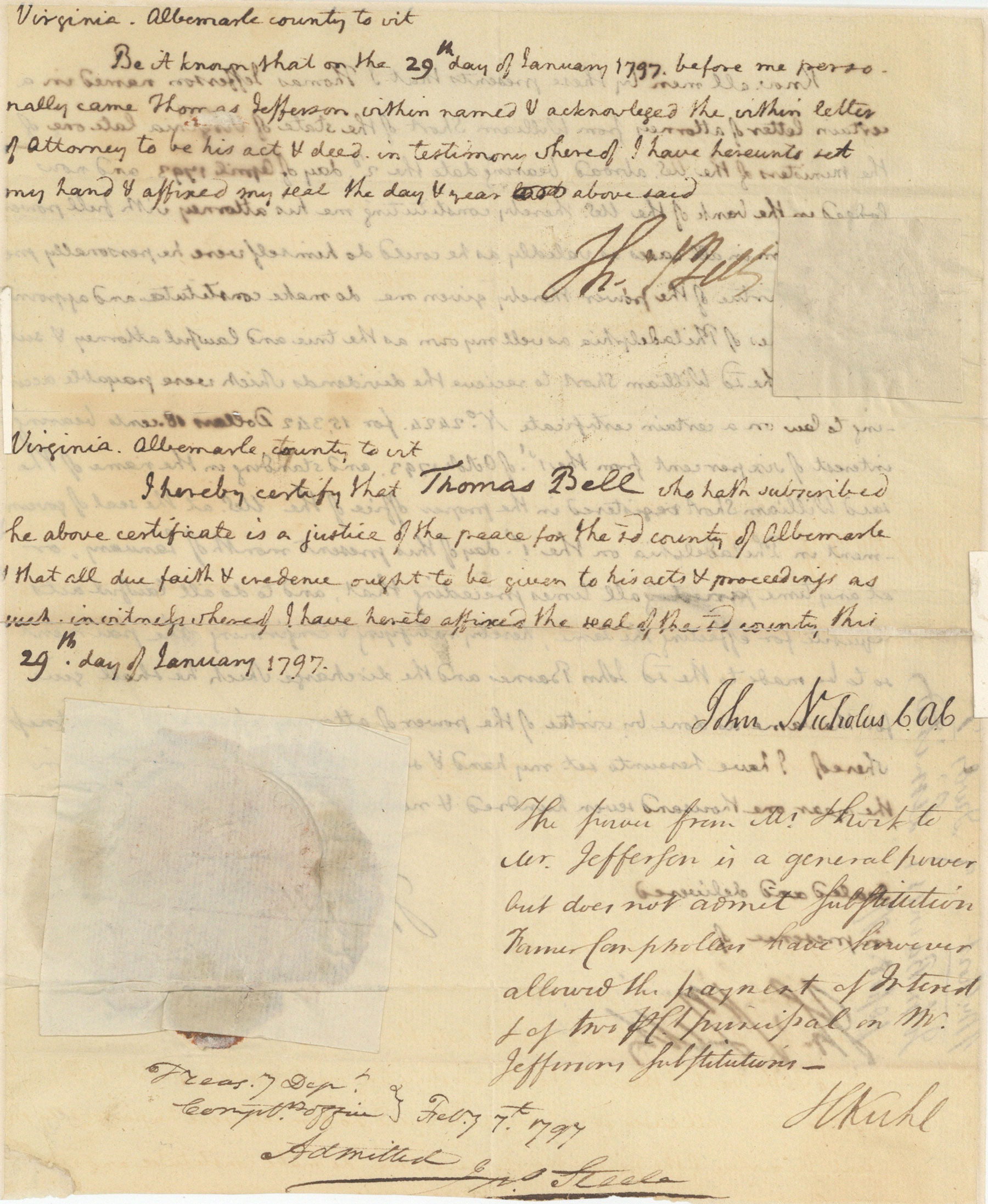
On the verso:
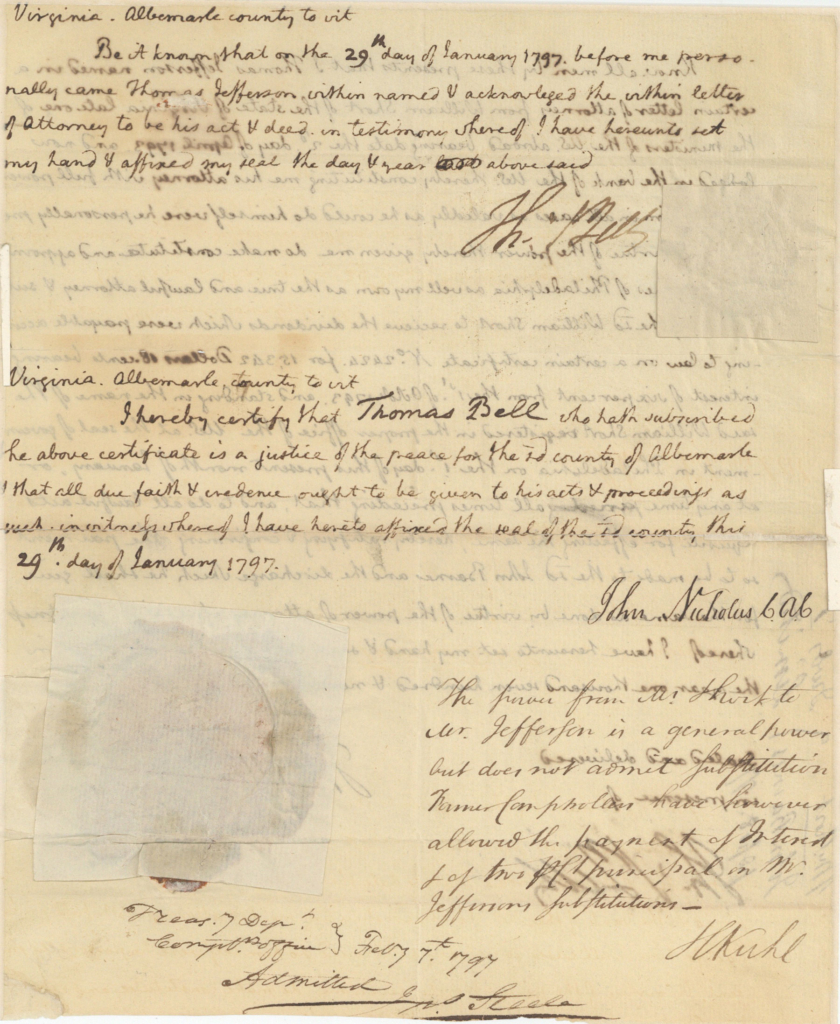
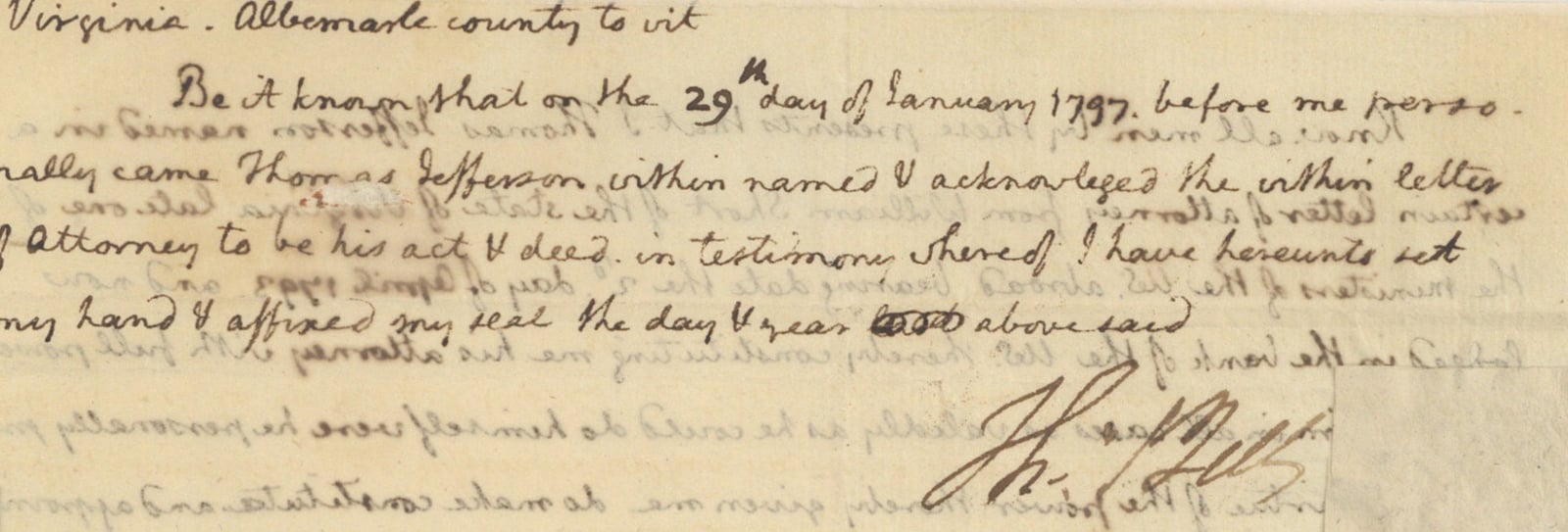
Also in Jefferson’s hand, with his full signature in the text: “Be it known that on the 29th day of January 1797, before me personally came Thomas Jefferson, within named & acknowledged the within letter of attorney to be his act & deed, my hand & affixed my seal the day & year above said.” It is signed by Thomas Bell.
Also in Jefferson’s hand: “Virginia, Albemarle county to wit. I hereby certify that Thomas Bell who hath subscribed the above certificate is a justice of the peace for the said county of Albemarle & that all due faith & credence ought to be given to his acts & proceedings as such in witness whereof I have herunto affixed the seal of the said county, this 29th day of January 1797.” This is signed by Clerk of Court John Nicholas, C.A.C.
In February 1797, this document is endorsed and signed in the hand of Henry Kuhl, who had been Hamilton’s assistant at the Treasury Department, noting that the policy is to not allow this authority for Jefferson to sub-designate Barnes, but allowing it, at least in part: “The power from Mr. Short to Mr. Jefferson is a general power but does not admit substitution. Treas. Comptrollers have however allowed the payment of interest & of two fifth principal on Mr. Jefferson’s substitutions.” Signed by Kuhl.
Final endorsement by the US Comptroller, Jonathan Steele of North Carolina, appointed in 1796 by George Washington, who notes that it was “Admitted.”
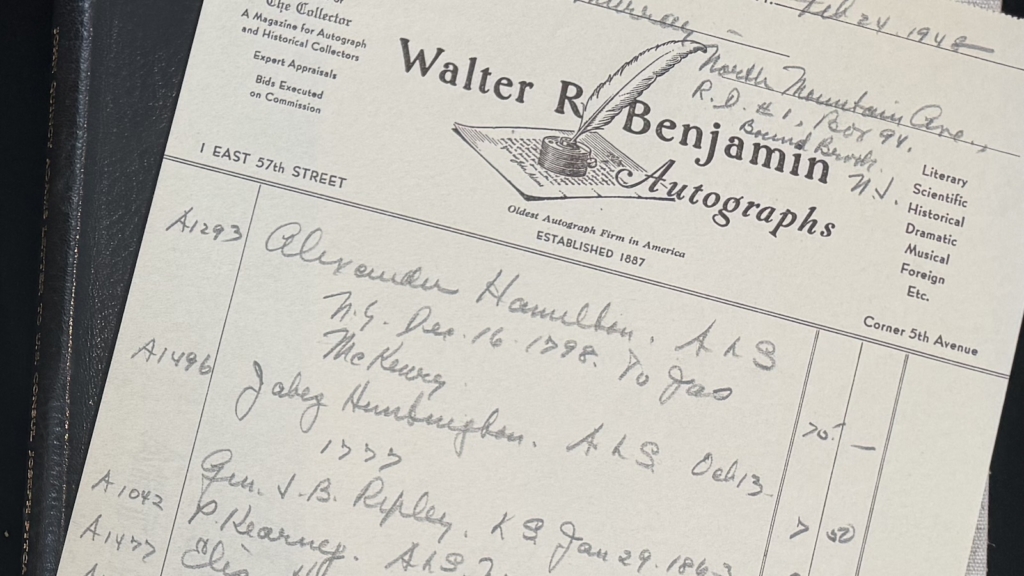
This last sold in 1976, through Robert Batchelder and Ralph Newman at the Abraham Lincoln Bookshop. It has remained with the same family since that time.
Jefferson must have struggled with these transactions because during this stretch there are a handful of such efforts to delegate this responsibility. A previous example, pre-dating this by a month or so, is in the Massachusetts Historical Society.

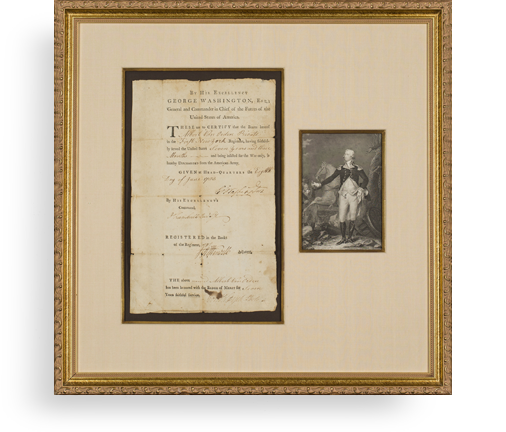
Frame, Display, Preserve
Each frame is custom constructed, using only proper museum archival materials. This includes:The finest frames, tailored to match the document you have chosen. These can period style, antiqued, gilded, wood, etc. Fabric mats, including silk and satin, as well as museum mat board with hand painted bevels. Attachment of the document to the matting to ensure its protection. This "hinging" is done according to archival standards. Protective "glass," or Tru Vue Optium Acrylic glazing, which is shatter resistant, 99% UV protective, and anti-reflective. You benefit from our decades of experience in designing and creating beautiful, compelling, and protective framed historical documents.
Learn more about our Framing Services