







A Prayer for the Traveler, the Sailor and the Carolingian Bishop in the 9th Century, the Text Likely Used to Pray for Charlemagne and his Descendants and Referencing the Parting of the Red Sea
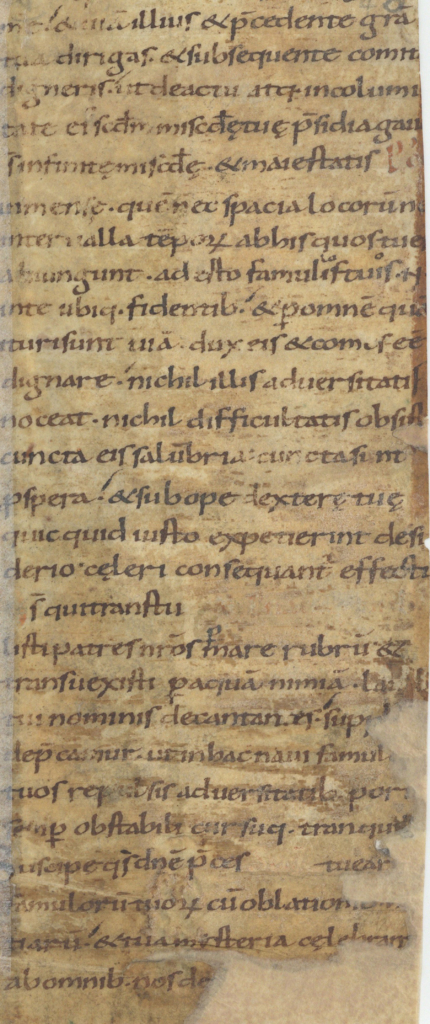
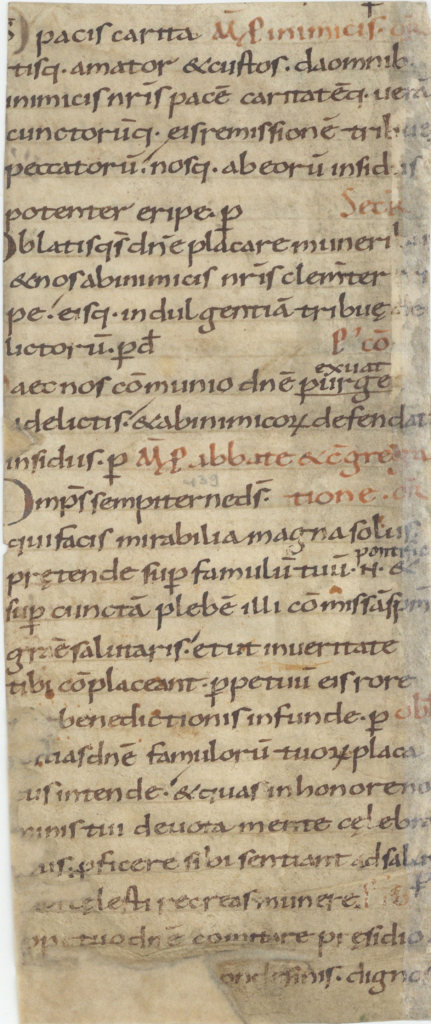

A rare document from the 800s in Europe, showing the reach of Charlemagne’s Empire, in which a religious congregation was asked to pray for that “God, who prepared the [Holy] Roman Empire for the preaching of the Gospel of the eternal King, stretch forth the heavenly weapons to your servant N., our king.”
- Currency:
- USD
- GBP
- JPY
- EUR
- CNY
 This currency selector is for viewing only.
The Raab Collection only accepts USD payments at checkout.
Exchange rates are updated hourly. Rates may be inaccurate.

It is fascinating to think that the men and women who said this prayer lived early enough to have perhaps lived concurrently with Charlemagne himself, who died in 814, but almost ertainly with his son Louis, who lived into the 840s.
Documents of any import or interest from this early era...


It is fascinating to think that the men and women who said this prayer lived early enough to have perhaps lived concurrently with Charlemagne himself, who died in 814, but almost ertainly with his son Louis, who lived into the 840s.
Documents of any import or interest from this early era are very uncommon
The Rise of Charlemagne
The late eighth century saw a new power rising in Europe in the form of the empire of Charlemagne (747-814). Originally from the region of north-eastern France and the adjacent territories of the Low Countries, within a few decades most of Europe from the Channel to the Pyrenees, eastwards into much of Germany, and downwards into Italy had fallen under his sway. It is clear that he saw the correct fostering of religion, writing, reading and learning in general as a vehicle to give this unit a collective identity, remaking the Roman Empire as he saw it out of the fragmented and disparate communities left behind when that power structure fell in the fifth century.
In 800, Charlemagne was crowned Emperor of the Romans by Pope Leo III, reviving the ancient imperial title in the West.
Charlemagne’s only surviving legitimate son, Louis the Pious, inherited the entire empire. Louis was deeply religious and capable but lacked his father’s political and military authority. He ruled as Emperor (814–840) and sought to maintain unity, but his own reforms and family disputes soon undermined that goal.
These conflicts ended with the Treaty of Verdun (843), which permanently divided Charlemagne’s empire into three main kingdoms: West Francia, ruled by Charles the Bald, became the foundation of modern France; East Francia, ruled by Louis the German, evolved into Germany; Middle Francia, ruled by Lothair I, included northern Italy, Burgundy, and the Low Countries; this area later fractured further.
Louis the German ruled East Francia from 843-876, followed by Carloman of Bavaria, Louis the Younger, and Charles the Fat.
Although politically divided, Charlemagne’s empire left a lasting legacy. The idea of a Christian emperor ruling Europe persisted, inspiring the later Holy Roman Empire (begun in 962 under Otto I). His reforms in education, administration, and law profoundly shaped medieval Europe.
The Sacramentary was one of the oldest tools of the Western clergy. It combined the various readings needed for Masses and the liturgy in a single convenient volume for use by a bishop or a priest. The earliest examples to survive are the Leonine and Gelasian Sacramentaries, both with origins in the seventh century, but as with the Bible and other key Christian books the careful reform and correction of such texts was at the forefront of the earliest waves of the Carolingian renaissance. Between 781 and 791, Charlemagne wrote to Pope Hadrian I asking him for an approved copy of the service-book of the Roman Church. That was examined, added to on numerous occasions and disseminated, and became the Gregorian Sacramentary. It is likely to have been further added to in the provinces of Europe, and the text dominated liturgical practice for the next three centuries.
Votive Masses for those on voyages and at sea, for one’s enemies, and for the Bishop and congregation. Reading in part: “Almighty and everlasting God, who alone work great marvels, stretch forth upon your servant N., Bishop, and upon all the peoples committed to him the spirit of saving grace; and that they may truly be pleasing to you, pour upon them the continual dew of your blessing…. O God, Who didst bring our fathers through the Red Sea and didst guide them in safety through the overflowing waters, whilst they sang praises to Thy name, we humbly pray that Thou wouldst keep in safety Thy servants on board ship and grant them a calm voyage to the haven they desire… O God of infinite mercy and immeasurable majesty, whom neither the expanse of places nor the intervals of times separate from those whom you protect, be present to your servants who everywhere place their trust in you, and deign to be for them—through the whole journey they are about to undertake—a guide and a companion. Let nothing of adversity harm them; let nothing difficult stand in their way. Let all things be healthful for them, all things prosperous; and under the help of your right hand, may they swiftly obtain, with effect, whatever they seek with just desire.”
Leaf, measuring 230 x 99 mm, blind-ruled for two columns of 27 lines, written in large and rounded Carolingian minuscule, rubrics in orange-red, recovered from reuse in a later binding.
It is fascinating to think that the men and women who said this prayer lived early enough to have perhaps lived concurrently with Charlemagne who died in 814 but certainly with his son Louis. These changes would have been uttered at a time when the consolidation of their empire was a recent and not distant event and Charlemagne’s grandchild was on the throne. These were events of real import to them and had daily consequences.
Our gratitude to manuscript expert Dr. Timothy Bolton, who aided in the research of this document.
PROVENANCE
Produced in an abbey within the Holy Roman Empire
Cut up for use in a binding probably in the 16th century
Maggs Bros, Catalogue 1002 [1980]
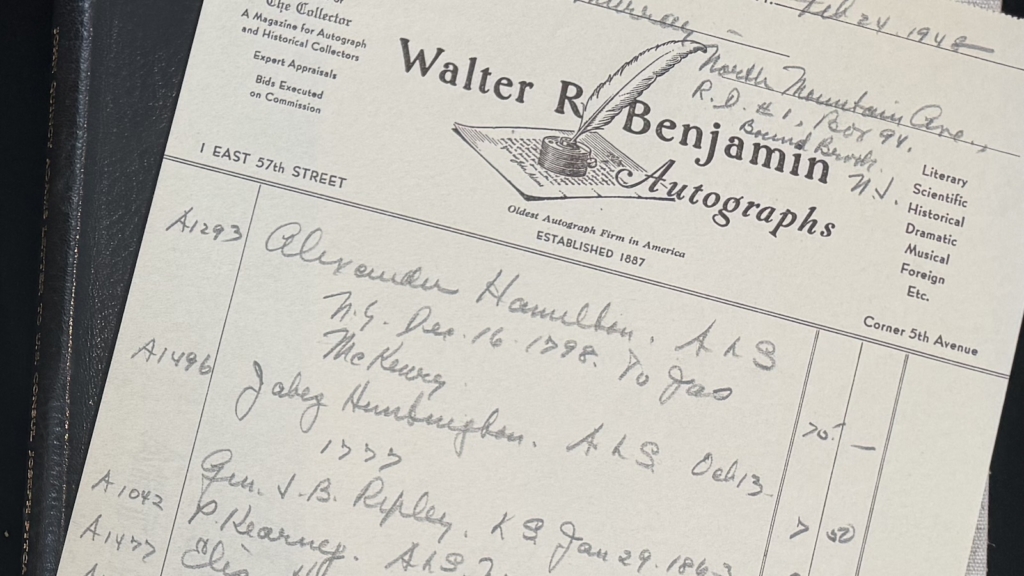
Mark Lansburgh (1925–2013), teacher, hand-press printer, and book collector (on whom see Dutschke, 2024); presumably sold by him to:
Neil F. Phillips (1924–1997), QC, of Montreal, New York, and Virginia: his MS 698; sold at Sotheby’s, 2 December 1997, lot 42; bought by:
The Boehlen Collection, Bern, MS 804.

Frame, Display, Preserve
Each frame is custom constructed, using only proper museum archival materials. This includes:The finest frames, tailored to match the document you have chosen. These can period style, antiqued, gilded, wood, etc. Fabric mats, including silk and satin, as well as museum mat board with hand painted bevels. Attachment of the document to the matting to ensure its protection. This "hinging" is done according to archival standards. Protective "glass," or Tru Vue Optium Acrylic glazing, which is shatter resistant, 99% UV protective, and anti-reflective. You benefit from our decades of experience in designing and creating beautiful, compelling, and protective framed historical documents.
Learn more about our Framing Services

