






Albert Einstein’s Official Defense to the Japanese People, and Indeed the People of the World, of His Role in the Development of the Atomic Bomb


The original English language version of his great nuclear defense
To be initially published in Japan, whose people at Hiroshima and Nagasaki were victims of the two atomic bomb blasts; Japan remains the only country to have been a victim of a nuclear bomb
This statement was a response to a simple question from the Japanese: “Why did you co-operate with...


To be initially published in Japan, whose people at Hiroshima and Nagasaki were victims of the two atomic bomb blasts; Japan remains the only country to have been a victim of a nuclear bomb
This statement was a response to a simple question from the Japanese: “Why did you co-operate with the production of the atomic bomb although you were aware of its tremendous destructive power?”
Here, in this letter acquired from the direct descendants of the recipient, Einstein comes to terms with the consequences of his letter to President Roosevelt and role in the nuclear program in one of the most important pieces of Einstein ever offered for sale
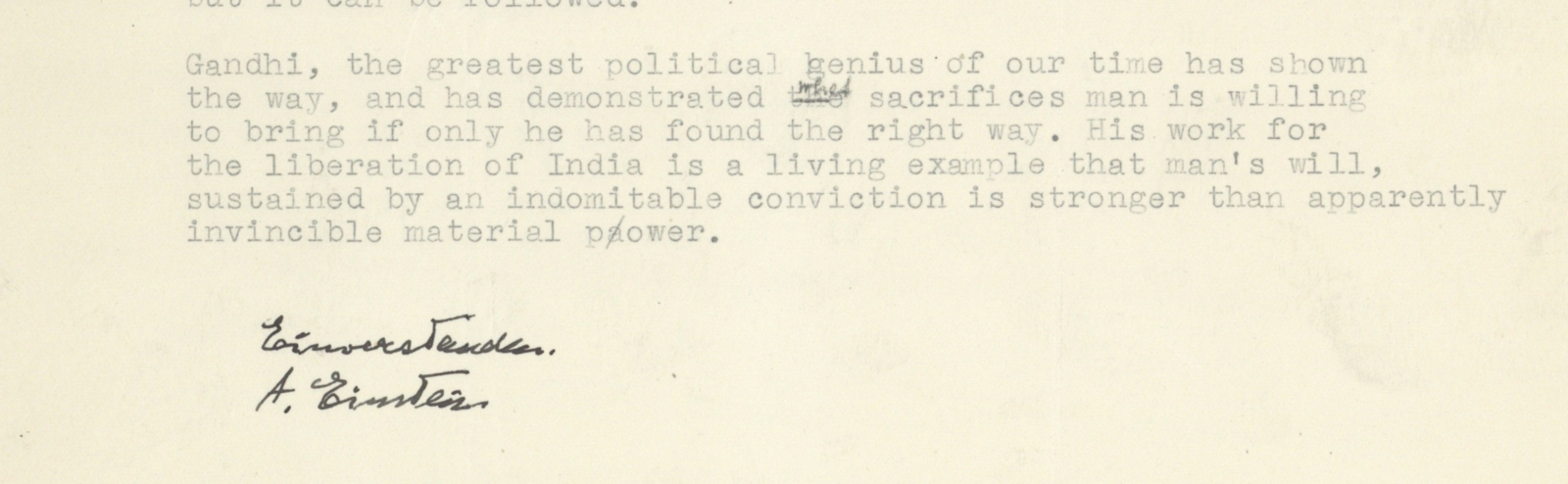
He cites Gandhi: “Gandhi, the greatest political genius of our time has shown the way, and has demonstrated the sacrifices man is willing to bring if only he has found the right way. His work for the liberation of India is a living example that man’s will, sustained by an indomitable conviction is stronger than apparently invincible material power.”
This is the original, official English language manuscript, retained by the physicist who published it; the draft in German is in the Einstein Papers
In creating this English language version, Einstein hoped to exonerate his conduct to the widest possible audience
He predicts the arms race “spells universal destruction.”
Einstein acknowledges the “dreadful danger for all mankind” posed by atomic weapons, but states, “My participation in the production of the atom bomb consisted in a single act: I signed a letter to President Roosevelt.…The probability that the Germans might work on that very problem with good chance of success prompted me to take that step.”
He adds, “I did not see any other way out, although I always was a convinced pacifist”
Although Albert Einstein’s participation in the production of the atomic bomb was limited, the public perceived his role as crucial, and he was in fact the face of the project to many. The reasons were that although he did not work on the Manhattan Project, the US effort to build the bomb, his famous equation, E=mc2, provided the theoretical basis for understanding the immense energy released in nuclear fission, which is the process that powers the bomb. And his 1939 letter to President Roosevelt, co-signed by Leo Szilárd, alerted the US government to the potential of nuclear weapons and prompted the start of research that eventually led to the Manhattan Project. Feeding the public perceptions of his responsibility were publications like The Smyth Report, a history of the development of the bomb published the day after the bombing of Nagasaki, which ascribed great historical weight to Einstein’s 1939 letter to President Franklin D. Roosevelt in catalyzing the development of the bomb. In 1946, Time magazine published the famous cover featuring Einstein’s portrait backgrounded by an enormous mushroom cloud emblazoned with “E=mc2,” and the accompanying article by Whittaker Chambers referred to him as “the father of the bomb,” a title which resonated in the popular imagination. A March 1947 Newsweek cover featured Einstein, above the headline “Godfather of the Atomic Bomb”. Einstein was hounded by the association throughout the rest of his life, culminating in his November 1954 admission to Linus Pauling, “I made one great mistake in my life when I signed the letter to President Roosevelt recommending that atom bombs be made….” Einstein was often asked about his role, and in each case he would deflect the question, or end the discussion, until 1953, when he responded at length to defend his role in his only extended explanation on the subject.
Following the 1952 lifting of the Japanese ban on publishing images of the destruction wrought by the bomb, the editor of the influential Japanese magazine Kaizō, Katsu Hara, sent Einstein a series of questions on the destructive power of the atomic bomb and its implications, ending with the direct query, “Why did you co-operate with the production of the atomic bomb although you were aware of its tremendous destructive power?” Einstein responded in German with a full statement, aware that it would be for publication. The fact that the questions emanated from Japan, spurred by the images of the devastation of their people, “provoked Einstein into discussing, at greater length than he had ever done before, his role [in the production of the bomb]” (see Einstein on Peace, p. 581).
In 1922, the publisher of Kaizo had brought Einstein to Japan for a series of lectures. His reception upon arriving in Japan occasioned Einstein to remark to his wife Elsa, “No living person deserves this sort of reception…” (Issacson, Einstein: His Life and Universe, p 307). Einstein formed a lasting relationship with the publication Kaizo, and a particular bond and affection for the Japanese people. Likely, it was this affection, along with the emotional effect of the publication of the photos of the devastation at Hiroshima and Nagasaki, which led Einstein to craft this unique in-depth response to Kaizo, explaining and defending his role, which was published in 1952 in Japan in a special edition of that magazine.
Dr. Herbert Jehle was a pioneering theoretical physicist whose work spanned quantum field theory, biophysics, and astrophysics. He was a student and friend of Einstein in the 1920s in Germany; and a disciple and friend of Dietrich Bonhoeffer. At Princeton in 1947 he provided Richard Feynman with the spark which would lead to his path integral formulation. Einstein had left for the United States in 1933, the same year that Jehle received his doctorate from the Technische Hochschule Berlin. In the same year, Dietrich Bonhoeffer, Jehle’s friend and mentor stepped down from his professorship at Berlin, in protest of the Nazi ascent to power. In 1940, Jehle refused to assist in the German armament and atomic project, and was interned in concentration camps. Escaping in 1941 with the help of Quaker and Christian relief organizations, Jehle made his way to the United States, where he took a position at Harvard University, until leaving for Princeton in 1947. At Princeton, Jehle’s pacifist beliefs coincided with Einstein’s own and they reconnected, bonding over shared views of social responsibility and ethics in science, and playing music together regularly, Einstein on violin, Jehle on the piano.
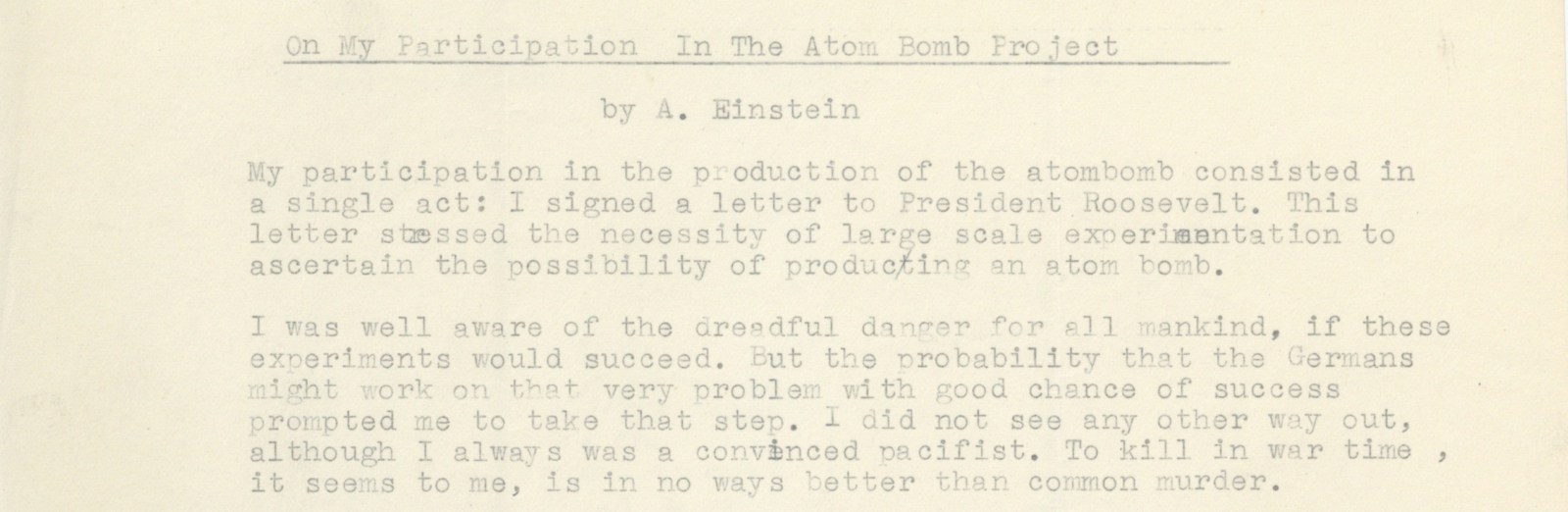
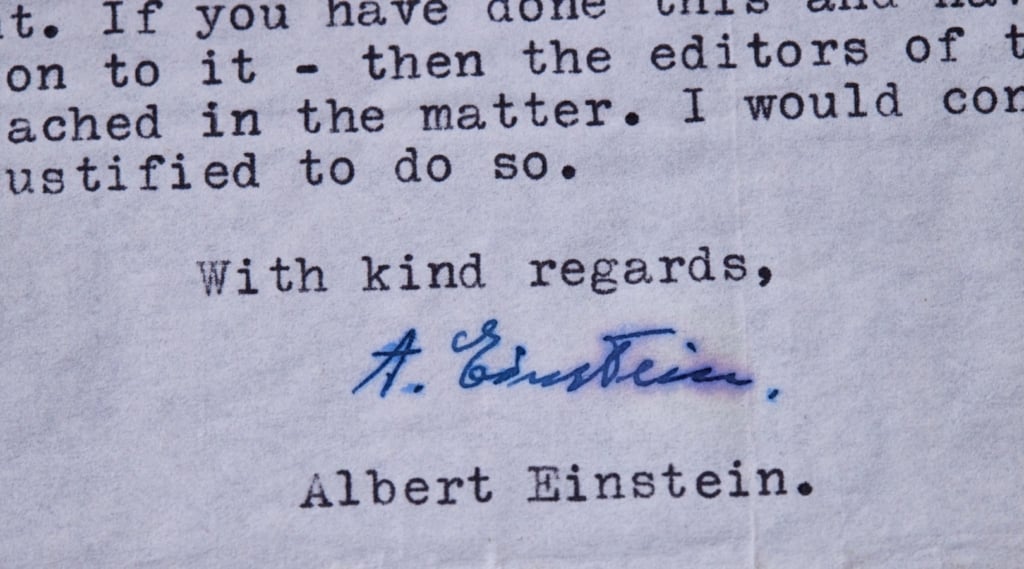
Jehle was also the editor of the Society for Social Responsibility in Science newsletter, of which Einstein was a member. In early 1953, Einstein gave to Jehle the English version of Einstein’s German language response to Kaizo’s questions. It is signed by him at the base, “Einverstanden/ A. Einstein” [“Agreed, A. Einstein”]. This in turn was printed in 1953 in the Society for Social Responsibility in Science newsletter and also in the New Outlook. Jehle retained the original and passed it down in his family.
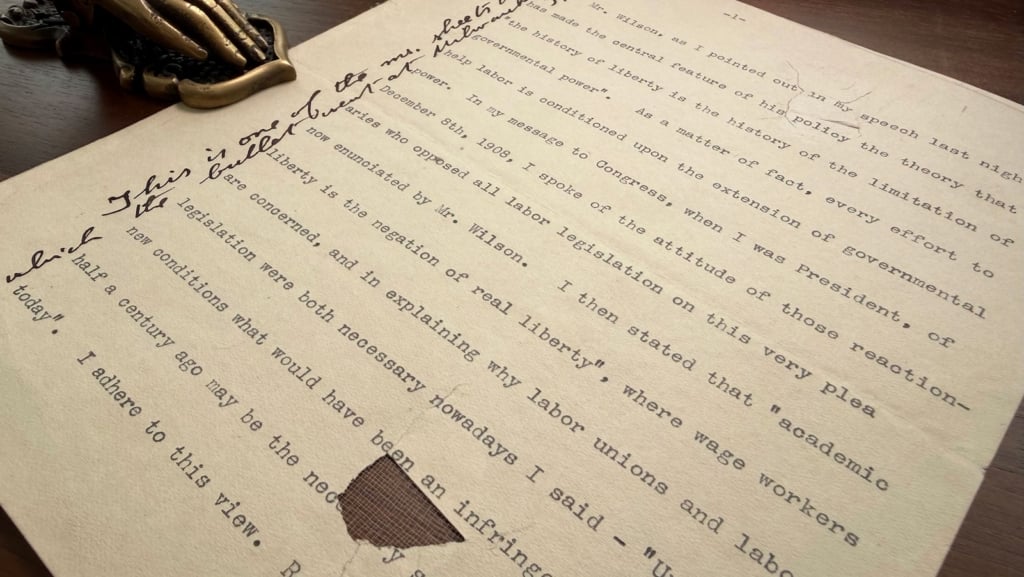
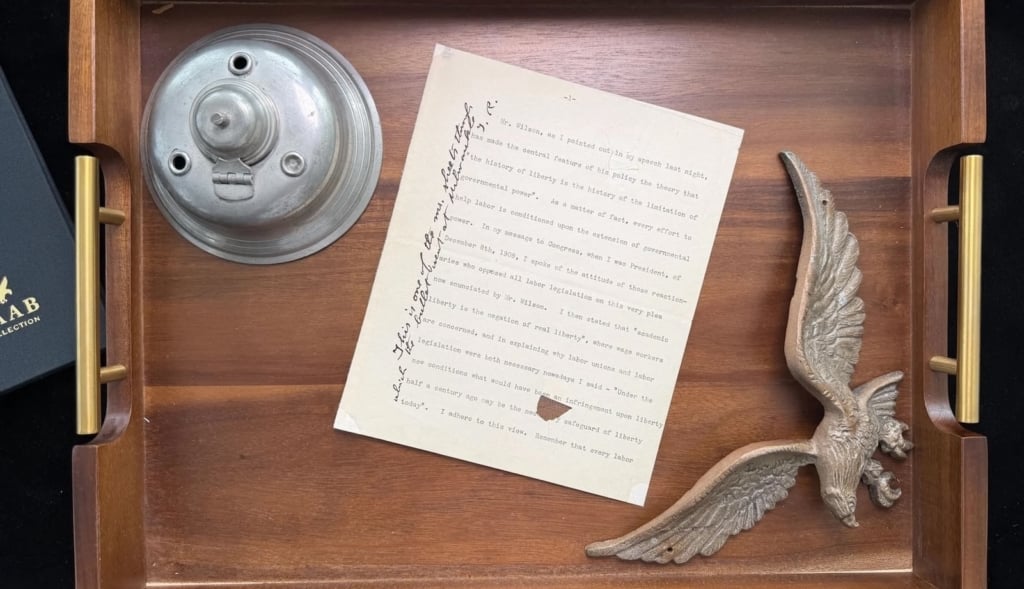
This is Einstein’s defense, addressed to the Japanese people but also intended to exonerate his conduct to the people of the world. Typed manuscript signed, 1953, with Einstein emphasizing his limited involvement in the development of the atomic bomb, which he said consisted of “a single act” – signing the 1939 letter to President Roosevelt. He also stresses a point that he had limited options back then – “I did not see any other way out, although I always was a convinced pacifist,” and that the only way to stop the arms race is “radical abolition of war.”
“My participation in the production of the atom bomb consisted in a single act: I signed a letter to President Roosevelt. this letter stressed the necessity of large scale experimentation to ascertain the possibility of producing an atom bomb.
“I was well aware of the dreadful danger for all mankind, if these experiments would succeed. But the probability that the Germans might work on that very problem with good chance of success prompted me to take that step. I did not see any other way out, although I always was a convinced pacifist. To kill in war time, it seems to me, is in no ways better than common murder.
“As long however, as nations are not ready to abolish war by common action and to solve their conflicts in a peaceful way on a legal basis, they feel compelled to prepare for war. They feel moreover compelled to prepare the most abominable means, in order not to be left behind in the general armaments race. Such procedure leads inevitably to war, which, in turn, under today’s conditions, spells universal destruction.
“Under such circumstances there is no hope in combating the production of specific weapons or means of destruction. Only radical abolition of war and of danger of war can help. Toward this goal one should strive; in fact nobody should allow himself to be forced into actions contrary to this goal. This is a harsh demand for anyone who is aware of his social inter-relatedness; but it can be followed.
“Gandhi, the greatest political genius of our time has shown the way, and has demonstrated the sacrifices man is willing to bring if only he has found the right way. His work for the liberation of India is a living example that man’s will, sustained by an indomitable conviction is stronger than apparently invincible material power.”
Einstein’s German language original draft is at the Einstein Archive in Jerusalem. It is clear from the corrections how deeply he considered the questions from Kaizo, resulting in his most powerful defense of his involvement in the creation of the atomic bomb. The nature of Einstein’s struggles to explain the complex circumstances surrounding his participation in the atomic bomb project, and his defense of that participation, make this one of the most moving and important Einstein manuscripts to reach the market. We find no original English language version of this manuscript except this Jehle version. And we obtained this manuscript directly from the Jehle family.
Along with original and unpublished photographs of Einstein, Bohr and other scientists taken by Jehle himself.

Frame, Display, Preserve
Each frame is custom constructed, using only proper museum archival materials. This includes:The finest frames, tailored to match the document you have chosen. These can period style, antiqued, gilded, wood, etc. Fabric mats, including silk and satin, as well as museum mat board with hand painted bevels. Attachment of the document to the matting to ensure its protection. This "hinging" is done according to archival standards. Protective "glass," or Tru Vue Optium Acrylic glazing, which is shatter resistant, 99% UV protective, and anti-reflective. You benefit from our decades of experience in designing and creating beautiful, compelling, and protective framed historical documents.
Learn more about our Framing Services


