





Alexander Graham Bell Wins a Patent Case for His Contributions to Aviation

He writes his attorneys indicating he will continue the case, which contested who invented and perfected the use of ailerons for lateral control of an airplane
- Currency:
- USD
- GBP
- JPY
- EUR
- CNY
 This currency selector is for viewing only.
The Raab Collection only accepts USD payments at checkout.
Exchange rates are updated hourly. Rates may be inaccurate.

Bell won by the case when the Patent Office found for him the next year
Alexander Graham Bell was not merely the inventor of the telephone, but a pioneering aviation researcher, who formed the Aerial Experiment Association (AEA) in 1907 to develop flying machines – to “put a man in the air”....

Bell won by the case when the Patent Office found for him the next year
Alexander Graham Bell was not merely the inventor of the telephone, but a pioneering aviation researcher, who formed the Aerial Experiment Association (AEA) in 1907 to develop flying machines – to “put a man in the air”. The team invented and perfected the use of ailerons for lateral control, which was a critical, lasting contribution to aircraft design. They also developed the successful Silver Dart airplane, which achieved the first powered, controlled flight in Canada in 1909.
This letter relates to a patent interference case between Alexander Graham Bell’s and his research group, the Aerial Experimental Association (AEA), and another inventor, George Francis Myers. Among other members of the AEA listed in the case, all aviation pioneers in their own right, are Frederick “Casey Baldwin, John A. McCurdy, and Glenn Curtiss. Bell’s cousin, Charles J. Bell, was the Association’s legal trustee.
In 1909, Bell and his group received a patent that “relates to a flying machine and more particularly consists of means for maintaining or restoring the lateral equilibrium thereof.” Myers claimed the patent should be his, that he had a previous conception and previous application. He sued for patent interference.
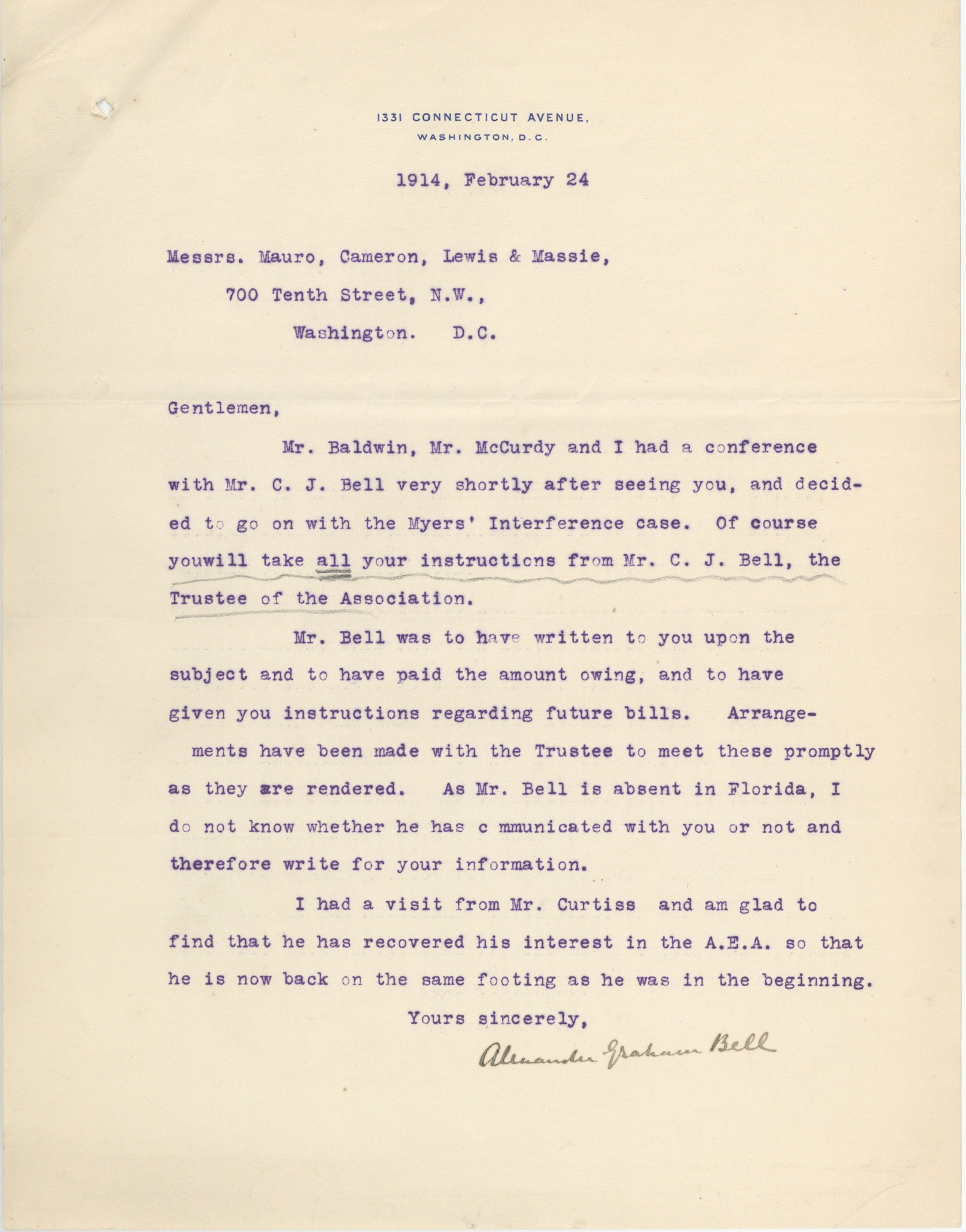
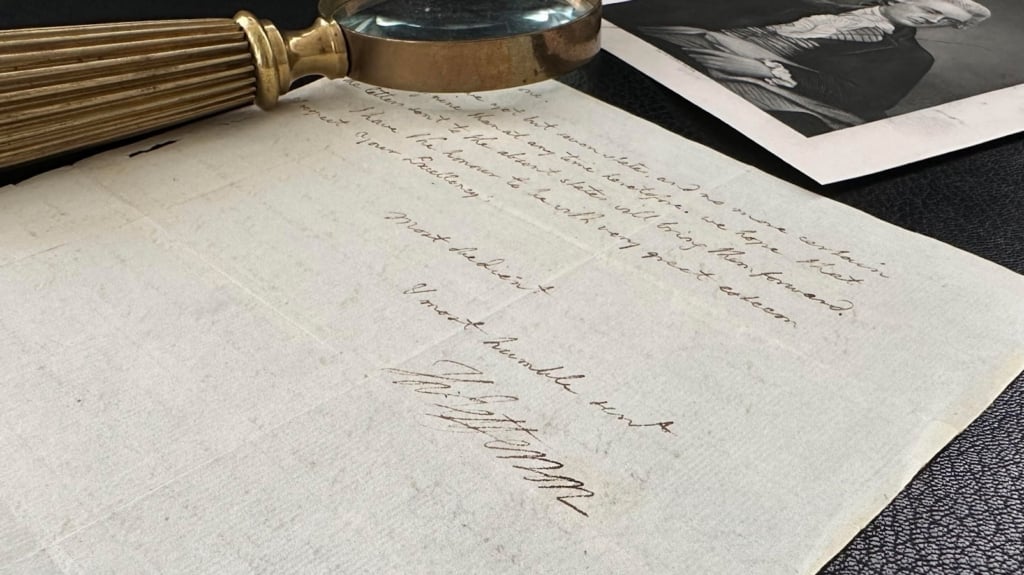
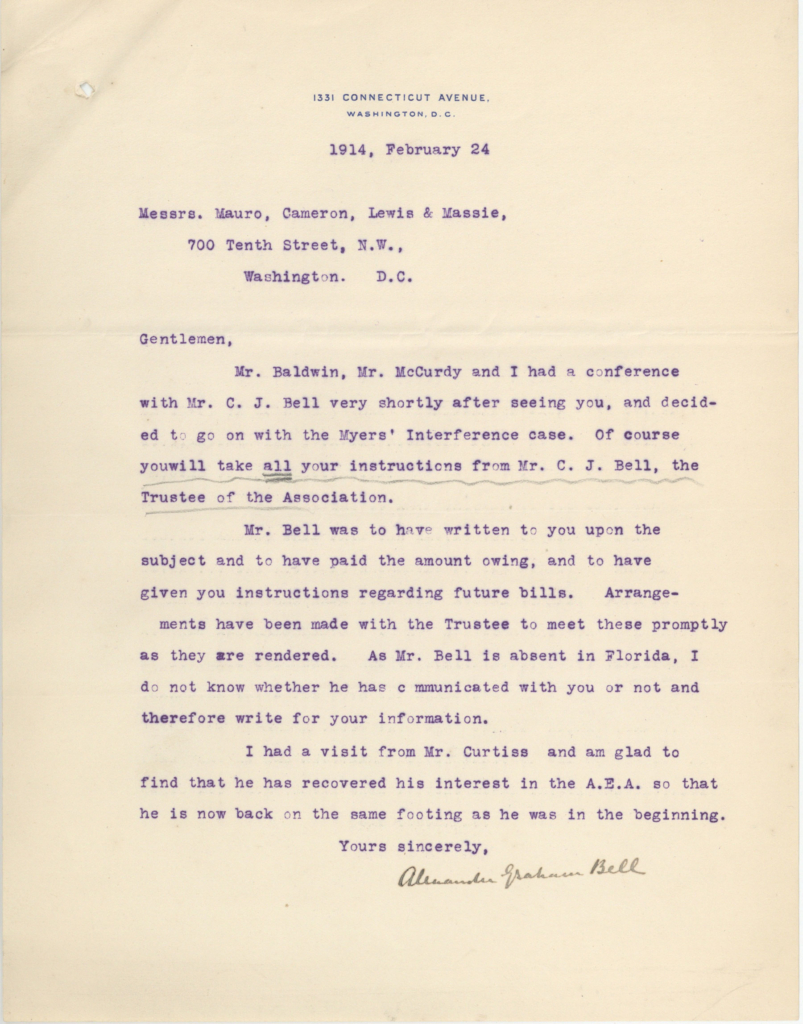
Typed letter signed, Washington, D.C. February 24, 1914, to Bell’s legal counsel attorneys Mauro, Cameron, Lewis & Massie, agreeing to move forward with the patent interference case. “Gentlemen, Mr. Baldwin, Mr. McCurdy and I had a conference with Mr. C. J. Bell very shortly after seeing you, and decided to go on with the Myers’ Interference case. Of course you will take all your instructions from Mr. C. J. Bell, the Trustee of the Association. Mr. Bell was to have written to you upon the subject and to have paid the amount owing, and to have given you instructions regarding future bills. Arrangements have been made with the Trustee to meet these promptly as they are rendered. As Mr. Bell is absent in Florida, I do not know whether he has communicated with you or not, and therefore write for your information. I had a visit from Mr. Curtiss and am glad to find that he has recovered his interest in the A.E.A. so that he is now back on the same footing as he was in the beginning. Yours sincerely, Alexander Graham Bell.” Pencil notations to text, presumably by Bell.
The Patent Offie issued an opinion on the case in 1915. It stated: “For there being no evidence to show the slightest activity on the part of Myers between February 20, 1907, and December 5, 1908, during which period, as will presently appear, Bell et al entered the field and reduced to practice, he must certainly be regarded as lacking in diligence and would obtain no particular advantage therefrom. In the absence of proofs, therefore, Myers is restricted to December 5, 1908, for conception and constructive reduction to practice.” Bell’s group was found to have a conception date of April 6, 1908 and a reduction to practice date of June 15, 1908.
“Alexander Graham Bell,” the opinion maintained, “testifies that he has long been interested in aerial locomotion; that some years ago he began experiments with kite constructions with the idea of building one of sufficient power to carry a man…The witness further testifies that after some further experiments with tetrahedral kite structures he and his associates, McCurdy, Baldwin, Curtiss and Selfridge, on October 1, 1907, organized the Aerial Experiment Association with the object of using their combined efforts to devise and construct a practical aerodrome that would carry a man into the air, propelled by its own power…It clearly appears from the testimony of Patterson, Kleckler, and the two joints applicants, Bell and Curtiss, that about June 25, 1908, the supporting surfaces of the machine, which were porous and leaked air, were varnished and the lifting power of the machine being found to be materially increased, the ailerons were placed at a zero angle of incidence. As thus changed both Bell and Curtiss declare that the “June Bug” was flown successfully a number of times in June and July, 1908, on one of its flights, on July 4, 1908, winning the trophy offered by the “Scientific American” for the first flight of one kilometer distance by a heavier-than-air machine…Both Patterson and Kleckler testify that after the ailerons had been changed the “June Bug” was flown repeatedly both before and after July 4, 1908, and that they witnessed all of these flights, as well as that which occurred on July 4. Cameron says he was in Hammondsport on July 8, 1908, made a very careful study of the construction of the machine designated the “June Bug” and witnessed a flight of that machine with Curtiss as aviator. The flight, he says, was made with perfect balance, the machine being tilted to the right or left at the will of the aviator and then returned to an even keel and a perfectly balanced landing accomplished. The descriptions given by all the witnesses of the construction of the “June Bug” at the time of the flights referred to show conclusively that it fully satisfied every count of the issue.”
Finally, the Patent Office held, “The evidence clearly shows that Bell et al, by the building and successful operation of an aeroplane embodying the complete invention in issue, accomplished an actual reduction to practice at least as early as July, 1908. Since Myers has no established date of either conception or reduction to practice prior to his filing date of December 5, 1908, and since Myers, even if entitled to a date of conception prior to that proved by Bell et al, was clearly lacking in diligence, it is evident that he cannot prevail. Priority of invention of the subject matter at issue herein is awarded to Alexander Graham Bell, Frederick W. Baldwin, John A. Douglas McCurdy, Glenn H. Curtiss, and Edward E. Selfridge.”
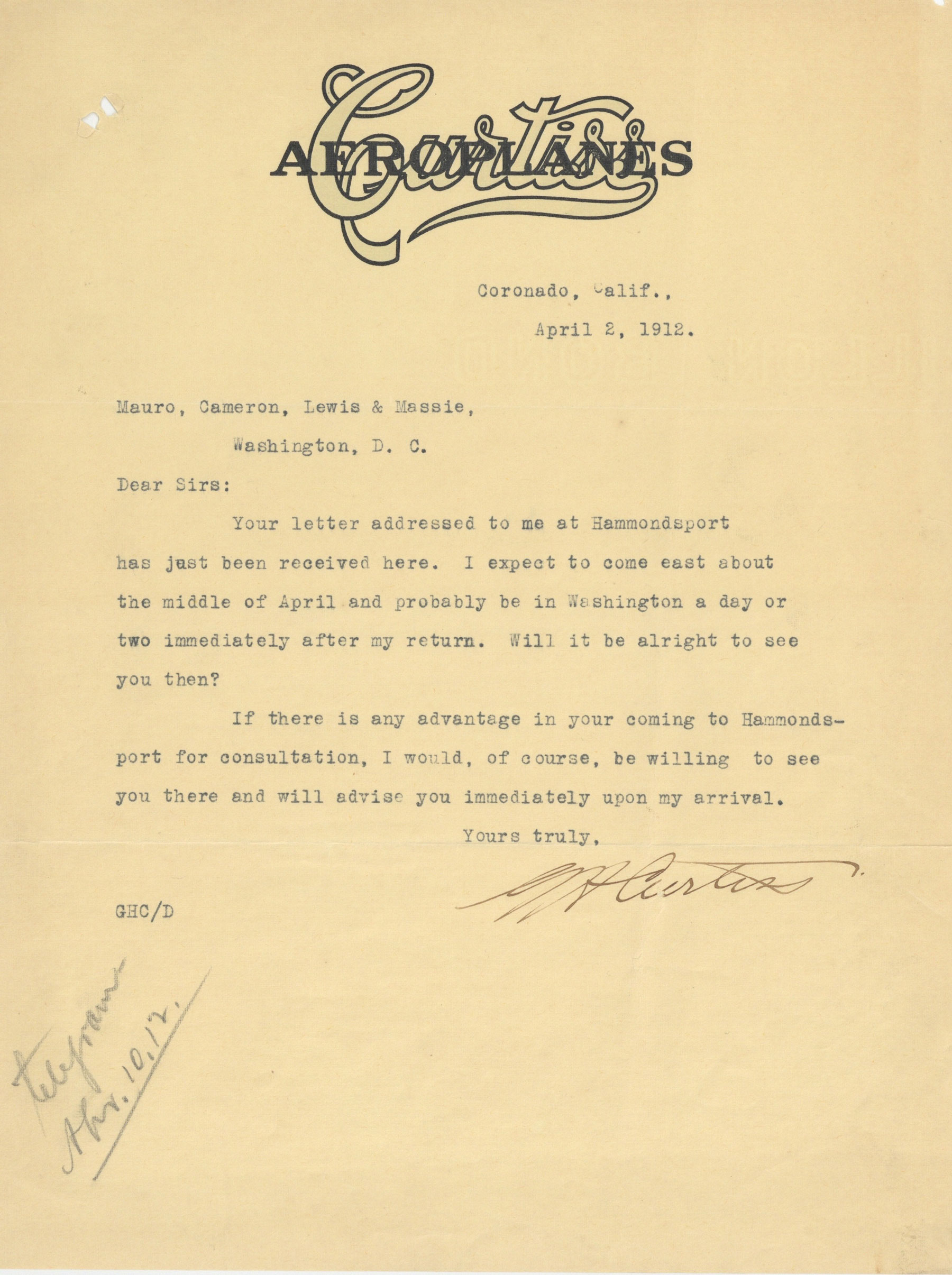
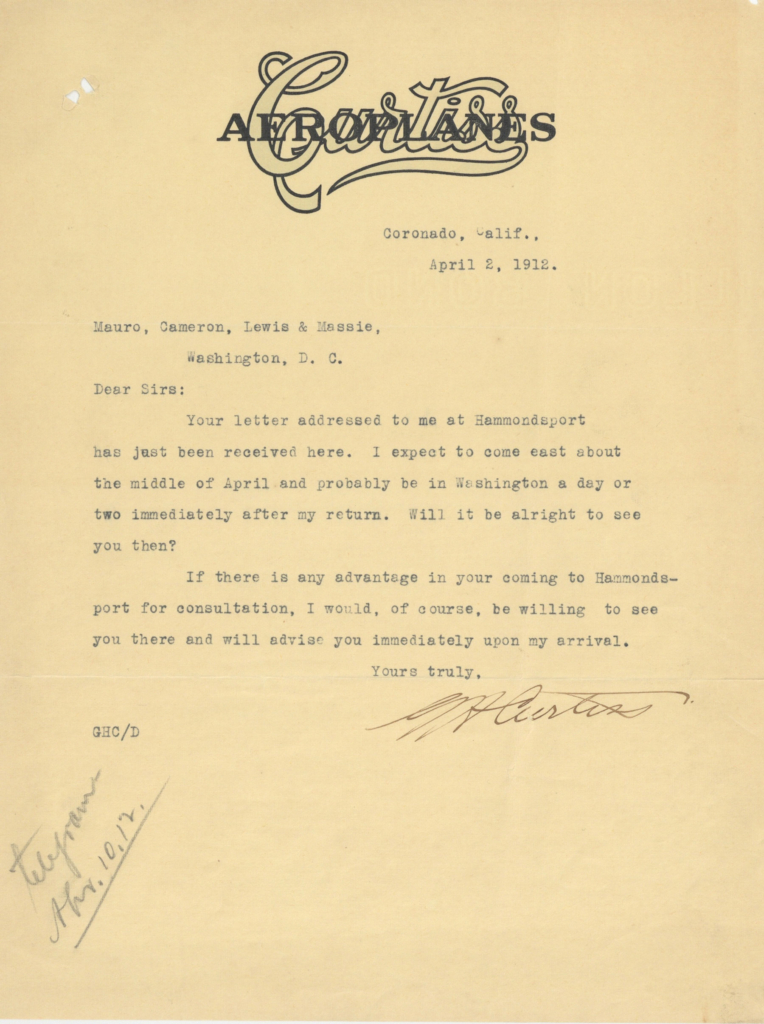
Included with this is a typed letter signed by aviation pioneer Glenn Curtiss, dated April 2, 1912, addressed to Mauro, Cameron, Lewis & Massie, regarding coordinating a meeting for consultation.

Frame, Display, Preserve
Each frame is custom constructed, using only proper museum archival materials. This includes:The finest frames, tailored to match the document you have chosen. These can period style, antiqued, gilded, wood, etc. Fabric mats, including silk and satin, as well as museum mat board with hand painted bevels. Attachment of the document to the matting to ensure its protection. This "hinging" is done according to archival standards. Protective "glass," or Tru Vue Optium Acrylic glazing, which is shatter resistant, 99% UV protective, and anti-reflective. You benefit from our decades of experience in designing and creating beautiful, compelling, and protective framed historical documents.
Learn more about our Framing Services