






The Rare Great Seal of Ferdinand and Isabella, On an Illuminated, Unique Document of Flemish and Spanish Art, Establishing a Commercial Center as a Reward to the Family of King John II’s Bodyguard


Signed by the very same men who signed Christopher Columbus's instructions that year for this third expedition
- Currency:
- USD
- GBP
- JPY
- EUR
- CNY
 This currency selector is for viewing only.
The Raab Collection only accepts USD payments at checkout.
Exchange rates are updated hourly. Rates may be inaccurate.

We found no record for a great seal of the Catholic Monarchs having reached the market, nor any record of a document from the Court of the Great Monarchs of this ornate, illuminated nature from this early having come up for sale
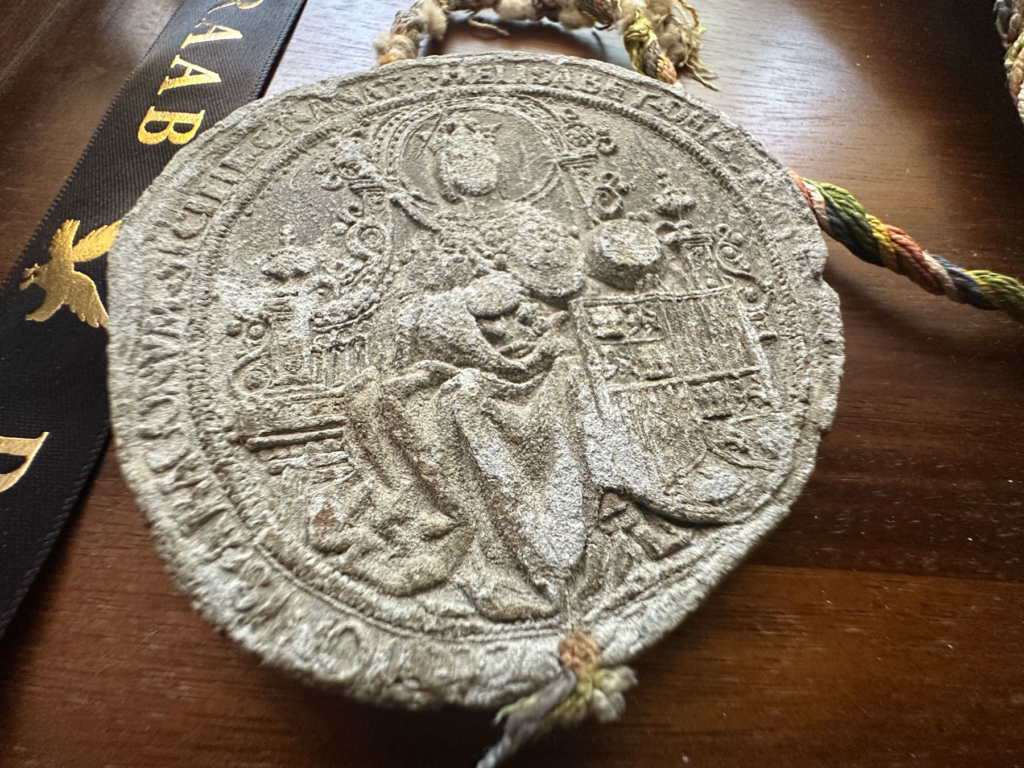
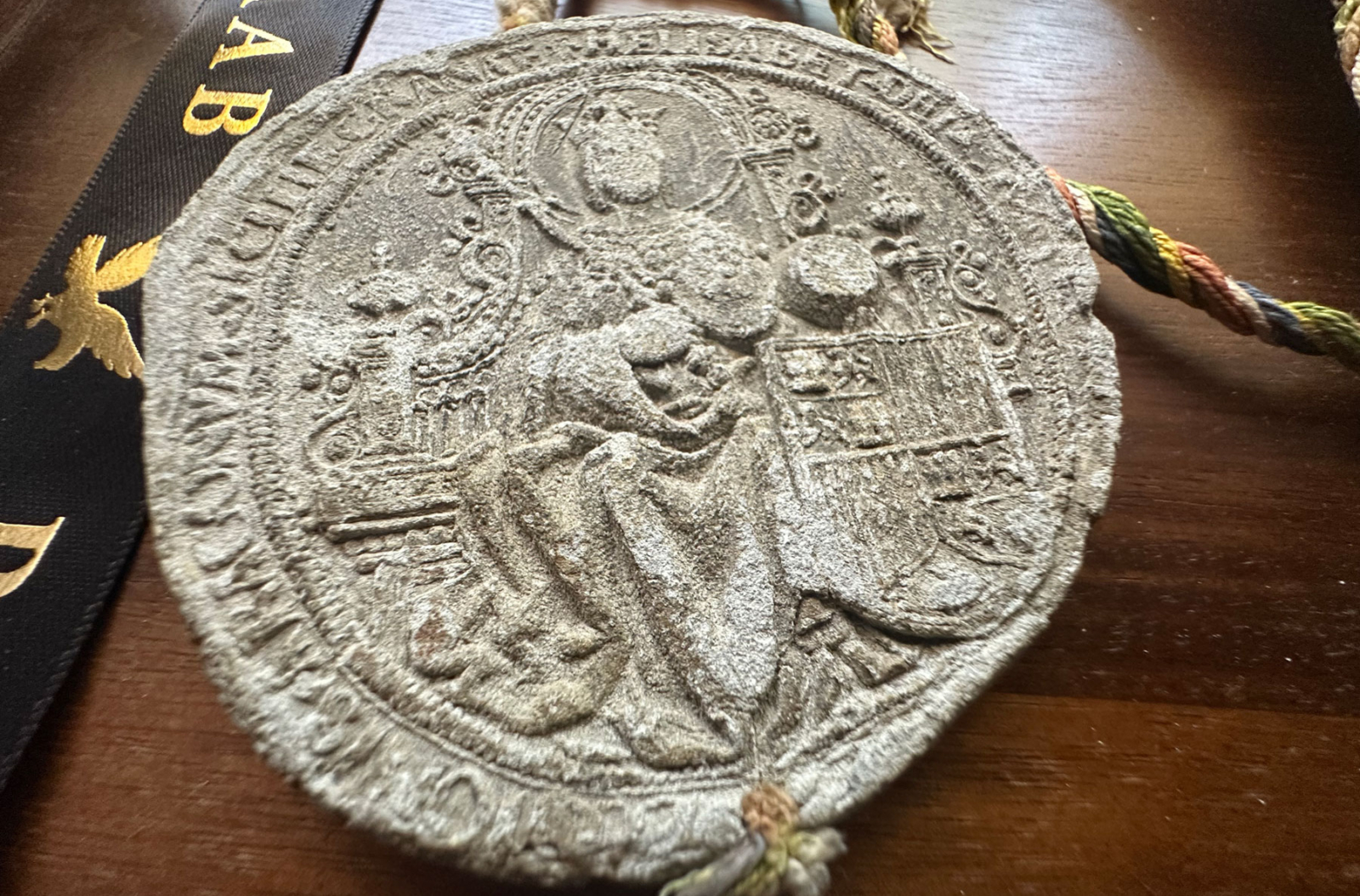
The large lead seal, attached with multicolored thread, shows...


We found no record for a great seal of the Catholic Monarchs having reached the market, nor any record of a document from the Court of the Great Monarchs of this ornate, illuminated nature from this early having come up for sale
The large lead seal, attached with multicolored thread, shows Ferdinand on horseback; Isabella on the throne
In 711, Muslim Moors crossed the Strait of Gibraltar and began their conquest of Southern Spain. So began Islamic rule in Spain that would last 300 years in much of the Iberian Peninsula and nearly 800 years in Granada and the South in a group of Muslim states called Al-Andalus.
John II of Castile, Isabella’s father, was King of Castile and León from 1406 to 1454. He succeeded his older sister, Maria of Castile, Queen of Aragon, as Prince of Asturias in 1405. John was the son of King Henry III and his wife, Catherine of Lancaster, a granddaughter of King Peter.
On October 19, 1469, Ferdinand of Aragon and Isabella of Castille married, bringing together the two crowns and uniting Christian parts of Spain as they had not been previously. At the time of their marriage, Muslim control over Spain had weakened. The heart of its remaining power was in the Emirate of Granada, iconicized in the oft-visited Al-Hambra, an Emirate which centered on the city and expanded into a great portion of Southern Spain. Among those towns outside Granada was Montefrio, then called Munt Farid. This town was taken by the Spanish in 1486 and only populated by military personnel and others taking part in the “Guerra de los Moros”, or war against the Moors. It was a gateway city to the stronghold of Granada and part of the effort of the Catholic Monarchs to chip away at Muslim control. It is approximately 35 miles from Granada itself.
It was only by virtue of loans from Castile’s great benefactors that Ferdinand and Isabella waged the war to expel the Muslims from Spanish territory. Foremost among these was Alonso de Aguilar, who had been involved in this decades-long Holy Warm, fought in many battles, and was considered a hero. He was also a close friend and companion of explorer Ponce de Leon, who would discover Florida. Washington Irving, in his “Chronicles of the Conquest of Granada,” extolled the virtues of Aguilar. Ponce de Leon, he explained, had a faithful friend, “among the most distinguished of the Christian cavalry. This was Don Alonso de Cordova…. He was one of the most hardy, valiant, and enterprising Spanish knights, and foremost in all service of a perilous and adventurous nature.”
In April of 1491, the Catholic Monarchs brought their forces into camp on the road to Granada, near Castro del Rio. From there they would proceed to Granada, and besiege the city. Castile’s bravest nobles formed the vanguard of the army of approximately 50,000 men. Ferdinand and Isabella traveled with the army, with Ferdinand in an advanced position. With victory at Granada, the Catholic Monarchs sought to extend their control and solidify their power, expel the Moors, and begin to repopulate the occupied lands.
The reign of the Catholic Monarchs corresponded with a flourishing in art and culture in Spain. Castile was a major exporter of wool for Flemish looms; in return, Castilians bought finished goods from Flanders, including tapestries, sculpture and paintings. But this fascination with Flemish art was developing even before. In the 15th century both Juan II of Castile (1405-54) and Alfonso V (1396-1458), King of Aragón and Naples, collected works by Roger van der Weyden, one of best-known Flemish painters of the time. Alfonso V also entertained as early as 1428 Jan van Eyck – arguably the most influential Flemish painter of the 15th century. And in 1431, Alfonso’s court painter, Luis Dalmau, travelled to Flanders possibly on a mission for the king but also to acquaint himself with the works of the Flemish masters. Ferdinand and Isabella had several paintings by Flemish and German artists in her collection, many of which can be seen in the sacristy of the Royal Chapel in Granada (where she and Ferdinand are buried). Furthermore, she invited two northern painters to serve as court painters. This extended to manuscript art.
Separate from art, Ferdinand and Isabella worked to develop the commercial centers of their empire. The granting of a right to have this commercial center, or market, was a major event in the development of a region. This tied the monarchs to the town and the town to the monarchs and was a special right given conservatively.
Sancho Sánchez De Avila (5th Lord of Avila, Villanueva de Gomez) was the bodyguard of King John II, Isabella’s father, and died in the mid 15th century. He married twice. From first wife he had Gómez Dávila Fajardo (6th Lord of Avila). Gomez married Juana de Rivera and had Sancho Sánchez Dávila de Rivera (7th Lord of Avila, Villanueva).
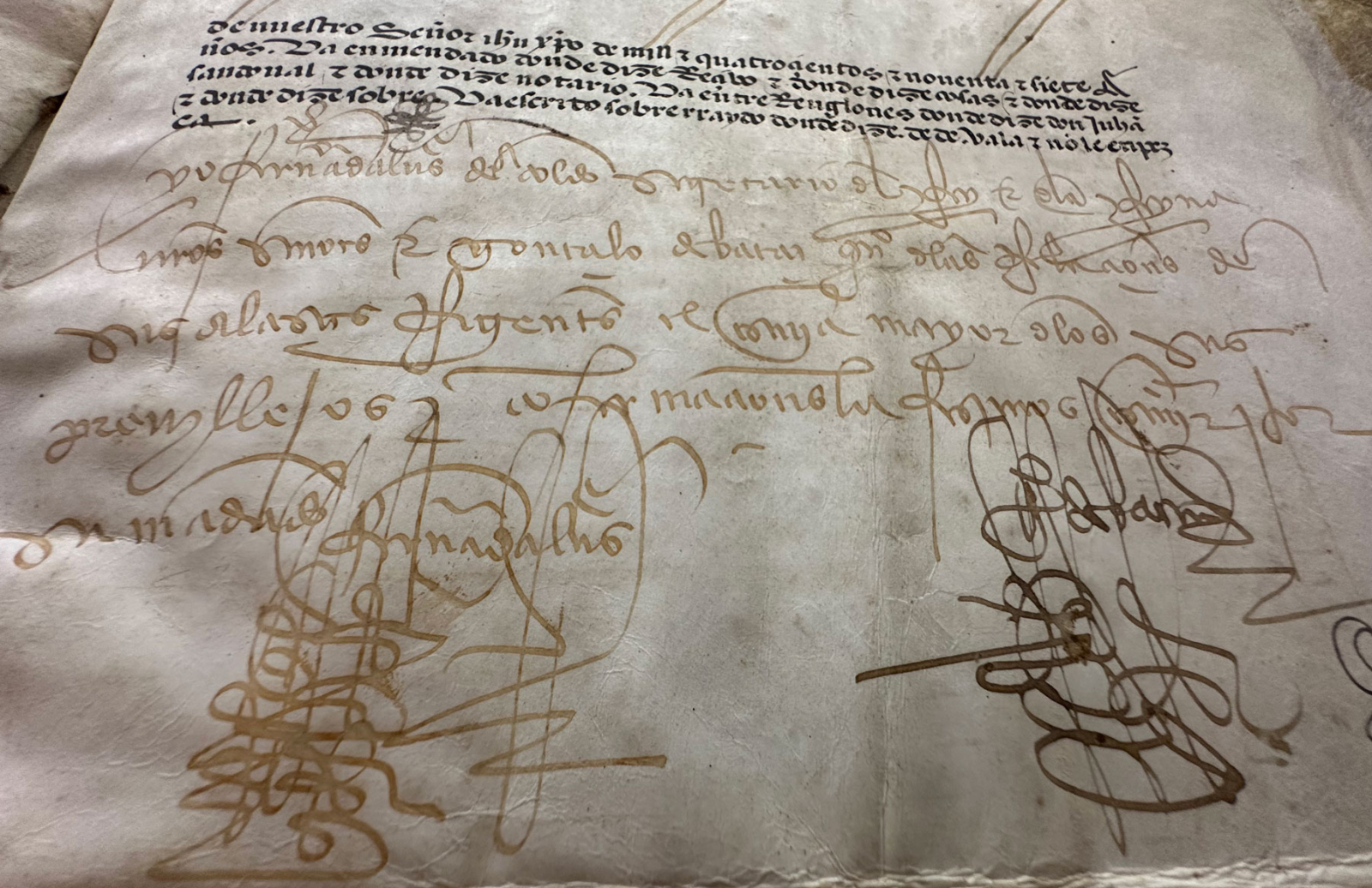
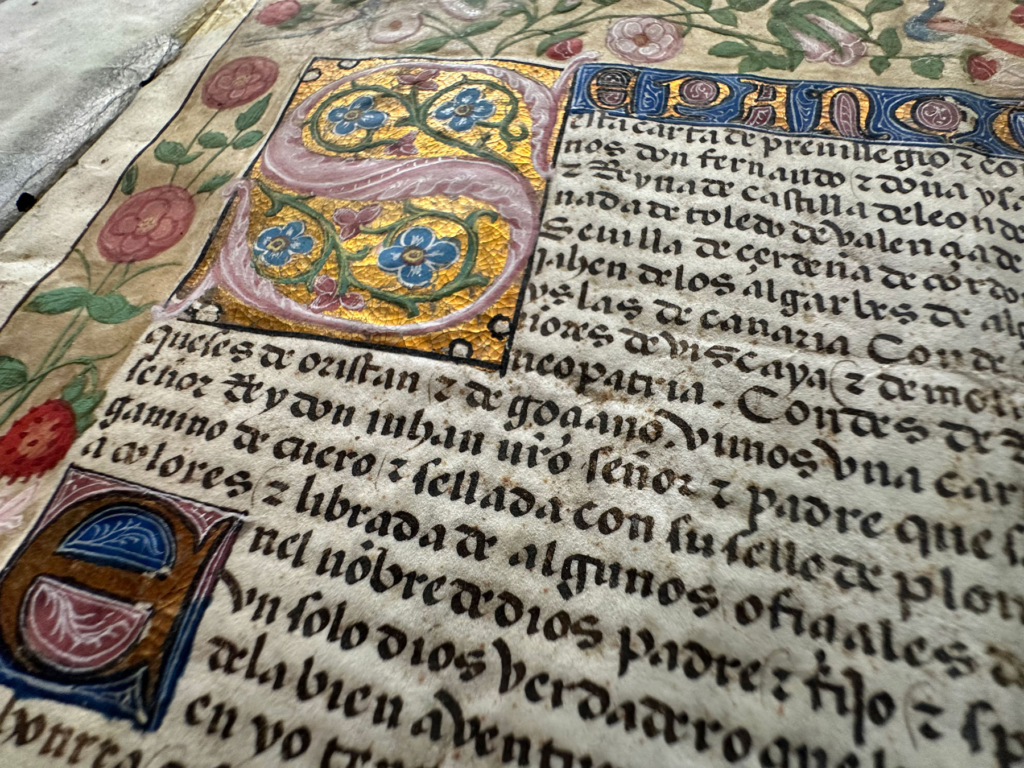
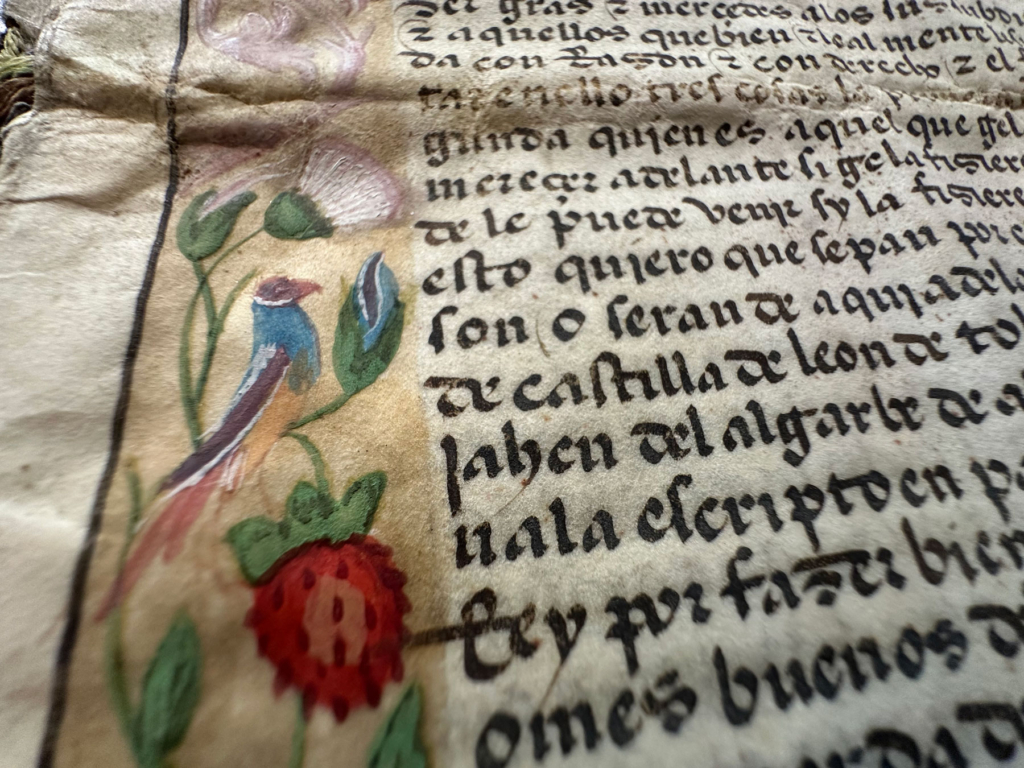
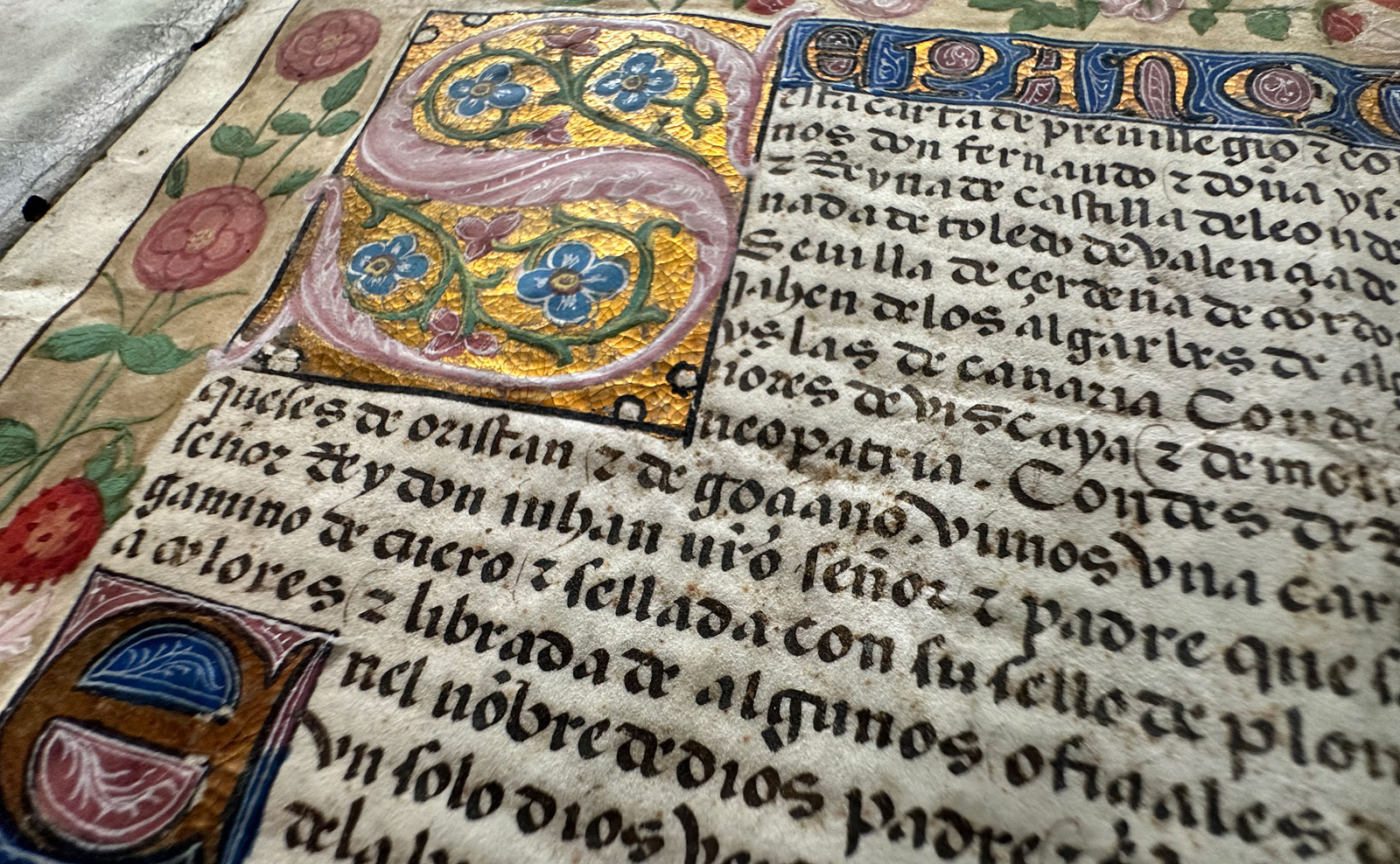
Document Signed, September 12, 1497, Fernand Alvarez (the Secretary to the Monarchs), Gonzalo de Baeca (Royal accountant), Rodericus Doctor, Antonius Doctor, the same men who signed the privileges for Columbus’s orders that same year for his 3rd expedition, granting the rights for the town of Villanueva to have their own commercial center, issues to Sancho Sanchez of Avila, the 7th, 330 x 240 mm. 4 vellum leaves. 41-45 long lines, faintly ruled in lead (written area: 215 x 150 mm). Copied in a round Spanish script. The first page is beautifully decorated with a Flemish-style border at top and inner margin, consisting of flowers, fruits, birds and acanthus scrolls on an ochre ground, one 11-line decorated initial on a golden metallic ground, one 4-line metallic initial on blue and mauve ground, first line of text consists of similar golden initials on blue and mauve grounds. Stitched into a parchment wrapper using a twisted silk cord made of strands of blue, yellow, green, red, and pink. The same cord attaches a lead seal (ca. 80 mm in diameter) depicting Ferdinand on horseback on one side and Isabella enthroned holding a scepter on the other.
The art on the document displays a beautiful combination of Spanish and Flemish art, a unique development at this era in Spain.
The document begins by noting that the Monarchs “have seen a sealed charter of privilege from the lord King Don Juan, our lord and father, may he rest in holy glory, written on parchment and sealed with his lead seal, hanging by threads of colored silk, and issued by some officials of his household, made in this manner:” John’s order, dated, December 7, 1420, reads in small part: “I, the King, in order to do good and grant favor to the council, mayors, constable, officials, and good men of Villanueva, a place belonging to Sancho Sánchez de Ávila, my vassal and my bodyguard, so that you may be better settled, and because the said Sancho Sánchez requested it of me as a favor, I am pleased and it is my will that from now on and forevermore there be held in the said place, each week on Thursday, a market and public square for the buying and selling of all goods that may arrive or take place there; and that the persons and goods coming to said square and market and present there on the said day each week shall have and enjoy all the protections, liberties, and exemptions that are had and enjoyed by those living and present in other places of my kingdoms where, in a similar manner, they have by my grace—and by the grace of the kings from whom I descend—the said market and square.”
There follows another section, copied from a document in 1421, in which John confirms this right, noting, in part, that “no one nor any persons shall dare now or henceforth to wound, nor kill, nor maim, nor dishonor, nor do any harm, damage, or injury whatsoever to such persons nor to any one of them, nor to use force against them, nor rob them, nor do them any other wrong, nor to take from them the said merchandise and goods nor any part thereof that they thus bring to the said market at the said place or have there or carry from there to any other parts against their will, under the penalties that are established in such cases against those who do and commit the contrary… And I strictly forbid that anyone or any persons dare to act or proceed against these said favors, exemptions, liberties, and graces that I grant them, nor against any part of them, in order to break or diminish them at any time or in any way; and whoever does so shall incur my wrath, and moreover shall pay me a penalty of one thousand maravedís of the current coin for each offense, and to the said council and good men of said place, or to whoever holds or shall hold their rights, double all the costs, damages, and losses that they may thereby suffer… And I, the aforementioned King Don Juan, reigning together with Queen Doña María, my wife, and with the Infanta Doña Catalina, my sister, in Castile, León, Toledo, Galicia, Seville, Córdoba, Murcia, Jaén, Baeza, Badajoz, El Algarve, Algeciras, Vizcaya, Molina, grant and confirm this privilege.” There follows a copied long list of those who have confirmed this.
The final portion is the portion dedicated to the Spanish markets. “We, the aforesaid King Don Ferdinand and Queen Doña Isabella, wishing to do good and show favor to you, the said Sancho Sánchez, have deemed it well, and by the present letter we confirm and approve for you the said charter of privilege incorporated above and the grant contained therein, and we command that it shall be valid and be kept in every respect according as it is contained and declared therein, in the same way as it was better and more fully valid and kept in the time of the said Lord King Don Juan, our father, and of the Lord King Don Enrique, our brother, of blessed memory, and in our time up to now….And of this we commanded to be given, and we did give, this our charter of privilege and confirmation, written on parchment of leather, sealed with our lead seal hanging by threads of colored silk, and sealed by our record keepers and chief scribes of our privileges and confirmations, and by other officials of our household.”
Alvarez has written: “I, Fernando Álvarez de Toledo, secretary of the King and Queen, our lords, and Gonzalo de Baeza, auditor of the relations of their highnesses and regents, the chief scribe of their privileges and confirmations, caused it to be written by their command.”
A full transcription and translation is available.
We found no record for a great seal of the Catholic Monarchs having reached the market. While illuminated manuscripts in Spain are found from later in the 16th century, we also found no record of a document of this ornate, illuminated nature from this early having come up for sale.
Our gratitude to the noted scholar David Arbesu of the University of South Florida for his expertise.

Frame, Display, Preserve
Each frame is custom constructed, using only proper museum archival materials. This includes:The finest frames, tailored to match the document you have chosen. These can period style, antiqued, gilded, wood, etc. Fabric mats, including silk and satin, as well as museum mat board with hand painted bevels. Attachment of the document to the matting to ensure its protection. This "hinging" is done according to archival standards. Protective "glass," or Tru Vue Optium Acrylic glazing, which is shatter resistant, 99% UV protective, and anti-reflective. You benefit from our decades of experience in designing and creating beautiful, compelling, and protective framed historical documents.
Learn more about our Framing Services


