






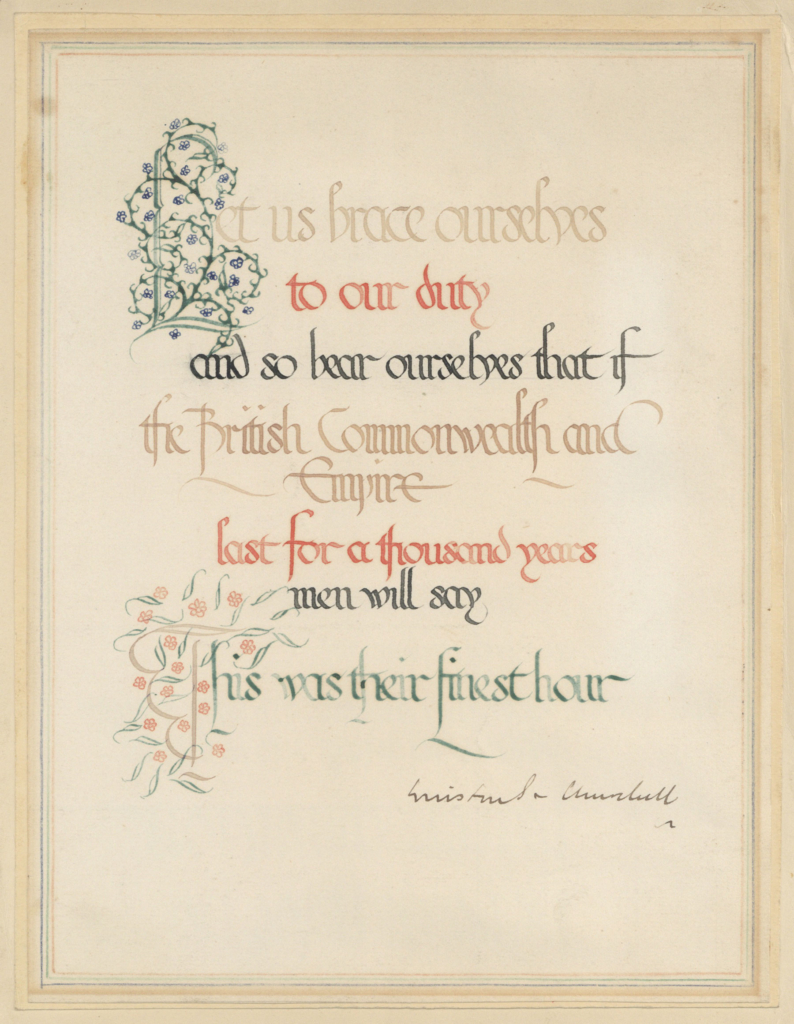
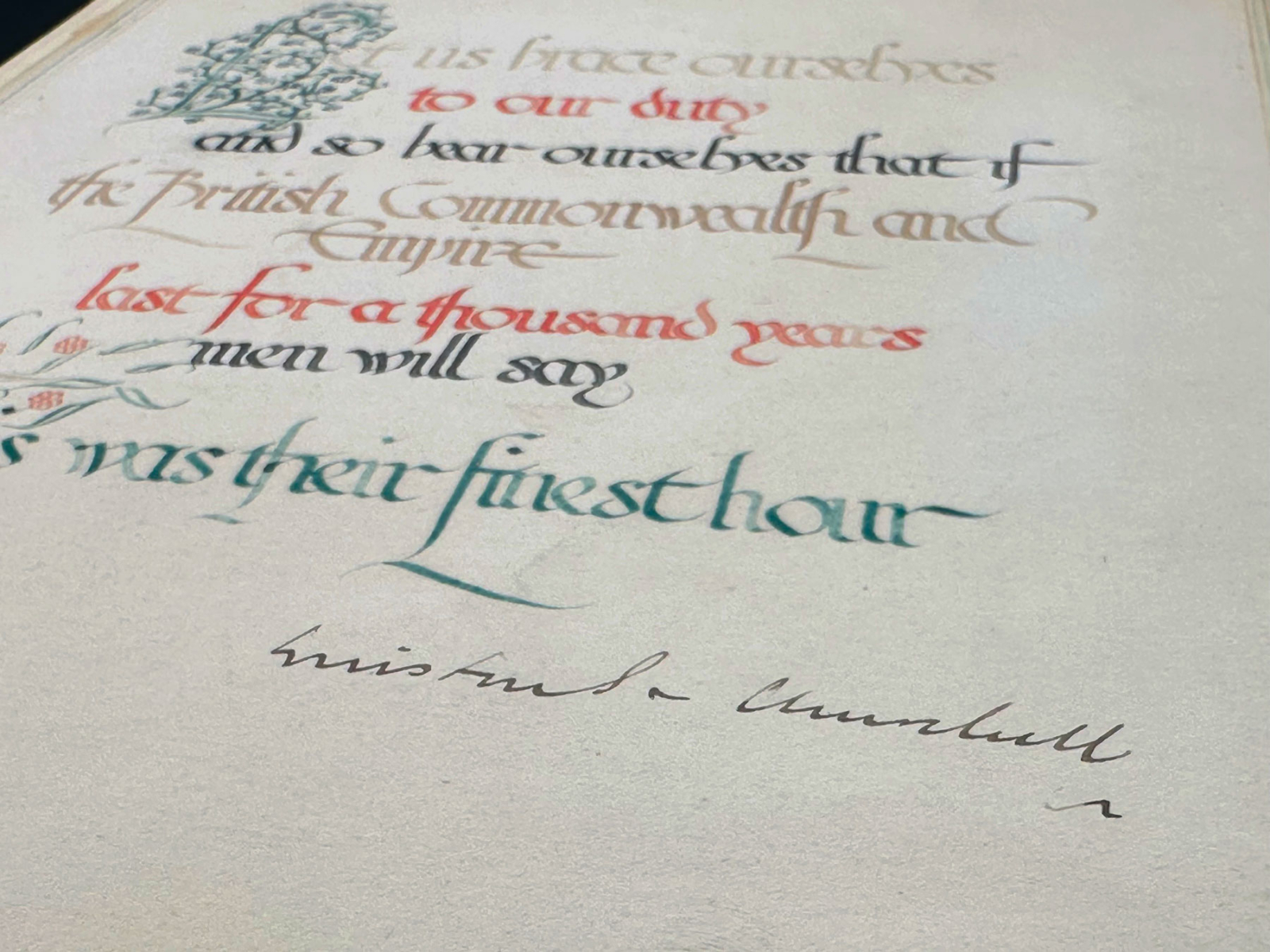
The Great Quotation of Winston Churchill, Signed: “Let us brace ourselves to our duty and so bear ourselves that if the British Commonwealth and Empire last for a thousand years, men will say: This was their finest hour.”


This was one of the greatest rallying cries in world history, from one of the most inspirational speeches ever given
- Currency:
- USD
- GBP
- JPY
- EUR
- CNY
 This currency selector is for viewing only.
The Raab Collection only accepts USD payments at checkout.
Exchange rates are updated hourly. Rates may be inaccurate.

We are not aware of any other signed quotation of ‘Finest Hour’ in private hands, making this extremely rare if not unique
“The ‘finest hour’ quotation document has special meaning not only to the British people, but also to all the rest of the free world … [it] serves as...


We are not aware of any other signed quotation of ‘Finest Hour’ in private hands, making this extremely rare if not unique
“The ‘finest hour’ quotation document has special meaning not only to the British people, but also to all the rest of the free world … [it] serves as a reminder that freedom is not free without the blood, sweat and tears of its citizenry,” writes presidential descendant Massee McKinley
Winston Churchill took over as prime minister on May 10, 1940, the day the Germans invaded the Low Countries and France. He faced grim prospects, as the Germans were a juggernaut that seemed unstoppable. They had already captured Poland, Czechoslovakia, Denmark and had invaded Norway. In France, the German military employed a “lightning war” strategy (Blitzkrieg), using fast-moving, mechanized infantry and dive bombers to overwhelm Allied forces. They pushed deep into France and quickly reached the English Channel, trapping British and French forces. The overall Allied position in France became unsustainable, and the British began a major evacuation from Dunkirk in late May, with all the British soldiers being evacuated by June 4. Italy joined the war as an ally of the Germans on June 10. The Germans occupied Paris unopposed on June 14, causing enormous consternation in Britain. After the flight of the French government and the collapse of the French Army, German commanders met with French officials on June 18 to negotiate an end to hostilities. Losing its chief ally on the continent, Britain was in a desperate situation. It knew that “whole fury and might” of the foe would soon be directed at them. France would formally surrender to Nazi Germany on June 22.
It was the voice and confidence of Winston Churchill that pulled the British people through the fire and on to ultimate victory. As philosopher and historian Isaiah Berlin said, “So hypnotic was the force of his word, so strong his faith, that by the sheer intensity of his eloquence he bound his spell (upon the British people) until it seemed to them that he was indeed speaking what was in their hearts and minds. Doubtless it was there, but largely dormant until he had awakened it within them.”
His wartime speeches were legendary. On May 13, 1940, newly ensconced in office, Churchill had told the British public that he had nothing to offer “but blood, tears, toil, and sweat.” On the 19th, he called upon the people to be “men of valor,” and added that “conquer we must, as conquer we shall.” On June 4, in the wake of Dunkirk, he said, “We shall go on to the end, we shall fight in France, we shall fight on the seas and oceans, we shall fight with growing confidence and growing strength in the air, we shall defend our Island, whatever the cost may be, we shall fight on the beaches, we shall fight on the landing grounds, we shall fight in the fields and in the streets, we shall fight in the hills; we shall never surrender.” This was a moving speech and did much to encourage the British people.
On June 18, 1940, came Churchill’s masterpiece, his most important speech, when he attempted to lift up Britain following the fall of France. At the moment of great apparent danger to British national survival, he spoke of endurance and of noble causes for which Britain was fighting (freedom, civilization, the rights of small nations), and appealed for this to be Britain’s “finest hour”. Here is the conclusion of that famous speech: “What General Weygand called the Battle of France is over. I expect that the Battle of Britain is about to begin. Upon this battle depends the survival of Christian civilization. Upon it depends our own British life, and the long continuity of our institutions and our Empire. The whole fury and might of the enemy must very soon be turned on us. Hitler knows that he will have to break us in this Island or lose the war. If we can stand up to him, all Europe may be free and the life of the world may move forward into broad, sunlit uplands. But if we fail, then the whole world, including the United States, including all that we have known and cared for, will sink into the abyss of a new Dark Age made more sinister, and perhaps more protracted, by the lights of perverted science. Let us therefore brace ourselves to our duties, and so bear ourselves that, if the British Empire and its Commonwealth last for a thousand years, men will still say, “This was their finest hour.” This was one of the most inspirational speeches ever given, and according to the Council on Foreign Relations, one of the greatest rallying cries in world history.
To maintain optimism of British victory in these dark days of World War II required a sense of hope and conviction that appeared to observers to border on folly. In July, the Battle of Britain began, with the German air force launching air raids against RAF airfields, and British shipping, ports, and radar stations to weaken the nation to the point that he could launch an invasion. But the success of the RAF caused Hitler to change tactics and he switched to a campaign of fear and intimidation. In September 1940, German bombers began to appear over London. Bombing London to ruin, Hitler thought, would demoralize the population to the point of hopelessness and surrender. For the next year Britain held its resolve. It was battered but did not crumble. As for Churchill, he was energized and commented that “success consists of going from failure to failure without a loss of enthusiasm.” Alternatively, “If you’re going through hell, keep going.”
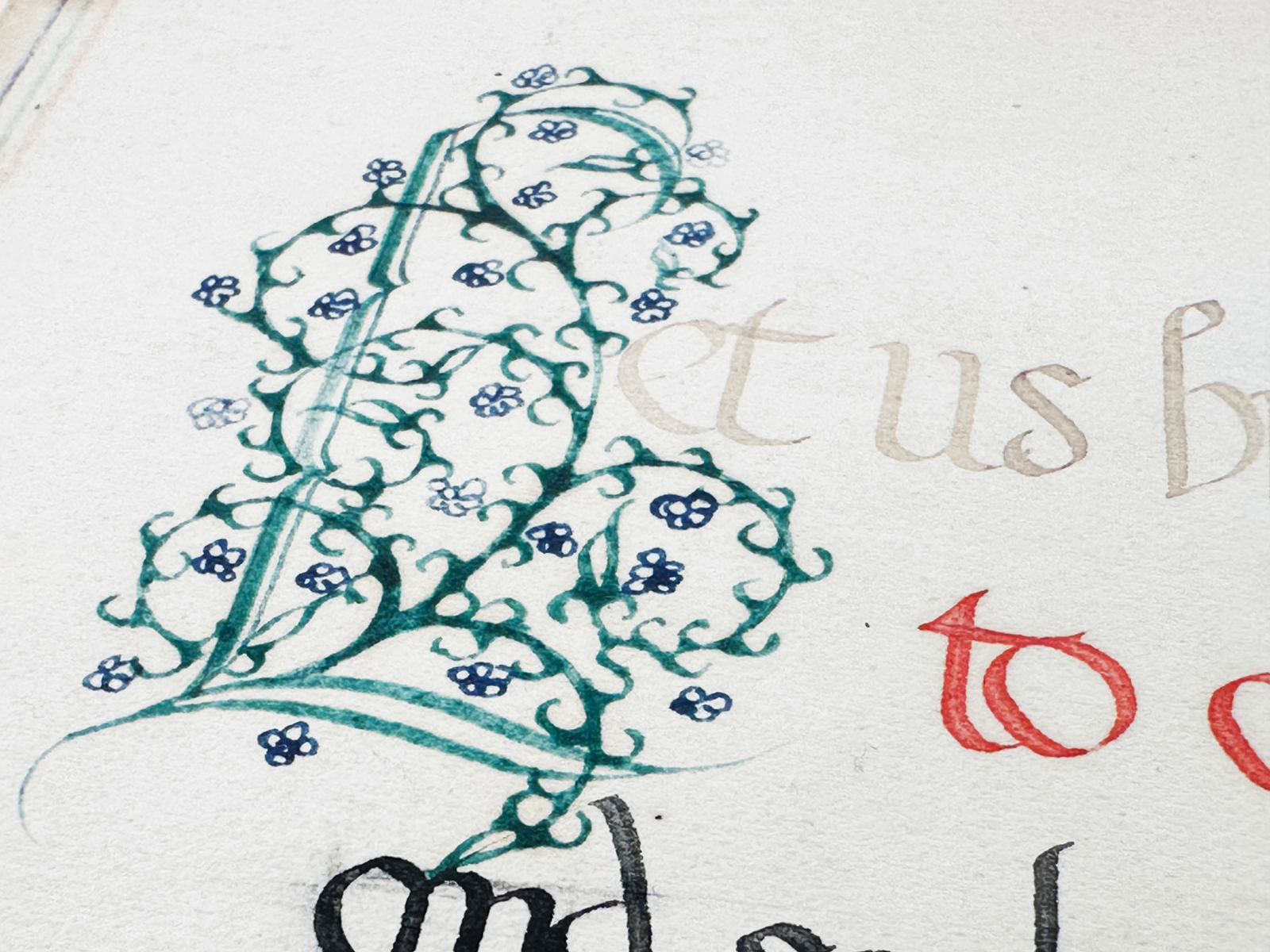
Gorgeous hand-illuminated manuscript quotation executed in colorful calligraphy on an off-white 7.75 x 10 card, affixed to a slightly larger card stock sheet, signed at the bottom in fountain pen, “Winston S. Churchill.” Taken from Churchill’s historic speech of June 18, it contains the most famous quote from that speech: “Let us brace ourselves to our duty and so bear ourselves that if the British Commonwealth and Empire last for a thousand years, men will say: This was their finest hour.”
Churchill’s speech – ‘Their Finest Hour’ – delivered to the House of Commons on June 18, 1940, stands as one of the most significant addresses in modern history. Coming at a time when much of Europe had fallen to Nazi Germany and Britain stood alone, Churchill’s words were a rallying cry that bolstered national morale and steeled the resolve of the British people. By framing the coming struggle as a defining moment not only for Britain but for the survival of Western civilization, Churchill stirring oratory transformed fear and uncertainty into a sense of duty and purpose. The speech’s legacy endures as a symbol of leadership under pressure and the power of words to unite and embolden a people in their darkest hour.
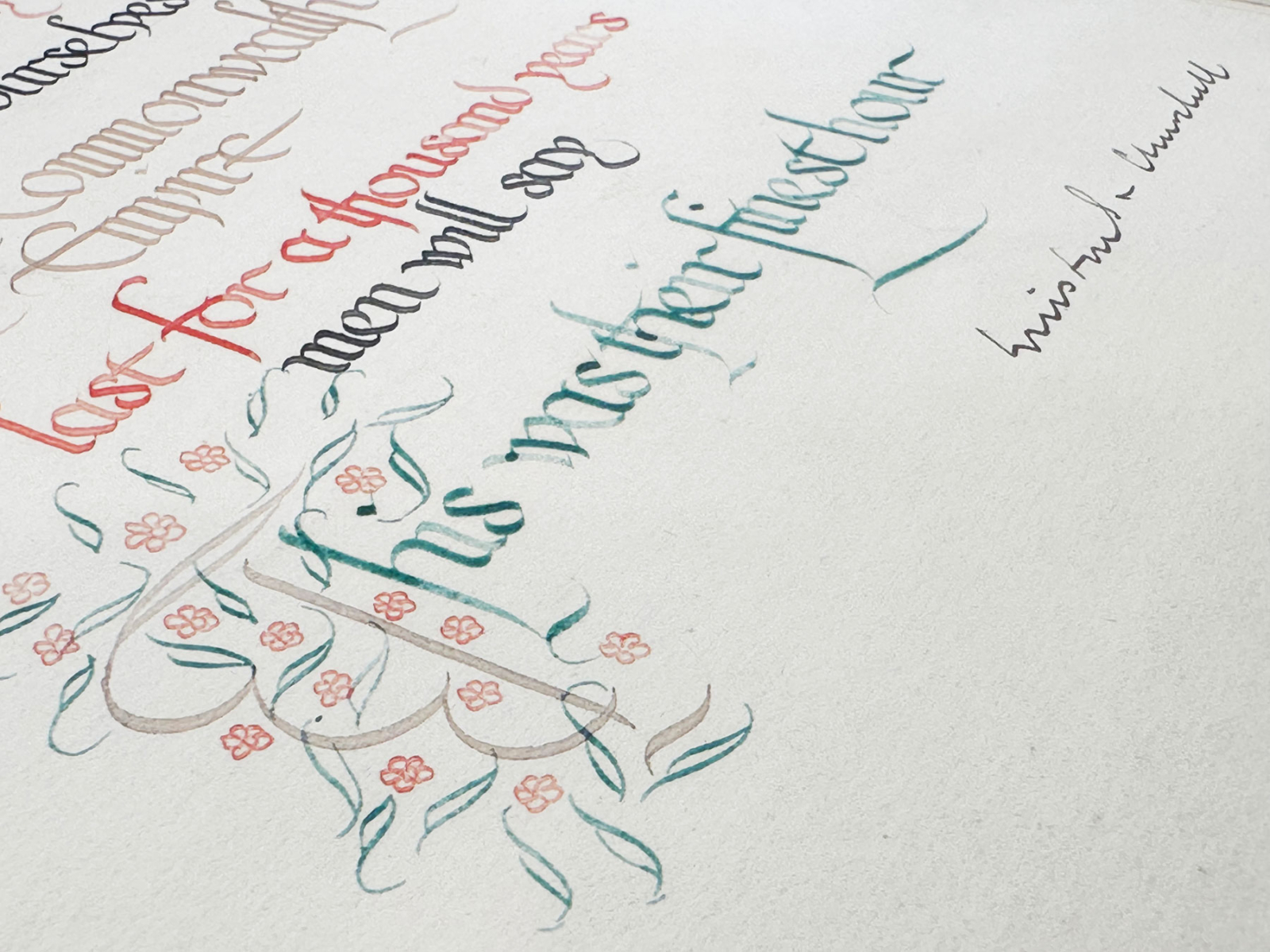
We cannot determine who created this presentation or when it was created. But we may have a clue. This quotation is accompanied by a letter by Mrs. R. E. K. Hill, personal secretary to Churchill, on 10 Downing Street letterhead, July 20, 1942, in part: “I should be very glad to see you here in connection with the book at 3 p.m. on Wednesday next, the 22nd, or on Friday next between 3 and 4 p.m., whichever day would be more convenient to you.” Perhaps the recipient of this letter was the creator and this meeting with Churchill was an opportunity to get him to sign it.
Close to forty years ago, a few signed quotes from Churchill speeches, in the same format, came up for sale and were acquired by a noted World War II archive. Our quotation is deaccessioned from that archive. We are not aware of any other signed quotation of ‘Finest Hour’, making this extremely rare if not unique.

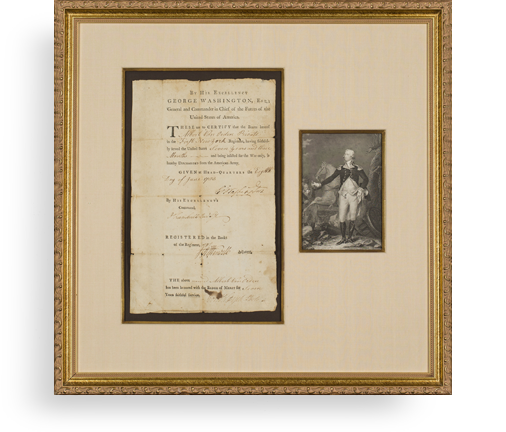
Frame, Display, Preserve
Each frame is custom constructed, using only proper museum archival materials. This includes:The finest frames, tailored to match the document you have chosen. These can period style, antiqued, gilded, wood, etc. Fabric mats, including silk and satin, as well as museum mat board with hand painted bevels. Attachment of the document to the matting to ensure its protection. This "hinging" is done according to archival standards. Protective "glass," or Tru Vue Optium Acrylic glazing, which is shatter resistant, 99% UV protective, and anti-reflective. You benefit from our decades of experience in designing and creating beautiful, compelling, and protective framed historical documents.
Learn more about our Framing Services


