





An Illustrated Guide to Historical Documents From the Victorian Era That Collectors Can Look for on the Market
The 19th century was one of rapid development and change, far swifter than in previous centuries. During this period England changed from a rural, agricultural country to an urban, industrialized one. A similar trend occurred in the United States. And dominating that century was the Victorian Age from 1837-1901, under the stewardship of the legendary Queen Victoria.

Among the greatest changes in the Victorian Age were in science and industry, and included technological and industrial innovations (such as manufacturing and mass production, the invention of railway networks, sewing machines, gas and electric light, the telegraph, printing press, movies, radio, and the automobile). It was also a time of great scientific theories and discoveries, such as Charles Darwin’s theory of Evolution. This led to enormous changes in daily life.
In social reforms, legislation protecting child and adult workers began to be enacted. Important reforms included legislation on child labor, safety in mines and factories, public health, the end of slavery in the British Empire and the United States, and the enactment of compulsory education for children.
Society was hierarchical, yet there was much social and geographical mobility. It was an age of self-made entrepreneurs, the great moguls of the era, who used their new wealth to rise notably in society. This included men like Andrew Carnegie, Cornelius Vanderbilt, and J.P. Morgan. It’s not for nothing that a portion of the Victorian era is called the Gilded Age.
The British Empire was growing, and Britain’s trading dominance, naval and military strength, and successful competition for territory against other European nations were facts of life. It was also a time of exploration, and by the end of Victoria’s reign imperialists could boast that the sun never set upon the British Empire. For the United States, the later part of the era saw territories and states added, and a rise in international prominence.
A moral code and the ideal of family – respectable and loving – dominated the Victorian period. The cult of the home grew steadily, with Queen Victoria and her family providing a role model for the nation. The era also saw the beginning of mass leisure: seaside holidays, religious activities, and the development of public parks, museums, libraries, spectator sports, theaters, and music halls.
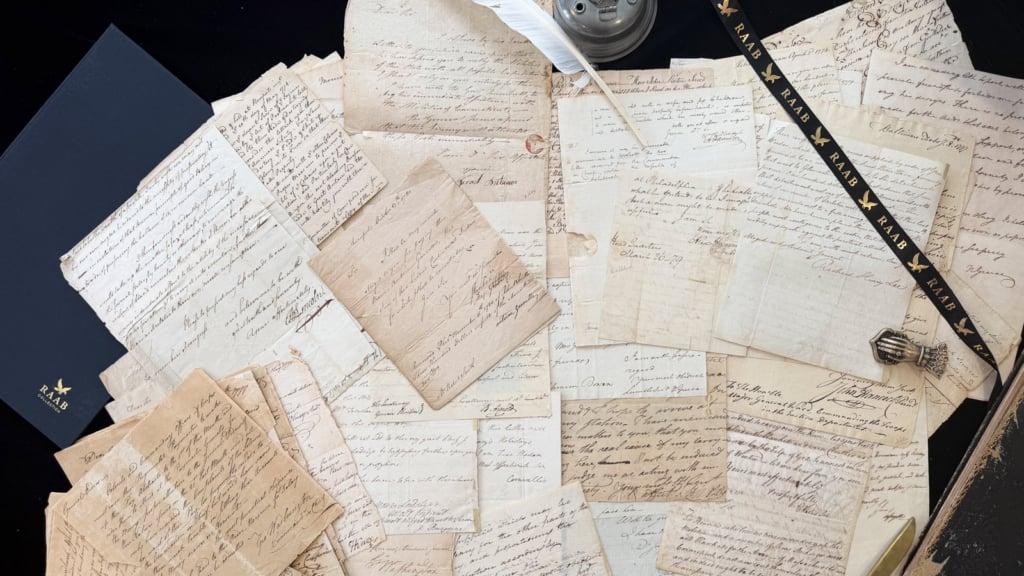
The Raab Collection seeks out and offers important letters and documents for those who collect the Victorians. Below is a selection.
Documents Signed by Queen Victoria

The Dawn of the Victorian Age: An Invitation to Victoria’s Coronation, Signed by Her as Queen
The Victorian era began on June 20, 1837, when King William IV died and his niece, Princess Victoria, became Queen at the age of 18. Her official coronation was held at Westminster Abbey on June 28, 1838. The coronation was a huge occasion, and 400,000 visitors went to London to see the new Queen crowned. Pictured above is an invitation to Queen Victoria’s coronation, signed by her. “Whereas the Twenty eighth day of June next is appointed for the solemnity of Our Royal Coronation, These are to will and command you (all excuses set apart) to make your personal attendance on us at the time above mentioned furnished and appointed as to your rank and quality appertaineth, there to do and perform all such services as shall be required and belong unto you whereof you are not to fail.”

Victoria’s Empathy for Others Who Have Lost Spouses
In a touching letter written by Queen Victoria when a friend’s husband died in 1882, she wrote that having lost her own beloved husband, Prince Albert, she could empathize: “It is only a month yesterday that our dear Dean was taken. It seems much longer. Windsor – always gloomy will be doubly so now – where we shall miss Him everywhere!”
Documents Signed by Charles Darwin

In this important letter written and signed by Charles Darwin, the famous scientist uses the language of religion to describe the increasing number of scientists adopting his Theory of Evolution. He writes, “About a week ago I had a nearly similar account from Germany and at the same time I heard of some splendid converts…I look at a man who treats Natural History in the spirit with which you do, exactly as good for what I believe to be the truth, as a convert.” Scientists, Darwin felt, should work in the spirit of seeking “truth,” with no preconceived notions. He also hopes to continue his career in science. “I hope that I may yet have strength to do a little more work in natural science; shaky and old though I be.”

Charles Darwin Writes Naturalist John Jenner Weir Regarding the Nesting Habits of Birds
Charles Darwin was interested in the nesting habits of birds, starting with his observation of the finches in the Galapagos, which helped define his life’s work. In this signed letter, Darwin thanks naturalist John Jenner Weir for sharing information; the two had been corresponding regarding birds, and Weir had evidently also invited Darwin to the annual exhibition of canaries and foreign cage birds being held at the Crystal Palace in February 1876. Darwin declined, but his letter remains a witness to their scientific collaboration.
Documents Signed by Literary Victorians: Dickens, Tennyson & Trollope
Charles Dickens Aids a Charity
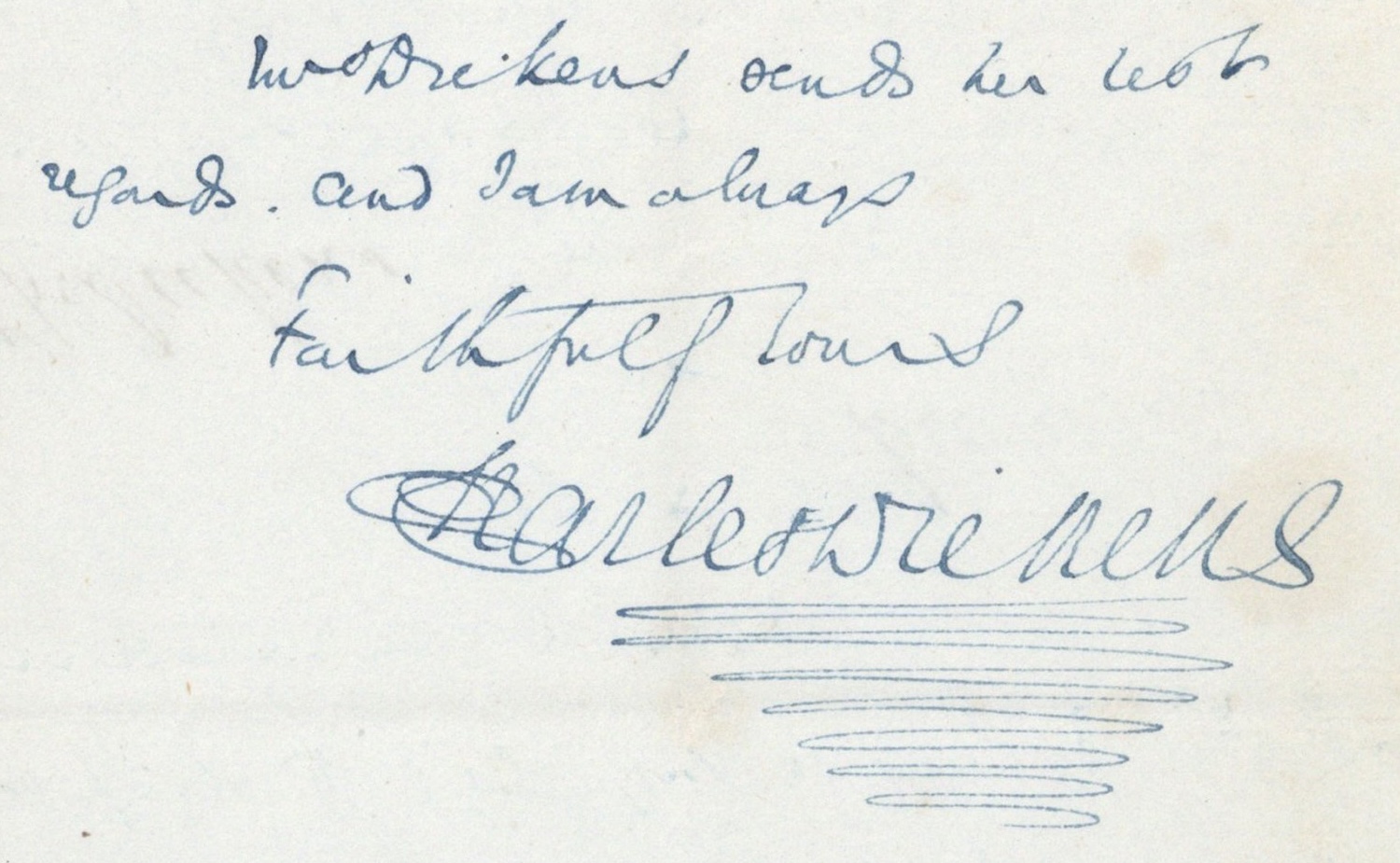
Charles Dickens, best known as the author of several novels, including Oliver Twist, Great Expectations, and A Christmas Carol, was deeply involved in charity, both through his personal giving and advocacy for institutions supporting the poor and the sick. Having grown up poor and risen to great success, Dickens supported over 43 charities, contributing time, money, and his literary platform to raise awareness and funds. This letter written by Dickens (and showing his autograph with its hallmark flourish) was sent to his friend John Kenyon and highlights his role as fundraiser. “First, let me thank you for your kind and liberal donation to the Sanatorium. When they send you, as they will, a little report, do give it a perusal one morning at breakfast. It will show you what an excellent Institution it is, and how well it merits your voluntary support.” He also mentions his novel, The Life and Adventures of Martin Chuzzlewit.

Alfred Lord Tennyson Pens a Line from a Great Poem
Lord Tennyson embodied the Victorian age, perhaps more so than any other British poet. He has been called the “official poetic spokesman for the reign of Victoria,” as popular as the Queen herself, or nearly so. He assumed the role of England’s poet laureate in 1850, after the death of William Wordsworth, becoming a bridge between the Romantics and the Victorians. In the letter pictured above, Tennyson has inscribed a line of poetry from his narrative poem, The Princess (1847): “Thy voice is heard thro’ rolling drums.”

Anthony Trollope Hopes to Arrange a Visit at a College
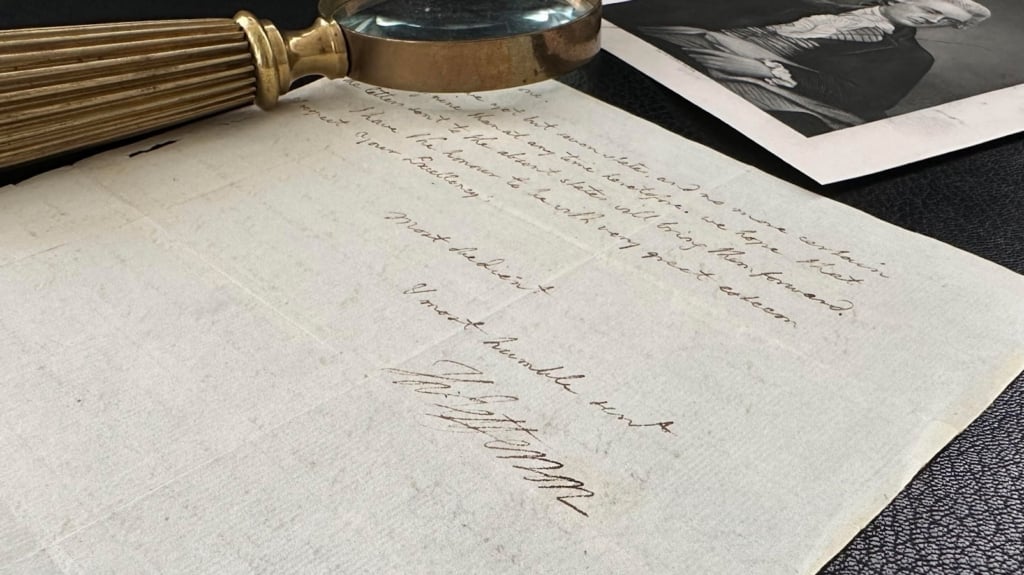
Like Dickens and Tennyson, the name Trollope evokes Victorian literature. He wrote 47 novels, 42 short stories, and 5 travel books. Among his best-known works is a series of novels including Barchester Towers, collectively known as the Chronicles of Barsetshire, which revolves around the imaginary county of Barsetshire. In 1874, Trollope wrote this letter (above), on his personal letterhead, to arrange a visit to a college, mentioning his invitation to dine with the school’s subwarden and the bursars. At the time, he was writing a sweeping satire, The Way We Live Now, which many consider his masterpiece.
From the Victorian Age to the Edwardian Era

Above is an invitation to King Edward VII’s coronation in 1902, signed by him as King. The Edwardian Era has often been described as a golden sunlit afternoon, personified by its genial and self-indulgent King, with the cares of world war still not visible on the horizon. The appeal of the Edwardian Era is wide. Wealth was abundant and nearly income tax free; society was no longer a small, exclusive circle confined to those of aristocratic birth, but open to more and more people; the arts (theater, opera, ballet, painting, literature, music, etc) produced genius and modern movements; and the technological advances were thrilling. Albert Einstein was an Edwardian and promulgated his Special Theory of Relativity in 1905. So were the Wright Brothers, who invented the airplane in 1903. The overall image of the Edwardian age is that of an era of opulence, but it was also an era of change, where the rumble of automobiles and planes, champagne, and lavish ocean liners, the frenetic syncopation of ragtime, and the pomp of the aristocracy and royalty, coexisted with civil rights and independence movements, Socialism, immigration, and technological advances.
Victorians perceived their world as rapidly changing. These documents are our connection to that era.