






Acquired from the direct descendants, the unpublished archive details the storied career of an early Naval Academy graduate turned Civil War hero
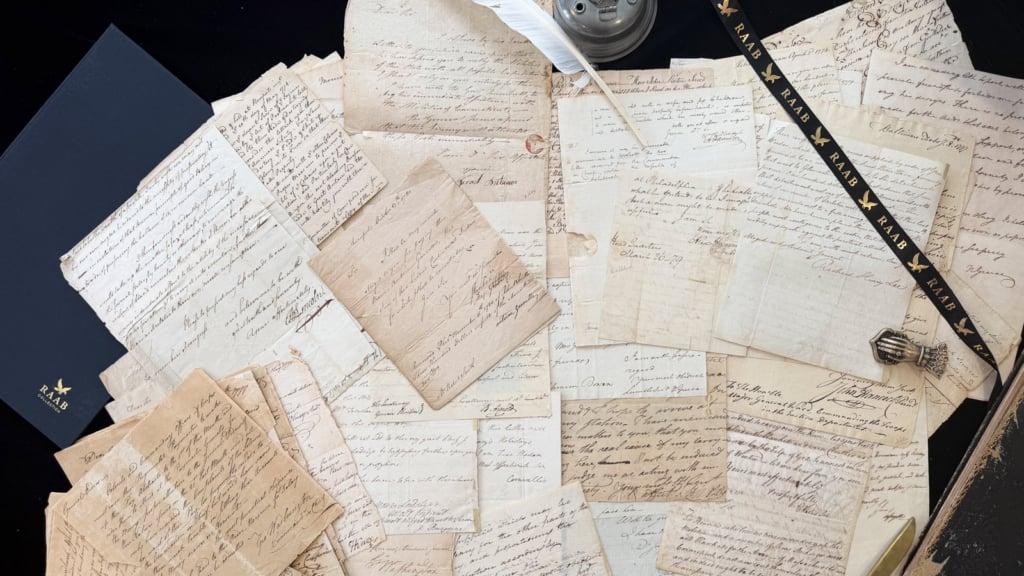
The Raab Collection announced that it has discovered and acquired an archive of historical documents, letters, journals, and objects from the heirs of Moses Sherwood Stuyvesant, a U.S. Naval Academy graduate (1860) and Lt. Commander during the Civil War. Stuyvesant’s voluminous correspondence, numbering, for example, more than 300 letters, details his service aboard several Navy ships and his thoughts on Lincoln’s presidency, the abolitionist John Brown, slavery, and much more. The archive was not known to have survived and has never before been offered for sale.

From the U.S. Naval Academy to the Civil War
Moses Sherwood Stuyvesant was born in Indiana in 1841 and was appointed to the U.S. Naval Academy at Annapolis, joining what would become the last graduating class before the Civil War. Stuyvesant’s complete, signed yearbook for the Class of 1860 is one of the many pieces acquired by Raab from his descendants.

The yearbook pictures all of the class members and the leadership of the academy, as well as a black servant named George Brown. The photographs are large, and many are signed; others depict staff and buildings. The men who signed this book went on, very shortly after, to fight against each other. It offers a fascinating look into the Naval Academy on the brink of the Civil War.
Stuyvesant’s letters home–about 300 unpublished letters–comprise the bulk of the remarkable archive long preserved by his heirs. The correspondence begins at the academy in 1856, when he commenced the habit of writing to his mother, sending details about fellow students, academics, training expeditions, and the like, plus report cards, photographs, and other personal effects.

Upon his graduation in 1860, Stuyvesant served as Midshipman, first on the U.S.S. Pawnee, then on the Powhatan, cruising in the latter in the Gulf of Mexico. He traveled far and served on several ships throughout his service, but always managed to send home reports as an eyewitness to many significant events of the era as they unfolded. Among the subjects: the Capture of Fort Hatteras; the Trent Affair; the Union scuttling of Merrimac and the subsequent sinking of his vessel, the USS Cumberland by that same scuttled vessel; the Peninsula Campaign and McClellan; Battle of Drury’s Bluff, the First and Second Battles of Charleston Harbor; the sinking of the Ironclad Weehawken; the Swamp Angel; prisoner ship conditions; meeting slaves seeking freedom with him and his vessels.
From the Civil War to a Russian Tour
After the war ended, Stuyvesant continued in the service of the U.S. Navy. Serving the Union throughout the war, Stuyvesant was promoted to the rank of Lt. Commander by President Andrew Johnson in 1866.

Stuyvesant’s commission, signed by President Johnson, is beautifully illustrated with engravings of Neptune, flags, an eagle, and the sea and ships. The president commends his service thusly: “Reposing special trust and confidence in the patriotism, valor, fidelity and abilities of Moses S. Stuyvesant, I have nominated, and with the advice and consent of the Senate, do appoint him a Lieutenant Commander in the Navy, from the 11th day of April 1866.”
Soon after his promotion, Stuyvesant was assigned to the double turreted U.S. Steamer Miantonomoh, and, as her Commander, made with her the memorable cruise across the Atlantic and through the North Sea, the Baltic and then through the Mediterranean, in 1866 and 1867. President Johnson sent the ironclad Miantonomoh on this world tour to better diplomatic relations and specifically to congratulate Russia on the freeing of the serfs and Tsar Alexander on surviving the assassination attempt.

While in Russia, the Americans were gifted a symbol of their newly instituted freedoms from slavery: a medal struck in memory of the enfranchisement of the serfs in Russia. An official said, “The friendship of the two nations… among the causes to which is due this mutual spirit, is the great event [emancipation] which has been accomplished almost simultaneously in the two countries – there by a sanguinary struggle, here by the path of peace.”
That historic medal, given by the Russians to the Americans to commemorate the freedom of their former slaves, has been preserved and handed down in the Stuyvesant family ever since. It remains in a case, on the inside of which Stuyvesant, as commander of the expedition, signed his name and dated it, September 15, 1866, the day of the presentation of the medal, and written, “From the Emperor of Russia Alex III” [II].
While it is not known how many of these medals were made, none are akin to this one, with the important symbolism of a state gift congratulating a nation on emancipation. It has remained with Stuyvesant’s direct descendants until now.
The Stuyvesant-Crowninshield Connection
On April 5, 1864, Moses Sherwood Stuyvesant married Daisy Crowninshield, granddaughter of the former Secretary of the Navy Benjamin Crowninshield, joining himself to the prominent Crowninshield family of Salem seamen and privateers.
For two centuries, the heirs of the Crowninshield-Stuyvesant family retained large archives related to both men. When the time came to find these documents a new home, they called The Raab Collection, which has worked with so many historically important families to help them find the next stewards for these pieces of history.
Raab has handled many of the most important historical documents to reach the market and worked with the families of famous Americans in the sale and preservation of their family treasures, among them Neil Armstrong, Thomas Jefferson, Ulysses S. Grant, William Henry Harrison, F. Scott Fitzgerald, and Ronald Reagan.
