






The Marquis de Lafayette, Newly Arrived at Mount Vernon for the First Time Since the War, Writes to James Madison, Referencing Washington Multiple Times, and Announcing His Plans for His American Tour


These included a tour of New England (where he met Adams), a visit to the Richmond Legislature and Patrick Henry, and his Acceptance of Honorary Citizenship by Congress then in Trenton
This letter, apparently unpublished, shows that Lafayette’s grand tour with Madison was not as happenstance as had been thought
Writing from Mount Vernon while visiting George Washington, Lafayette sheds light on his relationship with “The General”
This document has been in the same private collection for at least a century
...

This letter, apparently unpublished, shows that Lafayette’s grand tour with Madison was not as happenstance as had been thought
Writing from Mount Vernon while visiting George Washington, Lafayette sheds light on his relationship with “The General”
This document has been in the same private collection for at least a century
Finding early American correspondence between Founders is incredibly uncommon
Hear more on the Inspired by History podcast
In 1784, the Marquis de Lafayette returned to the United States for the first time since the Revolutionary War, visiting old comrades, meeting with leaders like George Washington and James Madison, and solidifying French-American ties. He also received honorary citizenship from Congress and several states, and participated in various negotiations, solidifying his legendary status as a hero of liberty who helped birth the new nation.
Lafayette arrived in New York on August 4, 1784, and shortly went to Mount Vernon to spend time with Washington, arriving on August 17. There he was received with great affection by Washington and his wife Martha, and the momentous event marked the first time Washington and Lafayette could enjoy each other’s company without the immense pressures of war. Lafayette wrote his wife about his visit to Mount Vernon on August 20, shedding much light on that visit and on the life that Washington and his family were leading at Mount Vernon: “I arrived here on the seventeenth, and as the general, though he had been anticipating my arrival, did not expect me for several more days, I found him in the routine of his estate, where our meeting was very tender and our satisfaction completely mutual. I am not just turning a phrase when I assure you that in retirement General Washington is even greater than he was during the Revolution. His simplicity is truly sublime, and he is as completely involved with all the details of his lands and house as if he had always lived here. To describe to you the life that we lead here, I shall tell you that after breakfast the general and I chat together for some time. After having thoroughly discussed the past, the present, and the future, he withdraws to take care of his affairs and gives me things to read that have been written during my absence. Then we come down for dinner and find Mrs. Washington with visitors from the neighborhood. The conversation at table turns to the events of the war or to anecdotes that we are fond of recalling. After tea we resumed our private conversations and pass the rest of the evening with the family.”
Lafayette soon learned that Washington had an urgent trip to visit his land holdings in the West, and though he asked Lafayette to accompany him, Lafayette’s schedule would not permit for that. Washington left for his western trip on September 1. Lafayette then went to Baltimore, Philadelphia, New York, Albany, and Boston. Washington’s trip was a deliberate and forward-looking tour west across the Allegheny Mountains to assess the future of the American frontier after independence. Traveling through western Virginia, Maryland, and Pennsylvania into the Ohio Country, Washington inspected rivers, portage routes, and settlements with a strategic eye, convinced that the young republic’s survival depended on binding the trans-Appalachian West to the Atlantic states through commerce and transportation. He feared that without reliable eastern trade routes, western settlers might drift toward British or Spanish influence, undermining national unity. The journey sharpened his belief in internal improvements—especially river navigation linking the Potomac to the Ohio—and directly inspired his leadership in founding the Potomac Company the following year, marking a critical step in his evolution from Revolutionary commander to architect of American national integration.
Lafayette and James Madison met first in early September 1784 in Baltimore. At that time, Madison’s term in Congress was concluded and he was serving in the Virginia General Assembly. He would return to Congress in 1786. It has been thought that the meeting in Baltimore was a chance one, but this letter proves it was the result of planning; Lafayette wanted to meet with Madison.
Lafayette had stopped in Baltimore while he was traveling north to negotiate with the Iroquois in New York state, and after meeting Madison, invited Madison to join him, which Madison did. Thus began a decades-long friendship and correspondence that continued through Lafayette’s 1824-25 Farewell Tour, when he visited Madison at Montpelier. On September 29, 1784, Lafayette and Madison arrived in at Fort Stanwix in New York to be involved in the negotiation of the Treaty of Fort Stanwix. There, Lafayette played a significant, though unofficial, role, arriving as a respected figure to influence negotiations between the newly formed U.S. and the Iroquois Confederacy. He advocated equitable treatment for the Iroquois, and a less punitive treaty than the U.S. commissioners intended. The resulting treaty forced major land cessions from the Iroquois, but established Lafayette as a Native American advocate. Madison observed and reported on the negotiations, describing them as contentious in a letter to Thomas Jefferson.
Lafayette then went via Albany to Boston, and in early October stayed several days there. In Boston, he was warmly welcomed with processions, and lodged with John Adams, while also being honored by Harvard. Madison did not accompany him on this leg of the trip and headed South. Lafayette then departed from Boston in early November by frigate to meet George Washington in Virginia. They reunited in Richmond, and Lafayette accompanied Washington from Richmond for a second visit to Mount Vernon. In December, Lafayette visited Trenton, then the temporary U.S. capital, to bid farewell to the Congress. At that time Congress granted him honorary American citizenship, with states like Maryland, Virginia, and Massachusetts following suit. Lafayette sailed back to France aboard the frigate La Nymphe on December 24, 1784.
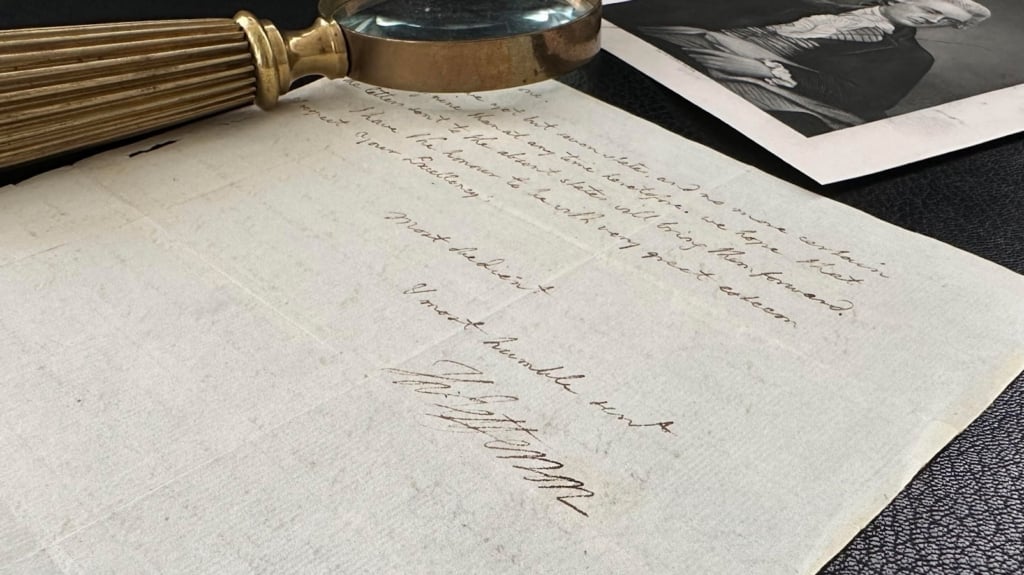
Autograph letter signed, in English, Mount Vernon, August 24, 1784, an unpublished letter to James Madison, seeking to set up their first meeting together and also speaking of George Washington. “My dear Sir, While I am upon a visit to my American friends, it should be a great mortification for me not to enjoy the Honor of your company. I therefore take the liberty to acquaint you with my plans, and hope, in the course of my peregrination [travels] to be allowed the pleasure to take you by the hand. First of all, it had been my intention to begin with a visit to my friends in your State. But the General, you know, is upon an indispensable journey to the Westward where he was pleased to wish I should accompany him. As I could not so long delay my Northern trip, he has insisted upon it I should not go farther Southward before he can go down with me. I am therefore going to New England and by the middle of October will be back at Mount Vernon. From there to go to Williamsburg, wait upon tho Assembly in Richmond, and return to Trenton for the meeting of Congress. At any of these places, my dear Sir, I will be extremely happy to see you, and I beg you will let me know what is the most convenient way to you that can provide me the pleasure to tell you myself how affectionate is the regard I have, the honor to be with. Dear Sir, Your obedient, humble servant, Lafayette.” Lafayette has addressed it to Madison at the bottom left. Wrinkling. No loss of text or ink.
This letter is unpublished and we were unable to find Madison’s reply. This seems to be because the two met in person in Baltimore before Madison could fashion his reply.
Madison wrote to his son September 6, writing “At the latter place [Baltimore] I fell in with the Marquis & had his company thus far. He is proceeding Northwd. as far as Boston from whence he goes to the Indian Treaty at Fort Stanwix & from thence returns to Virga. about the same time that I must be there. He presses me much to fall into his plan, and I am not sure that I shall decline it.” He wrote likewise the Jefferson the following day. The Madison papers notes “By a chance encounter with the Marquis de Lafayette in Baltimore, JM changed his travel plans from a health-seeking “ramble into the Eastern States” into a rousing tour with the famous Frenchman.”
This is the first Lafayette letter we have ever seen reach the market addressed to any of the great American Founding Fathers, and it is an important one. It sheds light on his relationship with George Washington, a very important relationship indeed, as Washington saw Lafayette as a surrogate son, while Lafayette deeply admired Washington as a father figure and mentor. The letter also shows Lafayette arranging a meeting with James Madison, a fact previously unknown.

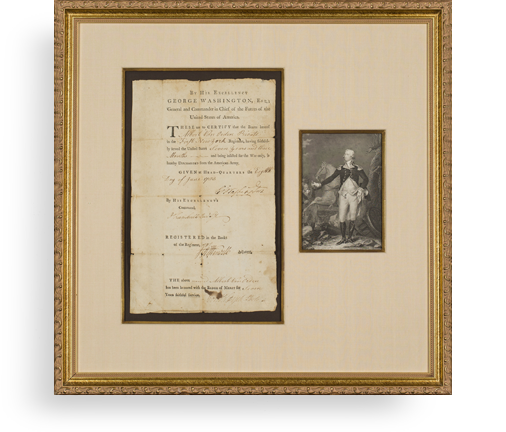
Frame, Display, Preserve
Each frame is custom constructed, using only proper museum archival materials. This includes:The finest frames, tailored to match the document you have chosen. These can period style, antiqued, gilded, wood, etc. Fabric mats, including silk and satin, as well as museum mat board with hand painted bevels. Attachment of the document to the matting to ensure its protection. This "hinging" is done according to archival standards. Protective "glass," or Tru Vue Optium Acrylic glazing, which is shatter resistant, 99% UV protective, and anti-reflective. You benefit from our decades of experience in designing and creating beautiful, compelling, and protective framed historical documents.
Learn more about our Framing Services

