





An Original Pen John F. Kennedy Used to Sign His Very First Major Legislation – The Housing Act of 1961
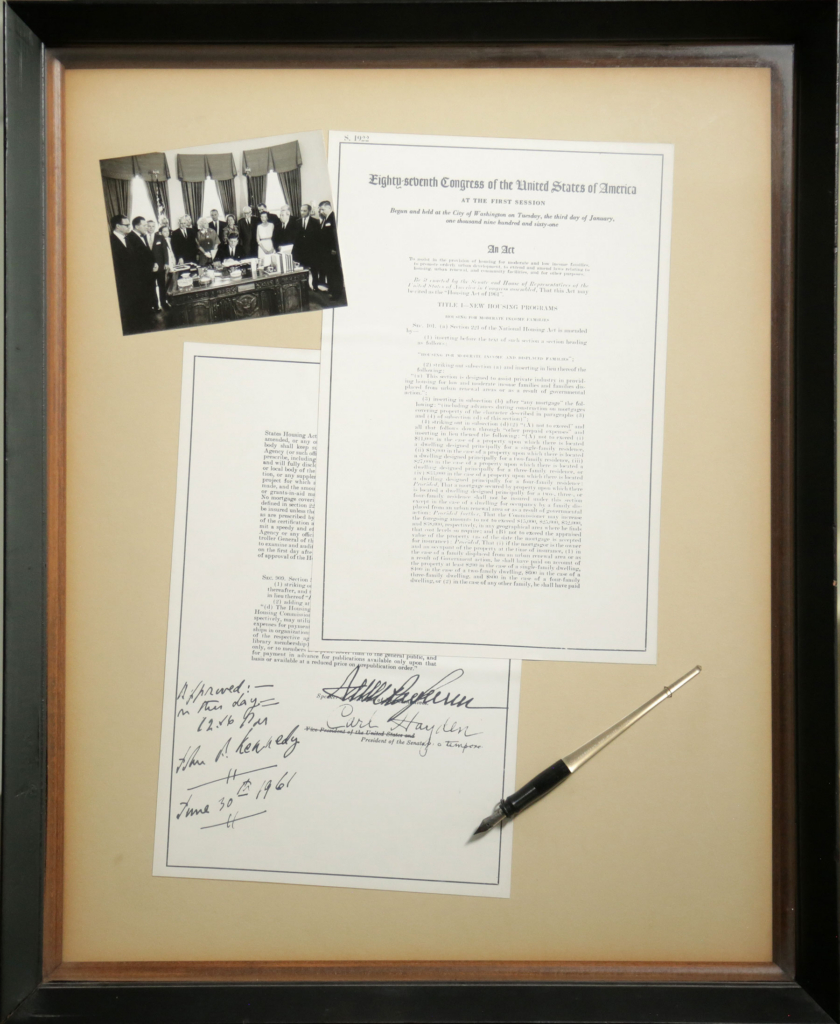

This is as important a JFK signing pen as you will find and it has never been offered for sale
It was given to William L. Slayton, his Commissioner of the Urban Renewal Administration, who was present at the signing
We obtained this directly from the Slayton descendants. Its continued existence was not known until now, and it have never before been offered for sale
We found record of only...


It was given to William L. Slayton, his Commissioner of the Urban Renewal Administration, who was present at the signing
We obtained this directly from the Slayton descendants. Its continued existence was not known until now, and it have never before been offered for sale
We found record of only one other pen used for this act having reached the market ever
On January 20, 1961, John F. Kennedy ushered in a new era in the United States (and indeed the world) with his historic, visionary, and inspirational Inaugural Address. Spellbinding to hear, it seemed to leave behind existing attitudes and limitations, while acting as a clarion call to young and old alike to realize their personal potential while helping build a better nation and world. Some of the quotations from his address have become legendary, such as: “Let every nation know…that we shall pay any price, bear any burden, meet any hardship, support any friend, oppose any foe to assure the survival and the success of liberty…The energy, the faith, the devotion which we bring to this endeavor will light our country and all who serve it – and the glow from that fire can truly light the world…And so, my fellow Americans: ask not what your country can do for you–ask what you can do for your country. My fellow citizens of the world: ask not what America will do for you, but what together we can do for the freedom of man.”
That moment inaugurated a period known to history as Camelot, the brief Kennedy years that infused energy, optimism and excitement throughout the nation and world. Washington was bristling with it, which led to such programs as the Peace Corps, and such major Kennedy policies and achievements as the Nuclear Test Ban Treaty. The Sixties, which followed from that moment, would have been impossible without it. It was a watershed moment, one that began in earnest after the inaugural festivities when JFK took his seat in the Oval Office.
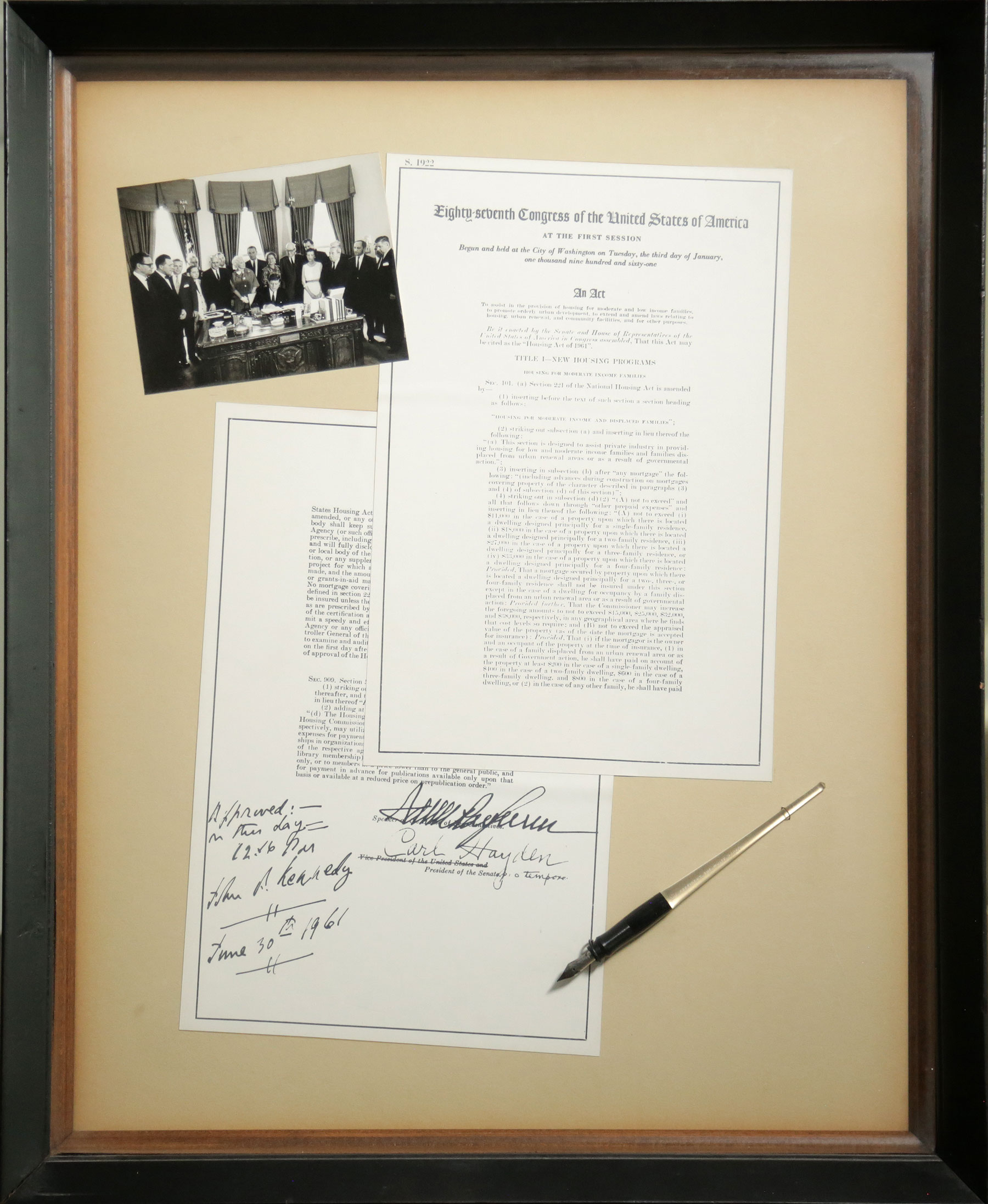
The Housing Act of 1961, signed by President John F. Kennedy on June 30, 1961, was the first major New Frontier legislation of his new administration, and a cornerstone of Kennedy’s housing program. Its passage was a major victory for the new president. It revitalized federal housing and urban renewal efforts. The bill authorized nearly $5 billion for urban renewal, expanded public housing and community facilities, and focused on slum clearance, moderate-income housing, and housing for the elderly. It also introduced 35-to-40-year, low-down-payment mortgages, Considered the most significant housing legislation since 1949, this act aimed to foster long-term, orderly urban development and help those in need of housing.
Some of its key provisions were: Mass Transit- A total of $50,000,000 in emergency loans to communities for rail, bus, subway; Open Spaces- A total of $50,000,000 in grants to state and local authorities for acquiring vacant land for recreation, conservation or esthetic purposes; Urban Renewal- A total of $2,000,000,000 in matching grants for slum rehabilitation, land purchase and redevelopment; Public Housing- Authorization for forty-year Federal rental subsidies of low-rent public housing, permitting local construction of 100,000 new units; Housing for the Elderly- An additional total of $75,000,000 in direct loans to local public agencies for building housing for persons aged 62 or over; Community Facilities- A total of $450,000,000 in low-interest loans for the construction of water works, fire houses and the like; College Housing- A four-year program providing $1,200,000,000 in low-interest loans for construction of college dormitories; Farm Homes -A four-year extension and $200,000,000 more for direct loans for farm and non-farm housing in rural areas; Low Down Payment Mortgages- Federally insured thirty-five-year mortgages for modest-income home buyers; and Special Mortgage Assistance- Authority for the President to use an additional total of $750,000,000 in Treasury funds for the Federal National Mortgage Association’s special assistance fund to purchase mortgages in support of the new programs.
Upon signing the bill, President Kennedy proudly remarked, “I want to express our pleasure in signing S. 1922, the Housing Act of 1961. This bill is the most important and far-reaching Federal legislation in the field of housing since the enactment of the Housing Act of 1949. For the communities of the Nation, large and small, it provides an opportunity for a giant step toward better cities and improved housing. And I think the beneficial effects of this legislation will be felt by every American.”
William L. Slayton worked as JFK’s Commissioner of Urban Renewal, serving in that post under JFK and then Lyndon Johnson, from 1961 to 1966. He later became the executive director and executive vice president of Urban America Incorporated, which was involved in research, urban policy, and addressing the challenges of urban development. Slayton was there when Kennedy signed the Housing Act of 1961, and Kennedy gave him one of his signing pens. These signing pens are given as souvenirs to key supporters and dignitaries present at signings.
This is that very signing pen from the first major legislation of the Kennedy administration. It comes with a photograph of those present at the signing ceremony, showing Kennedy actually signing the legislation, and a copy of the bill itself. All of these were the property of Slayton, and we obtained them directly from the Slayton descendants. Their continued existence was not known until now, and they have never before been offered for sale.

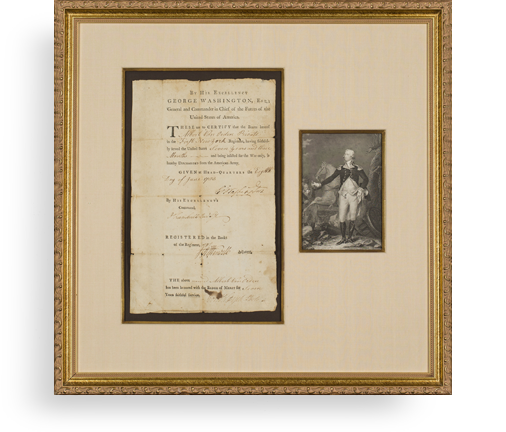
Frame, Display, Preserve
Each frame is custom constructed, using only proper museum archival materials. This includes:The finest frames, tailored to match the document you have chosen. These can period style, antiqued, gilded, wood, etc. Fabric mats, including silk and satin, as well as museum mat board with hand painted bevels. Attachment of the document to the matting to ensure its protection. This "hinging" is done according to archival standards. Protective "glass," or Tru Vue Optium Acrylic glazing, which is shatter resistant, 99% UV protective, and anti-reflective. You benefit from our decades of experience in designing and creating beautiful, compelling, and protective framed historical documents.
Learn more about our Framing Services