






President Thomas Jefferson and Secretary of State James Madison Grant a Patent for an Improvement in the Plow

Patents signed by Jefferson as President are uncommon, this being just the second one we have had in all these decades
From the very beginning of the Republic, the Founding Fathers were concerned with promoting invention and the advancement of technology. They inserted in the Constitution of the United States, at Article I, Section 8, a provision that “The Congress shall have Power…to promote the Progress of Science and useful Arts, by securing...


From the very beginning of the Republic, the Founding Fathers were concerned with promoting invention and the advancement of technology. They inserted in the Constitution of the United States, at Article I, Section 8, a provision that “The Congress shall have Power…to promote the Progress of Science and useful Arts, by securing for limited Times to Authors and Inventors the exclusive Right to their respective Writings and Discoveries.”
After the new government was inaugurated in 1789, President George Washington saw the importance of creating a patent system. On January 8, 1790, during his first State of the Union, he called on Congress to establish such a system. Washington said, “The advancement of Agriculture, commerce and Manufactures, by all proper means, will not, I trust, need recommendation.” The First Congress lost no time in effectuating this encouragement of invention in the new nation, and on April 1, 1790, the first U.S. Patent Act was passed. It was entitled “An Act to promote the Progress of Useful Arts”, a title that stated clearly its purpose. As Secretary of State, Jefferson oversaw the first patent applications.
Richard B. Chenoweth was born January 8, 1765 in Baltimore Co., Maryland. He was originally a blacksmith by trade and then had a successful business in Baltimore consisting of shops and forges that manufactured agricultural implements. He invented notable plow improvements on which he obtained patents in 1808 and 1838. He died on April 20, 1846 at the age of 81.
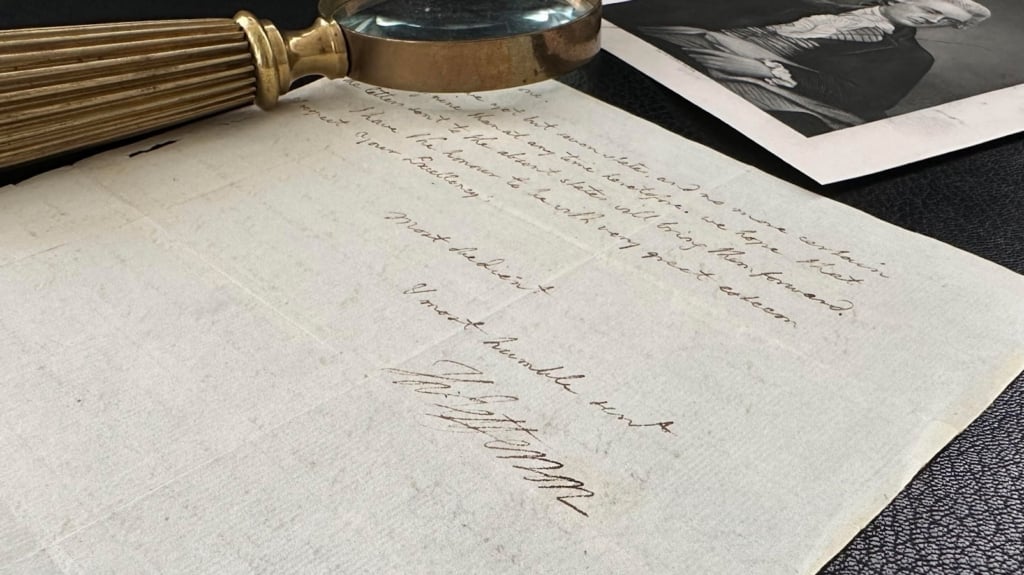
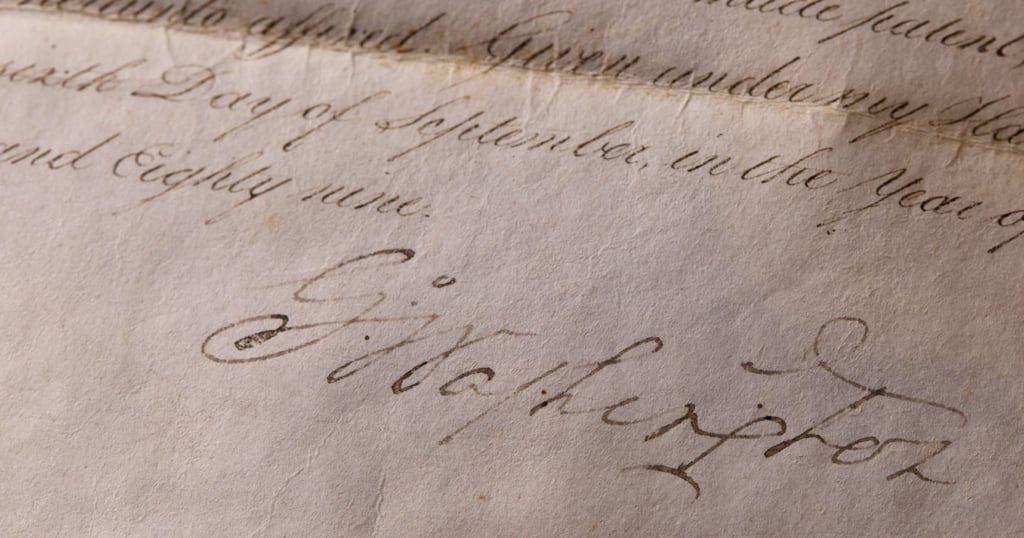
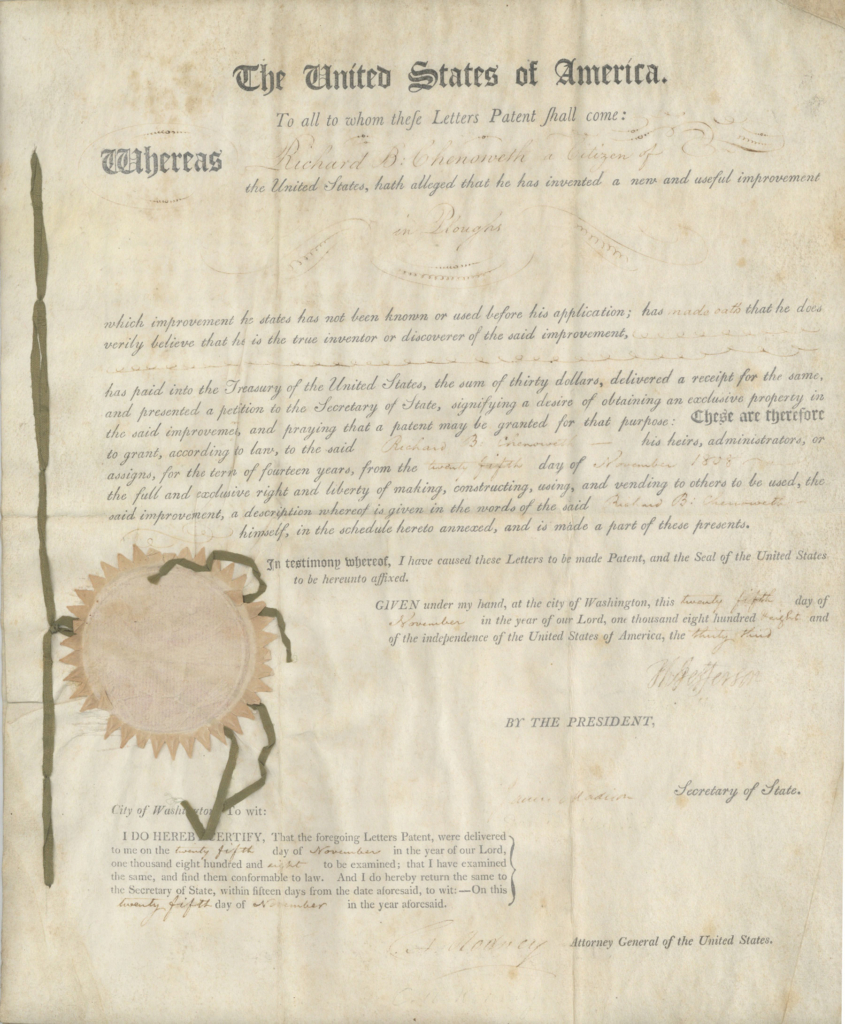
Document signed by Thomas Jefferson as President and James Madison as Secretary of State, with the great seal of the United States still intact, Washington, November 25, 1808, granting a patent to Chenoweth. The document states: “Richard B. Chenoweth, a citizen of the United States, has alleged that he has invented a new and useful improvement in ploughs, which improvement he states has not been known or used before his application; has made oath that he does verily believe that he is the true inventor and discoverer of the said improvement, has paid into the Treasury of the United States the sum of thirty dollars…and presented a petition to the Secretary of State signifying a desire of obtaining an exclusive property…in the said improvement and praying that a patent may be issued for that purpose. These are therefore to grant to the said Richard B. Chenoweth…for the tern of fourteen years, from the twenty fifth day of November 1808 the full and exclusive right and liberty of making, constructing, using, and vending to others to be used, the said improvement, a description whereof is given in the words of the said Richard B. Chenoweth himself, in the schedule hereto annexed…”
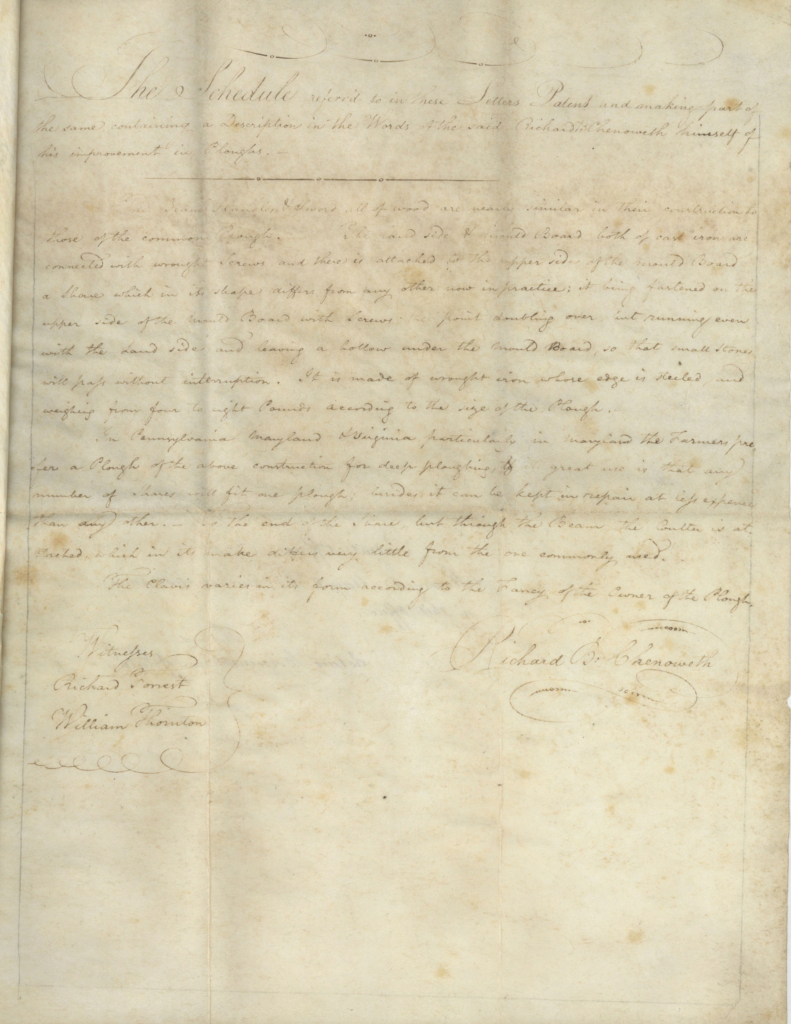
In the schedule attached to the patent document, Chenoweth described his invention as follows: “To all whom it may concern: Be it known that I, RICHARD B. CHENOWETH, of Baltimore, in the county of Baltimore and State of Maryland, have invented certain new and useful improvements in Plows, of which the following is a specification. The beam handles and sword, all of wood, are nearly similar ìn their construction to those of the common plow. The land side and moldboard, both of cast-iron, are connected with wrought screws, and there is attached to the upper side of the mold-board a share, which in its shape differs from any other now in practice, it being fastened on the upper side of the mold-board with screws, the point doubling over but running even with the land side, and leaving a hollow under the mold-board, so that small stones will pass without interruption. It is made of wrought-iron whose edge is steeled, and weighing from four to eight pounds, according to the size of the plow. In Pennsylvania, Maryland, and Virginia, particularly in Maryland, the farmers prefer a plow of the above construction for deep plowing, and its great use is that any number of shares will fit one plow. Besides it can be kept in repair at less expense than any other. To the end of the share, but through the beam, the colter is attached, which in its make differs very little from the one commonly used. The clevis varies in its form, according to the fancy of the owner of the plow.”
Most of the government files for patents prior to 1836 were lost in the great fire of December 1836, including this one. That leaves this document as the main resource for our knowledge about this patent.
Patents signed by Jefferson as President are uncommon, this being just the second one we have had in all these decades.

Frame, Display, Preserve
Each frame is custom constructed, using only proper museum archival materials. This includes:The finest frames, tailored to match the document you have chosen. These can period style, antiqued, gilded, wood, etc. Fabric mats, including silk and satin, as well as museum mat board with hand painted bevels. Attachment of the document to the matting to ensure its protection. This "hinging" is done according to archival standards. Protective "glass," or Tru Vue Optium Acrylic glazing, which is shatter resistant, 99% UV protective, and anti-reflective. You benefit from our decades of experience in designing and creating beautiful, compelling, and protective framed historical documents.
Learn more about our Framing Services

