





President Dwight D. Eisenhower Confirms He Will Participate in the Lincoln Center Groundbreaking, Which He Considered an Important Cultural Event
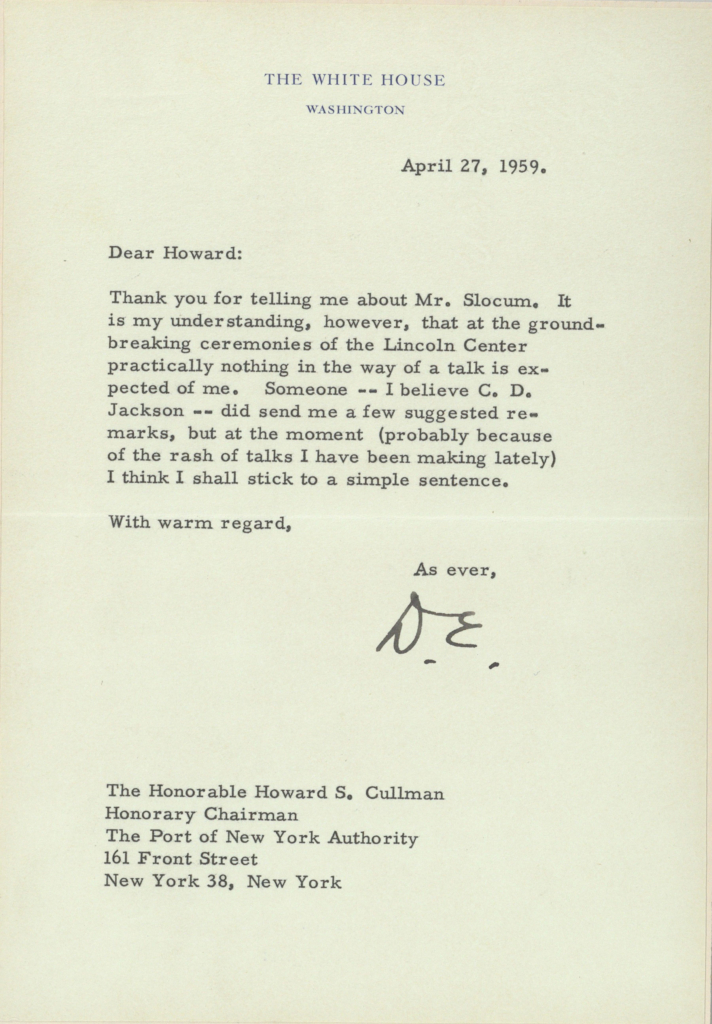

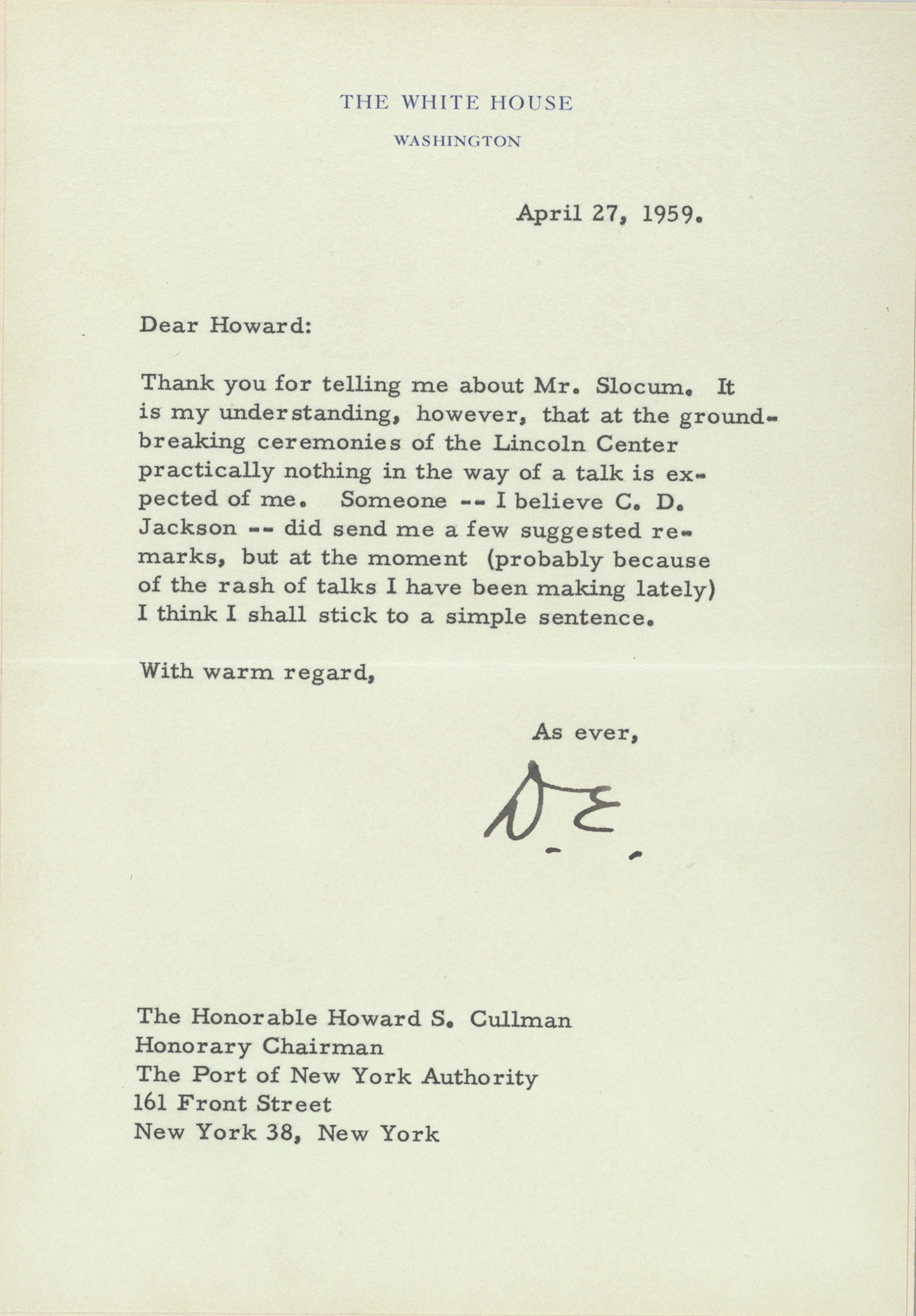
“It is my understanding, however, that at the groundbreaking ceremonies of the Lincoln Center practically nothing in the way of a talk is expected of me.”
By the 1950s, two of the United States’ oldest performing arts organizations—The Metropolitan Opera and the New York Philharmonic—were searching for new homes. Meanwhile, Robert Moses was leading the massive Lincoln Square Urban Renewal Project. This convergence led to the imagination and construction of the world’s first modern performing arts center –...


By the 1950s, two of the United States’ oldest performing arts organizations—The Metropolitan Opera and the New York Philharmonic—were searching for new homes. Meanwhile, Robert Moses was leading the massive Lincoln Square Urban Renewal Project. This convergence led to the imagination and construction of the world’s first modern performing arts center – the
Lincoln Center for the Performing Arts.
The ground-breaking ceremonies for the Lincoln Center took place in New York City on May 14, 1959. There were remarks by conductor Leonard Bernstein and President Dwight D. Eisenhower (who also broke the ground), plus music by the New York Philharmonic, Juilliard Chorus, and the Metropolitan Opera. Eisenhower’s remarks stressed the event’s cultural aspect, and its ability to promote peace and understanding: “Lincoln Center for the Performing Arts symbolizes an increasing interest in America in cultural matters…Here in the heart of our greatest metropolitan center, men of vision are executing a redevelopment of purpose, utility, and taste. It is a cooperative venture in which Federal and local government, artistic groups, large foundations, and private citizens are joining forces….All of us salute this magnificent effort. At Lincoln Center, Americans will have new and expanded opportunities for acquiring a real community of interest through common contact with the performing arts.
“American technology, labor, industry, and business are responsible for the twentieth century freedom of the individual–making free a greater portion of his time in which to improve the mind, the body, and the spirit. To them we are likewise indebted for the capacity to establish this Center. The lives of all of us will be enriched. The beneficial influence of this great cultural adventure will not be limited to our borders. Here will occur a true interchange of the fruits of national cultures. From this will develop a growth that will spread to the comers of the earth, bringing with it the kind of human message that only individuals–not governments–can transmit. Here will develop a mighty influence for peace and understanding throughout the world. And the attainment through universal understanding of peace with justice is today, as always, the noblest and most shining ideal toward which man can strive and climb.
“And so, as we break ground for the first of your great halls, the concert hall, the new home of New York’s Philharmonic Symphony Orchestra, I pay sincere tribute to your vision, your effort, your energy that is creating the Lincoln Center for the Performing Arts. And now I understand we proceed with the ceremony by turning over the first shovel of earth.”
Typed letter signed, on White House letterhead, Washington, April 27, 1959, to Howard S. Cullman, Honorary Chairman of The Port of New York Authority, confirming that he will participate in the Lincoln Center groundbreaking. “Thank you for telling me about Mr. Slocum. It is my understanding, however, that at the groundbreaking ceremonies of the Lincoln Center practically nothing in the way of a talk is expected of me. Someone — I believe C. D. Jackson — did send me a few suggested re-marks, but at the moment (probably because of the rash of talks I have been making lately) I think I shall stick to a simple sentence.” He has signed with initials, “D.E.”
C. D. Jackson was a key advisor and speechwriter to President Eisenhower who drafted the remarks for the groundbreaking ceremony of Lincoln Center. While Eisenhower ultimately opted for a pared down statement, he used Jackson’s draft and went beyond “a simple sentence” and spoke of the importance of the event.
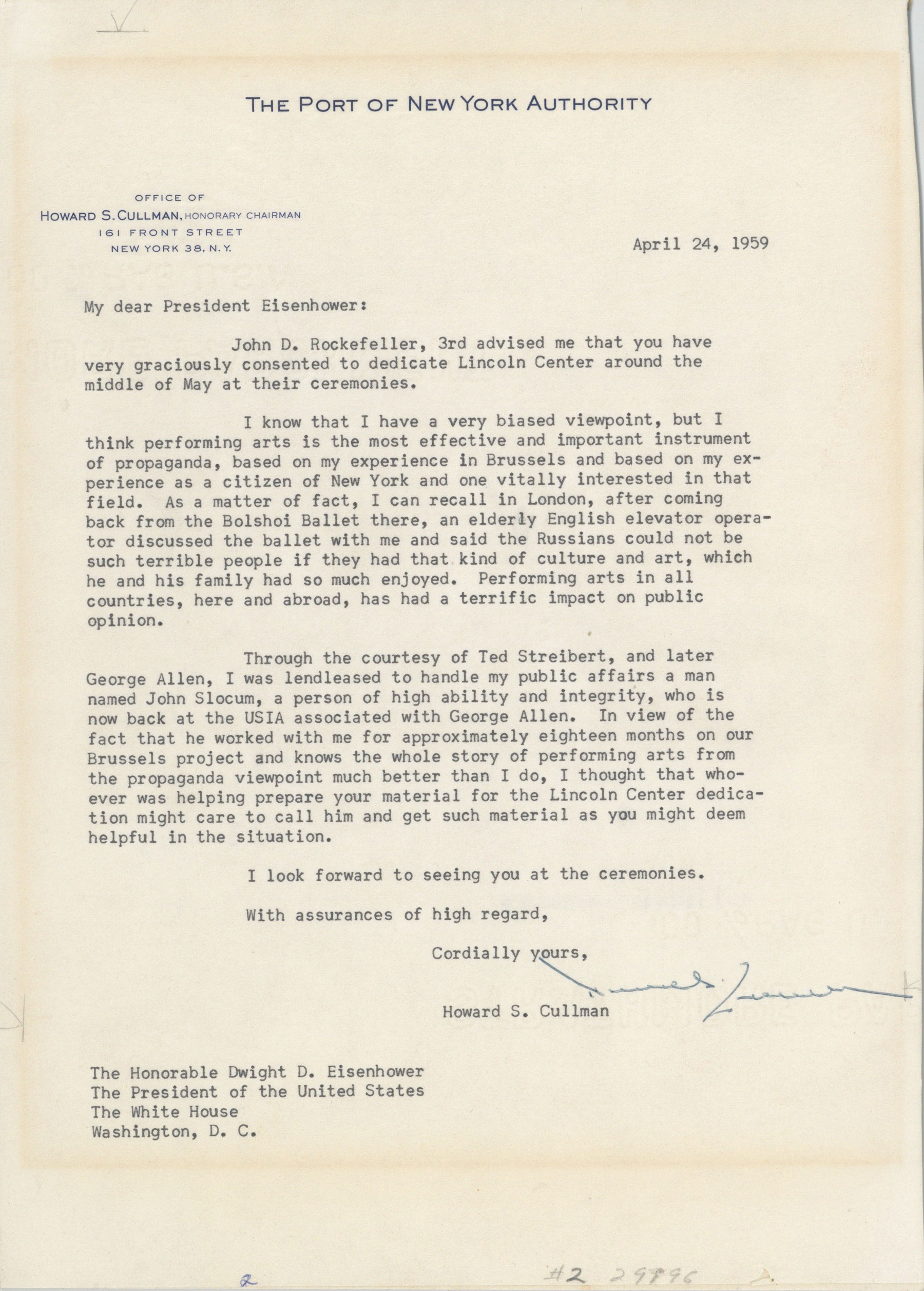
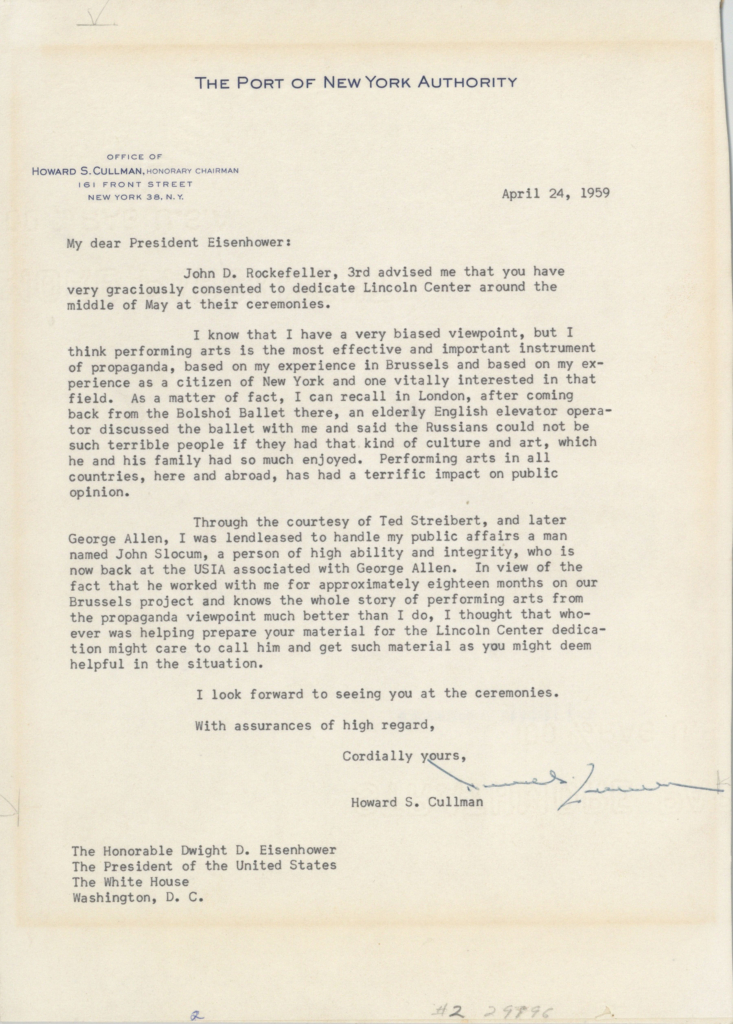
This comes with a letter from Cullman to Eisenhower dated April 24, 1959, acknowledging that Ike had “very graciously consented to dedicate Lincoln Center around the middle of May at their ceremonies.”
The Ike letter is affixed to a small board and is lightly trimmed.

Frame, Display, Preserve
Each frame is custom constructed, using only proper museum archival materials. This includes:The finest frames, tailored to match the document you have chosen. These can period style, antiqued, gilded, wood, etc. Fabric mats, including silk and satin, as well as museum mat board with hand painted bevels. Attachment of the document to the matting to ensure its protection. This "hinging" is done according to archival standards. Protective "glass," or Tru Vue Optium Acrylic glazing, which is shatter resistant, 99% UV protective, and anti-reflective. You benefit from our decades of experience in designing and creating beautiful, compelling, and protective framed historical documents.
Learn more about our Framing Services