






The Dawn of Modern Music: The Earliest Known Example of Musical Notations from Western Europe in Private Hands, Dating from the 800s
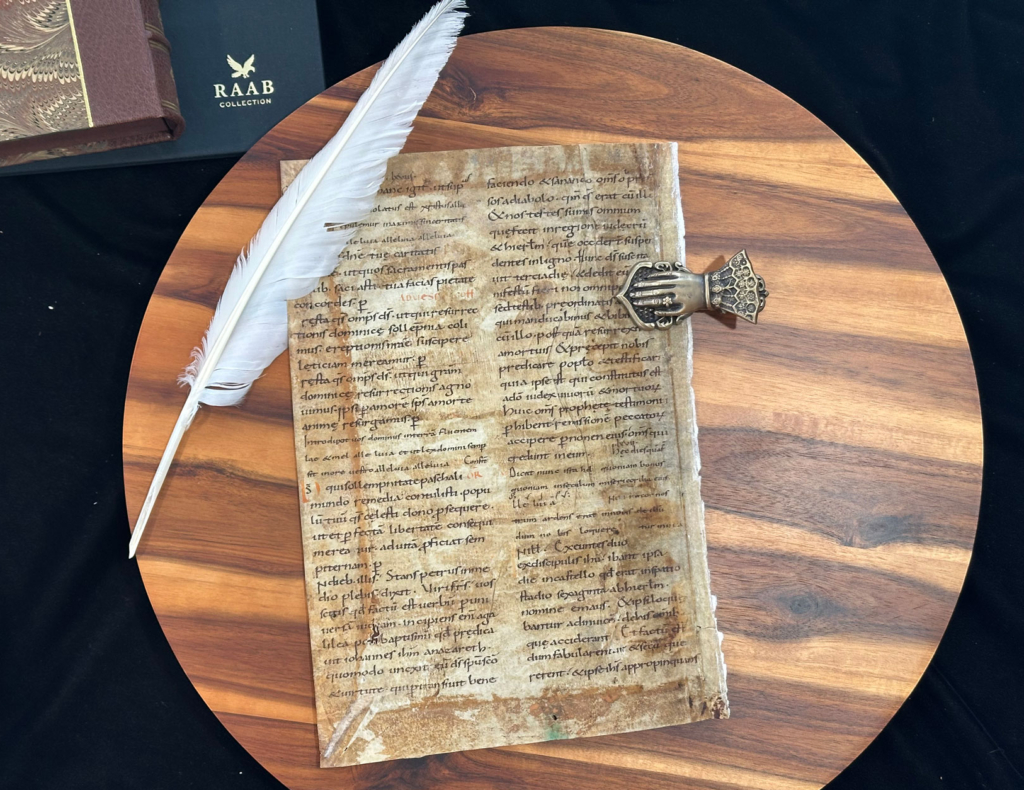
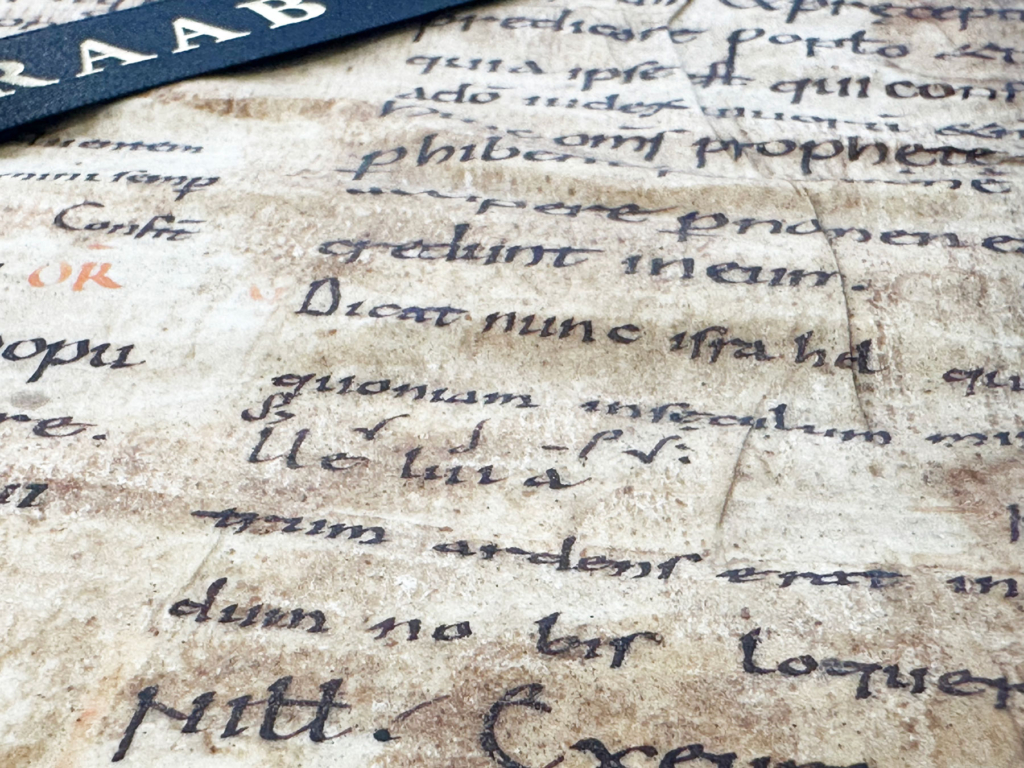
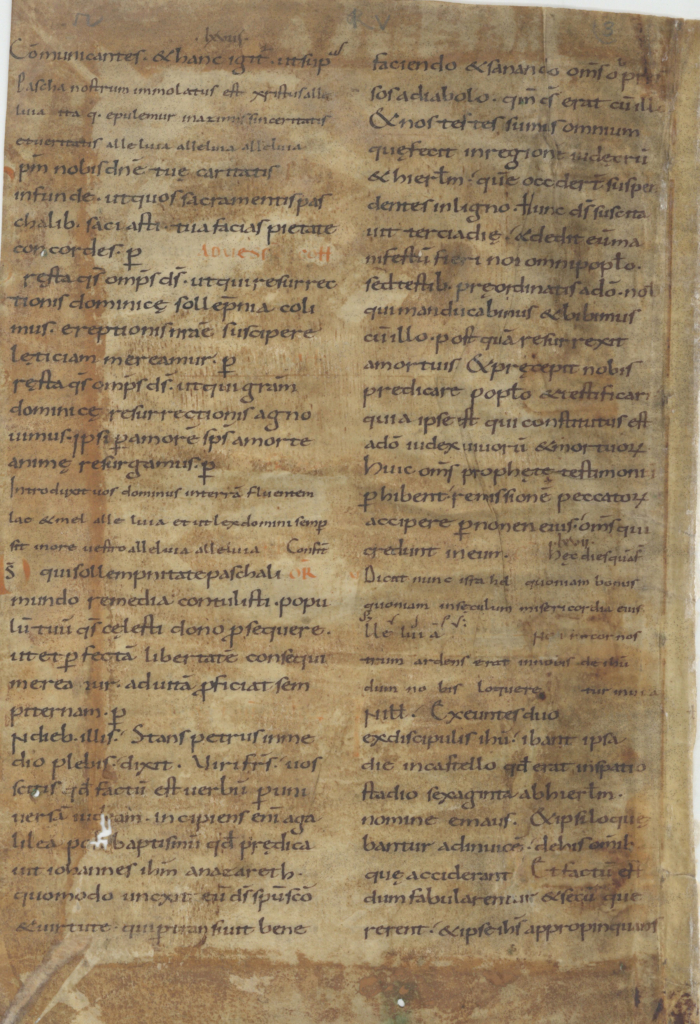
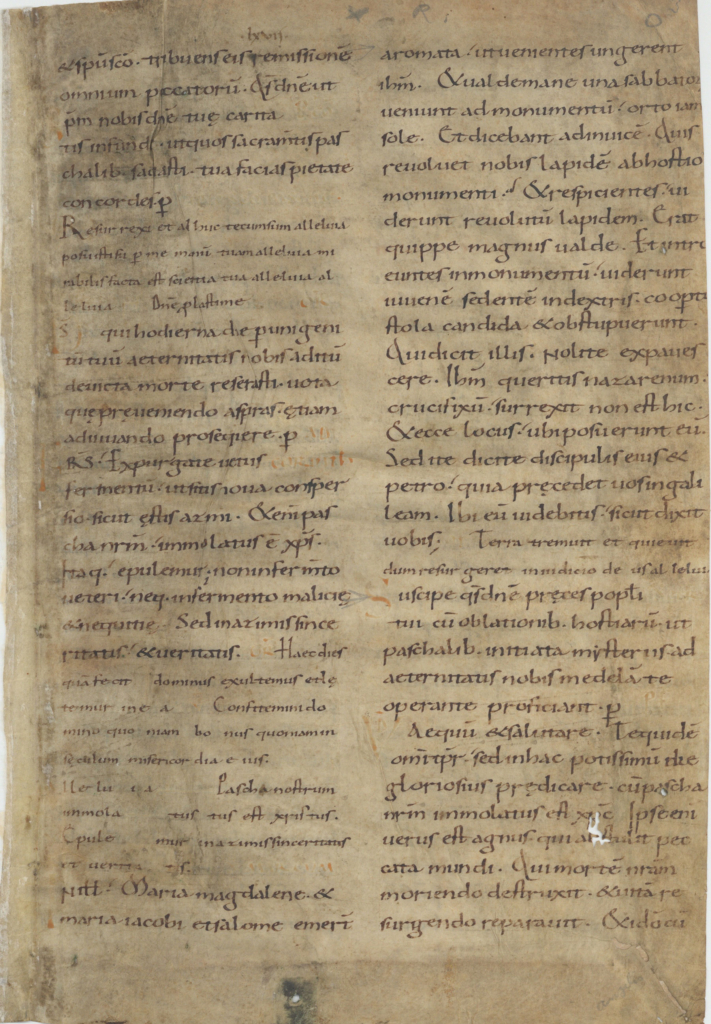

This manuscript ranks among the earliest known written examples of what we call today musical notations, including well known examples inside institutions; none earlier are known to exist in any private collection or to have reached the public market
The Rise of Charlemagne
The late eighth century saw a new power rising in Europe in the form of the empire of Charlemagne (747-814). Originally from the region of north-eastern France and the adjacent territories of the Low Countries, within a few decades most of Europe from the Channel to the...


The Rise of Charlemagne
The late eighth century saw a new power rising in Europe in the form of the empire of Charlemagne (747-814). Originally from the region of north-eastern France and the adjacent territories of the Low Countries, within a few decades most of Europe from the Channel to the Pyrenees, eastwards into much of Germany, and downwards into Italy had fallen under his sway. It is clear that he saw the correct fostering of religion and learning as a vehicle to give this unit a collective identity, remaking the Roman Empire as he saw it out of the fragmented and disparate communities left behind when that power structure fell in the fifth century.
Charlemagne also took great interest in music and standardizing notation.
The dawn of modern musical notation
While music has been a constant of human culture, its recording in a written form is not. In Western Europe its absolute dawn appears to be the ninth and tenth centuries, and came about as part of the changes to religious music at the time. The anonymous monk of St. Gall who composed De vita Caroli magni (perhaps Notker Balbulus) records that around 885 great differences had grown up between Roman and Frankish Gregorian chants, and that Charlemagne sent a singer to Rome for instruction, assigning him to Metz on his return, so that Frankish chant was still called “ecclesiastica cantilena Metensis”. The teaching of the singer in Rome must have been done orally, and there is no evidence of musical notation in Italy at this time or before. The existence of variant forms and the urge to reinstate an earlier and perhaps truer form of liturgy must also have been behind the adaptation of Byzantine ekphonetic notation marks or other inflections and accents to form a series of penstrokes and simple shapes (called neumes), that when written above words could help by marking the general rising and falling of pitch and other audible features. These functioned as a form of aide-memoire to the singer (the musical stave establishing pitch was not invented until the eleventh century, and then with only 4-lines; with full notation in polyphonic 5-line staves only following in the second half of the fifteenth century).
Listen to the Inspired by History Podcast
The earliest surviving examples of Western music, contemporary or after this one:
Dated to the ninth century:
The Laon Gradual (Laon Bibliothèque municipale, MS. 239, an incomplete gradual manuscript, with neumes extensively added to its lines of text. Bischoff and Contreni both dated it to the ninth century, but Marie-Noëlle Colette has most recently redated it to the end of the ninth or early tenth century);
The St. Gall Cantatorium (St. Gallen, MS. 359; with most assessments placing this in the period 922-926: see A. Von Euw, Die St. Galler Buchkunst vom 8. bis zum Ende des 11. Jahrhunderts, 2008, I:470-72), but some locating it at the end of the ninth century.
In the tenth century, these are followed by:
the Einsiedeln Gradual (Einsiedeln Abbey, MS. 121, dating to 960-996);
the Bamberg Gradual (Bamberg Staatsbibliothek, MS. Lit.6, dating to 966-1000);
the St. Gall Gradual and Sacramentary (San Gallen, MS. 339, dating to 980-1000);
the Troyes ‘Missale vetustissimum’ (Troyes, Médiathèque Jacques-Chirac, MS. 522, dating to the late tenth century, and with short parts of its text noted in neumes);
the Mont Renaud Antiphonal (privately owned, but published in black and white facsimile in 1955, the text dating to the tenth century);
the Nonantola ‘Antiphonale Missarum’ (surviving in fragments only, these dating to the tenth century, and perhaps associated with the nearby Carolingian dominated centre of Verona);
and Chartres, Bibliothèque Municipale, MS. 47 (dating to the tenth century; this witness destroyed in 1944 by allied bombing, and known only through a partial facsimile printed in 1910.
In addition to these, we know of only a handful of fragments, all dateable to the tenth century.
Thus, the music here stands among the very earliest witnesses to the notation of music in the West, alongside the Laon Gradual and the St. Gall Cantatorium at its very earliest possible dating. Indeed, it seems quite possible that the present witness predates both of these manuscripts. No other older witness to musical notation is known to us in private hands, and it seems extremely unlikely that any other will be offered in our lifetime.
The early date of this also means that there would have been people in this congregation alive during the time of Charlemagne himself. The Holy Roman Emperor at the time would have been a near descendant, perhaps his grandson.
The format: inside a religious medieval text
The Sacramentary was one of the oldest tools of the Western clergy. It combined the various readings needed for Masses and the liturgy in a single convenient volume for use by a bishop or a priest. The earliest examples to survive are the Leonine and Gelasian Sacramentaries, both with origins in the seventh century, but as with the Bible and other key Christian books the careful reform and correction of such texts was at the forefront of the earliest waves of the Carolingian renaissance. Between 781 and 791, Charlemagne wrote to Pope Hadrian I asking him for an approved copy of the service-book of the Roman Church. That was examined, added to on numerous occasions and disseminated, and became the Gregorian Sacramentary. It is likely to have been further added to in the provinces of Europe, and the text dominated liturgical practise for the next three centuries. By the midpoint of the twelfth century the text was in decline, as the Missal grew to fill the space it once occupied, and it was rarely copied in the thirteenth century, unless as luxury presentation copies apparently for individual bishops.
The document
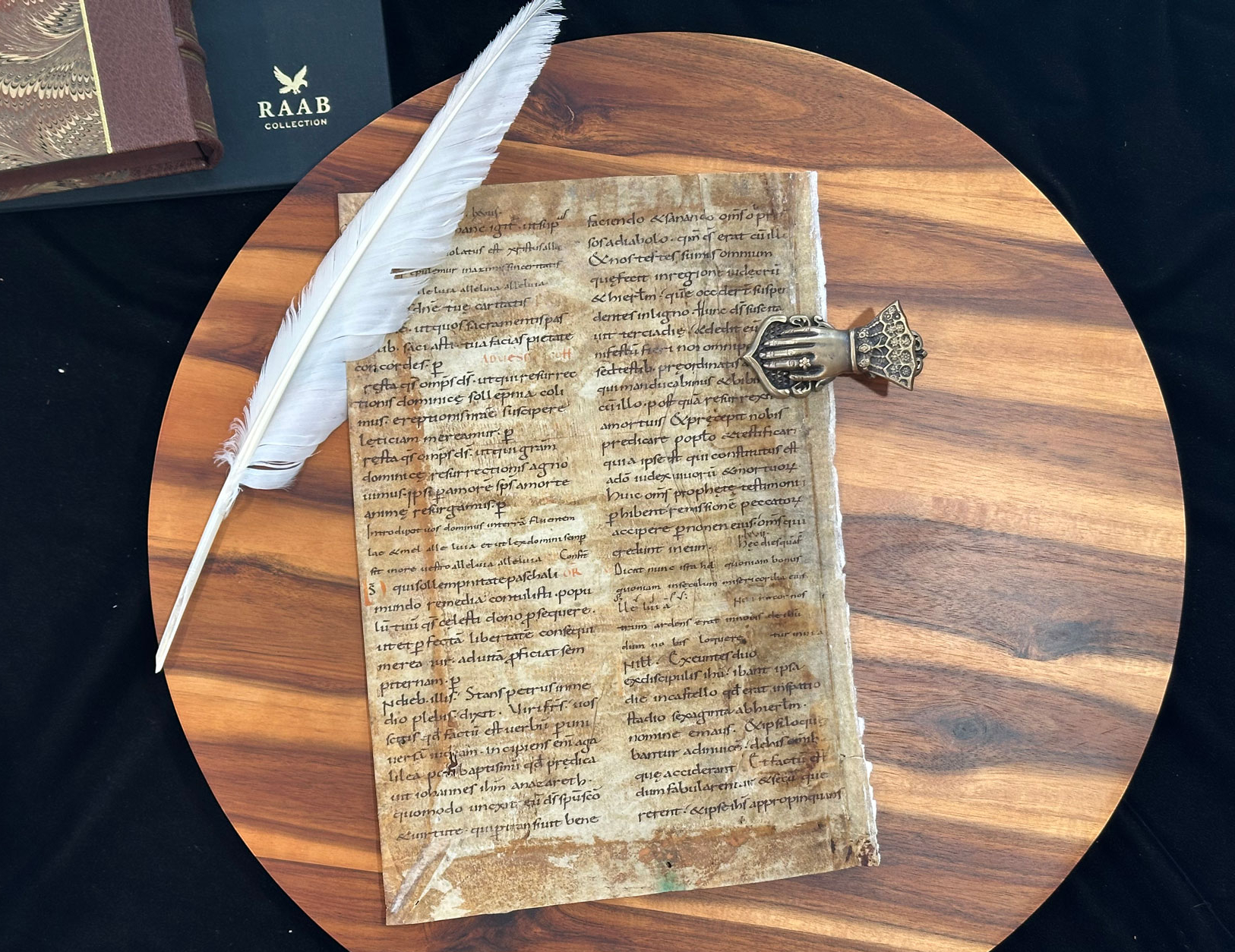
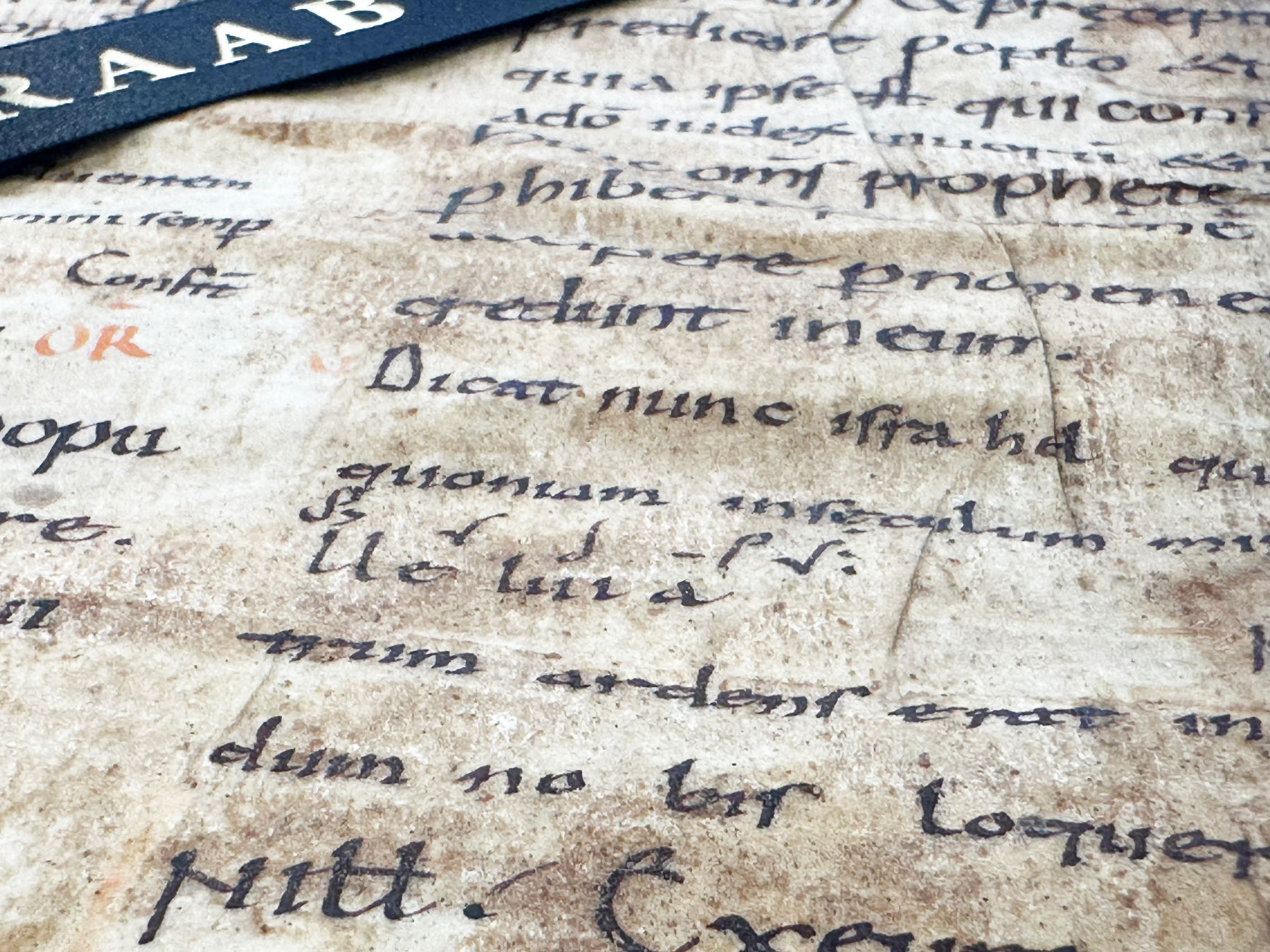
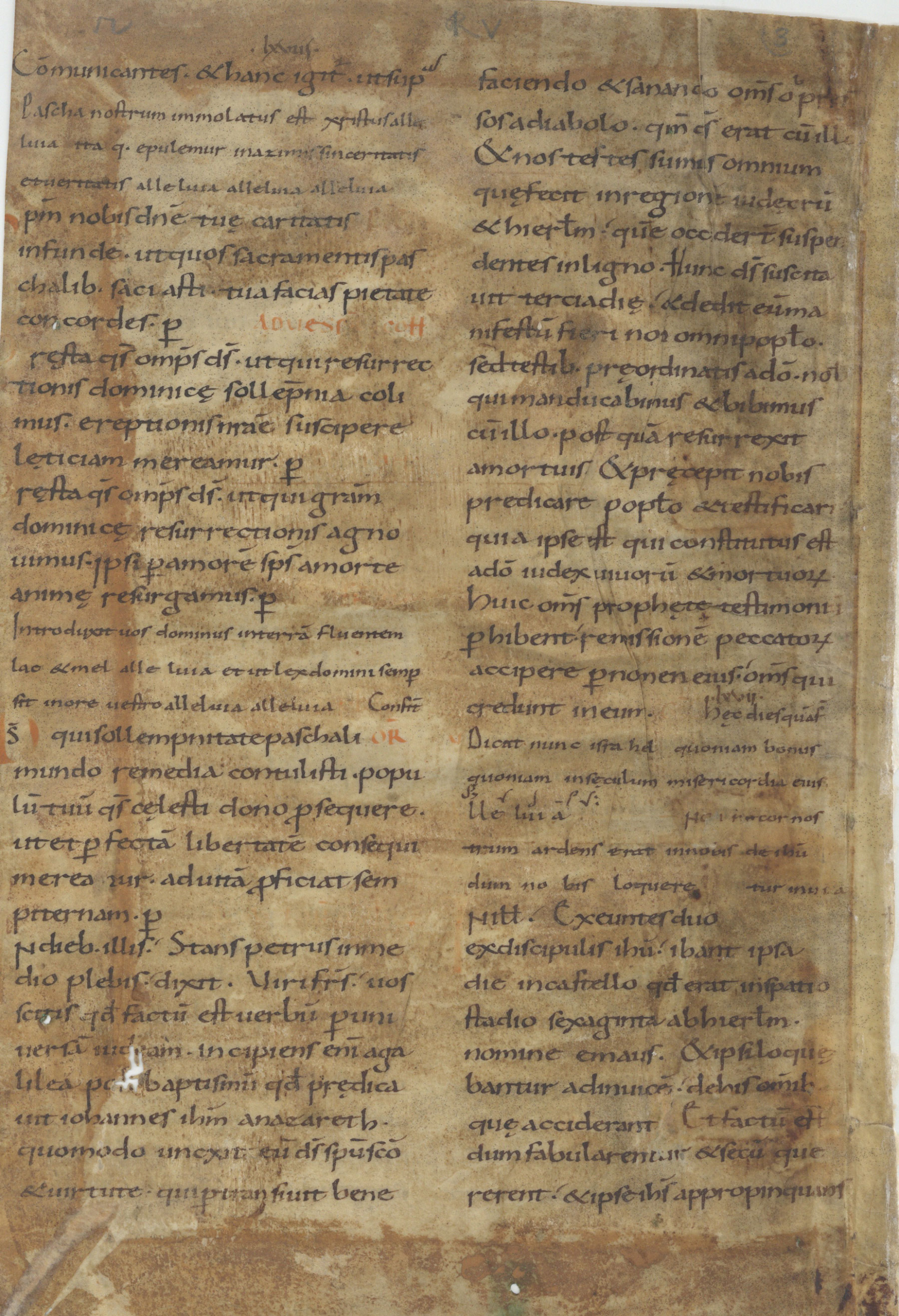
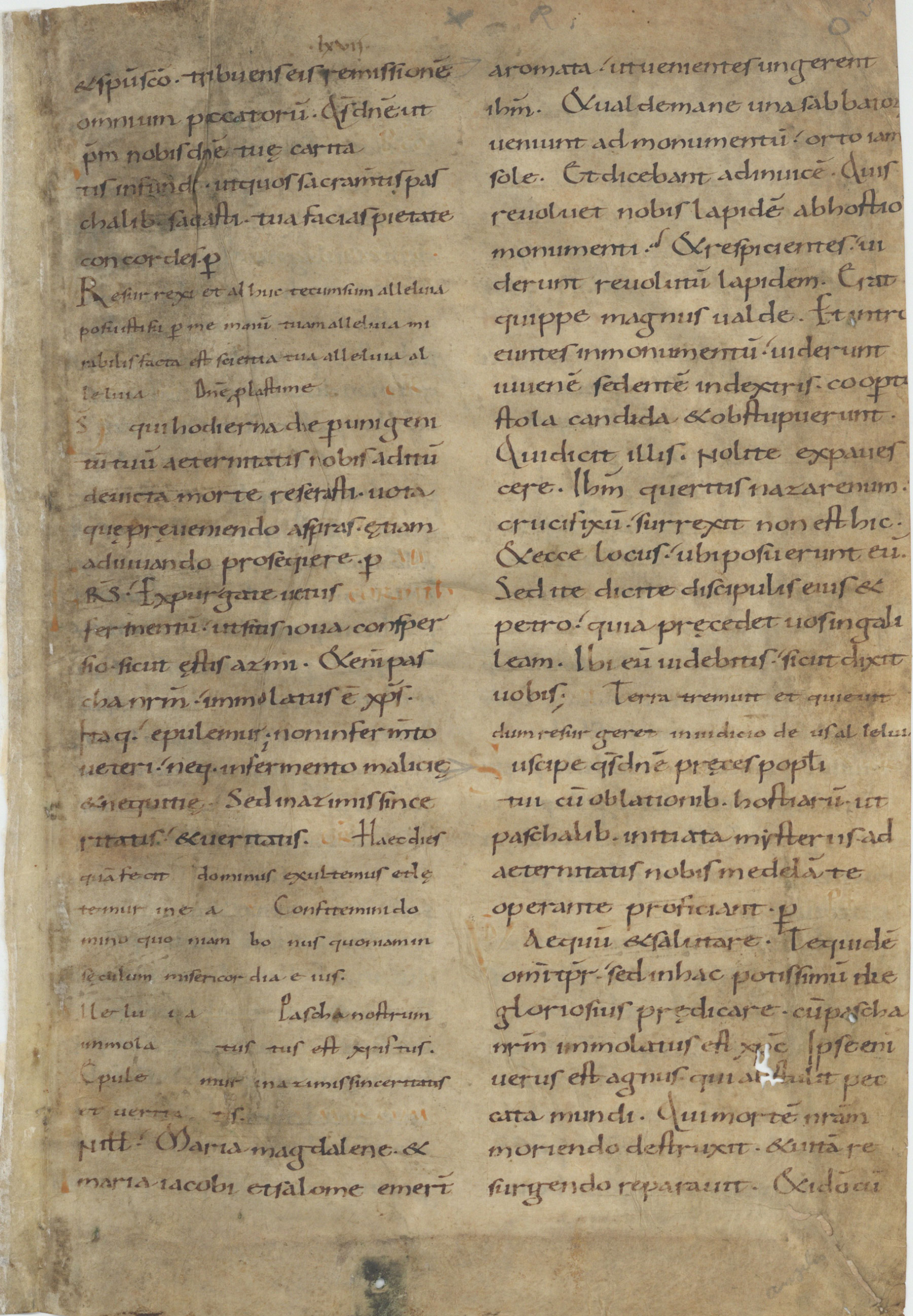
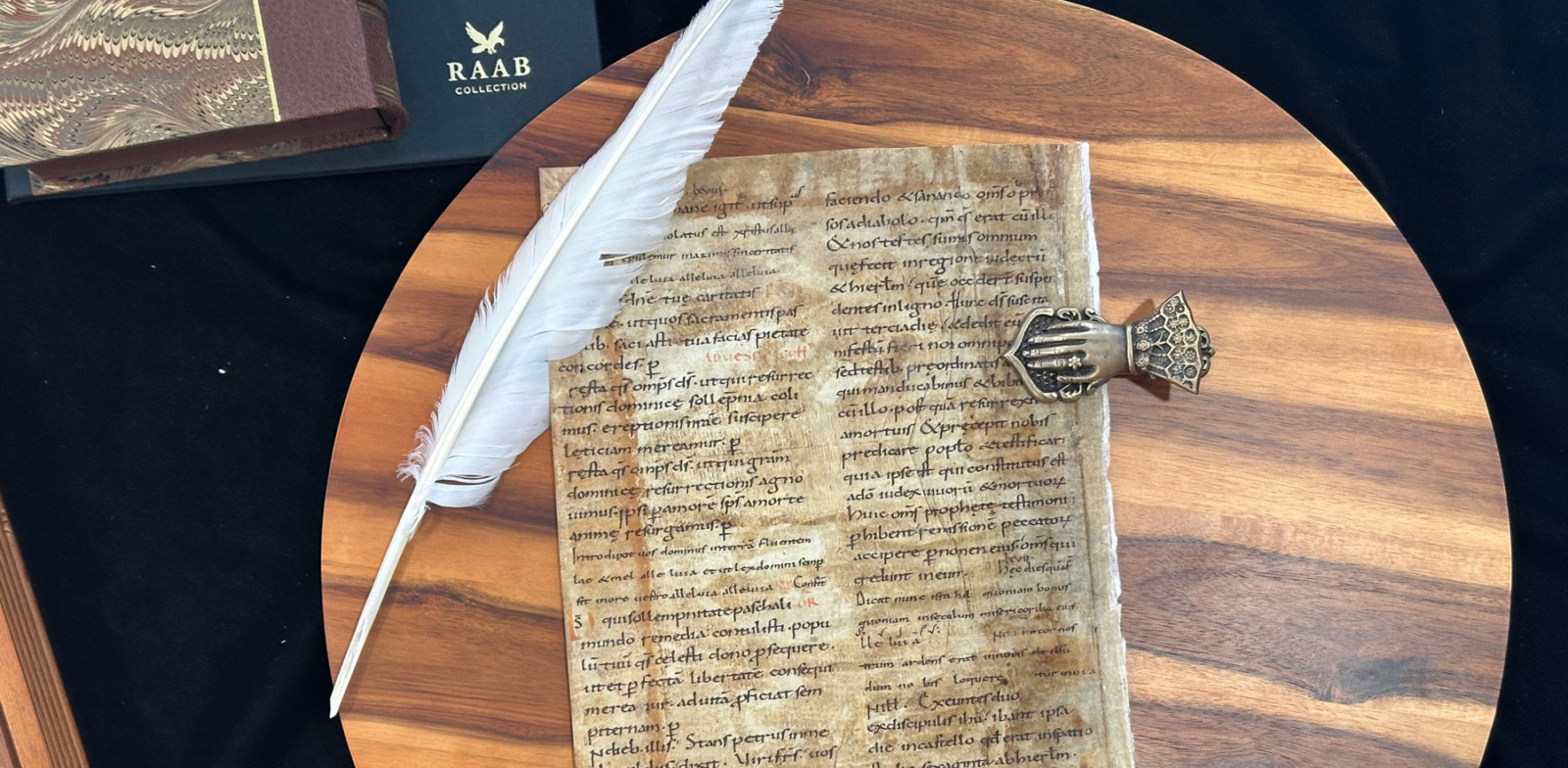
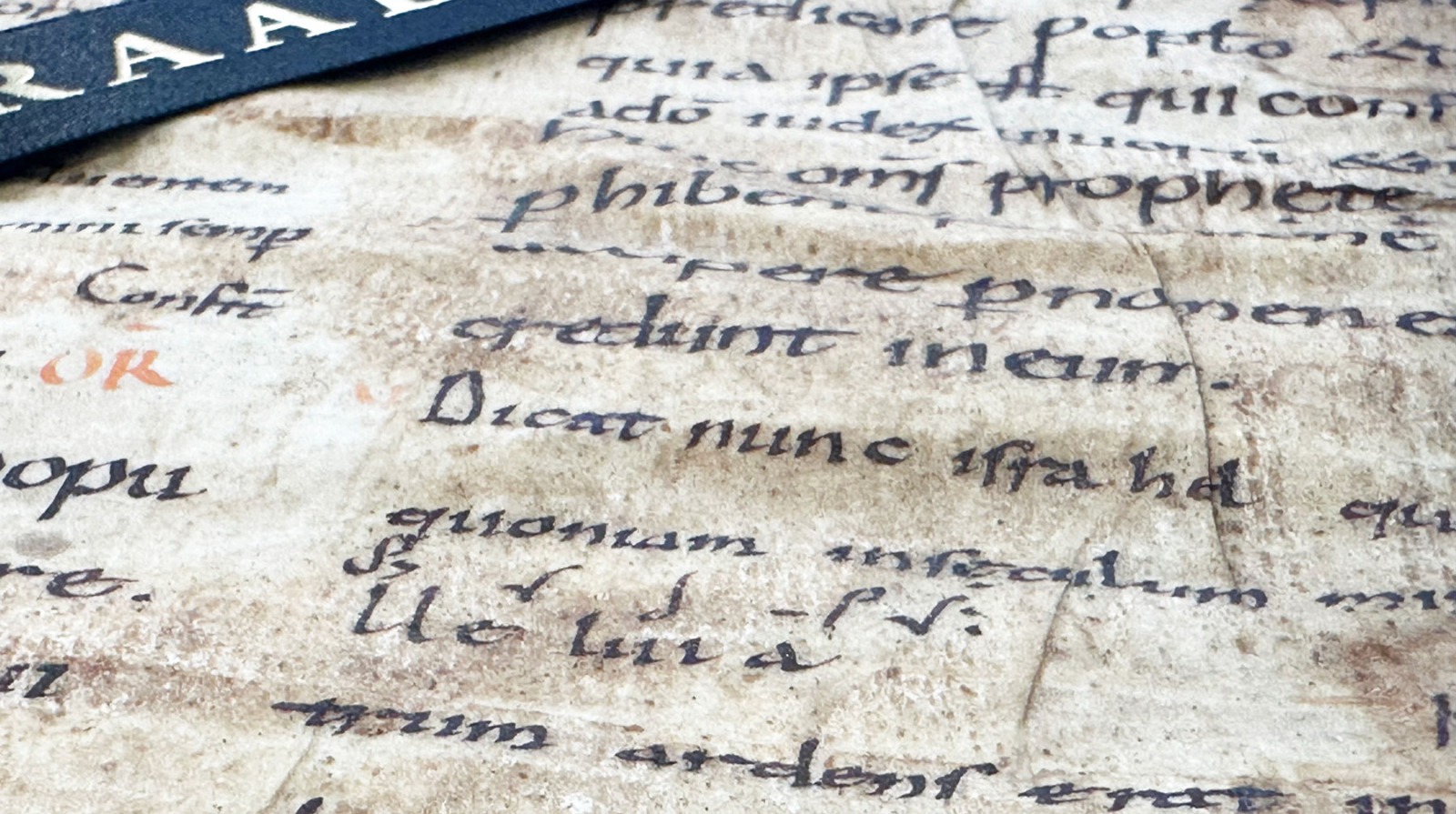
Manuscript leaf from an early Sacramentary, with one of the earliest surviving records of the writing down of music in Western Europe, in Latin, manuscript on vellum, Temporale for Easter Day and Easter Monday. With penstrokes and dots written above the word “[A]lleluja” in a choral refrain to be sung by the Congregation.
[most probably Germany, second half of the ninth century]
Large leaf, measuring 322 by 220 mm, blind-ruled for two columns of 33 lines, written in two sizes of a large and rounded Carolingian minuscule, rubrics in orange-red, initials in red or brown, spaces left for some initials, some punctuation marks for public reading (some perhaps added later), recovered from reuse in a later binding with consequent damage
Provenance
1. The inclusion of the unusual mass for a Holy Roman Emperor on a related fragment (“Deus qui ad praedicandum aeterni regis euangelium romanum imperium preparasti …”, corresponding to H.A. Wilson, The Gregorian Sacramentary under Charles the Great, 1915, p. 187) suggests production within a scriptorium fully under Carolingian control in the second half of the ninth century. The script was taken by another earlier cataloguer to be Italian, but Italy remained only partially under Carolingian rule throughout the ninth and tenth centuries, and so the mass for an emperor as well as the likely origin of the sixteenth-century scrawls from the period of the fragments reuse in a later binding (see below), consolidate the impression that the paleography here is Germanic instead.
2. Reused in a later binding, apparently an account book, and with a sixteenth-century hand adding an inscription to a corresponding leaf: “… Arnelofo … blanksbergi comitis” (indicating the name Arnulf, and perhaps the place Blankenburg at the foot of the Harz mountains in Saxony-Anholt in middle Germany).
3. Maggs Bros, Catalogue 1002 Western Text Hands from the Late 9th to Early 14th Century (1980), no. 8, and illustrated there.
4. Mark Lansburgh (1925-2013), teacher, printer and book collector (on him, see C. Dutschke, ‘Mark Lansburgh: Collector and Seller of Medieval Manuscripts’, in Medieval Manuscripts and Their Provenance: Essays in Honour of Barbara A. Shailor, ed. by A.S.G. Edwards (2024), pp. 116-31).
5. Neil F. Phillips (1924–1997), QC, of Montreal, New York, and Virginia: his MS 698; sold in Sotheby’s, 2 December 1997, lot 42.
6. Ernst Boehlen (1935-2022) of Bern, Switzerland; his MS. 804.
Our gratitude to manuscript expert Dr. Timothy Bolton for his assistance with this document.

Frame, Display, Preserve
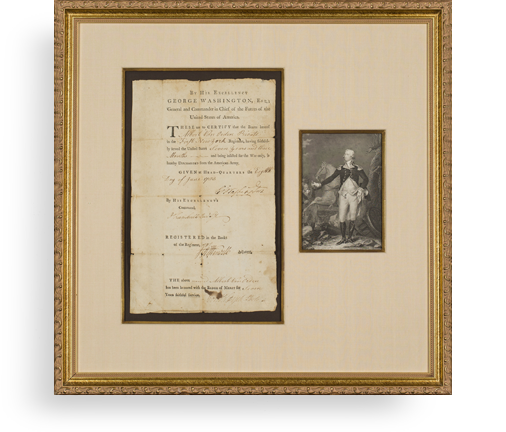
Each frame is custom constructed, using only proper museum archival materials. This includes:The finest frames, tailored to match the document you have chosen. These can period style, antiqued, gilded, wood, etc. Fabric mats, including silk and satin, as well as museum mat board with hand painted bevels. Attachment of the document to the matting to ensure its protection. This "hinging" is done according to archival standards. Protective "glass," or Tru Vue Optium Acrylic glazing, which is shatter resistant, 99% UV protective, and anti-reflective. You benefit from our decades of experience in designing and creating beautiful, compelling, and protective framed historical documents.
Learn more about our Framing Services