







Napoleon, Weakened by his Failed Attempt to Take Moscow and Falling Back from the Iberian Peninsula, Pardons a Large Group of Deserters from the Marine Artillery, Sending Them Back to Fight


A large, ornate vellum document signed by Napoleon, the Arch Chancellor of the Empire, Minister of State, and the Grand-Judge Minister of Justice
1813 was not a great year for Napoleon. In December 1812 he had returned from Moscow with a fraction of his army, after a famous defeat and retreat. His control of Spain was falling apart. In March, his brother (who was Spanish King Joseph) left Madrid for good. France was beginning to...


1813 was not a great year for Napoleon. In December 1812 he had returned from Moscow with a fraction of his army, after a famous defeat and retreat. His control of Spain was falling apart. In March, his brother (who was Spanish King Joseph) left Madrid for good. France was beginning to lose ground in the East as well, as the Russians and Prussians made a Treaty.
In the Napoleonic military service, the French navy included marine artillery regiments. These regiments were primarily composed of naval gunners used for coastal batteries and fortresses, and were part of a broader naval structure that included regiments of marines and sailors. The French marine artillery regiments were organized into several units, including the 1st, 2nd, 3rd, and 4th Regiments of Marine Artillery. Desertion was a significant issue. While harsh training and geographic origin played a role, soldiers also often deserted multiple times, encouraged by amnesties that allowed a return to the regiment. As the noose tightened and Napoleon’s fortunes waned, the need to have these troops became more and more central to not losing the war. That meant that soldiers were better placed on the front lines than kept locked up in prison.
Document signed by Napoleon, the Arch Chancellor of the Empire (Jean-Jacques-Régis de Cambacérès), Minister of State, and the Grand-Judge Minister of Justice (Claude Ambroise Régnier, duc de Massa), Trianon Palace, located on the grounds of Versailles, March 14, 1813, to the first President and Counsellors of the Court of Colmar, acknowledging the good conduct of 13 separate workers and cannoneers of the first through fourth marine artillery regiments at the “atelier of Valdieu”: “Napoleon by the grace of God, and the constitutions of the empire, emperor of the French, king of Italy, protector of the confederation of the Rhine, mediator of the Swiss confederation.”
“By the judgments rendered by the councils of war… For desertion and detained in the set atelier… We have recognized that we can demonstrate the effects of our clemency: and in consequence we have convened in private council in our Palace of Trianon [it then notes the various attendees, including the Archichancellor of the Empire, the Dukes of Massa, the Grand-Judge Minister of Justice, Ministers of the Interior and Finance, President of the Senate, etc…]… We now order by these present letters, sealed with the seal of the empire, that they be presented by our procurer general, in public audience, where these men will be led…”
As both Colmar, where the court was held, and Valdieu, where they were imprisoned, is on the central western border of France, it seems likely that these marine artillery men deserted from those front lines between France and Germany. It is possible that they were part of the waves of desertion during the Russian campaign.
An uncommon pardon showing Napoleon’s clemency.

Frame, Display, Preserve
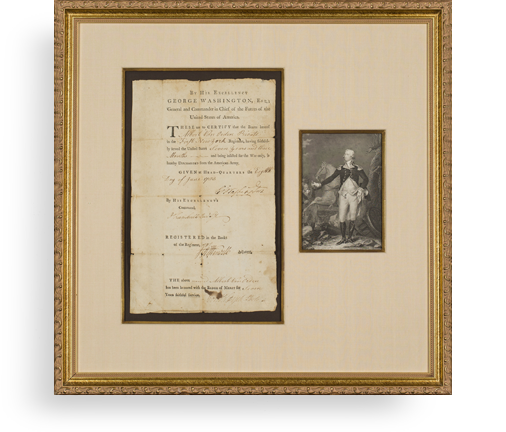
Each frame is custom constructed, using only proper museum archival materials. This includes:The finest frames, tailored to match the document you have chosen. These can period style, antiqued, gilded, wood, etc. Fabric mats, including silk and satin, as well as museum mat board with hand painted bevels. Attachment of the document to the matting to ensure its protection. This "hinging" is done according to archival standards. Protective "glass," or Tru Vue Optium Acrylic glazing, which is shatter resistant, 99% UV protective, and anti-reflective. You benefit from our decades of experience in designing and creating beautiful, compelling, and protective framed historical documents.
Learn more about our Framing Services
