





Paul Revere Constructs a Bell for a Patriot Church on His Midnight Ride, Replacing a Bell that Tolled to Warn then-Menotomy, Now Arlington, of the Arrival of the British on April 19, 1775


The sounding of the bell summoned the minutemen to action and warned the westward towns of Lexington and Concord and their military commanders near that the British were marching in their direction
A rarity, we found only 2 other documents directly relating to Revere’s furnishing of a bell, and none connecting him to a patriot church that answered his call on the fateful evening April 18
Featured on the Inspired by History podcast
After the Boston Tea Party in 1773, the British...


A rarity, we found only 2 other documents directly relating to Revere’s furnishing of a bell, and none connecting him to a patriot church that answered his call on the fateful evening April 18
Featured on the Inspired by History podcast

After the Boston Tea Party in 1773, the British Parliament passed the Intolerable Acts (early 1774), including the restrictive Massachusetts Government Act. Patriot leaders in Suffolk County, Massachusetts, adopted the Suffolk Resolves in resistance to the acts. The leaders formed a Patriot provisional government, the Massachusetts Provincial Congress, and called for local militias to train for possible hostilities. The Provincial Congress effectively controlled the colony outside of Boston. On September 17, 1774 the First Continental Congress endorsed the Suffolk Resolves. In response, in February 1775, the British government declared Massachusetts to be in a state of rebellion.
On April 18, 1775, about 700 British Regulars in Boston, under Lieutenant Colonel Francis Smith, received secret orders to capture and destroy colonial military supplies reportedly stored at Concord. Through effective intelligence gathering, Patriot leaders, among them John Adams and John Hancock, received word weeks before the British expedition that their supplies might be at risk and had moved most of them to other locations. On the eve before the battles of Lexington and Concord, a series of military movements by General Gage and Smith raised the attention of many of the men in the Provincial Congress, among them Joseph Warren, who sent for Paul Revere under the highest level of secrecy, Revere barely evading the patrols of the British. He, along with a couple other men, was to warn area militias of the British plans and approaching British Army expedition from Boston.
Revere crossed the Charles River in the late hours of April 18, and, receiving a horse, proceeded West toward Lexington, passing before through the town of Menotomy, or West Cambridge, now Arlington. There, on the 19th at 2am, he met with Benjamin Locke, commander of the Menotomy Minutemen, and warned him of the activities and pending aggression of the British. Locke raised the minutemen he had been training and prepared for battle the next day. Revere had beaten Smith to Locke by just 3 hours. Smith’s men heard, as they marched West, the sounds of guns and the church bell of the 2nd parish. All secrecy was lost; the countryside was alarmed to their presence. Smith dispatched a post rider to Boston with an urgent request for reinforcements and continued his march towards Lexington. Most Menotomy families sent their women and children to seek refuge in homes far removed from the Concord road.
On the retreat the British passed again through Menotomy and this time a battle took place with the heroes of Benjamin Locke’s minutemen and others taking center stage. Many were members of the Church there, the 2nd parish, the same whose bell had tolled in the dawn hours of April 19. They helped construct the church, clean it, make repairs, or were involved in the management or religious instruction there, including Benjamin Locke. This was a true patriot church.
These men of the 2nd parish took up arms. Indeed, Menotomy was a scene of unlikely heroism. Locke’s men and many others took part. The first group to engage the British, and to take a prisoner, was a collection of older men, who, though too old to join the minutemen, nonetheless grabbed their muskets and attacked. Locke’s men fought and two were among those listed as among the five missing by the Provincial Congress later that day. It was the third battle of the day, behind Lexington and Concord.
Paul Revere not only had a silversmith business. He became an accomplished bell maker. Eighteenth century Menotomy was a village of four to five hundred farmers, millers, tavern keepers and their families. It grew up along the Concord road (now Massachusetts Avenue) from high ground known as “the foot of the rocks” in the west near Lexington, to Cambridge and Charlestown in the east. The town was not incorporated until 1807, then as West Cambridge, losing its original Indian name, and renamed as Arlington sixty years later.
At around the same time, the church of the 2nd parish began a major renovation. This included the purchase of a new bell to replace the previous, and they turned to Revere, the same men who had warned them a generation before, to make this bell, which would replace the bell that had tolled on that night to warn the residents.
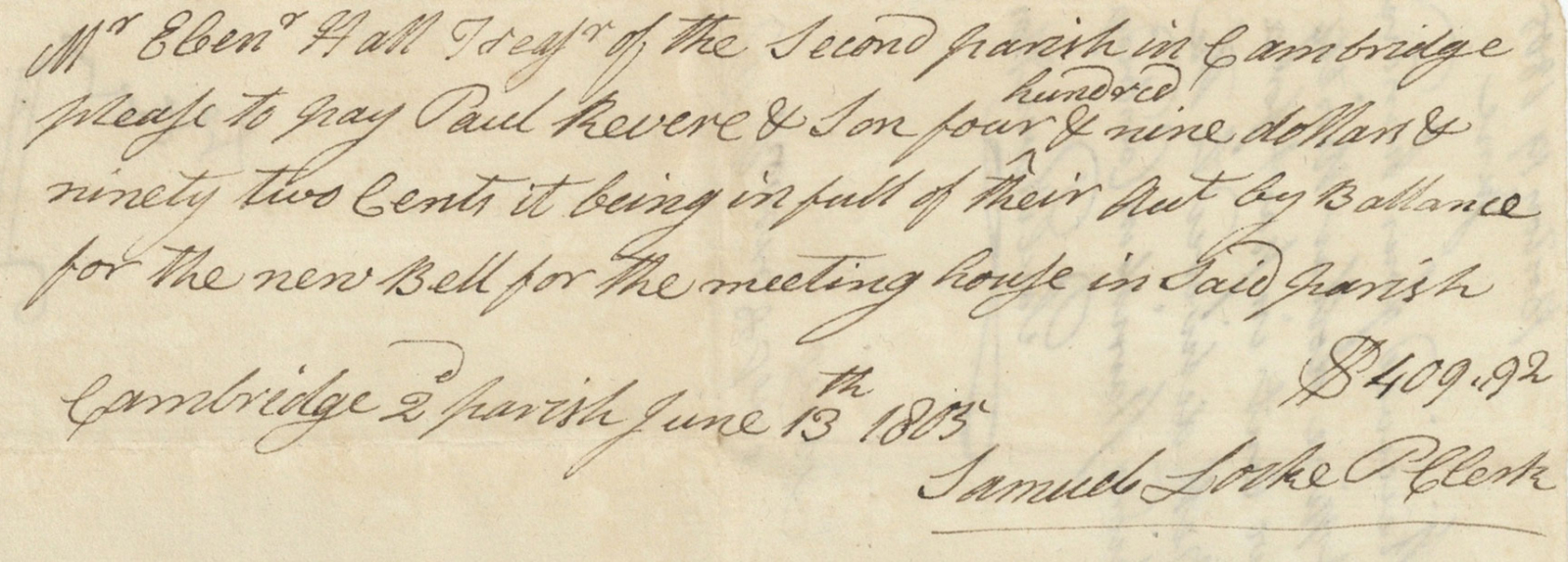
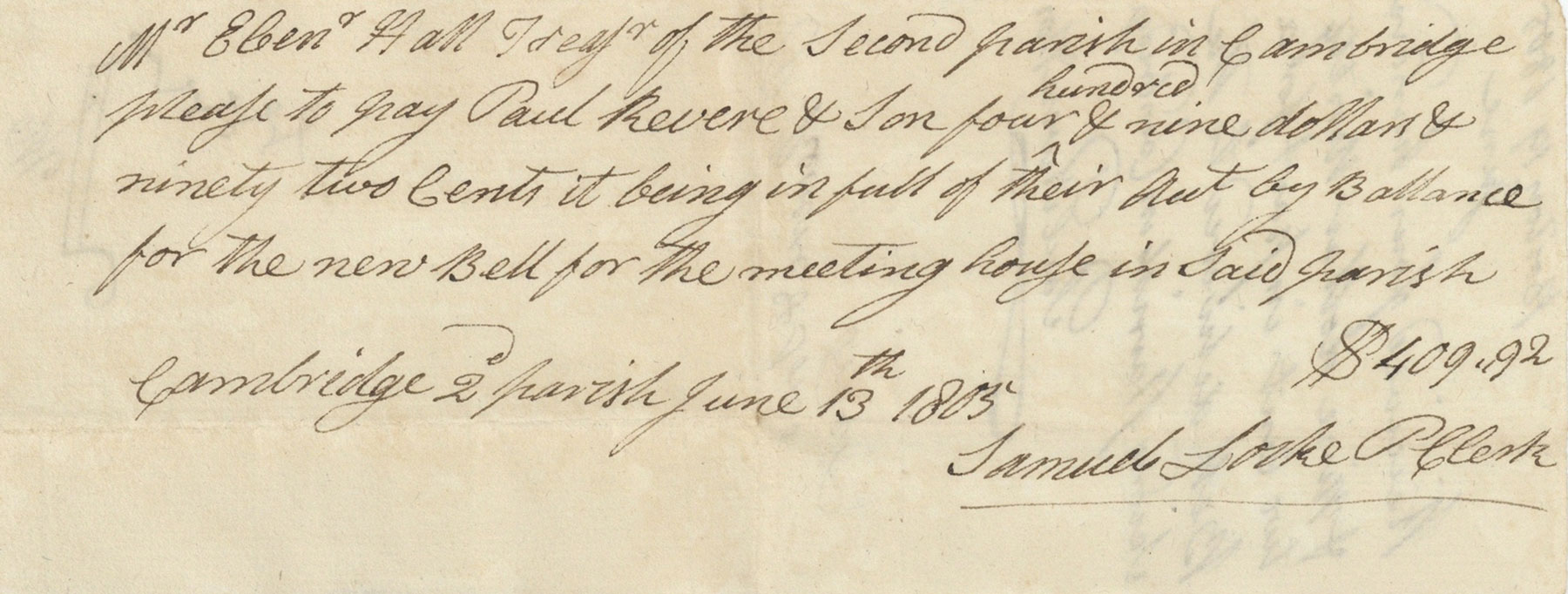
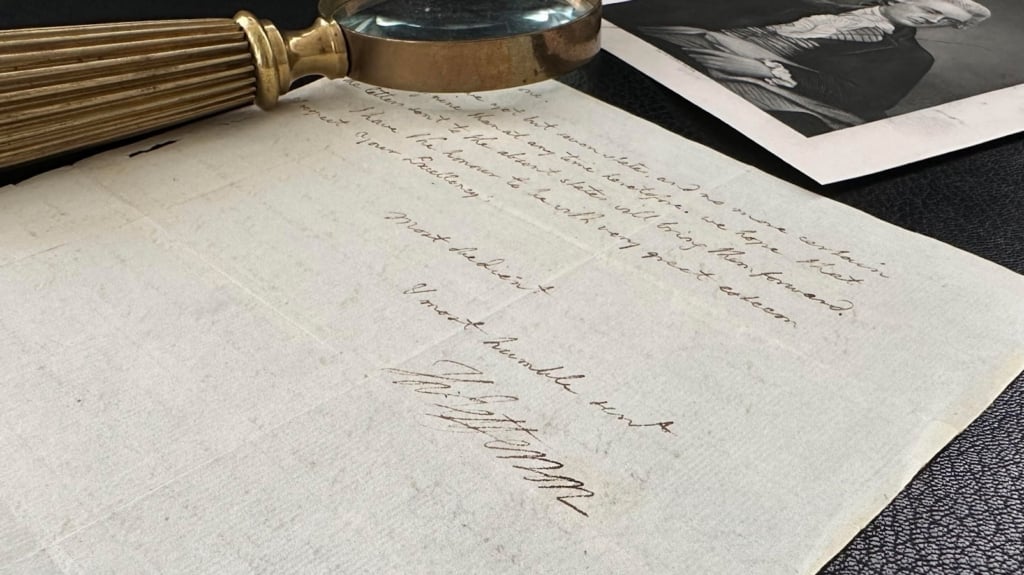
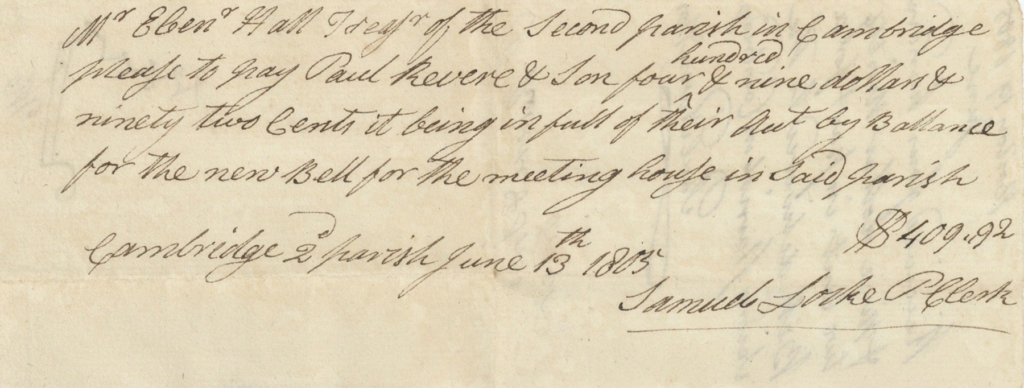
Document signed, Cambridge, June 13, 1805, Samuel Locke, clerk of the church, authorizing “Mr. Ebenezer Hall Treasurer of the Second Parish in Cambridge, please to pay Paul Revere and Son four hundred and nine dollars and ninety two cents it being in full of their account by balance for the new bell for the meeting house in said parish.”
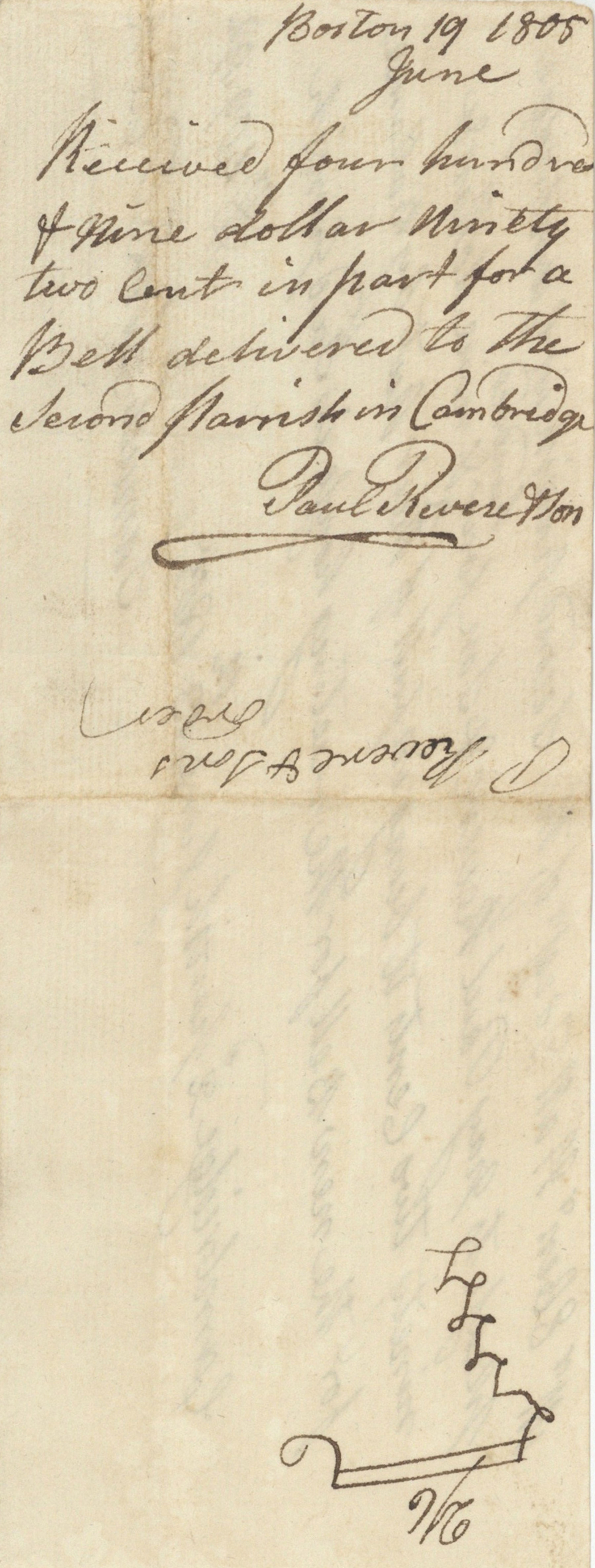
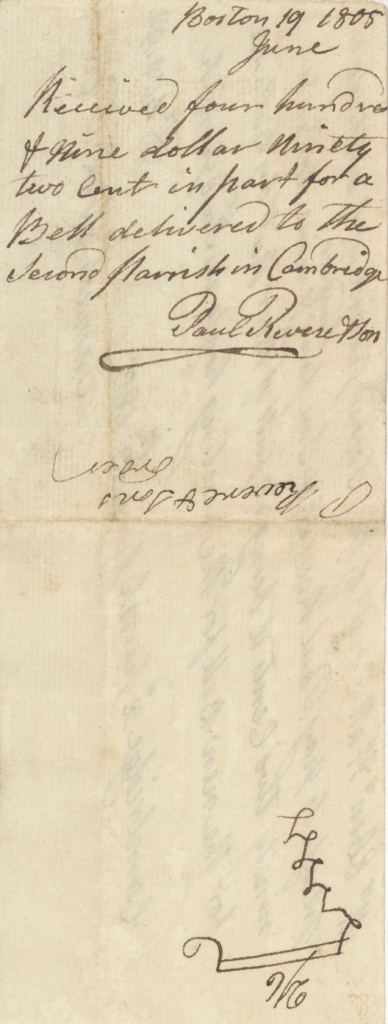
Signed by Revere, Boston, June 19, 1805, “Paul Revere & Son.” “Received four hundred and nine dollars and and ninety two centers for a Bell delivered to the Second Parish in Cambridge.”
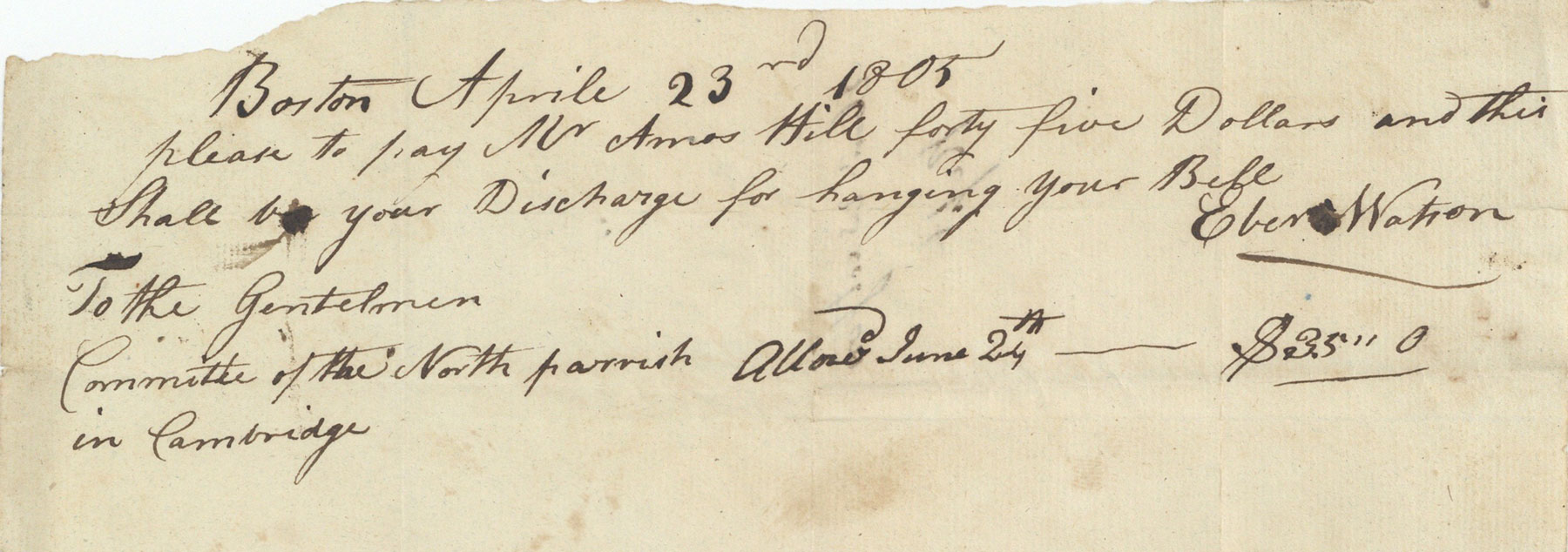
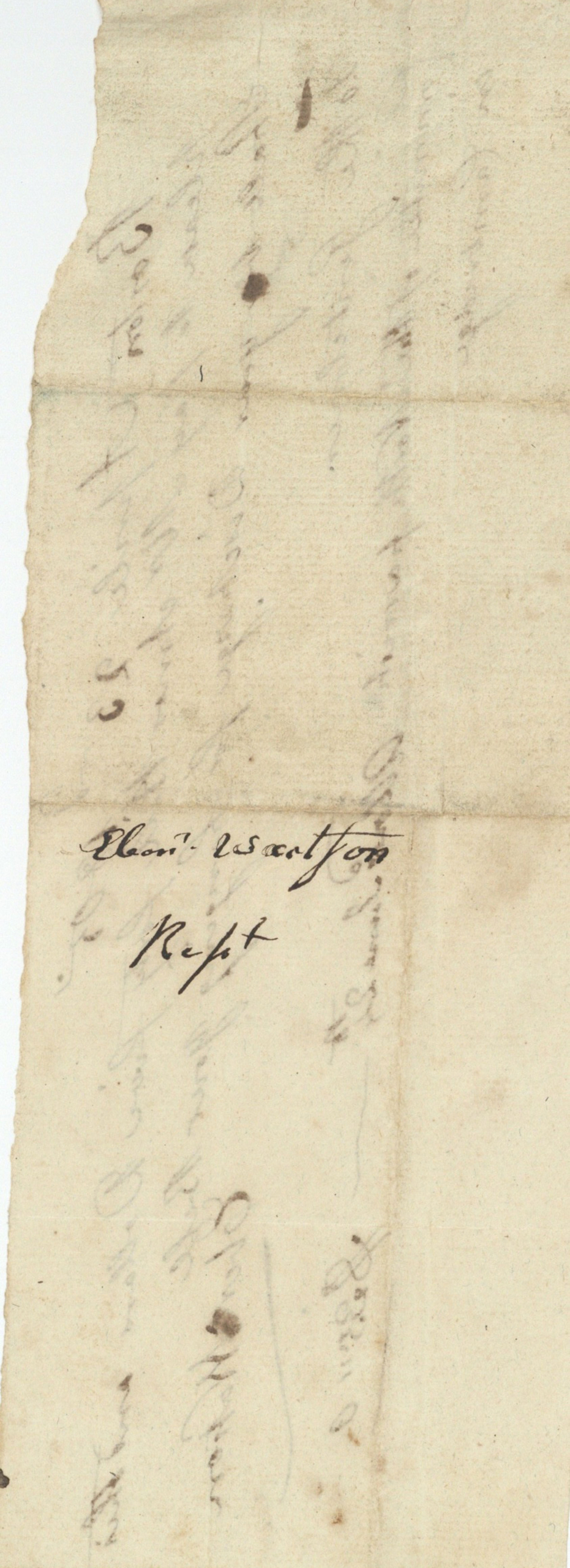
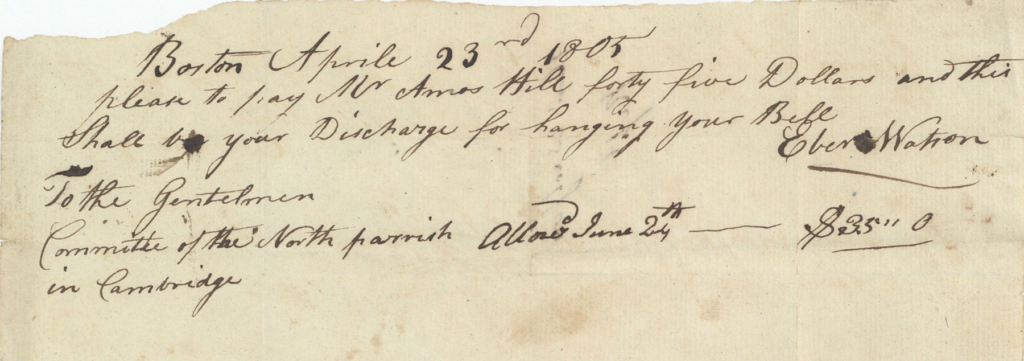
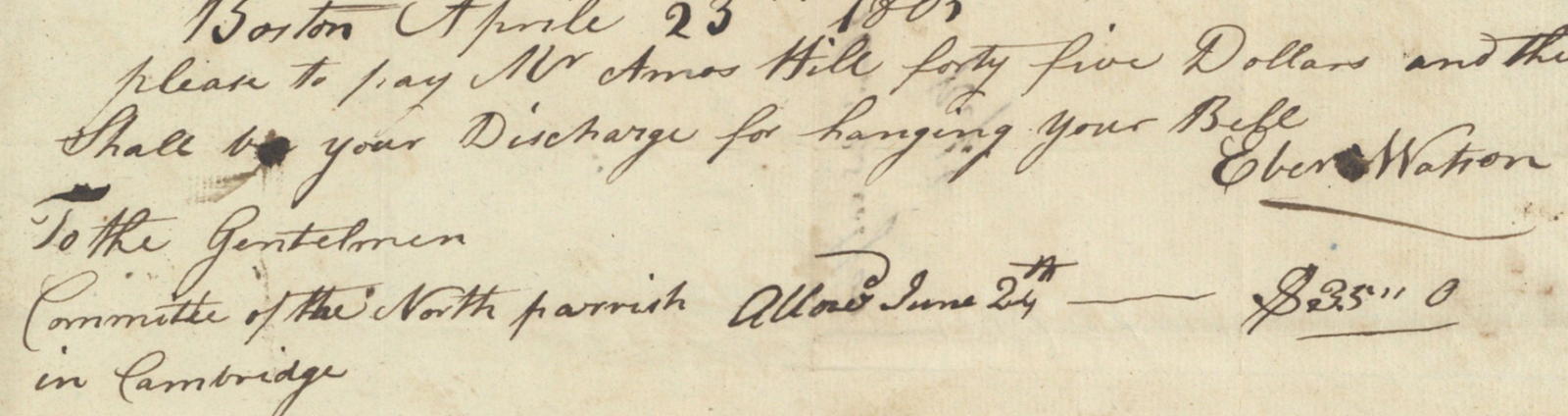
Along with: Document signed, April 23, 1805, Ebenezer Watson, paying “Amos Hill forty five dollars and this shall be your discharge for hanging your bell.” Endorsed by Watson on verso.
These documents were acquired at a private estate sale 2 generations ago and have never been on the public market. Their contents were not known. We are aware of only 2 documents of Revere having reached the market relating to his important bell business, and none with this connection to an early patriot church, where he went on his midnight ride.

Frame, Display, Preserve
Each frame is custom constructed, using only proper museum archival materials. This includes:The finest frames, tailored to match the document you have chosen. These can period style, antiqued, gilded, wood, etc. Fabric mats, including silk and satin, as well as museum mat board with hand painted bevels. Attachment of the document to the matting to ensure its protection. This "hinging" is done according to archival standards. Protective "glass," or Tru Vue Optium Acrylic glazing, which is shatter resistant, 99% UV protective, and anti-reflective. You benefit from our decades of experience in designing and creating beautiful, compelling, and protective framed historical documents.
Learn more about our Framing Services