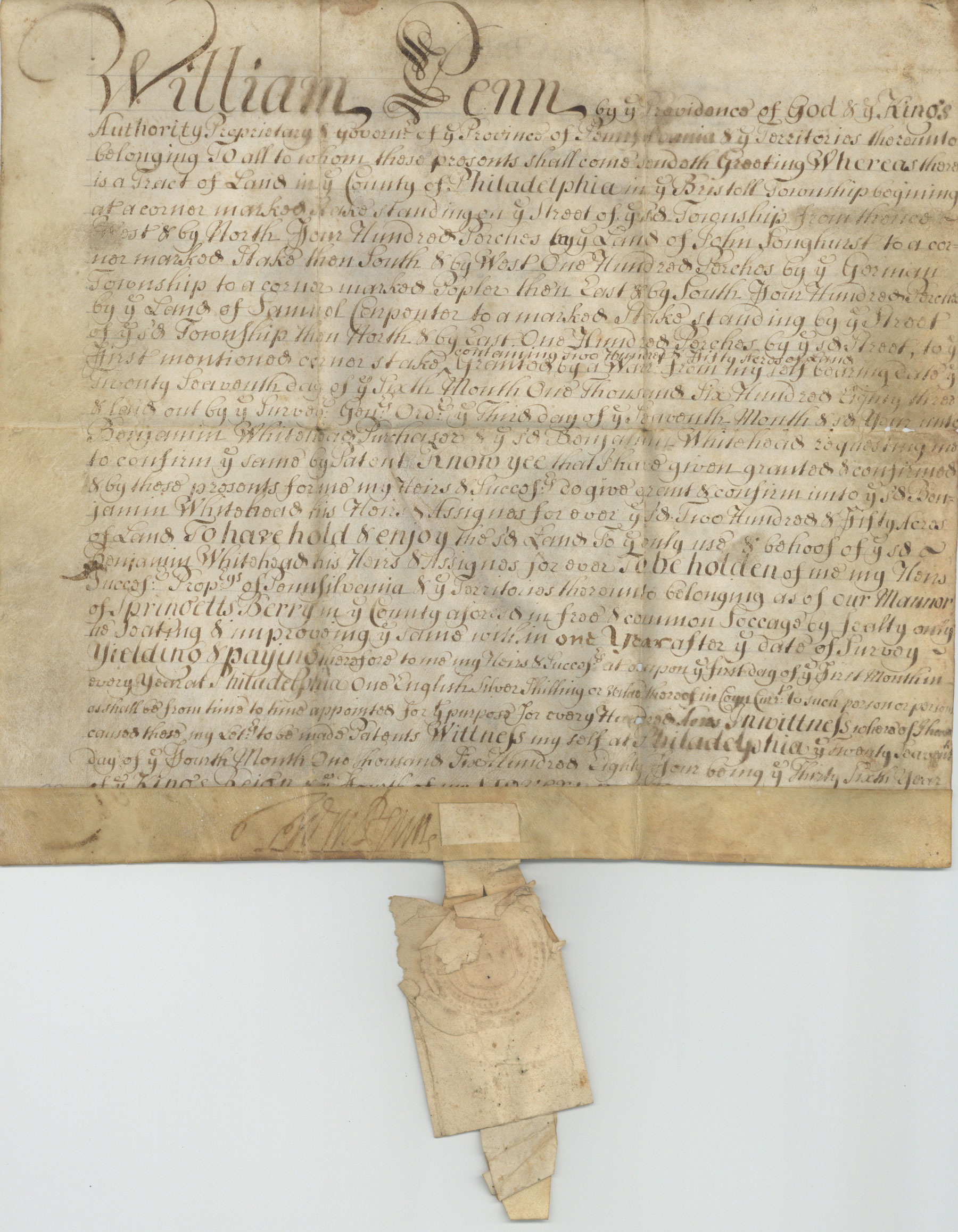






An Extremely Rare Confirmation of Land Ownership, 250 Acres, Issued and Signed by William Penn in the New World
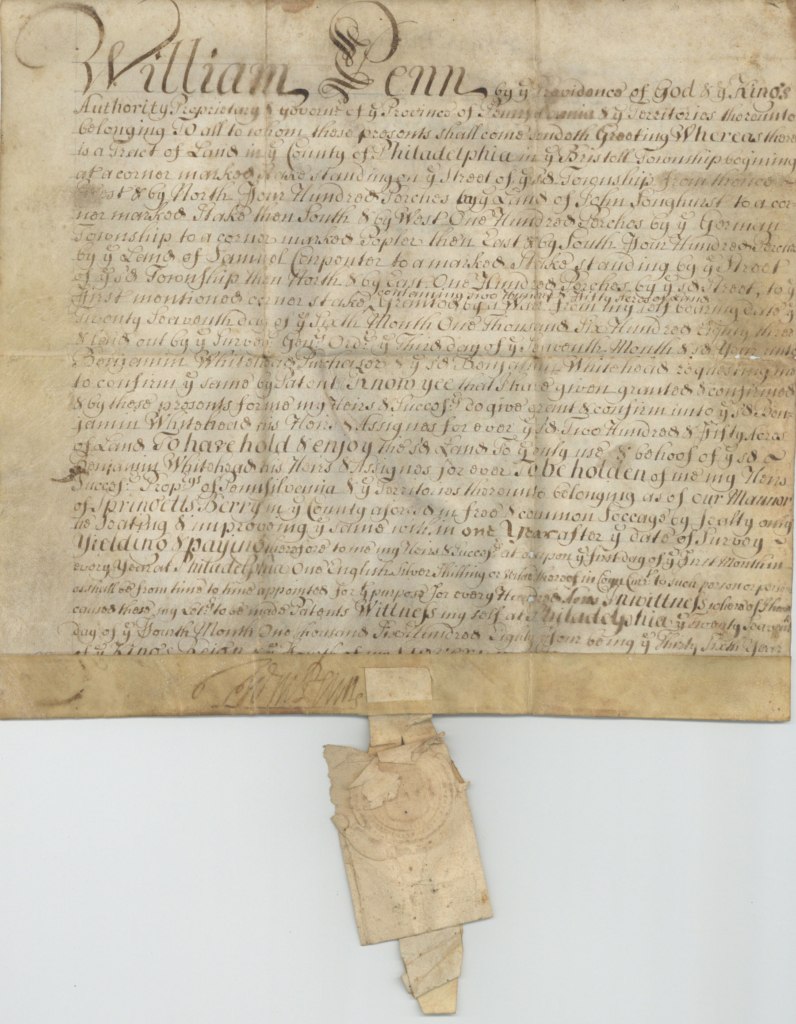

This is just the second such document we have seen, and this one covers an extensive holding
This is all the more rare as it is signed by Penn in Pennsylvania, where he initially resided less than two years
William Penn was the son of Admiral Sir William Penn. Despite high social position and an excellent education, he shocked his upper-class associates by his conversion to the beliefs of...


This is all the more rare as it is signed by Penn in Pennsylvania, where he initially resided less than two years
William Penn was the son of Admiral Sir William Penn. Despite high social position and an excellent education, he shocked his upper-class associates by his conversion to the beliefs of the Society of Friends, or Quakers, then a persecuted sect. He used his inherited wealth and rank to benefit and protect his fellow believers.
King Charles II owed William Penn £16,000, money which his late father Admiral Sir Penn had lent him. Seeking a haven in the New World for persecuted Friends, Penn asked the King to grant him land in the territory between Lord Baltimore’s province of Maryland and the Duke of York’s province of New York. With the Duke’s support, Penn’s petition was granted. The King signed the Charter of Pennsylvania on March 4, 1681, and it was officially proclaimed on April 2. In England, Penn drew up the First Frame of Government, his proposed constitution for Pennsylvania which became famous as a summation of his governmental ideals. By July 1681, Penn announced his plan of land distribution, and also started granting land to those Quakers that sought to leave Great Britain.
Later, in October 1682, Penn arrived in Pennsylvania on the ship Welcome. He visited Philadelphia, just laid out as the capital city, created the three original counties, and summoned a General Assembly to Chester on December 4. On December 7, the Assembly adopted the Great Law, a humanitarian code that became the fundamental basis of Pennsylvania law and which guaranteed liberty of conscience. By the time of Penn’s return to England, the foundations of the Quaker Province were well established.
Benjamin Whitehead was a Quaker who was a passenger on the ship America with his daughters Esther and Elizebeth, arriving in Pennsylvania on August 20, 1683. He came well equipped, and brought with him 8 cwt.[hundredweight] of nails; 4 cwt. wrought iron; 6 cwt. lead shot; 40 yds. flannel; 1 cwt. gunpowder; 20 lbs. fabrics; 3 Irish rugs; 12 doz. candles; 9 cwt. cheese; 7A cwt. haberdashery; 4 lbs. wrought silk; 8 hats; 6 dozen plain gloves; and 1 chest window glass.
Whithead obtained a warrant for 250 acres of land from William Penn on the 27th day of August, 1683. The land was laid out in Bristol Twp., and Penn at Whitehead’s request provided a patent (or confirmation) for the grant on the 27th day of June, 1684. In return, Whitehead agreed to pay Penn, his heirs and successors annually the nominal sum of “one English silver shilling.” Whitehead also had a lot on Second Street in Philadelphia, according to the Pennsylvania Genealogical Magazine. When Whitehead died in February 1698, he left his estate to his two daughters; of these Elizabeth married John Bezer, Jr., the son of one of three Commissioners appointed by Penn to come to America, establish a colony, and carry out Penn’s “plans and specifications”, including the founding of the city which was to be named Philadelphia. Being related to the prominent Bezers was a prestigious connection.
Document signed, Philadelphia, April 27, 1684, being the original land patent confirmation Penn provided to Whitehead. The signature is bold, and the seal is still present.
Because of a conflict with Lord Baltimore over the dividing line between Pennsylvania and Maryland, Penn’s presence was required in England, and he left Pennsylvania in August 1684 – less than two years after arriving. Only a small percentage of Penn documents were signed in Pennsylvania in that short stretch of time, with the lion’s share being signed in England either before or after Penn’s time in America. This is an uncommon patent signed in Philadelphia.

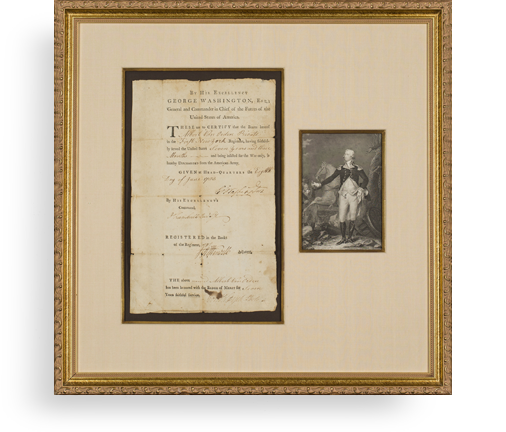
Frame, Display, Preserve
Each frame is custom constructed, using only proper museum archival materials. This includes:The finest frames, tailored to match the document you have chosen. These can period style, antiqued, gilded, wood, etc. Fabric mats, including silk and satin, as well as museum mat board with hand painted bevels. Attachment of the document to the matting to ensure its protection. This "hinging" is done according to archival standards. Protective "glass," or Tru Vue Optium Acrylic glazing, which is shatter resistant, 99% UV protective, and anti-reflective. You benefit from our decades of experience in designing and creating beautiful, compelling, and protective framed historical documents.
Learn more about our Framing Services