






William Penn Signed Quitclaim Deed for Land in Pennsylvania, Given to One of the Original Quaker Settlers There

In 1682, Henry Child bought the land from Penn, and with his family was in the original Quaker migration
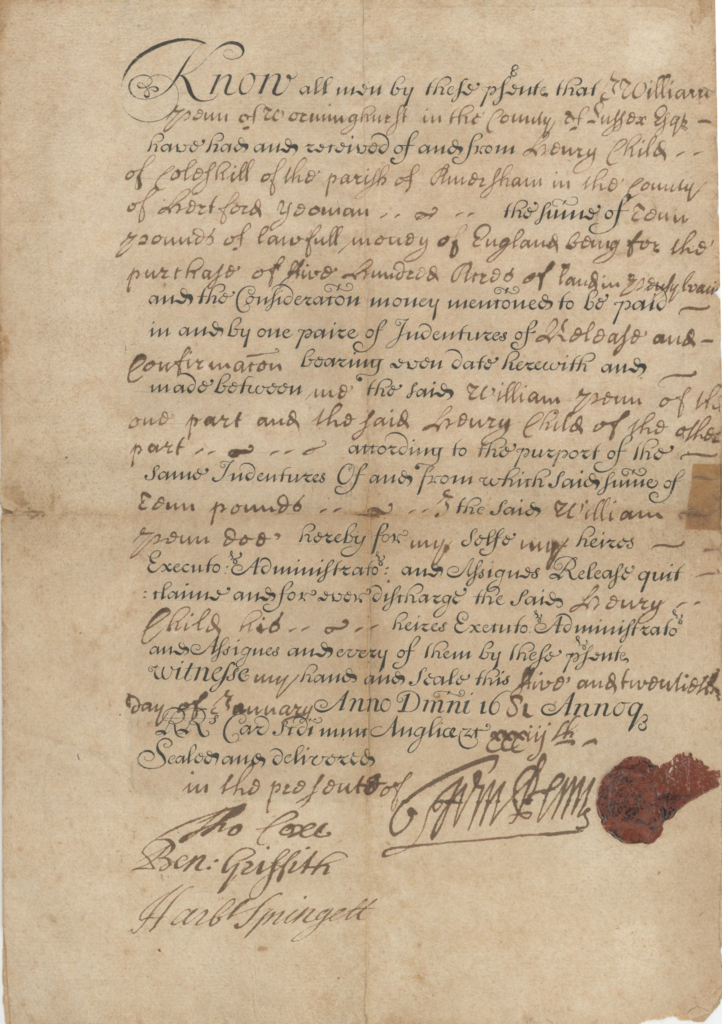
Penn’s personal seal affixed by him, is uncommonly still present on the document
King Charles II owed William Penn £16,000, money which his late father Admiral Sir Penn had lent him. Seeking a haven in the New World for persecuted Quakers, Penn asked the King to grant him land in the territory...


Penn’s personal seal affixed by him, is uncommonly still present on the document
King Charles II owed William Penn £16,000, money which his late father Admiral Sir Penn had lent him. Seeking a haven in the New World for persecuted Quakers, Penn asked the King to grant him land in the territory between Lord Baltimore’s province of Maryland and the Duke of York’s province of New York. With the Duke’s support, Penn’s petition was granted. This generous grant established Penn as a proprietor over a territory of more than 45,000 square miles, which he named “Penn’s Woods” [Pennsylvania]. The King signed the Charter of Pennsylvania on March 4, 1681, and it was officially proclaimed on April 2.
Upon receiving his grant for Pennsylvania, Penn immediately set about attracting investors and settlers. To pay expenses and realize a profit from his enterprise, Penn had to sell land. Penn sought to attract individuals who would settle the colony, or send servants or tenants to do so, and who had the capital or expertise to establish commercial and agricultural foundations for the province. Penn’s first promotional tract, Some Account of the Province of Pennsylvania, set out the terms for obtaining land and promised to clear all Indian titles. By July 1681, Penn announced his plan of land distribution, and his first land sale followed soon thereafter.
Henry Child purchased 500 acres in Bucks County, Pennsylvania, from William Penn in a document dated 1681, but was 1682 using today’s calendar. This document shows a direct transaction between the two individuals – Penn and Child – and established Child as a landowner in Penn’s new colony. Child, a Quaker, received the land for the sum of £10, and he would settle on that land.
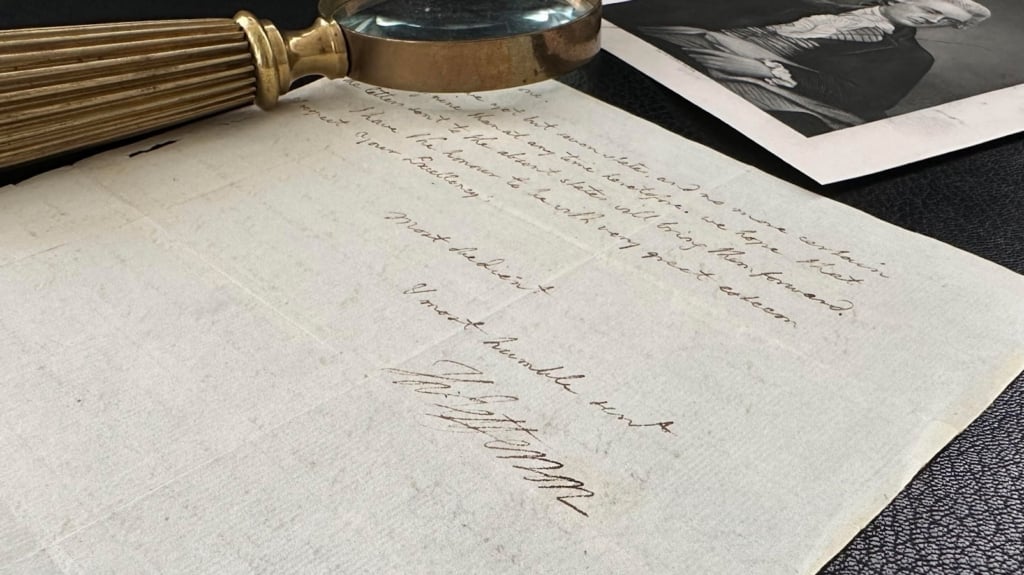
Manuscript document signed, England, January 25, 1681/82, only ten months after the official Charter granted to Penn by Charles II, with Penn’s red seal still present, being a Quitclaim Deed for the land Child bought in Pennsylvania. “Know all men by these presents that William Penn, of Worminghurst in the county of Sussex, Esq. has had and received of and from Henry Child of Coleshill of the parish of Amersham in the county of Hertford, yeoman the sum of ten pounds of lawful money of England, being for the purchase of five hundred acres of land in Pennsylvania, and the consideration money mentioned to the paid in and by one pair of indentures of release and confirmation bearing even date herewith and made between me, the said William Penn, of the one part and the said Henry Child of the other part according to the purport of the same indentures, of and from which said sum of ten pounds the said William Penn do hereby for myself, heirs, executors, and administrators, and assigns release, quitclaim, and forever discharge the said Henry Child, his heirs, executors, and administrators, and assigns, and every of them by these presents. Witness my hand and seal this five and twentieth day of January, Anno Domini 1681.”
The document is witnessed and signed by Thomas Coxe, a merchant and one of the 24 Proprietors of East New Jersey; Benjamin Griffith, an agent for William Penn who handled Penn’s business in the Province of Pennsylvania; and Harbert Springett, Penn’s father-in-law.
In the summer of 1682, a small fleet left England bound for the new colony of Pennsylvania, filled with Quakers who had bought land to found a settlement there. These were the original grantees, and most had parcels of 500 or 1,000 acres. Henry Child was among these, and he settled in Warminster Township, Bucks County, Pennsylvania, with his wife and son, in 1682. Penn saw the venture, in his famous words to his friend and land agent for Pennsylvania, James Harrison, as a “holy experiment,” which would become, as he confidently predicted, “the seed of a nation.”
This is a fascinating document from early in Penn’s venture in Pennsylvania, and a rare one in that Penn’s personal seal is still attached.

Frame, Display, Preserve
Each frame is custom constructed, using only proper museum archival materials. This includes:The finest frames, tailored to match the document you have chosen. These can period style, antiqued, gilded, wood, etc. Fabric mats, including silk and satin, as well as museum mat board with hand painted bevels. Attachment of the document to the matting to ensure its protection. This "hinging" is done according to archival standards. Protective "glass," or Tru Vue Optium Acrylic glazing, which is shatter resistant, 99% UV protective, and anti-reflective. You benefit from our decades of experience in designing and creating beautiful, compelling, and protective framed historical documents.
Learn more about our Framing Services
