






Amelia Earhart Signed Photograph, Midway Through Her Doomed Attempt to Circumnavigate the World, A Photograph Taken, Printed and Signed During Her Stay in Africa


Almost certainly the last thing Earhart signed to have reached the market and the only during the actual eastward voyage itself
She is shown in Senegal in June 1937, with Fred Noonan, her navigator, who has also signed and who perished with her
Amelia Earhart was the first female aviator to fly across the Atlantic Ocean. She set many other records, was one of the first aviators to promote commercial air travel, wrote...


She is shown in Senegal in June 1937, with Fred Noonan, her navigator, who has also signed and who perished with her
Amelia Earhart was the first female aviator to fly across the Atlantic Ocean. She set many other records, was one of the first aviators to promote commercial air travel, wrote best-selling books about her flying experiences, and was instrumental in the formation of The Ninety-Nines, an organization for female pilots. She also encouraged women to pursue their dreams and worked to inspire women by showing that they can be successful at daunting tasks.
In 1937, Earhart and her navigator Fred Noonan attempted a circumnavigational flight, departing from Miami on June 1 and aiming to fly around the world at the equator. Their route took them first to South America, then to Africa, India, and Southeast Asia, reaching Lae, New Guinea, on June 29. The next leg of their journey involved flying from Lae to Howland Island, a small island in the Pacific, but they disappeared en route on July 2. She and Noonan were searched for fruitlessly, never found, and were eventually pronounced dead. Earhart remains a legend to this day.
Three days into their trip, on June 4, 1937, Earhart and Noonan flew from Paramaribo, Surinam, to Fortaleza, Brazil, a journey of 1,330 miles. Earhart mentioned being impressed with Fortaleza’s airport and decided to make final preparations for their upcoming South Atlantic crossing there. They then flew a shorter leg of 267 miles to Natal, Brazil. They planned to depart from Natal for their South Atlantic crossing, intending to leave on the same day if possible, but ultimately stayed the night. On June 7, at 3:15 a.m., they departed from Parnamirim Airport in Natal, to cross the South Atlantic Ocean en route to Dakar, Senegal. They landed in Saint-Louis, Senegal, arriving on June 8, and then flying on to Dakar the same day. They remained in Dakar until June 10, then flew to Mali and headed east across Africa.
An extraordinary 5” X 7” photograph of Earhart, showing the aviatrix posing in front of her Lockheed Model 10-E Electra airplane during her ill-fated flight. This image was taken in Dakar, Senegal on either June 8 or 9, 1937. She is shown alongside four other gentlemen in sun hats. She herself is dressed in a black-and-white patterned shirt and jumpsuit. She has signed boldly in fountain pen ink, and the image is additionally signed by Fred Noonan. The photograph bears a ‘Lataque’ stamp to the reverse, as well as a ‘Lataque’ imprint to the lower right of the image, indicating that the image was taken by the Senegal-based French photographer Oscar Lataque. After taking this image on 8 or 9 June, Lataque had to have developed it in time for signatures to be sought prior to Earhart’s departure on June 10, 1937.
Contemporary images confirm that the men pictured with Earhart were mechanics who worked on Earhart’s plane in Dakar. Hence the photograph’s subjects and photographer stamps allow it to be dated to June 8 or 9, 1937, during that stay in Dakar. Earhart was also pictured wearing this exact same shirt in a famous image alongside Noonan a few days earlier, on June 7, 1937 in Natal, Brazil.
Earhart and Noonan left Senegal for Mali on June 10, only to meet their tragic end soon after.
It seems likely that this is one of the last images – if not the very last – to be signed by Earhart. We found no sale record of any postdated autograph. An extraordinary and unique piece of history.

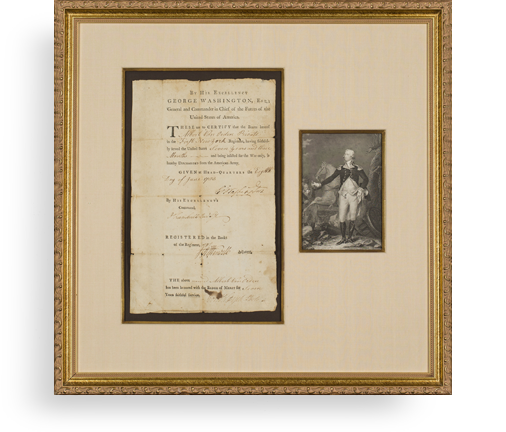
Frame, Display, Preserve
Each frame is custom constructed, using only proper museum archival materials. This includes:The finest frames, tailored to match the document you have chosen. These can period style, antiqued, gilded, wood, etc. Fabric mats, including silk and satin, as well as museum mat board with hand painted bevels. Attachment of the document to the matting to ensure its protection. This "hinging" is done according to archival standards. Protective "glass," or Tru Vue Optium Acrylic glazing, which is shatter resistant, 99% UV protective, and anti-reflective. You benefit from our decades of experience in designing and creating beautiful, compelling, and protective framed historical documents.
Learn more about our Framing Services

